
In This Article
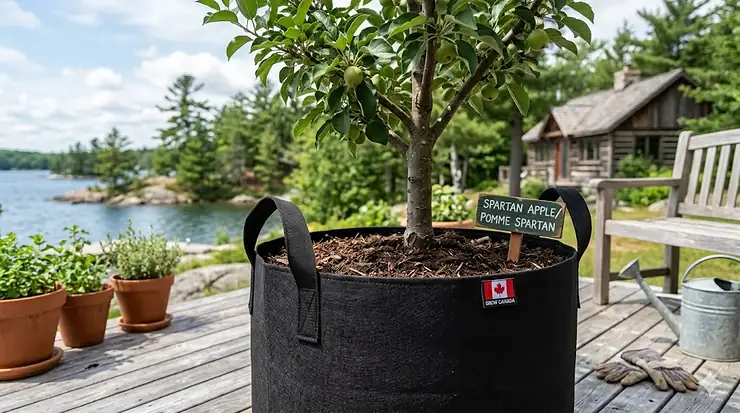
Let me paint you a picture: it’s late April in Mississauga, the last frost has finally passed, and you’re dragging a rigid 20-litre plastic pot across your patio, cursing every chip in the concrete. Sound familiar? If you’ve been growing fruit trees in traditional containers, you already know the struggle. That’s exactly why 20 gallon grow bags for fruit trees have quietly become the go-to solution for Canadian home gardeners — from condo balconies in Vancouver to backyard patios in Halifax.
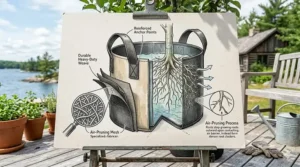
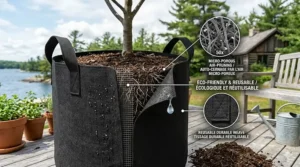
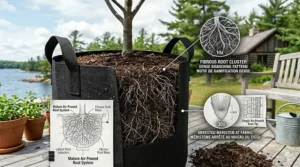
So, what exactly are 20 gallon grow bags for fruit trees? In short, they’re flexible fabric containers — typically made from nonwoven polypropylene or felt — that hold approximately 75–76 litres of growing medium. That volume is specifically engineered to support the root development of dwarf and semi-dwarf fruit trees, giving them just enough space to thrive without the circling root problems that doom trees planted in hard-sided pots. Unlike plastic planters, fabric walls allow oxygen to reach the root zone continuously, which triggers a phenomenon called “air pruning” — the roots self-prune when they contact air rather than wrapping endlessly around the container wall. The result? A denser, more fibrous root system that absorbs water and nutrients far more efficiently.
For Canadian gardeners, the appeal goes even deeper. Our growing seasons are notoriously short — whether you’re in Zone 5b Ontario or Zone 6a southern BC — which means every week of productive growth matters. Fabric grow bags warm up faster in spring than terracotta or thick plastic, giving your trees a precious two-to-three-week head start when temperatures swing unpredictably between freeze and thaw. And when that early September frost threatens your Honeycrisp apple or your dwarf Bartlett pear? You simply pick up the handles and bring the whole tree inside or under cover. Try doing that with a ceramic urn.
In this guide, I’ve researched and ranked the top 20 gallon grow bags for fruit trees available right now on Amazon.ca, priced in CAD, with honest commentary on what each one means for Canadian growing conditions. Whether you’re a first-time container gardener in a Toronto condo or a seasoned Okanagan orchardist looking to expand your dwarf collection, there’s something here for every level of experience and budget. Let’s dig in. 🌱🇨🇦
Quick Comparison: Top 20 Gallon Grow Bags for Fruit Trees in Canada
| Product | Fabric Weight | Size | Pack Count | Best For | Est. Price Range (CAD) |
|---|---|---|---|---|---|
| VIVOSUN 20 Gallon Grow Bags | 300g nonwoven | 52 cm dia × 37 cm H | 5-pack | Best overall value | $20–$35 |
| Gardzen 10-Pack 20 Gallon | 300g nonwoven | 52 cm dia × 37 cm H | 10-pack | Budget bulk buyers | $30–$45 |
| VIVOSUN 30 Gallon Grow Bags | 300g nonwoven | 57 cm dia × 42 cm H | 5-pack | Larger dwarf trees | $30–$45 |
| Smart Pots 20-Gallon | Patented geotextile | 51 cm dia × 38 cm H | 1-pack | Premium air pruning | $25–$40 |
| LotFancy 5-Pack 20 Gallon | 300g nonwoven | 52 cm dia × 37 cm H | 5-pack | Beginners on a budget | $18–$30 |
| Fhyisble 20 Gallon 5-Pack | 320g nonwoven + LST | 52 cm dia × 37 cm H | 5-pack | Advanced training | $25–$40 |
| JERIA 12-Pack 20 Gallon | 300g nonwoven | 52 cm dia × 37 cm H | 12-pack | Multi-tree setups | $35–$55 |
The table above reveals a few things worth calling out. First, the 300g fabric weight is essentially the standard across most grow bags in this price range — what differentiates them is handle construction, reinforcement stitching, and extras like LST training rings. Second, you’ll notice Smart Pots stands alone with its patented geotextile fabric; that proprietary construction genuinely outperforms standard nonwoven in long-term durability, which is why it commands a higher per-unit price even when sold individually. For Canadian buyers planning to overwinter their bags indoors, that durability gap matters more than it might in warmer climates.
💬 Just one click — help others make better buying decisions too!😊
✨ Don’t Miss These Exclusive Deals!
🔍 Take your container orchard to the next level with these carefully selected grow bags. Click on any highlighted product below to check current pricing and availability on Amazon.ca. These tools will help you grow healthy, productive fruit trees your family will enjoy for years!
Top 7 Grow Bags for Fruit Trees in Canada: Expert Analysis
1. VIVOSUN 5-Pack 20 Gallon Plant Grow Bags
The VIVOSUN 5-Pack 20 Gallon is the grow bag most Canadian gardeners end up recommending to their neighbours — and not just because the price-to-performance ratio is hard to beat on Amazon.ca.
Key specs and what they actually mean: The 300g nonwoven fabric is thick enough to be reusable across multiple growing seasons, which in Canada’s climate matters because you’ll be folding, storing, and unfolding these every spring. At approximately 52 cm diameter × 37 cm height (20.5″ × 14.5″), they offer generous depth for the taproot systems of dwarf apple, pear, cherry, and fig varieties. The reinforced strap handles aren’t just decorative — VIVOSUN uses serger stitches to attach them separately from the bag wall, meaning they won’t tear away when you’re lifting 20+ kg of moist soil. That’s a critical detail if you’re repositioning trees on a deck in wet BC spring conditions.
Who is this for? This is the bag I’d recommend to someone growing their first containerized fruit tree on a Toronto or Calgary patio. It’s accessible, ships Prime-eligible across most of Canada (check your postal code, as remote northern addresses may see extended delivery times), and the 5-pack lets you plant a small collection of dwarf varieties without breaking the bank. The BPA-free certification is a genuine plus for food-growing applications — something worth confirming on any fabric you’re using to grow edibles.
Canadian context: In colder provinces like Manitoba or Saskatchewan, you’ll want to bring these bags indoors before hard freezes — the fabric itself is durable, but the roots inside are vulnerable to freeze-thaw cycles. The lightweight design makes that job far easier than wrestling with ceramic pots.
What Canadian buyers say: Reviewers on Amazon.ca consistently praise the handle durability and how well the bags hold their shape when filled. A few note minor variations in colour between orders, which doesn’t affect function.
✅ Pros:
- Serger-stitched handles genuinely hold weight
- BPA-free, food-safe fabric
- Folds flat for compact winter storage
❌ Cons:
- Standard 300g (not premium) — may wear faster in very high-UV environments like Okanagan summers
- Sold in packs of 5; odd number if you want an even row
Price range: Around $20–$35 CAD for a 5-pack — outstanding value, roughly $5–$7 per bag.
2. Gardzen 10-Pack 20 Gallon Grow Bags
If you’re planning a proper container orchard and want to standardize your setup across ten trees without a major outlay, the Gardzen 10-Pack 20 Gallon is one of the most practical purchases you can make on Amazon.ca.
Key specs and real-world meaning: At 300g nonwoven fabric with the same 52 cm × 37 cm footprint as the VIVOSUN, the Gardzen bags are functionally comparable per unit — but you get twice as many for a price that works out to roughly $3–$4.50 CAD per bag at the $30–$45 range. The 37 cm depth is worth emphasizing specifically for fruit trees: according to GardenWorks, a BC-based garden centre, containers for fruit trees should be at minimum 15 gallons (51 cm diameter × 36 cm height) — the 20-gallon Gardzen bags clear this threshold comfortably, giving you the soil volume needed for consistent moisture retention between watering events.
Who is this for? The Gardzen 10-pack is ideal for community garden organizers, CSA farms experimenting with containerized production, or backyard growers who want uniformity in their setup. If you’re planting a row of dwarf Cortland apples or a collection of semi-dwarf Montmorency cherries along a fence line, ten matching bags look intentional and tidy. This is also a smart buy for Canadian market gardeners who want to trial containerized fruit trees before committing to in-ground planting.
Canadian context: The washable, foldable design is particularly useful in Canada — you’ll be folding these away from October through April in most provinces. They stack neatly into a storage bin or hang on a garage wall.
✅ Pros:
- Best cost per unit in the 20-gallon category on Amazon.ca
- Washable and foldable for long Canadian winters
- Adequate depth for most dwarf fruit tree root systems
❌ Cons:
- Handle stitching is functional but not as robust as VIVOSUN’s serger construction
- Plain styling (one colour option)
Price range: $30–$45 CAD for a 10-pack — the best per-bag cost on this list.
3. VIVOSUN 5-Pack 30 Gallon Plant Grow Bags
When your dwarf fruit tree starts pushing the limits of a 20-gallon container — or when you’re starting with a semi-dwarf variety that needs more room from day one — the VIVOSUN 5-Pack 30 Gallon deserves serious consideration as the ideal large fabric planters for trees in the Canadian market.
Key specs and real-world meaning: Scaling from 20 to 30 gallons adds approximately 38 litres of growing medium — that’s a meaningful volume increase that translates to better moisture buffering between waterings, which is especially relevant during the intense heat events that increasingly hit BC, Ontario, and Prairie provinces in July and August. The larger diameter (approximately 57 cm) also provides more surface area for top-dressing with compost, a practice Agriculture and Agri-Food Canada encourages to improve organic matter content in container growing systems. Same 300g construction and serger-stitched handles as the 20-gallon version.
Who is this for? I’d recommend the 30-gallon version to anyone growing fig trees in Zone 6a+ (they’re surprisingly winter-hardy in pots and can be moved into a garage), semi-dwarf pear trees, or dwarf peach varieties, which tend to develop wider root systems than apples. If you’re in the Okanagan and growing an Anna apple or a Desert Gold peach in a container, go 30 gallons without hesitation — the extra soil volume will meaningfully extend time between irrigation cycles.
✅ Pros:
- Meaningful volume increase for larger root systems
- Same proven VIVOSUN handle construction
- Better moisture buffering in summer heat
❌ Cons:
- Heavier when filled — two people needed for moving loaded bags
- Slightly higher price point than 20-gallon
Price range: Around $30–$45 CAD for a 5-pack.
4. Smart Pots 20-Gallon Soft-Sided Container with Handles
The Smart Pots 20-Gallon occupies a different category than the rest of this list — it’s not the cheapest option, and it doesn’t need to be. Smart Pots is the original fabric container brand, having supplied professional tree nurseries for over 25 years before the home gardening market caught on. That history shows in the product.
Key specs and real-world meaning: The proprietary geotextile fabric used in Smart Pots is meaningfully different from standard nonwoven polypropylene — it’s engineered specifically for air pruning, with a fibrous inner surface that encourages lateral root branching rather than simply stopping growth at the wall. The result is a root ball that, on transplanting, establishes far more quickly in new soil because it’s already dense with fibrous feeding roots rather than a tangled mass of circling primary roots. For Canadian gardeners who plan to eventually transplant their containerized trees into the ground, this is a significant advantage.
Who is this for? Serious container orchardists, anyone transplanting into the ground after 2–3 seasons in containers, and gardeners in southwestern BC or southern Ontario who can realistically overwinter fruit trees semi-outdoors. Smart Pots’ higher per-unit price is justified when you’re treating this as a long-term horticultural investment rather than a seasonal planter.
✅ Pros:
- Patented geotextile fabric produces superior air pruning compared to standard nonwoven
- Professional-grade durability — genuinely multi-year
- Industry-validated design (25+ years in professional nursery use)
❌ Cons:
- Sold individually on Amazon.ca — higher per-unit cost vs. multi-packs
- Tan/natural colour shows soil staining more visibly
Price range: Around $25–$40 CAD per unit.
5. LotFancy 5-Pack 20 Gallon Grow Bags
The LotFancy 5-Pack 20 Gallon occupies a useful niche in the Canadian market: it’s the grow bag for the gardener who wants reasonable quality at the lowest possible entry price, without buying an unknown brand with no reviews.
Key specs and real-world meaning: LotFancy uses a 300g nonwoven fabric — consistent with the category standard — with reinforced handles. The bags measure approximately 52 cm × 37 cm, giving them identical usable volume to the VIVOSUN and Gardzen options. What distinguishes LotFancy is the price point, which frequently dips below $20 CAD for a 5-pack on Amazon.ca, making it genuinely accessible for first-time container gardeners or seniors on fixed incomes who want to try a dwarf blueberry or a small apple tree on a deck.
Who is this for? New Canadian gardeners trying container fruit growing for the first time, apartment and condo dwellers testing balcony feasibility, or anyone who wants to fill a number of spots quickly on a tight budget. I wouldn’t buy these expecting them to last a decade, but for two to four growing seasons with proper care — rinsing, drying before storage — they perform respectably.
✅ Pros:
- Most accessible entry price on Amazon.ca in this category
- Adequate quality for 2–4 season use
- Lightweight and compact for storage
❌ Cons:
- Handle construction less robust than VIVOSUN
- Limited colour options
Price range: Around $18–$30 CAD for 5-pack.
6. Fhyisble Fabric Pots 20 Gallon 5-Pack with LST Rings
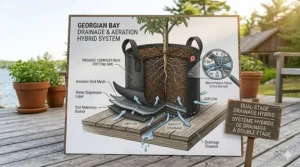
The Fhyisble 20 Gallon 5-Pack is the grow bag for the gardener who doesn’t just want a container — they want control. The built-in Low Stress Training (LST) rings integrated along the upper rim of each bag are a genuine differentiator that most competitors simply don’t offer in this price range.
Key specs and real-world meaning: At 320g fabric weight (slightly heavier than the 300g standard), the Fhyisble bags have marginally better durability. But the headline feature is those LST training rings — evenly spaced anchor points that allow you to tie down and redirect branches of your dwarf fruit tree to improve canopy structure and light exposure. In a container context, this is enormously practical: most dwarf fruit trees benefit from open-centre or espalier-style training to maximize fruiting surface area, and having built-in tie-down points means you’re not improvising with binder clips and wire. For a Canadian balcony grower trying to train a dwarf cherry or a columnar apple in a constrained space, this feature alone justifies the slight price premium over comparable options.
Who is this for? Intermediate and advanced container gardeners who are actively shaping their trees — anyone interested in espalier, open-centre, or fan-trained fruit tree forms. Also a strong pick for urban gardeners in dense cities like Montréal or Toronto where horizontal space is limited and vertical training is the only way to maximize yield.
✅ Pros:
- LST rings enable professional-style branch training
- 320g fabric is slightly more durable than standard 300g
- BPA-free, food-safe
❌ Cons:
- LST rings may feel unnecessary to casual growers
- Slightly higher price than basic options
Price range: Around $25–$40 CAD for 5-pack.
7. JERIA 12-Pack 20 Gallon Grow Bags
The JERIA 12-Pack 20 Gallon is the container orchard starter kit in grow bag form: twelve bags at a competitive bulk price, with solid 300g construction and reinforced handles, available on Amazon.ca for those ready to commit to a serious multi-tree setup.
Key specs and real-world meaning: The 12-pack format at a $35–$55 CAD range works out to under $5 per bag, making it competitive with the Gardzen 10-pack while giving you two additional containers. The reinforced handle design and standard 52 cm × 37 cm dimensions put it squarely in the reliable mid-range. What makes JERIA stand out in the extra large grow bags review category is the pack quantity — if you’re planning a full container orchard of, say, four apple varieties, two pear trees, two plum trees, and a fig, twelve bags lets you plant everything in one order.
Who is this for? Gardeners setting up a container orchard from scratch — particularly those in southern Ontario or BC’s Lower Mainland where a range of dwarf apple, pear, cherry, and plum varieties are realistically growable in containers. Also excellent for community garden co-ops, school gardening programs, or anyone who wants a uniform look across a large container planting.
✅ Pros:
- Best bulk value for 12-unit sets on Amazon.ca
- Solid 300g construction with reinforced handles
- Great for multi-variety container orchards
❌ Cons:
- Less brand recognition than VIVOSUN or Smart Pots
- Limited style/colour options
Price range: Around $35–$55 CAD for a 12-pack.
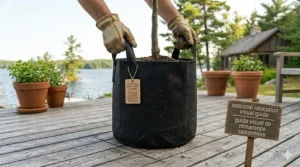
How to Set Up and Use 20 Gallon Grow Bags for Fruit Trees in Canada: A Practical Guide
Getting the most out of your 20 gallon grow bags for fruit trees in Canadian conditions requires a bit more intentionality than simply filling them with soil and dropping in a sapling. Here’s a practical setup guide based on real container growing experience in our climate.
Step 1: Choose the Right Growing Medium
This is where most Canadian first-timers go wrong: they fill their grow bags with pure garden soil from the backyard. That’s a mistake. Garden soil compacts badly in containers, reducing the drainage and aeration that make fabric bags valuable in the first place. Instead, use a mix of approximately 60% high-quality potting mix, 30% compost (ideally well-aged), and 10% coarse perlite or vermiculite. This blend retains moisture without waterlogging — critical for the fruit tree roots to access oxygen. For fruit trees specifically, adding a slow-release granular fertilizer designed for fruit production at planting time will serve you well through the first season.
Step 2: Positioning — Sun, Wind, and Surface
Canadian summers offer excellent solar intensity, but wind can dehydrate container-grown trees surprisingly quickly on exposed decks or balconies. Position your 20-gallon grow bags where they receive a minimum of six hours of direct sun daily, but where they’re partially sheltered from prevailing winds. Placing bags on a wooden pallet or grow bag tray elevates them slightly, improving drainage and preventing the bottom of the bag from sitting in standing water after heavy rain.
Step 3: Watering in the Canadian Climate
Fabric bags drain faster than plastic pots, which is great for preventing root rot but means more frequent watering during Ontario’s July heat or BC’s August dry spells. Plan to water dwarf fruit trees in 20-gallon bags at least every two to three days during peak summer — daily during heat events above 32°C (90°F). A simple soil moisture meter (available on Amazon.ca for around $15–$20 CAD) will help you dial in timing and avoid both under- and over-watering.
Step 4: Winter Storage — The Canadian Critical Step
This is where Canadian container growers must plan ahead. Most dwarf and semi-dwarf fruit trees are cold-hardy in the ground through Zone 4–5, but roots in containers are exposed to ambient air temperature on all sides rather than insulated by surrounding soil. In most of Canada, this means containerized fruit trees need winter protection. Options include:
- 🏠 Moving bags into an unheated garage or shed (ideal — roots stay dormant but protected from deep freeze)
- 🌿 Wrapping bags in horticultural fleece or bubble wrap and grouping them together against a sheltered south-facing wall
- 🪣 Sinking the grow bag into a larger container filled with straw or wood shavings for insulation
The lightweight, foldable nature of fabric bags makes garage storage the easiest approach — far simpler than moving a heavy ceramic pot.
Step 5: When to Upsize or Transplant
A healthy dwarf fruit tree in a 20-gallon grow bag will typically need to be either upsized to a 30-gallon container or transplanted to the ground within three to five years, depending on species and rootstock vigour. Signs it’s time: roots visibly emerging through the bag walls, rapid soil drying requiring daily watering even in mild weather, and slowing annual growth. The good news? If you’ve used fabric bags consistently, the transplant-ready root ball will be fibrous and healthy, and establishment in new soil is dramatically faster than with a root-bound plastic pot.
Real Canadian Growers: Which Bag Should You Choose?
Container fruit growing looks different in Vancouver than it does in Sudbury or Charlottetown. Here are three Canadian grower profiles to help you self-identify and match to the right product.
Profile 1: The Urban Balcony Grower (Toronto, Montréal, Vancouver Condo)
Situation: Limited outdoor space — a 2.5 m × 3 m balcony, no ground access, weight restrictions on the building’s structure, and neighbours close enough to care about aesthetics. Goal: grow one or two fruit trees that produce edibles.
Best match: The VIVOSUN 5-Pack 20 Gallon or Smart Pots 20-Gallon. For a condo grower, the VIVOSUN 5-pack offers flexibility — you can use two or three bags and store the rest flat. The Smart Pots single-unit option is ideal if you’re only growing one premium tree (say, a columnar ‘Scarlet Sentinel’ apple or a dwarf ‘Conference’ pear) and want maximum root health. Budget in the $25–$40 CAD range. Choose a dwarf or columnar variety rated for Zone 6 or lower; for BC balconies, a dwarf ‘Anna’ apple or a patio fig in a Smart Pot is a rewarding project.
Profile 2: The Suburban Backyard Grower (Calgary, Ottawa, Halifax)
Situation: A proper backyard, space for six to ten container trees along a fence or deck railing, wants a productive mini-orchard without the commitment of in-ground planting (renting, or soil quality issues). Budget-conscious.
Best match: The Gardzen 10-Pack 20 Gallon or JERIA 12-Pack 20 Gallon. The bulk format matches the scale of a multi-tree setup, and the per-bag cost is the most competitive on Amazon.ca in this category. Plant a mix of heritage apple varieties like ‘Honeycrisp,’ ‘Cortland,’ and ‘McIntosh’ (all excellent in Canadian climates) for cross-pollination and a staggered harvest window from August through October.
Profile 3: The Enthusiast Trainer (BC Interior, Southern Ontario Orchardist)
Situation: Already comfortable growing fruit trees, wants to add containerized specimens for espalier or fan training against a wall, maximize yield in a confined space, or experiment with borderline-hardy varieties like figs, peaches, and apricots that may need winter shelter.
Best match: The Fhyisble 20 Gallon 5-Pack with LST Rings for training projects, or the VIVOSUN 30 Gallon for larger semi-dwarf varieties. The LST rings genuinely accelerate open-centre and fan-trained canopy development, reducing the time to first fruiting. In the BC Interior — where Statistics Canada reports that extreme winter temperature fluctuations have increasingly damaged tree fruit crops — the ability to move containerized trees to shelter is a meaningful form of climate risk management.
How to Choose 20 Gallon Grow Bags for Fruit Trees in Canada: 7 Key Criteria
Choosing the right grow bag in the Canadian context isn’t just about fabric weight and price. Here’s my framework:
1. Fabric weight: 300g minimum, 400g+ for long-term use Below 300g, you’ll see fabric breakdown within two seasons under UV exposure and freeze-thaw cycling. For one or two seasons, 300g is fine. If you want five or more years from the same bags, look for 400g+ — or invest in Smart Pots’ geotextile.
2. Handle construction: Sewn-on vs. single-piece Single-piece handles (where the handle is a folded extension of the same bag wall) tear under heavy loads. Sewn-on handles with serger or double-stitch construction hold reliably when you’re moving a bag with 20 kg of moist soil. Always check the product listing for handle reinforcement details.
3. Volume: 20 gallon for dwarf, 30 gallon for semi-dwarf A BC-based nursery expert at GardenWorks advises a minimum 15-gallon container for any fruit tree; 20 gallons is a comfortable working size for dwarf varieties, and 30 gallons gives you additional moisture buffering and root volume for semi-dwarf rootstocks.
4. BPA-free certification Whenever you’re growing edibles in fabric containers, BPA-free material is non-negotiable. Most reputable brands on Amazon.ca now list this explicitly — verify it in the product description.
5. Drainage performance The whole point of nonwoven fabric is drainage without waterlogging. Test a corner of the fabric under running water before planting — water should pass through within seconds, not pool. If it pools, the weave is too tight and aeration will suffer.
6. Price per bag, not price per pack Calculate cost per unit before buying. A 5-pack at $35 CAD is $7/bag. A 10-pack at $40 CAD is $4/bag. If you’re planting more than six trees, bulk packs offer significantly better value.
7. Canadian shipping availability Some grow bag listings on Amazon.ca are fulfilled by third-party sellers with limited or no shipping to Quebec, northern territories, or remote postal codes. Always check the shipping details for your specific address — Prime-eligible items from Amazon.ca’s own fulfilment are the safest bet for reliable delivery.
Grow Bags vs. Traditional Containers for Fruit Trees in Canada
| Factor | 20-Gallon Fabric Grow Bags | Plastic/Ceramic Pots | Wooden Half-Barrels |
|---|---|---|---|
| Root health (air pruning) | ✅ Excellent | ❌ Root circling likely | ⚠️ Moderate |
| Winter mobility | ✅ Lightweight, foldable | ❌ Heavy, rigid | ❌ Very heavy |
| Drainage | ✅ Superior | ⚠️ Drainage holes required | ⚠️ Varies |
| Spring warm-up speed | ✅ Fast | ⚠️ Slower (especially ceramic) | ⚠️ Moderate |
| Durability (years) | ⚠️ 2–7 yrs depending on quality | ✅ 10+ years | ✅ 5–15 years |
| Cost (CAD) | ✅ $3–$40/unit | ⚠️ $15–$150/unit | ❌ $40–$200/unit |
| Storage when empty | ✅ Folds flat | ❌ Bulky | ❌ Very bulky |
| Best For | All Canadian container gardeners | Decorative/permanent | Rustic aesthetic, large patios |
The comparison reinforces what most experienced Canadian container gardeners discover over time: fabric grow bags win on root health, mobility, and cost — the three factors that matter most for fruit tree success in our climate. The only scenario where hard-sided containers genuinely outperform fabric bags is if you want a permanent, decorative planter that stays in place year-round and doesn’t need to be stored. For active fruit-growing where you’re moving trees seasonally and optimizing root development, fabric is the clear choice.
Canada’s fruit industry itself has taken note of containerized cultivation: Agriculture and Agri-Food Canada has invested in supporting hardy and resilient fruit varieties for Canadian growers — a trend that extends naturally into the home container garden sector where adaptable dwarf rootstocks shine.
✨ Don’t Miss These Exclusive Deals!
🔍 Ready to start your container orchard? Click on any highlighted grow bag product above to check current pricing and availability on Amazon.ca. These carefully selected fabric planters will help you grow healthy, productive fruit trees right on your patio or balcony!
Common Mistakes Canadian Gardeners Make with Grow Bags for Fruit Trees
Understanding what to avoid is just as valuable as knowing what to do. Here are the most frequent missteps I see Canadian gardeners make with containerized fruit trees and grow bags:
Mistake 1: Using garden soil instead of potting mix Garden soil compacts in fabric bags, defeats the drainage advantage, and often introduces fungal pathogens. Always use a quality potting mix designed for containers.
Mistake 2: Choosing too small a bag A 10-gallon bag might look substantial, but for a fruit tree that you want to carry through multiple seasons, it’s borderline. Start at 20 gallons minimum; don’t be tempted to save money by undersizing.
Mistake 3: Leaving bags outdoors through a Canadian winter Unlike in the UK or Pacific Northwest US where winters are milder, most Canadian climates will freeze root balls solid at -10°C to -20°C. Container roots can’t tolerate sustained deep freezing. Move your trees into a sheltered, unheated structure before hard frost sets in.
Mistake 4: Overwatering in spring, underwatering in summer Early spring in Canada brings abundant rain and cool temperatures — grow bags drain quickly, but overwatering cool spring soil inhibits root establishment. Then in July–August heat, gardeners often forget that fabric bags dry out faster than plastic. A consistent watering schedule keyed to soil moisture (not calendar) is the best approach.
Mistake 5: Not cross-pollinating Many Canadian gardeners plant a single apple or pear tree in a grow bag and are mystified when it doesn’t fruit. Most apple and pear varieties require a second tree of a different variety for cross-pollination. Plant at least two compatible varieties in separate 20-gallon bags — this is actually one of the easiest arguments for container growing, since you can arrange multiple trees in a compact space in a way you couldn’t manage with in-ground planting.
Mistake 6: Ignoring Canadian climate ratings when choosing tree varieties Growing a Zone 7 fig in a Winnipeg backyard in-ground is a recipe for heartbreak. In containers, however, you have the freedom to experiment with slightly tender varieties (peaches, figs, apricots) because you can bring them in before temperatures drop. That said, always buy trees from reputable Canadian nurseries that list hardiness zones — it matters enormously for long-term success.
Long-Term Cost and Value: Grow Bags in CAD Over Time
Let’s do the math that most gardening articles skip. A set of five VIVOSUN 20-gallon grow bags runs around $25–$35 CAD. With reasonable care — rinsing before storage, folding rather than crumpling, drying before putting them away — these bags should last three to five growing seasons. That works out to roughly $1–$2.50 CAD per bag per season. Compare that to a single quality ceramic planter that might cost $80–$150 CAD and offers inferior root development, much heavier weight, and no folding storage advantage.
The Smart Pots premium option costs more per unit ($25–$40 CAD each), but if you’re investing $50–$80 CAD in a quality dwarf fruit tree, protecting that investment with the best-performing container is logical economics. The geotextile fabric in Smart Pots is designed for commercial nursery use and will last significantly longer than standard nonwoven — I’d expect five to ten years with basic care.
Total cost of ownership in a Canadian container orchard:
- Grow bags (20-gallon, quality tier): $25–$45 CAD per 5-pack, refreshed every 3–5 seasons
- Potting mix: $20–$40 CAD per large bag (need 2–3 per 20-gallon bag initially)
- Slow-release fertilizer: $15–$25 CAD per season
- Dwarf fruit trees: $30–$80 CAD each from Canadian nurseries
A five-tree container orchard set up properly costs roughly $300–$500 CAD in year one, with running costs of $75–$150 CAD per season thereafter. That’s a meaningful but not extravagant investment for a hobby orchard that produces real fruit and genuine satisfaction, particularly in Canada where fruit cultivation is a culturally meaningful part of our agricultural heritage — from the Okanagan’s heritage apple orchards to Ontario’s Niagara Peninsula peach country.
FAQ: 20 Gallon Grow Bags for Fruit Trees in Canada
❓ Can I use 20 gallon grow bags for fruit trees year-round in Canada?
❓ What's the best soil mix to use in 20 gallon grow bags for fruit trees on Amazon.ca?
❓ Are grow bags available with free shipping on Amazon.ca in Canada?
❓ What size grow bag do I need for a dwarf apple tree in Canada?
❓ How long do fabric grow bags last through Canadian winters?
Conclusion: The Right Grow Bag Makes All the Difference for Canadian Fruit Tree Growers
There’s something genuinely exciting about growing fruit trees in containers — it democratizes the orchard experience, making it accessible to anyone with a balcony, deck, or small backyard regardless of soil quality or renter status. And in Canada specifically, the flexibility of fabric grow bags transforms a challenging climate from a limitation into a manageable variable.
The 20 gallon grow bags for fruit trees I’ve reviewed in this guide represent the best available on Amazon.ca right now — from the dependable everyday value of the VIVOSUN 5-Pack and Gardzen 10-Pack, to the professional-grade air pruning of Smart Pots, to the training-ready design of the Fhyisble LST bags. Each one serves a specific type of Canadian grower, and the right choice depends more on your specific situation — patio size, climate zone, number of trees, budget in CAD — than on any absolute ranking.
What they all share is the core advantage of fabric construction: superior root development through air pruning, faster spring warm-up, better drainage, lighter weight, and the foldable portability that makes seasonal storage in a Canadian garage a realistic option rather than a chore. If you’re currently growing fruit trees in plastic or ceramic pots and haven’t tried fabric bags yet, making the switch this spring will likely be the most impactful change you make to your container orchard setup.
Start with the VIVOSUN 5-Pack if you’re new to this and want proven quality at an accessible CAD price. Step up to Smart Pots if you’re serious about long-term root health. And if you’re ready to commit to a full container orchard, the Gardzen 10-Pack or JERIA 12-Pack gives you the scale to do it right without overextending your budget.
✨ Don’t Miss These Exclusive Deals!
🔍 Your container orchard starts with the right foundation. Click any highlighted product in this guide to check current pricing and availability on Amazon.ca. Happy growing! 🌳🇨🇦
Recommended for You
- Best 10 Gallon Grow Bags for Potatoes Canada 2026
- Best 10 Gallon Fabric Pots Canada 2026 – Top 7 Picks
- 7 Best 5 Gallon Grow Bags Canada 2026
Disclaimer: This article contains affiliate links. As an Amazon Associate, I earn from qualifying purchases. If you purchase products through these links, we may earn a small commission at no additional cost to you.
✨ Found this helpful? Share it with your friends! 💬🤗
