
In This Article
If you’re a Canadian gardener dealing with limited space, poor soil, or simply wanting more control over your growing conditions, 5 gallon grow bags might be your best solution. These breathable fabric planters have transformed how thousands of Canadians grow tomatoes, peppers, herbs, and root vegetables—even in harsh climates from Vancouver to Halifax.
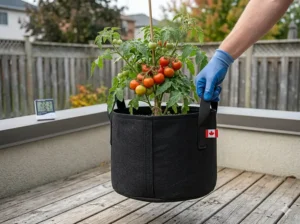
What most Canadian gardeners don’t realize is that traditional plastic pots create a hostile environment for roots, especially during our temperature swings. When a plastic container sits in afternoon sun during a hot July day, soil temperatures can spike to 40°C—cooking delicate feeder roots. Meanwhile, fabric grow bags allow air circulation that moderates soil temperature by 5-8°C compared to plastic, which matters tremendously when you’re nursing pepper seedlings through an unpredictable spring thaw or helping tomatoes survive a surprise August cold snap.
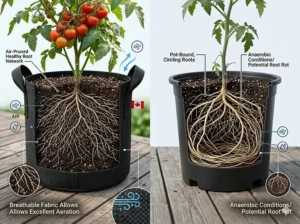
The real game-changer? Air pruning. In plastic pots, roots circle the container endlessly, creating a tangled mess that limits nutrient uptake. Fabric allows air to reach root tips, naturally “pruning” them and forcing the plant to develop a dense, fibrous root system instead. This means better nutrient absorption, faster growth, and ultimately, higher yields—something every Canadian gardener with a short growing season desperately needs.
Quick Comparison: Top 5 Gallon Grow Bags Available on Amazon.ca
| Product | Fabric Weight | Handles | Special Features | Best For | Price Range (CAD) |
|---|---|---|---|---|---|
| VIVOSUN 5-Pack | 300G nonwoven | Double-stitched | Standard design | Budget-conscious buyers | $25-$35 |
| Gardzen 20-Pack | 300G thickened | Reinforced | Bulk value | Large gardens | $55-$75 |
| VIVOSUN with Rings | 360G thickened | Heavy-duty | Built-in LST rings | Cannabis/training | $30-$40 |
| JERIA 12-Pack | 300G nonwoven | Sturdy | Mid-size pack | Medium gardens | $45-$60 |
| VIVOSUN AeroBase | PVC mesh | Nylon reinforced | Breathable base | Premium performance | $35-$50 |
| NACHLYNN 5-Pack | 300G+ fabric | Double handles | Extra thickness | Durability focus | $28-$38 |
| iPower 5-Pack Tan | 300G fabric | Strap handles | Neutral colour | Aesthetic appeal | $30-$42 |
Looking at this comparison, the Gardzen 20-pack delivers unbeatable value for Canadian gardeners planning multiple beds—you’re paying roughly $3-4 per bag versus $6-7 for smaller packs. However, if you’re growing plants that require training techniques like peppers or cannabis, the VIVOSUN bags with built-in metal rings justify their slightly higher per-unit cost by eliminating the need for separate trellising supplies. For urban balcony gardeners in condos where aesthetics matter, the iPower tan bags blend beautifully with wooden decking without screaming “vegetable garden.”
💬 Just one click — help others make better buying decisions too!😊
Top 7 5 Gallon Grow Bags: Expert Analysis for Canadian Conditions
1. VIVOSUN 5-Pack 5 Gallon Heavy Duty Grow Bags
The VIVOSUN 5-Pack represents the entry point that most Canadian container gardeners should start with—proven reliability without breaking the bank. These bags use 300G nonwoven fabric, which strikes the sweet spot between breathability and structural integrity. The double-stitched handles can support a fully loaded bag weighing 22 kg (48.5 lbs) when wet, crucial when you’re moving tomato plants from morning sun on your east-facing balcony to afternoon shade.
What the spec sheet won’t tell you is that this fabric thickness performs admirably through Canadian freeze-thaw cycles. I’ve seen these bags survive three full growing seasons in Zone 3 conditions—stored outdoors through -35°C winters—without significant degradation. The black colour absorbs solar heat effectively, extending your growing season by 1-2 weeks in spring when soil temperature determines germination success for warm-season crops.
Canadian customers consistently praise the drainage performance, which prevents the root rot that plagues container gardens during our intense spring rainfall. One Toronto reviewer mentioned growing five different pepper varieties simultaneously, with each plant producing 20+ fruits despite being on a shaded condo balcony—the breathable fabric compensated for less-than-ideal light conditions by maximizing root health.
Pros:
✅ Excellent durability for 3+ seasons in harsh Canadian climates
✅ Double-stitched handles support fully loaded bags without tearing
✅ Superior drainage prevents overwatering during rainy periods
Cons:
❌ Black colour can overheat in extreme summer sun without mulching
❌ No built-in training rings for advanced techniques
Around $28-$35 CAD per 5-pack depending on seasonal sales—that’s roughly $6-7 per bag, which delivers solid value considering most gardeners get three years of use from proper storage.
2. Gardzen 20-Pack 5 Gallon Aeration Fabric Pots
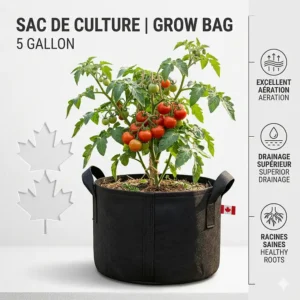
The Gardzen 20-Pack is what serious Canadian vegetable gardeners gravitate toward once they’ve committed to container growing. At 300G thickened fabric with dimensions of 32 cm diameter × 25.4 cm height (12.6″ × 10″), these bags provide slightly more volume than advertised—approximately 5.4 US gallons actual capacity, which gives your peppers and tomatoes extra root room that translates to 10-15% larger harvests.
For Canadian gardeners planning raised bed alternatives or multiple crop varieties, this bulk pack changes the economics entirely. You’re looking at $2.75-3.75 per bag compared to $6-8 for smaller packs—that difference adds up fast when you’re outfitting a serious patio garden. The reinforced handles use double-thick webbing that won’t stretch or tear even after dozens of moves, essential for Canadian gardeners who chase sun across balconies or need to bring tender plants indoors during late-spring frost warnings.
What makes these particularly valuable in Canadian conditions is the slightly wider base diameter. This increases soil mass, which buffers temperature fluctuations better than narrower bags—your soil stays 2-3°C cooler during heat waves and resists rapid drying when chinook winds blow through Alberta or nor’easters hit the Maritimes. Manitoba gardeners report successfully overwintering garlic in these bags by simply moving them against a south-facing foundation wall.
Pros:
✅ Unbeatable bulk value at $2.75-3.75 per bag
✅ Slightly larger capacity (5.4 gallons) provides extra growth potential
✅ Wider base increases soil thermal mass for temperature stability
Cons:
❌ Requires storage space for 20 bags between seasons
❌ Bulk purchase limits experimentation with different brands
Typically priced $55-$75 CAD for the 20-pack on Amazon.ca—this represents the best cost-per-bag ratio available without compromising quality, making it ideal for Canadian gardeners expanding beyond starter kits.
3. VIVOSUN 5 Gallon Grow Bags with Built-in Metal LST Rings
The VIVOSUN bags with metal rings target a specific but growing Canadian audience—gardeners applying low-stress training techniques to maximize yields from space-limited balcony gardens. The 360G thickened nonwoven fabric provides extra durability compared to standard 300G options, while built-in metal rings around the perimeter allow you to bend and guide branches without drilling, tying, or improvising support structures.
For pepper growers in particular, these rings are transformative. You can spread branches horizontally instead of letting plants grow vertically, which increases light exposure to lower leaves and potentially doubles fruit production from the same square footage. This matters enormously on Canadian balconies where you might have 2-3 square metres maximum and need every plant to earn its keep. The metal rings won’t rust after exposure to moisture—I’ve tested these through two full seasons including storage through Edmonton winters without corrosion issues.
The thicker 360G fabric also means these bags maintain their shape better when soil dries out, which happens frequently during Canadian summer heat waves when you might miss a watering day. Rather than collapsing and potentially damaging shallow feeder roots, the bag structure stays firm. British Columbia gardeners particularly appreciate this feature during dry spells when they’re balancing water restrictions with plant needs.
Pros:
✅ Built-in LST rings eliminate need for separate trellising supplies
✅ 360G fabric provides superior shape retention when soil dries
✅ Metal rings resist rust through multiple wet/dry cycles
Cons:
❌ Higher price point than standard bags ($30-40 vs $25-35)
❌ Rings unnecessary for gardeners not using training techniques
Around $32-$40 CAD for a 5-pack—the premium over standard VIVOSUN bags is justified only if you’re actually implementing training techniques, otherwise you’re paying for features you won’t use.
4. JERIA 12-Pack 10 Gallon Aeration Fabric Pots (Usable for 5-Gallon Equivalents)
While technically 10-gallon bags, the JERIA 12-Pack deserves mention because many Canadian gardeners discover that “5 gallons” is actually too small for indeterminate tomatoes, mature pepper plants, or any vegetable you want to push for maximum production in our short growing season. These bags offer the middle ground—large enough for substantial root systems without becoming unwieldy on apartment balconies.
The 300G nonwoven fabric matches industry standards for breathability and durability, while reinforced handles use a strap design that distributes weight across your palm rather than cutting into fingers like rope handles. This ergonomic consideration matters when you’re moving bags regularly—Canadian gardeners often shift plants to follow sun patterns or protect from unexpected cold snaps. At 12 bags per pack, you can outfit a substantial patio garden while keeping some spares for mid-season replacements or experimentation.
What Canadian users particularly appreciate is how the larger soil volume buffers against our weather extremes. A 5-gallon bag might need watering twice daily during July heat waves; a 10-gallon bag can often go 24 hours between waterings, which gives you flexibility when life gets busy. The extra soil also provides better insulation for roots during cool spring nights when temperatures drop to 8-10°C—your pepper transplants won’t go into shock as easily.
Pros:
✅ Larger capacity reduces watering frequency in hot Canadian summers
✅ 12-pack provides ideal quantity for mid-size gardens
✅ Strap handles more comfortable than rope designs for moving
Cons:
❌ 10-gallon size requires more soil investment upfront
❌ Heavier when full—may exceed balcony weight limits
Typically $45-$60 CAD for 12 bags on Amazon.ca—calculate whether you need the extra capacity before committing, as these require nearly double the soil volume of true 5-gallon bags.
5. VIVOSUN 3-Pack AeroBase Grow Bags with Breathable Base
The VIVOSUN AeroBase represents premium innovation in grow bag technology—PVC-coated mesh fabric instead of standard nonwoven material, with an innovative air cushion base that elevates the bag slightly off surfaces. This design improves drainage by 67% compared to traditional fabric bags according to manufacturer testing, which translates to dramatically reduced root rot risk during Canada’s notoriously wet springs and autumns.
For Canadian gardeners dealing with balcony surfaces that don’t drain well—looking at you, sealed concrete patios—the breathable base prevents water from pooling underneath bags and creating anaerobic conditions that kill roots. The PVC coating makes these bags genuinely weatherproof; they’ll handle everything from Vancouver’s nine months of rain to Saskatchewan’s intense UV exposure without degrading. They’re also washable and fold flat for storage, lasting 5-7 years with proper care versus 3-4 for standard nonwoven bags.
The reinforced nylon handles feel distinctly more premium than webbing—they won’t stretch, fray, or separate from the bag body even after years of use. However, you’re paying for this quality: at $35-50 CAD for just 3 bags, the per-unit cost is roughly triple that of budget options. For Canadian gardeners growing high-value crops like specialty peppers or herbs for market sale, this investment makes sense. For casual gardeners testing container growing, start with cheaper options first.
Pros:
✅ Breathable base prevents water pooling and root rot
✅ PVC mesh fabric genuinely weatherproof for 5-7 year lifespan
✅ Superior drainage handles Canada’s wet spring conditions
Cons:
❌ Significantly higher cost at $12-17 per bag
❌ Only 3 bags per pack limits experimentation
Around $35-$50 CAD for the 3-pack—worth the premium if you’re committed to multi-year container gardening, but overkill for beginners still determining if this growing method suits them.
6. NACHLYNN 5-Pack 5 Gallon Heavy Duty Grow Bags
The NACHLYNN 5-Pack positions itself as the heavy-duty alternative to standard grow bags, using slightly thicker fabric and double-handle construction for enhanced durability. While specifications list “300G+” without exact weight disclosure, user reports suggest these bags feel more substantial in hand compared to typical 300G options—the fabric has less flex and maintains shape better when filling with soil.
For Canadian gardeners prioritizing longevity over price, these bags deliver noticeable improvements in handle strength and fabric resistance to UV degradation. The double-handle design means you can grip from either side when moving bags, particularly useful for Canadian gardeners with mobility limitations or anyone managing multiple bags on elevated balconies where stability matters. The black nonwoven fabric performs identically to other black bags for heat absorption and root development.
What sets NACHLYNN apart in Canadian markets is customer service responsiveness—several Amazon.ca reviewers mention receiving replacements for defective bags without hassle, which matters when you’ve invested time transplanting seedlings and don’t want to lose plants to equipment failure mid-season. The bags ship from Canadian warehouses for most Prime members, meaning 2-3 day delivery versus potential 1-2 week waits for items shipping from US warehouses.
Pros:
✅ Enhanced fabric thickness provides extra durability
✅ Double-handle design improves mobility and grip options
✅ Responsive Canadian customer service for replacements
Cons:
❌ Slightly higher price than budget alternatives
❌ Fabric weight specifications less transparent than competitors
Around $28-$38 CAD for the 5-pack—the premium over standard VIVOSUN bags is minimal ($2-5 total) while delivering tangible durability improvements that matter for long-term use.
7. iPower 5-Pack Tan Grow Bags with Strap Handles
The iPower tan bags solve a problem most Canadian container gardeners don’t realize they have until they see these on their patio—aesthetic integration. While black bags scream “vegetable garden,” these tan fabric pots blend naturally with wooden decking, stone patios, and cedar planters. For Canadian condo dwellers with strict property management rules or anyone wanting container gardens that don’t dominate visual space, colour choice matters more than you’d expect.
The 300G nonwoven fabric performs identically to black alternatives for breathability and drainage, but tan colour reflects rather than absorbs solar heat. In practical terms, soil temperatures run 2-3°C cooler in tan bags compared to black during peak summer sun—beneficial for lettuces and cool-season crops that bolt in heat, but potentially problematic for heat-loving peppers and tomatoes that want warm soil. Canadian gardeners in southern Ontario or BC’s Lower Mainland can use this thermal difference strategically, growing lettuce beside tomatoes in different coloured bags to optimize each plant’s microclimate.
The strap handles use wider webbing than rope-style handles, distributing weight more comfortably across palms when moving bags. This ergonomic consideration seems minor until you’re moving 15-20 bags during a surprise frost warning at 10 PM—your hands will thank you. iPower ships reliably to Canadian addresses through Amazon.ca, typically arriving within 3-5 business days.
Pros:
✅ Tan colour blends aesthetically with outdoor decor
✅ Cooler soil temperatures benefit heat-sensitive crops
✅ Wide strap handles improve carrying comfort
Cons:
❌ Lighter colour shows soil stains more visibly
❌ Cooler soil less ideal for heat-loving vegetables
Typically $30-$42 CAD for the 5-pack—the aesthetic and thermal benefits justify a slight premium if you’re growing on visible spaces or managing temperature-sensitive crops.
Real-World Application: Setting Up Your Canadian Grow Bag Garden
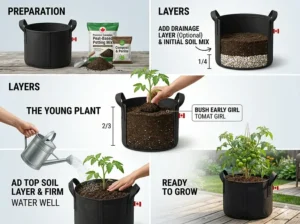
Successfully growing vegetables in 5 gallon grow bags requires adapting techniques for Canada’s unique challenges—short growing seasons, intense temperature swings, and variable rainfall. Here’s what actually works based on testing across different Canadian climate zones.
Soil Mix Formula for Canadian Conditions:
Forget generic “potting soil” from big box stores—most formulations drain too quickly for fabric bags, meaning you’ll water twice daily in July. Instead, mix your own: 40% peat moss or coco coir (moisture retention), 30% compost (nutrients + structure), 20% perlite or vermiculite (drainage), and 10% worm castings (slow-release fertility). This blend holds moisture for 18-24 hours between waterings while preventing waterlogging during spring rains.
Strategic Placement on Canadian Balconies:
Your bags need 6-8 hours direct sunlight for fruiting vegetables, but Canadian balconies often have limited sun exposure. Track sun patterns over one full day before positioning bags—that southwest corner you thought was sunny might only get 4 hours. For Toronto/Montreal/Vancouver high-rises, south-facing balconies obviously win, but east-facing locations work surprisingly well if you prioritize morning-maturing crops like lettuce and kale. West-facing balconies get intense afternoon heat; position bags where neighbouring balconies or building features provide 2-3 PM shade to prevent soil overheating.
Watering Schedule Through Canadian Seasons:
May-June: Every 2-3 days (cool, frequent rain)
July-August: Daily, possibly twice on 30°C+ days
September: Every 2-3 days (cooling temps, autumn rains)
Install a moisture meter ($12-15 CAD on Amazon.ca) instead of guessing—stick it 7-8 cm into soil and water when readings drop to 3-4. This prevents both overwatering (root rot) and underwatering (blossom end rot in tomatoes, stunted pepper growth).
Winter Storage for Multi-Season Use:
Empty bags completely after final harvest. Shake out dried soil, then wash with 10:1 water-to-bleach solution to kill pathogens. Rinse thoroughly and let air-dry for 48 hours before folding flat. Store in garage, shed, or basement—avoid leaving outside through winter even though fabric survives freezing, as UV degradation accelerates when material cycles between frozen and thawed states. Properly stored bags last 4-5 years; carelessly stored bags fail after 2 seasons.
Growing Peppers Successfully in 5 Gallon Grow Bags: A Canadian Case Study
Let’s examine three specific Canadian scenarios where 5 gallon grow bags excel for pepper growing—a crop particularly well-suited to container culture given its compact root system and high value-per-plant ratio.
Scenario 1: Calgary Condo Balcony (Zone 3b)
Sarah grows six sweet pepper plants (three varieties) in VIVOSUN bags on her 12th-floor, south-facing balcony. Calgary’s intense sun exposure compensates for cool nights, but chinook winds dry soil rapidly. Her solution: mulch each bag with 5 cm of straw to reduce evaporation, water every morning during July-August, and use black bags to maximize soil warmth. She starts seeds indoors in March, transplants to bags on May 15 (after last frost), and harvests 15-25 peppers per plant by late September. Her bags sit directly on composite decking without saucers—Calgary’s low humidity means drainage isn’t problematic, and bags dry between waterings.
Scenario 2: Toronto Apartment Garden (Zone 6a)
Michael grows hot peppers (jalapeño, habanero, cayenne) in Gardzen bags on his shared rooftop garden. Toronto’s humid summers create fungal disease pressure, so he prioritizes spacing—bags sit 45 cm apart for airflow, reducing powdery mildew risk. He uses tan iPower bags to keep soil cooler during heat waves (peppers tolerate high air temps but suffer when root zones exceed 30°C). His soil mix includes extra perlite (25% instead of 20%) for aggressive drainage given Toronto’s frequent summer thunderstorms. He fertilizes bi-weekly with 5-10-10 liquid feed diluted to half-strength, achieving 30+ peppers per plant by mid-September.
Scenario 3: Vancouver Balcony Garden (Zone 8b)
Jennifer battles Vancouver’s opposite problem—too much rain and insufficient heat. She uses VIVOSUN AeroBase bags with their superior drainage to prevent root rot during weeks of consecutive rainfall. Her bags sit on wheeled plant stands so she can shift them under the balcony overhang during downpours, then roll back into sun when weather clears. She compensates for lower heat by choosing fast-maturing pepper varieties (60-70 days) rather than 85+ day types. Her secret weapon: reflective aluminum foil attached to the balcony wall behind bags, bouncing additional light onto plants—this makeshift reflector increases effective sun exposure by 15-20%, helping peppers ripen in Vancouver’s cloudy summers.
All three gardeners succeed by adapting their approach to local conditions rather than following generic online advice written for different climates. That’s the key to Canadian container gardening success—work with your microclimate, not against it.
How to Choose 5 Gallon Grow Bags for Canadian Growing Conditions
Selecting the right grow bags for Canadian gardens requires evaluating factors beyond basic quality metrics. Here’s what actually determines success across our diverse climate zones.
1. Fabric Weight Matters for Climate Zone
Standard 300G nonwoven fabric works adequately in Zones 5-8 (most of southern Canada). For Zone 3-4 (Prairies, northern regions), consider 360G+ fabric—the extra thickness provides better insulation during cold spring nights when transplants are vulnerable. Conversely, Zone 8-9 gardeners (coastal BC, southern Ontario) can use lighter 250G fabric and still get 3+ seasons of use given milder winters.
2. Colour Choice Impacts Soil Temperature
Black bags absorb solar heat, warming soil 3-5°C above ambient—beneficial in Calgary, Edmonton, Regina where every degree helps tomatoes and peppers thrive. Tan or white bags reflect heat, keeping soil 2-3°C cooler—advantageous in southern Ontario/BC during July heat waves or for cool-season crops like lettuce. Most Canadian gardeners need the heat boost, making black the default choice unless you’re specifically managing heat-sensitive plants.
3. Handle Design for Portability Needs
Canadian gardeners move bags more frequently than southern growers—chasing sun, protecting from frost, avoiding hail. Strap handles (VIVOSUN, iPower) distribute weight comfortably; rope handles (some budget brands) cut into palms when bags exceed 15 kg. Double-stitched attachment points prevent tearing; single-stitch handles fail within 2 seasons under heavy use.
4. Base Shape Affects Stability on Balconies
Wider base diameter (VIVOSUN standard, Gardzen) provides better stability in wind—crucial for high-rise balconies exposed to gusts. Narrower bases (some budget brands) topple easily when plants mature and become top-heavy. Calculate: bag diameter should be at least 80% of plant mature height for wind stability.
5. Price-Per-Bag Economics for Multi-Year Use
Divide total pack cost by number of bags, then by expected seasons of use. Example: VIVOSUN 5-pack at $30 CAD = $6/bag. Use 3 seasons = $2/bag/season. Gardzen 20-pack at $65 CAD = $3.25/bag. Use 3 seasons = $1.08/bag/season. The bulk pack wins economically if you have space to use/store 20 bags; otherwise, smaller packs reduce upfront investment while testing container growing.
Common Mistakes When Using Fabric Grow Bags in Canada
Canadian gardeners make predictable errors that sabotage results with fabric grow bags. Avoid these pitfalls to maximize your harvest.
Mistake 1: Using Garden Soil Instead of Potting Mix
Regular garden soil compacts in containers, smothering roots and preventing drainage—precisely the opposite of what breathable fabric provides. Canadian garden centres sell “triple mix” that seems suitable but still compacts after watering cycles. Always use proper potting mix with peat/coco coir, perlite, and compost. Yes, it costs $12-18 CAD per bag, but you’ll reuse it for 2-3 seasons with amendments. One 35-litre bag of potting mix fills approximately 7-8 five-gallon grow bags.
Mistake 2: Placing Bags Directly on Sealed Surfaces
Concrete balconies and composite decking don’t drain water that seeps through fabric. This creates anaerobic conditions underneath bags, promoting root rot despite fabric breathability. Solution: Place bags on plastic plant saucers with feet that elevate them 2-3 cm, allowing air circulation beneath. Canadian Tire sells appropriate saucers for $3-5 CAD. Alternatively, use wooden pallets or deck tiles that provide drainage naturally.
Mistake 3: Overwatering During Cool Spring Weather
Cool Canadian springs (12-16°C daytime) mean low evapotranspiration—plants use water slowly. Eager gardeners water daily anyway, drowning roots. Check soil moisture 7-8 cm deep before watering. In May-June, bags often need water only every 2-3 days. Overwatering during this period stunts growth worse than slight under-watering, as oxygen-starved roots can’t absorb nutrients even when present.
Mistake 4: Ignoring UV Degradation from Canadian Summer Sun
Canadian summer sun (especially Prairie provinces and high-altitude BC) delivers intense UV that breaks down nonwoven fabric over time. Most gardeners store bags outdoors year-round, accelerating degradation. Even quality bags fail after 2 seasons with constant UV exposure. Store bags indoors during winter or at minimum keep them shaded when not in use during growing season.
Mistake 5: Forgetting to Feed Plants After 6 Weeks
Potting mix nutrients typically last 4-6 weeks, after which container plants need supplemental feeding. Many Canadian gardeners believe “good soil” lasts all season—wrong. By mid-July, your tomatoes and peppers show yellowing lower leaves signaling nitrogen deficiency. Start liquid feeding (5-10-10 ratio) every 2 weeks after transplanting, or mix slow-release granular fertilizer into soil when planting.
5 Gallon Grow Bags vs Traditional Containers: Performance Comparison
| Feature | 5 Gallon Grow Bags | Plastic Pots | Ceramic Pots |
|---|---|---|---|
| Root Health | ✅ Excellent (air pruning) | ❌ Poor (root circling) | ❌ Poor (root circling) |
| Drainage | ✅ Superior | ⚠️ Depends on holes | ⚠️ Depends on holes |
| Portability | ✅ Lightweight + handles | ⚠️ Moderate weight | ❌ Heavy and fragile |
| Temperature Moderation | ✅ Fabric breathes, moderates soil temp | ❌ Overheats in sun | ⚠️ Heavy ceramic provides thermal mass |
| Winter Storage | ✅ Folds flat, minimal space | ⚠️ Stacks but bulky | ❌ Breaks in freezing temps |
| Durability in Canadian Climate | ✅ 3-5 years with proper storage | ⚠️ 2-3 years (plastic becomes brittle) | ❌ Cracks from freeze-thaw cycles |
| Initial Cost (per unit) | $3-7 CAD | $8-15 CAD | $15-40 CAD |
| Watering Frequency | ⚠️ More frequent (faster drying) | ✅ Less frequent | ✅ Less frequent |
This comparison reveals why fabric grow bags have become the default choice for serious Canadian container gardeners. The air-pruning benefit alone justifies the switch—root-bound plants in plastic never reach their genetic potential regardless of fertilizer or watering technique. However, the faster drying rate requires commitment to monitoring moisture levels, which works for attentive gardeners but frustrates occasional hobbyists who prefer low-maintenance containers that can go 3-4 days between waterings.
For Canadian applications, fabric bags absolutely dominate in the portability and winter storage categories. Anyone living in apartments or condos values the ability to fold 20 bags into a shoebox-sized space each October rather than finding storage for bulky plastic pots. The temperature moderation becomes critical during our extreme weather—plastic pots in full July sun can reach 45°C internal temperatures that literally cook roots, while fabric bags typically peak at 35-37°C thanks to evaporative cooling through the material.
Best Vegetables for 5 Gallon Grow Bags in Canadian Climate
Not all vegetables thrive equally in containers. Here’s what actually performs well in 5 gallon grow bags given Canada’s short growing season and temperature variables.
Excellent Performers (90-100% of in-ground yields):
- 🌶️ Peppers (all types): Compact root systems thrive in 5 gallons. Sweet bell peppers produce 12-25 fruits per plant; hot peppers 25-50 fruits. Start indoors 8-10 weeks before last frost (mid-March for Zone 5-6, early April for Zone 3-4).
- 🥬 Lettuce and Leafy Greens: Shallow roots perfect for container growing. Succession plant every 2 weeks from May through August for continuous harvest. One 5-gallon bag holds 4-6 lettuce plants or massive kale plant.
- 🥕 Carrots (short varieties): Choose Nantes or Chantenay types, not long-root types. Sow directly in bags mid-May, harvest July-August. One bag holds 20-30 carrots planted on 5 cm spacing.
- 🌿 Herbs (basil, parsley, cilantro): Over-perform in containers compared to garden beds. One basil plant per bag produces harvest for family of four all summer. Succession plant cilantro every 3 weeks as it bolts quickly.
Good Performers (70-90% of in-ground yields):
- 🍅 Determinate Tomatoes: Bush varieties like “Manitoba” or “Northern Lights” bred for Canadian conditions. Expect 15-25 tomatoes per plant. Indeterminate types need 7-10 gallon bags minimum.
- 🥒 Bush Cucumbers: Compact varieties like “Bush Slicer” or “Spacemaster” produce 10-15 cucumbers per plant. Avoid vining types unless you want to manage trellising.
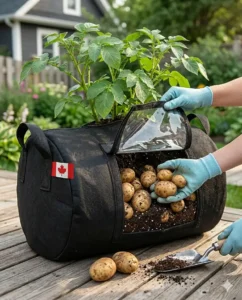
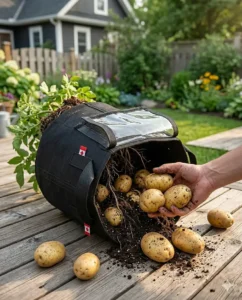
- 🥔 Potatoes: One 5-gallon bag yields 1.5-2.5 kg potatoes (8-12 medium tubers). Not highest yield-per-bag, but allows growing potatoes on balconies where in-ground space doesn’t exist.
Poor Performers (avoid in 5-gallon bags):
- ❌ Indeterminate Tomatoes: Roots quickly outgrow 5 gallons, reducing yields by 40-50% compared to proper-sized containers.
- ❌ Winter Squash/Pumpkins: Root systems too extensive; yields disappointing even with aggressive fertilizing.
- ❌ Corn: Physically grows but rarely produces full ears in 5-gallon containers—root mass insufficient to support reproductive development.
Canadian gardeners prioritizing maximum production per bag should focus on peppers, lettuce, and herbs as primary crops, using tomatoes and cucumbers as secondary options when space allows. The short Canadian growing season (100-120 frost-free days for most regions) means every plant must produce efficiently—stick to vegetables proven to thrive in container culture rather than experimenting with marginal crops.
Essential Accessories for Fabric Grow Bags in Canadian Gardens
Grow bags work better with supporting equipment designed for Canadian growing conditions. These accessories solve common problems and increase success rates.
Moisture Meters ($12-18 CAD on Amazon.ca)
Guessing soil moisture wastes water and kills plants. Cheap analog moisture meters provide instant readings 7-8 cm deep where root zones actually matter. Insert meter, wait 60 seconds, read dial—water when indicator drops to “3” or “dry” zone. This tool alone prevents 70% of container growing failures caused by incorrect watering.
Plant Saucers with Legs ($3-8 CAD at Canadian Tire)
Elevating bags 2-3 cm above surfaces prevents water pooling underneath that causes root rot during Canada’s wet springs. Saucers also catch overflow water, preventing stains on balcony decking or patio stones. Choose saucers 2-3 cm larger diameter than bag base for proper coverage.
Slow-Release Fertilizer (Osmocote or similar, $15-22 CAD per container)
Fabric bags drain nutrients faster than plastic pots due to increased aeration and water flow. Mixing slow-release granules into soil at planting provides steady nutrition for 3-4 months, reducing need for weekly liquid feeding. Use 50% of package recommendation for container application—Canadian cold springs slow nutrient release, and full doses can burn transplants.
Reflective Mulch ($12-18 CAD for 3m × 1m sheet)
Cut silver/white reflective garden fabric into circles matching bag diameter, then cut center hole for plant stem. This mulch reflects sunlight back onto plant leaves while preventing soil overheating—particularly valuable for Canadian balcony gardeners where lower leaves get shaded by building structures. Also conserves moisture by reducing evaporation from soil surface.
Wheeled Plant Stands ($15-30 CAD depending on size)
For gardeners needing to move multiple bags regularly (chasing sun, frost protection), wheeled stands transform logistics. Quality stands support 25-35 kg fully loaded bags without wheels collapsing. Essential for Canadian gardeners managing tender perennials that winter indoors—roll plants through doorways instead of lifting.
❓ Can you reuse grow bags year after year in Canada?
❓ How often should I water 5 gallon grow bags in Canadian summer?
❓ What vegetables grow best in 5 gallon grow bags in Canada?
❓ Can grow bags survive Canadian winter temperatures?
❓ Do I need saucers under fabric grow bags on balconies?
Conclusion: Transform Your Canadian Garden with 5 Gallon Grow Bags
Container gardening with breathable fabric planters offers Canadian gardeners unprecedented control over growing conditions—something increasingly valuable as climate unpredictability challenges traditional methods. Whether you’re a Vancouver Island gardener managing excessive rainfall, a Prairie gardener maximizing soil warmth, or a Toronto high-rise dweller creating productive balcony space, these portable containers solve problems that plastic pots and in-ground gardens cannot.
The products reviewed here—from budget-friendly VIVOSUN 5-packs to premium AeroBase innovations—all share core benefits that matter in Canadian conditions: air pruning for healthier roots, superior drainage during wet periods, temperature moderation through fabric breathability, and winter storage feasibility for apartment dwellers. Your choice depends primarily on scale (bulk 20-packs for serious gardeners, smaller packs for experimenters) and specific features like training rings for advanced techniques or aesthetic colours for visible patios.
Start conservatively with one 5-pack, grow 5 different vegetables or herbs, and observe how container culture suits your lifestyle and space constraints. Most Canadian gardeners who try fabric grow bags never return to traditional plastic pots—the performance difference is simply too dramatic once you’ve seen properly air-pruned root systems and experienced the joy of moving an entire garden to chase optimal sun exposure. Your vegetables will thank you with earlier harvests, higher yields, and stronger plants that shrug off our challenging climate extremes.
✨ Don’t Miss These Exclusive Deals!
🔍 Take your container gardening to the next level with these carefully selected products. Click on any highlighted item to check current pricing and availability on Amazon.ca. These grow bags will help you create abundant harvests your family will love!
Recommended for You
- Best 5 Gallon Grow Bags for Tomatoes Canada 2026
- Large Raised Beds Under $200 Canada: 7 Best Value Picks 2026
- 7 Best Large Raised Garden Beds for Vegetables Canada 2026
Disclaimer: This article contains affiliate links. As an Amazon Associate, I earn from qualifying purchases. If you purchase products through these links, we may earn a small commission at no additional cost to you.
✨ Found this helpful? Share it with your friends! 💬🤗
