
In This Article
A greenhouse ventilation fan is a powered fan that moves air through a greenhouse, either exhausting hot, moist air outdoors or circulating it inside the structure. Its job is to control temperature, cut humidity, banish stagnant pockets and replace stale air with fresh air your plants can actually use.

Here’s the Canadian twist. On a sunny April afternoon, your polycarbonate box can climb 15 °C above the outdoor temperature before you’ve finished your coffee. Come November, the problem flips: you’re trying to hold heat while still shedding moisture, because damp, cool air is basically a hospitality suite for grey mould. The same greenhouse ventilation fan has to be a sprinter in July and a careful librarian in January.
That’s why the purchase deserves more thought than “biggest CFM wins.” Extension researchers at UMass say improper fan sizing is a major cause of poor ventilation, and the cost of getting it wrong shows up as scorched seedlings, drippy ceilings and lost yield.
This guide covers seven real products across budget, mid-range and premium tiers. It also covers the sizing maths, intake rules, certification and winter humidity control. It is built on spec comparison and the review sentiment I could verify, not on invented test stories. Prices are shown as ranges in Canadian dollars, so check current pricing before you buy.
Greenhouse Ventilation Fan Comparison at a Glance
Here are the seven picks side by side. Airflow is shown in CFM with the metric equivalent (m³/h) in brackets, because that’s how you’ll compare it with your greenhouse volume.
| Product | Type | Airflow | Best For | Price Range (CAD) |
|---|---|---|---|---|
| iLIVING 12-Inch Shutter Exhaust Fan | Wall exhaust, thermostat | 960 CFM (about 1,630 m³/h) | Hobby greenhouses of roughly 10-35 m² | C$160-C$230 |
| VEVOR 12-Inch Shutter Exhaust Fan (EC motor) | Wall exhaust, smart control | 1,500 CFM (about 2,550 m³/h) | Value-focused temperature control | C$130-C$200 |
| KEN BROWN 12-Inch Shutter Exhaust Fan | Wall exhaust, aluminum shutters | 1,450 CFM (about 2,460 m³/h) | Powerful exhaust in covered structures | C$130-C$220 |
| iLIVING 20-Inch Shutter Exhaust Fan | Large wall exhaust, thermostat | 3,368 CFM (about 5,720 m³/h) | Big hoop houses and workshops | C$300-C$450 |
| VEVOR 20-Inch Oscillating Wall Mount Fan | Circulation fan | 4,650 CFM (about 7,900 m³/h) | Even airflow, no dead corners | C$130-C$230 |
| AC Infinity CLOUDLINE PRO T10 | Inline duct fan, VPD controller | 1,201 CFM (about 2,040 m³/h) | Ducted humidity control | C$280-C$400 |
| erifyng Solar Fan | Solar-powered exhaust | 200 CFM (about 340 m³/h) | Off-grid sheds and cold frames | C$40-C$100 |
The table makes one thing obvious: CFM per dollar is not the whole story. The VEVOR 12-Inch Shutter Exhaust Fan and KEN BROWN 12-Inch Shutter Exhaust Fan deliver the most exhaust for the money in the 12-inch class. The AC Infinity CLOUDLINE PRO T10 costs several times more per CFM but brings humidity and VPD logic that the others lack. The VEVOR 20-Inch Oscillating Wall Mount Fan isn’t an exhaust fan at all, so it solves a different problem.
💬 Just one click — help others make better buying decisions too!😊
Top 7 Greenhouse Ventilation Fan Picks: Expert Analysis
1. iLIVING 12-Inch Shutter Exhaust Fan — thermostat-driven all-rounder
The iLIVING 12-Inch Shutter Exhaust Fan earns its spot by doing the unglamorous job of automation properly. It pairs a built-in thermostat with variable speed, so the fan ramps up as the greenhouse heats instead of slamming on and off.
At 960 CFM, it comfortably fits small greenhouses of roughly 100-400 square feet (about 10-35 m²) when the structure is shaded or the climate is mild. In a blazing south-facing build, treat it as a good fit for the smaller end of that range. Roundups put its operating noise under 65 dB at one metre and describe the motor as UL listed. In Canada you’ll still want to confirm a CSA or cUL mark on the unit you receive.
Reviewers in the roundups I found praise the thermostat convenience and quiet running. I couldn’t verify a large pool of independent buyer reviews, so treat that as directional rather than definitive.
Pros:
- ✅ Thermostat with variable speed built in
- ✅ Quiet for its airflow class
- ✅ Automatic shutters close when idle
Cons:
- ❌ 960 CFM runs short in hot, unshaded houses
- ❌ Pricier per CFM than the VEVOR options
At roughly C$160-C$230, it’s a fair price for set-and-forget control. iLIVING 12-Inch Shutter Exhaust Fan is the pick if you value automation over raw airflow.
2. VEVOR 12-Inch Shutter Exhaust Fan (EC Motor) — best CFM per dollar with smart control
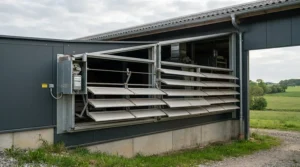
Here’s the budget disruptor. The VEVOR 12-Inch Shutter Exhaust Fan (EC Motor) lists 1,500 CFM, an EC motor, smart programming for variable speed, a temperature-control mode and a timer.
An EC motor matters more than the acronym suggests. It runs at partial speed efficiently, so the fan can idle gently on a cool day instead of cycling between “off” and “gale.” That keeps the temperature steadier and the electricity bill lower.
One caution from my research: VEVOR sells several 12-inch shutter fans. One roundup lists a 1,000 CFM galvanized version, while the smart-controller version lists 1,500 CFM. Check the exact listing before you order.
Review sentiment for this lineup looked solid in retailer listings, but I couldn’t confirm a specific rating for this exact model. The installation hardware is the common weak spot across wall-mount fans in this class, so buy a few extra stainless screws.
Pros:
- ✅ High airflow for the price
- ✅ EC motor with timer and temperature control
- ✅ Sturdy steel housing
Cons:
- ❌ Several similar listings cause spec confusion
- ❌ Brand has a smaller track record than iLIVING
Plan on roughly C$130-C$200. For most Canadian hobbyists, the VEVOR 12-Inch Shutter Exhaust Fan (EC Motor) is the value verdict.
3. KEN BROWN 12-Inch Shutter Exhaust Fan — raw exhaust muscle, with caveats
The KEN BROWN 12-Inch Shutter Exhaust Fan is the one for growers who want the most air out of a 12-inch hole. It’s listed at 1,450 CFM at 1,650 RPM with aluminum shutters, which is excellent for a hobby-grade exhaust fan.
Aluminum shutters resist rust better than painted steel, and they’re lighter, so they open with less back-pressure. That’s meaningful when your fan is pulling against a tight greenhouse.
Reviewers in the roundup that ranked it first note two gotchas. The included mounting hardware is minimal, so you may need your own screws. The powder coating can rust if the unit sits in direct rain, which means it suits enclosed or well-covered installations, not an exposed gable end without an overhang.
Pros:
- ✅ Strong 1,450 CFM from a compact opening
- ✅ Lightweight aluminum shutters
- ✅ Good fit for sheds and hobby greenhouses
Cons:
- ❌ Minimal mounting hardware included
- ❌ Powder coat can rust in direct rain
Expect roughly C$130-C$220. If you keep it sheltered, the KEN BROWN 12-Inch Shutter Exhaust Fan is a strong mid-range buy.
4. iLIVING 20-Inch Shutter Exhaust Fan — big-house power with thermostat control
For larger structures, the iLIVING 20-Inch Shutter Exhaust Fan moves 3,368 CFM with thermostat control and UL certification. A single unit can ventilate a sizeable hoop house or a workshop-style greenhouse.
One roundup claims it exchanges the air in a 5,000-square-foot greenhouse every minute. That claim doesn’t survive the maths. At one air change per minute, 3,368 CFM suits roughly 3,400 cubic feet of volume, or about 480 square feet of floor at a 7-foot average height. It’s still a heavy hitter, but size it by volume, not marketing square footage.
A bigger fan means a bigger intake. You’ll need generous shutters or louvres on the opposite wall, or the fan will starve and strain.
Pros:
- ✅ Handles large volumes with a single fan
- ✅ Thermostat control for hands-off cooling
- ✅ Strong CFM-per-dollar at this size
Cons:
- ❌ Needs a large, well-sized intake
- ❌ Coverage claims in roundups overstate real capacity
At roughly C$300-C$450, it’s the sensible choice for serious growers. iLIVING 20-Inch Shutter Exhaust Fan is where the greenhouse ventilation fan conversation graduates from hobby to small-farm scale.
5. VEVOR 20-Inch Oscillating Wall Mount Fan — kills dead air, doesn’t exhaust it
Not every greenhouse ventilation fan should push air outdoors. The VEVOR 20-Inch Oscillating Wall Mount Fan lists 4,650 CFM with 90° oscillation, which makes it a circulation fan for the inside of the greenhouse.
Why bother? Moving air evens out temperature, dries leaf surfaces and strengthens stems. Horticultural guidance suggests sizing horizontal airflow around 2 CFM per square foot of floor, and this fan covers that comfortably for a small house.
It cannot replace an exhaust fan, because it moves the same air around rather than swapping it. Use it alongside one of the exhaust fans above, and run it whenever the exhaust fan is off.
Pros:
- ✅ Oscillation reaches corners
- ✅ Huge circulation for the price
- ✅ Wall or floor flexibility
Cons:
- ❌ Doesn’t exchange air with the outdoors
- ❌ Not designed for damp, uncovered mounting
Budget about C$130-C$230. The VEVOR 20-Inch Oscillating Wall Mount Fan is the airflow management specialist on this list.

6. AC Infinity CLOUDLINE PRO T10 — ducted humidity and VPD brains
The AC Infinity CLOUDLINE PRO T10 is the odd one out, and deliberately so. It’s a 10-inch inline duct fan with 1,201 CFM, a brushless motor, 10 speeds and a rated noise level of 48 dB. It comes with a temperature, humidity and VPD controller plus app control.
VPD, or vapour pressure deficit, ties temperature and humidity into one number that tells you how hard plants are transpiring. If you’re growing in a sealed, insulated, ducted space, the controller can ramp the fan based on humidity, not just heat.
It’s an inline fan, so it wants ducting and a filter or hood, not a bare wall hole. Static pressure drops its real-world airflow below the nameplate. Online buyers consistently comment on quiet operation and responsive manufacturer support, though much of that feedback comes from grow-tent users.
Pros:
- ✅ Temperature, humidity and VPD control
- ✅ Very quiet for its airflow
- ✅ App connectivity and 10 speeds
Cons:
- ❌ Costly per CFM
- ❌ Built for ducted tents, not bare walls
Expect roughly C$280-C$400. AC Infinity CLOUDLINE PRO T10 earns its place for precise humidity control in smaller, tighter spaces.
7. erifyng Solar Fan — off-grid helper for tiny structures
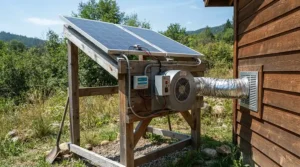
The erifyng Solar Fan is the budget wildcard. It lists 200 CFM with IPX7 waterproofing, and it’s solar-powered, so it needs no outlet. It runs hardest when the sun is strongest, which is exactly when a greenhouse needs ventilation.
Let’s be honest about the limits. 200 CFM equals one air change per minute only in a space of roughly 200 cubic feet, about 5.7 m³. That makes it a supplement for small cold frames, sheds and potting benches, not a main exhaust for a walk-in greenhouse.
Roundups recommend it as an off-grid ventilation option. I couldn’t verify a robust independent review pool, so manage expectations accordingly.
Pros:
- ✅ No wiring or outlet needed
- ✅ Waterproof IPX7 rating
- ✅ Peaks when the sun peaks
Cons:
- ❌ Low airflow for walk-in greenhouses
- ❌ Output falls on cloudy days and in winter
At roughly C$40-C$100, the erifyng Solar Fan is a cheap way to add ventilation where grid power doesn’t reach.
Top 7 Specs and Value Compared
| Product | Motor / Control | Noise Note | Review Sentiment (as found) | Best For |
|---|---|---|---|---|
| iLIVING 12-Inch Shutter Exhaust Fan | Thermostat, variable speed | Under 65 dB at 1 m | Positive in roundups | Automation lovers |
| VEVOR 12-Inch Shutter Exhaust Fan (EC Motor) | EC, timer, temperature mode | Not verified | Solid in listings | Value seekers |
| KEN BROWN 12-Inch Shutter Exhaust Fan | Basic wall exhaust | Not verified | Positive, hardware complaints | Sheltered sheds |
| iLIVING 20-Inch Shutter Exhaust Fan | Thermostat | Not verified | Positive in roundups | Large houses |
| VEVOR 20-Inch Oscillating Wall Mount Fan | 3-speed circulation | Not verified | Mixed data | Circulation |
| AC Infinity CLOUDLINE PRO T10 | Brushless, VPD controller | 48 dB | Strong, tent-heavy | Humidity-focused |
| erifyng Solar Fan | Solar | Quiet | Limited data | Off-grid |
Reading across the rows, the thermostat and EC-motor models (iLIVING 12-Inch Shutter Exhaust Fan, VEVOR 12-Inch Shutter Exhaust Fan (EC Motor)) are the easiest to live with because they adjust themselves. The KEN BROWN 12-Inch Shutter Exhaust Fan is the more manual choice, so pair it with an external thermostat. The AC Infinity CLOUDLINE PRO T10 wins on control sophistication, but only if your setup is ducted.
How to Choose a Greenhouse Ventilation Fan: 7 Steps That Actually Matter
- Measure volume, not floor area. Multiply length × width × average height. Volume is the number your fan has to beat, and floor area hides the height of your roof.
- Aim for one air change per minute in summer. The industry benchmark says fan CFM should roughly equal your greenhouse volume in cubic feet. Extension guidance is built on this.
- Adjust for your conditions. No shade cloth? Multiply by about 1.2. Dense crops or grow lights? Plan on 1.5-2 changes per minute. Sustained heat above 35 °C? Add roughly 15-20%.
- Plan the intake before the fan. An exhaust fan can only pull out what can get in. Undersized intakes are the number-one rookie mistake.
- Pick the control style. A thermostat is the minimum for a greenhouse fan for temperature control. A humidistat is the upgrade if damp shoulder seasons are your enemy.
- Check certification. In Canada, look for a CSA, cUL or cULus mark on the unit, not just “UL listed.”
- Add circulation. One horizontal-airflow fan can matter as much as the exhaust unit.
Notice how none of these steps say “buy the biggest.” Oversizing without speed control just means a fan that slams on, chills the plants, shuts off and repeats.
How to Size and Install a Greenhouse Ventilation Fan: A Step-by-Step Guide
Let’s walk the maths with a real example. Take a 3.7 m × 3.0 m × 2.7 m greenhouse (12 × 10 × 9 ft). Its volume is 1,080 cubic feet, about 31 m³.
Step 1: Baseline. One air change per minute means roughly 1,080 CFM.
Step 2: Climate multiplier. A hot, full-sun spot warrants a 1.5× factor, giving about 1,620 CFM (roughly 2,750 m³/h). In winter, a quarter air change per minute (about 270 CFM) moves moisture without freezing your seedlings.
Step 3: Derate for reality. Fan ratings assume free air. Extension specialists note that greenhouse fans are typically judged at about 0.10-0.125 inches of water pressure, so add a margin.
Step 4: Size the intake. Rules of thumb vary. One guide suggests about 1.5 square feet of intake per 1,000 CFM, which means roughly 2.4 square feet for 1,620 CFM. Another grower resource divides CFM by 250 to get shutter area, which means about 6.5 square feet. When two sources disagree this widely, build toward the larger number. Starving a fan costs far more than an oversized louvre.
Step 5: Choose the position. Put the exhaust fan high on the leeward side to pull out the hottest air, and put the intake low on the opposite wall. UMass notes that if the plastic gets sucked tightly against the frame or the door is hard to open while the fans run, your intake is too small.
Step 6: Match the fan. In this example, the VEVOR 12-Inch Shutter Exhaust Fan (EC Motor) at 1,500 CFM sits close to target, while the KEN BROWN 12-Inch Shutter Exhaust Fan at 1,450 CFM is slightly under. The iLIVING 12-Inch Shutter Exhaust Fan at 960 CFM makes sense only for a shaded or smaller build.
Real-World Scenarios: Matching Fans to Canadian Growers
The suburban hobbyist (Kitchener, ON). She has an 8 × 10 ft polycarbonate greenhouse with about 7 ft of average height, so about 560 cubic feet. Summer demand lands near 560-840 CFM. The iLIVING 12-Inch Shutter Exhaust Fan fits neatly, and the built-in thermostat handles workdays when she’s away. Add a small circulation fan and she’s set, with budget to spare.
The prairie homesteader (near Saskatoon, SK). His 12 × 24 ft hoop house with an 8 ft average height holds about 2,300 cubic feet. That implies 2,300-3,400 CFM in peak season. A single iLIVING 20-Inch Shutter Exhaust Fan at 3,368 CFM covers it with a big intake. Or he could run two VEVOR 12-Inch Shutter Exhaust Fan (EC Motor) units staged on separate thermostats, so only one runs on mild days.
The off-grid cold-frame gardener (Nova Scotia). Her 6 × 8 ft shed greenhouse holds roughly 288 cubic feet and has no power. The erifyng Solar Fan provides a gentle, sun-timed exhaust. It’s not full capacity, but it breaks up the worst afternoon heat spikes. She should still open a door on scorching days.
In every case, the decision turned on volume and power access first, product name second. That’s the mindset to borrow.
Problem → Solution: Fixing Common Greenhouse Fan Headaches
Problem 1: The plastic sucks inward and the door sticks. Your intake is too small. Add louvres or a motorized shutter on the opposite wall until the door swings freely.
Problem 2: One end is hot, the other is fine. Air is short-circuiting. Add a circulation fan like the VEVOR 20-Inch Oscillating Wall Mount Fan and make sure the intake is on the far side from the exhaust. For larger houses, space fans no more than about 7.6 m (25 ft) apart.
Problem 3: Night-time drip from the roof. Warm, moist air hits cold glazing. Run a short vent-and-heat cycle in late afternoon, keep air moving at night and water in the morning so leaves dry before dusk.
Problem 4: Seedlings get chilled in spring. The fan is oversized and cycling hard. Use variable speed, as on the iLIVING 12-Inch Shutter Exhaust Fan, or the EC-motor VEVOR 12-Inch Shutter Exhaust Fan (EC Motor), so airflow stays gentle.
Problem 5: Rust and rattling. Seal the housing from rain and use backing washers. This is the specific weak point flagged for the KEN BROWN 12-Inch Shutter Exhaust Fan. Tighten hardware at the start of each season.
Airflow Management: Why Circulation Beats Raw Exhaust
Airflow management is the most under-appreciated half of greenhouse climate. An exhaust fan swaps air; a circulation fan mixes it. You want both.
Without mixing, stratified air settles into hot ceiling pockets and clammy leaf-level microclimates. Gentle horizontal air movement, sized around 2 CFM per square foot of floor, keeps temperature and humidity even, dries leaf surfaces and builds sturdier stems. A gentle stir across the crop also prevents the saturated boundary layer that fungal spores love.
Think of the layout as a loop. Cool air enters low through the intake. The circulation fan keeps it moving across benches. The exhaust fan pulls the warmest, wettest air out high and downwind. Run the circulation fan whenever the exhaust fan is off, so the air never sits still.
Position matters, too. Aim circulation fans along the length of the greenhouse, all in the same rotational direction, rather than at each other. The VEVOR 20-Inch Oscillating Wall Mount Fan is built for this role. Its wide sweep reduces how many fixed fans you need.

Exhaust Systems vs Natural Ventilation: Which Wins?
Exhaust systems aren’t the only way to cool a greenhouse. Natural ventilation uses roof vents and roll-up sides. Some kits include automatic vent openers that work without electricity. Fan-and-pad systems add evaporative cooling for hot, dry climates.
| Option | Strength | Weakness | Best For |
|---|---|---|---|
| Natural ventilation (roof vents, roll-up sides) | Silent, no electricity | Depends on wind and temperature difference | Mild climates, hoop houses |
| Automatic vent opener | No power needed | Limited capacity | Small kit greenhouses |
| Exhaust fan with intake louvres | Reliable, controllable, uniform | Needs power and sizing | Most Canadian hobby and small commercial growers |
| Fan-and-pad evaporative cooling | Strongest cooling | Complex, water-hungry | Large, hot, dry operations |
Natural options shine when the breeze cooperates, and they’re gloriously quiet. But on a still, hot afternoon, they stall. Mechanical exhaust systems give you predictable airflow regardless of weather, which is why many commercial growers prefer them. For most backyard growers, the sweet spot is a hybrid: use roof vents for mild days and a thermostat-controlled fan as the safety net when the temperature spikes.
Greenhouse Fan for Temperature Control: Thermostats, Timers and Smart Controllers
A greenhouse fan for temperature control is only as good as its brain. There are three tiers of control.
Basic thermostat. The fan switches on at a set temperature and off below it. This is the iLIVING 12-Inch Shutter Exhaust Fan and iLIVING 20-Inch Shutter Exhaust Fan territory. It’s simple and reliable, and variable speed smooths out the cycling.
Programmable EC logic. The VEVOR 12-Inch Shutter Exhaust Fan (EC Motor) adds timers and smart speed profiles. You can run a gentle winter air-exchange schedule and a hard summer ramp without swapping hardware.
Environmental controllers. The AC Infinity CLOUDLINE PRO T10 controller reads temperature, humidity and VPD, then drives the fan accordingly. It’s overkill for a tomato shed and perfect for a propagation chamber.
As a starting point, many growers stage the first fan to engage a few degrees above the crop’s ideal range, then add a second stage later. Tune it by crop, because lettuce and peppers have different comfort zones. The differential matters, too. A tight on-off band causes short-cycling, while a wider band lets the greenhouse drift but saves motor wear.
Humidity Control in Canadian Greenhouses
Humidity control is the sneaky half of the ventilation job, and in Canada it’s a seasonal tug-of-war. Researchers at Université Laval note that preventing excessive humidity in Canadian greenhouses during winter is difficult and raises energy use. Natural ventilation brings in cold outdoor air that must be reheated.
The fundamentals are straightforward. Plant pathology guidance flags that fungal disease risk climbs once relative humidity stays above about 70%, and bacterial and water-mould problems increase as it approaches 85%. Condensation happens when leaf or glazing surfaces fall below the dew point. At roughly 16 °C and 85% RH, leaves cooler than about 13 °C can start collecting water.
Practical tactics:
- Vent in the afternoon, when outside air is cooler and drier than inside, then heat to carry moisture out.
- Water in the morning so foliage dries before dusk.
- Keep circulation fans running at night to prevent still, saturated air.
- Use a humidistat or controller where possible. The AC Infinity CLOUDLINE PRO T10 offers humidity-based control, and iLIVING lists smart-remote shutter fans with humidistats.
Remember that venting for humidity only pays off when the outdoor air is meaningfully cooler and drier. On a muggy autumn day it can make things worse.
Features That Actually Matter (And Those That Don’t)
Matter:
- Motor type. EC and brushless motors run efficiently at low speed, which is the winter sweet spot.
- Automatic shutters. They seal when the fan is off, which keeps drafts and cold air out.
- Static pressure performance. Real greenhouses resist airflow. A fan that holds CFM under pressure beats one with a flashy free-air number.
- Weather protection. Rain exposure is why the KEN BROWN 12-Inch Shutter Exhaust Fan needs shelter.
- Controls. A thermostat is table stakes.
Don’t matter as much:
- Peak CFM claims. Compare against your volume, not a “covers 5,000 sq ft” blurb.
- App connectivity in a simple hobby shed. Lovely, but it won’t rescue a bad intake.
- Oscillation on an exhaust fan. It belongs on circulation units like the VEVOR 20-Inch Oscillating Wall Mount Fan.
Safety, Certification and Regulations in Canada
Electrical safety is not a place to wing it. In Canada, certification is required by law for electrical products, and the usual marks come from CSA Group, UL Solutions and Intertek. A Canadian retailer that sells fans has noted that uncertified products are increasingly sold through online marketplaces, mostly from US-based sellers.
Look for CSA, cCSAus, cUL or cULus. A plain “UL” without the “c” is a US mark and may not satisfy Canadian inspectors on its own. The relevant national standard is the CAN/CSA-C22.2 No. 113 series, and you can read the scope of the CSA fans and ventilators standard on the Standards Council of Canada site. One listing for an iLIVING shutter model advertises cULus certification, while the iLIVING 12-Inch Shutter Exhaust Fan is described as UL listed, so confirm the mark on your delivered unit.
Practical safety tips: damp greenhouses call for GFCI-protected circuits, proper weatherproof boxes and drip loops. Have a licensed electrician check the setup, because extension cords and watering systems are a risky mix. Also remember that these fans are 120 V, and the plug and cord must suit Canadian outlets.
Long-Term Cost, Maintenance and Value
A fan’s purchase price is only part of the cost. Electricity is the other. As an illustration only, a 100 W fan running eight hours a day uses about 0.8 kWh daily. At C$0.15 per kWh that’s roughly 12 cents a day. Check the wattage on your label and your local rate to run your own numbers.
Maintenance protects the investment. University of Florida extension guidance stresses that fans must be properly maintained to perform at rated capacity, and it recommends calibrating thermostats and humidistats so they trigger as intended. Each season, clean shutters and blades, tighten mounts, check cords and seal gaps that leak air. Dust-clogged shutters are the quiet thief of airflow.
Here is the rough value picture, using midpoint prices from the ranges above (illustrative only):
| Tier | Product | Approx. Cost per 1,000 CFM | Best For |
|---|---|---|---|
| Budget | erifyng Solar Fan | About C$350 | Off-grid supplements |
| Mid-range | VEVOR 12-Inch Shutter Exhaust Fan (EC Motor) | About C$110 | Best value exhaust |
| Mid-range | KEN BROWN 12-Inch Shutter Exhaust Fan | About C$120 | Sheltered, powerful exhaust |
| Mid-range | iLIVING 12-Inch Shutter Exhaust Fan | About C$200 | Automation focus |
| Premium | iLIVING 20-Inch Shutter Exhaust Fan | About C$110 | Large houses |
| Premium | AC Infinity CLOUDLINE PRO T10 | About C$280 | Humidity and VPD control |
The numbers show why bigger fans often cost less per CFM. The iLIVING 20-Inch Shutter Exhaust Fan matches the VEVOR 12-Inch Shutter Exhaust Fan (EC Motor) on cost per CFM while serving a much larger house. The AC Infinity CLOUDLINE PRO T10 and erifyng Solar Fan look expensive per CFM, but they’re buying control and independence, not raw airflow. Buy the capability you’ll actually use.
Greenhouse Ventilation Fan FAQ
❓ Where should I mount a greenhouse exhaust fan?
❓ Can a greenhouse fan run all winter?
❓ Do I need a humidistat for humidity control?
❓ Is a solar greenhouse fan strong enough?
❓ Can I use an inline duct fan for greenhouse ventilation?
Conclusion
Choosing a greenhouse ventilation fan comes down to a few honest numbers. Measure your volume. Aim for one air change per minute in summer. Size your intake generously. Cut back to a gentle trickle in winter. Then add a circulation fan to keep the air honest.
If I had to simplify the seven picks: the VEVOR 12-Inch Shutter Exhaust Fan (EC Motor) is the best value for most hobbyists, and the iLIVING 12-Inch Shutter Exhaust Fan is the easiest to automate. The KEN BROWN 12-Inch Shutter Exhaust Fan gives you the most air from a small opening if you keep it sheltered. The iLIVING 20-Inch Shutter Exhaust Fan is for bigger houses, and the VEVOR 20-Inch Oscillating Wall Mount Fan is the circulation partner that fixes dead zones. The AC Infinity CLOUDLINE PRO T10 handles humidity and VPD in ducted spaces, and the erifyng Solar Fan helps where there’s no power.
Prices and availability change often, so check current listings on Amazon.ca and confirm the certification mark before you commit. Your plants can’t tell you they’re overheating, but a well-chosen fan can keep them from ever needing to.
Recommended for You
- Electric Greenhouse Heater Vs Propane Greenhouse Heater: 7 Best 2026
- 4-Tier Mini Greenhouse For Apartment Balcony: 7 Best Picks 2026
- 4-Tier Mini Greenhouse: 7 Best Picks For Canada (2026 Guide)
Disclaimer: This article contains affiliate links. As an Amazon Associate, I earn from qualifying purchases. If you purchase products through these links, we may earn a small commission at no additional cost to you.
✨ Found this helpful? Share it with your friends! 💬🤗
