
In This Article
Here’s a number worth sitting with: a typical 4-tier mini greenhouse occupies about 0.33 m² of floor (roughly 69 × 48 cm), the footprint of a doormat. It rises more than 1.5 m on that footprint and gives you four shelves of growing real estate. For a country where Toronto’s average last frost lands between April 30 and May 4, Barrie’s sits closer to May 20, and much of the Prairies and Atlantic Canada wait even longer, that is a very good trade.
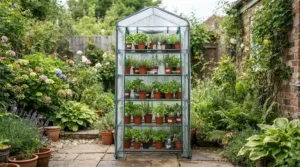
A greenhouse is, at heart, a structure that regulates temperature and humidity around plants. A 4-tier mini greenhouse shrinks that idea down to a balcony, a patio corner, or the sunny side of a garage. Think of it as a heated-by-the-sun bookshelf for tomatoes.
It won’t replace a proper glasshouse. It’s a cover on a rack. But it solves the problem most Canadian gardeners actually have: too little space, too short a season, and too many seedlings crowding the windowsill.
This guide compares seven real models, explains how to read the listings (the “PVC frame” versus “PVC cover” confusion is real), and shows you how to get genuine value from whichever one you choose. Every price below is a range in Canadian dollars, so check current pricing before you commit.
What Is a 4-Tier Mini Greenhouse?
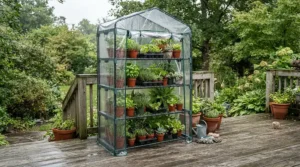
A 4-tier mini greenhouse is a compact, freestanding shelving greenhouse: a lightweight steel rack, or occasionally a PVC frame, with four shelves, wrapped in a clear PVC or PE cover with a zippered door. It traps solar heat and humidity around seedlings, herbs and tender plants, typically within about 0.33 m² of floor space.
The “4-tier” part matters more than it sounds. Vertical layering lets you stage plants by age: germinating trays on a lower, warmer shelf, hardening-off plants on top where light is strongest.
It’s also a useful compact garden structure for renters. There’s no foundation, no permit worry, and no digging. You assemble it in roughly 15 minutes according to most owner and roundup accounts, and you can fold it away in the off-season.
Quick Comparison: 7 Best 4-Tier Mini Greenhouse Picks for Canada
| Product | Size (cm) | Cover | Shelf load | Approx. price (CAD) | Best For |
|---|---|---|---|---|---|
| Ohuhu 4-Tier Mini Greenhouse | 69 × 48 × 158 | PE | 10 kg per shelf | Under C$100 | Seed starting on a budget |
| Pure Garden 4-Tier Mini Greenhouse | 69 × 48 × 160 | PVC | 11 kg per shelf | Under C$100 | Patios needing rolling mobility |
| Miracle-Gro 4-Tier Greenhouse | 58 × 43 × 145 | PVC | Check listing | Under C$100 | Narrow balconies |
| Outsunny 4-Tier with Wheels | 69 × 50 × 165 | PVC | Check listing | C$80–C$150 | Taller plants, mobile setups |
| Worth Garden 4-Tier Mini Greenhouse | 69 × 48 × 160 | PVC | Check listing | Under C$100 | Shoppers comparing spec twins |
| BOTAFLORA 4-Tier Mini-Greenhouse | 60 × 45 × 145 | PVC | Check listing | C$60–C$120 | Canadian-retailer shoppers |
| Outsunny 4-Tier Walk-In Greenhouse | 143 × 73 × 195 | PVC | Check listing | C$100–C$200 | Maximum capacity |
Prices are approximate planning ranges at the time of research and shift often. Availability on Amazon.ca varies by model, so verify before you plan around any of them.
The table shows a market clustered tightly at the budget end. The Ohuhu 4-Tier Mini Greenhouse and Pure Garden 4-Tier Mini Greenhouse are near-identical in footprint, so the real decision is cover material and mobility. The Outsunny 4-Tier Walk-In Greenhouse is the only model that changes the category, trading floor space for roughly double the shelf count. Buyers on tight balconies should note that the Miracle-Gro 4-Tier Greenhouse and BOTAFLORA 4-Tier Mini-Greenhouse are the slimmest options here.
💬 Just one click — help others make better buying decisions too!😊
Top 7 4-Tier Mini Greenhouse Models: Expert Analysis
A note on method before we dive in. I haven’t owned or personally tested these units, and I won’t pretend otherwise. What follows is analysis built from published specs, retailer listings and the aggregated themes in review coverage. Where I couldn’t verify review data, I say so.
1. Ohuhu 4-Tier Mini Greenhouse — the review-count heavyweight
Its standout trait is sheer popularity, which is useful because a big review pool exposes problems fast. Listings describe a 27 × 19 × 62 in (69 × 48 × 158 cm) steel frame, four shelves rated at 22 lb (10 kg) each, a UV-resistant PE cover and push-fit, tool-free assembly. Reports put assembly at roughly 15 to 16 minutes.
In practice, 10 kg per shelf sounds generous until you water a row of pots. Wet soil is heavy, so treat that number as a ceiling, not a target. Spread your load across tiers rather than loading the top.
The aggregated sentiment is consistently positive. Review roundups cite an average around 4.4 stars across thousands of ratings, and commonly credit the cover for holding heat and humidity well. Verify the current figure on the listing, since averages drift.
Pros:
- ✅ Strong rating across a very large review pool
- ✅ Quick tool-free assembly
- ✅ Good heat and humidity retention reported
Cons:
- ❌ PE film is generally thinner than PVC in wind
- ❌ Door is the only real ventilation
Price range: under C$100. For a first 4-tier mini greenhouse, the value verdict is excellent.

2. Pure Garden 4-Tier Mini Greenhouse — best for rolling shelter in and out
Locking wheels are the hook here. Also sold under the Home-Complete name, this 27 × 19 × 63 in (69 × 48 × 160 cm) model has a tubular steel frame, a PVC cover with zipper door, 14 in (36 cm) shelf spacing and a stated 24 lb (11 kg) per shelf.
That spacing is the quiet spec to appreciate. At 36 cm between shelves, pepper seedlings and potted herbs have headroom before you need to rearrange. The wheels mean you can park the unit against a south-facing wall during the day and roll it closer to the house when a cold night is forecast.
Review sentiment is more mixed than for some rivals. Roundups put its rating around 3.9 to 4.0, while one retailer listing showed 4.5 across a smaller pool of 61 ratings. Reviewers reportedly flag two recurring weak points, but the coverage I found doesn’t spell them out, so read the recent one-star and two-star reviews yourself.
Pros:
- ✅ Locking wheels make repositioning easy
- ✅ Higher 11 kg shelf rating
- ✅ Roomy 36 cm tier spacing
Cons:
- ❌ Rating trails some competitors in roundups
- ❌ Ventilation limited to the zip door
Price range: under C$100. It’s a solid value pick if mobility matters to you.
3. Miracle-Gro 4-Tier Greenhouse — the slimmest option for tight balconies
If your balcony is a hallway with a railing, this one earns a look. It measures 23 × 17 × 57 in (58 × 43 × 145 cm), with a powder-coated steel frame, UV-protected PVC cover, removable wire shelves and a roll-up double-zipper door.
Removable shelves are the underrated feature. Pull the second tier and you suddenly have headroom for a tall tomato transplant, which is the kind of flexibility a fixed rack can’t offer.
Roundup coverage cites roughly 4.0 stars across about 700 reviews. The most repeated complaints are that it behaves like a sail without anchoring and that ventilation is limited to the door. Both are fixable: anchor it, and prop the door open on sunny days.
Pros:
- ✅ Smallest footprint of the group
- ✅ Removable shelves for tall plants
- ✅ Sturdy powder-coated steel frame
Cons:
- ❌ Wind catches it without anchoring
- ❌ No ventilation beyond the door
Price range: under C$100. A good value for small spaces.
4. Outsunny 4-Tier Mini Greenhouse with Wheels — taller shelter, mobile base
This model stretches to 27.2 × 19.7 × 65 in (69 × 50 × 165 cm) and adds wheels and a roll-up door under a clear PVC cover. A related Outsunny rack comes with a PE cover at 31.5 × 19.3 × 63 in (80 × 49 × 160 cm), so check which variant you’re looking at.
The extra height is the practical gain. At 165 cm, there’s room for a leggy seedling to stretch before you must trim the layout. The wheels pair well with a patio that sees full sun at midday and shade by evening.
I couldn’t verify a meaningful pool of customer reviews for this model, so I’m not going to characterize owner sentiment. Treat it as spec-sheet-promising but unproven, and check Amazon.ca for current ratings before buying.
Pros:
- ✅ Slightly taller than most rivals
- ✅ Wheels for repositioning
- ✅ Clear PVC cover with roll-up door
Cons:
- ❌ Review data hard to verify
- ❌ Priced above the basic racks
Price range: roughly C$80–C$150. Value depends on how much you’ll use the mobility.
5. Worth Garden 4-Tier Mini Greenhouse — the spec twin worth cross-shopping
Its main role is as a comparison point. Roundups list it at 27 × 19 × 63 in (69 × 48 × 160 cm) with a PVC cover and alloy steel frame, essentially the same envelope as the Pure Garden 4-Tier Mini Greenhouse.
When two products share dimensions and cover material, the decision comes down to small things: shelf spacing, wheel presence, zipper quality and the seller’s return policy. Because those details are rarely printed in the headline specs, scan the Q&A and photo reviews for them.
I found no verifiable review data for this unit, so I can’t tell you what owners think. If it’s priced below the Pure Garden 4-Tier Mini Greenhouse and carries a decent rating when you check, it’s a reasonable alternative. If not, don’t take a gamble to save a few dollars.
Pros:
- ✅ Familiar 4-tier dimensions
- ✅ PVC cover with alloy steel frame
- ✅ Often cross-listed as a budget twin
Cons:
- ❌ Little verifiable review history
- ❌ Fewer standout features
Price range: under C$100. Decent value only if the listing’s reviews hold up.
6. BOTAFLORA 4-Tier Mini-Greenhouse — a lesser-known pick from a Canadian retailer
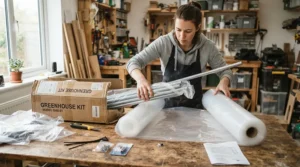
You’ll see it at BMR in Canada: 23.6 × 17.7 × 57 in (60 × 45 × 145 cm), with a transparent PVC cover, nylon zippered closure, powder-coated steel frame and removable wire-mesh shelves. Assembly is billed as quick and tool-free.
The Canadian retail footprint is the appeal. Returns and warranty claims are simpler when the retailer is local, which can matter if a zipper fails in June. Amazon.ca availability varies, so confirm it’s listed there before you plan around it.
Its dimensions closely match the Miracle-Gro 4-Tier Greenhouse, and so does the sensible use case: balconies, entryways and tight patios. I found no customer review data to summarize, so view this one as a spec-based option.
Pros:
- ✅ Compact footprint for tight spaces
- ✅ Removable shelves add flexibility
- ✅ Sold through a Canadian retailer
Cons:
- ❌ No verifiable review pool
- ❌ Amazon.ca stock may vary
Price range: roughly C$60–C$120. Value looks fair on paper.
7. Outsunny 4-Tier Walk-In Greenhouse — the capacity upgrade with 8 shelves
This one doubles the shelving. It measures 56.3 × 28.7 × 76.8 in (143 × 73 × 195 cm) and carries eight steel wire shelves under a transparent PVC cover with a roll-up zipper door.
Don’t let “walk-in” mislead you. At 73 cm deep, you won’t stroll in. It’s a tall, wide reach-in that’s better described as a greenhouse closet. That’s fine, and arguably more useful on a patio, but set expectations accordingly.
The gain is capacity: two shelves per tier gives you room for flats, pots and a storage corner for tools. The trade-off is wind exposure, since a 195 cm tall wall of plastic needs serious anchoring.
I couldn’t confirm owner reviews for this model. If you’re considering it, compare against other tall walk-in styles on Amazon.ca and read the stability complaints closely.
Pros:
- ✅ Eight shelves for high capacity
- ✅ Roughly 195 cm of vertical room
- ✅ Roll-up zip door for access
Cons:
- ❌ Large sail area demands anchoring
- ❌ Not truly walk-in at 73 cm deep
Price range: roughly C$100–C$200. It’s good value only if you’ll fill it.
4-Tier Mini Greenhouse Review: What Owner Feedback Actually Says
Let me level with you on a problem. Search for any 4-tier mini greenhouse review and you’ll find a swamp of near-identical “tested” roundups, many of which recycle the same Amazon star ratings. I’ve treated their hands-on claims with caution and leaned on the aggregated numbers and repeated themes instead.
| Product | Rating signal | Review-volume signal | Main recurring theme |
|---|---|---|---|
| Ohuhu 4-Tier Mini Greenhouse | About 4.4 stars | Thousands of ratings | Easy assembly, good heat retention |
| Pure Garden 4-Tier Mini Greenhouse | About 3.9–4.0 stars | Large pool, best-seller | Two repeated weak points, unspecified |
| Miracle-Gro 4-Tier Greenhouse | About 4.0 stars | About 700 reviews | Wind exposure, door-only ventilation |
| Outsunny, Worth Garden, BOTAFLORA | Not verifiable | Not verifiable | Judge by specs and return policy |
Read the table as a confidence ladder. The Ohuhu 4-Tier Mini Greenhouse has the deepest evidence behind it, the Pure Garden 4-Tier Mini Greenhouse has volume but mixed scores, and the rest are essentially unproven in the sources I could verify. That doesn’t make them bad. It makes them riskier.
Two complaints keep surfacing across this category: wind and ventilation. Neither is a deal-breaker, because both are solved by placement and habit rather than by spending more. We’ll cover the fixes in the problem-solving section below.
How to Choose a 4-Tier Mini Greenhouse
- Measure your spot first. Allow the footprint plus 50 cm in front so the zip door can roll up. A balcony railing and a door swing can eat your clearance quickly.
- Check shelf load honestly. A 10 to 11 kg rating is plenty for seedling trays, but wet 15 cm pots add up fast. Weigh one before trusting the rack.
- Pick your cover material deliberately. PVC is generally thicker and more durable but can stiffen in deep cold. PE is lighter and cheaper but generally tears more readily.
- Look for wheels only if you’ll move it. Locking wheels are great on a flat patio and pointless on uneven pavers.
- Plan for wind. Look for stake loops or a flat base you can weigh down. This is the most common failure point.
- Match your season to your zone. Natural Resources Canada recently released its updated plant hardiness zone map, with zones from 0 in Nunavut to 9 on Vancouver Island. Your zone and last-frost date decide whether a cover-only unit gives you three weeks or six.
PVC Frame vs Steel Frame vs PVC Cover: Decoding the Listings
Search listings and you’ll spot the term “PVC frame” scattered across product pages, sometimes where the unit actually has a steel frame under a PVC cover. One roundup even describes a wheeled model as having a “4-tier PVC frame,” while the manufacturer’s listings for similar units describe steel or iron. When a listing is ambiguous, read the product description and the photos.
A true PVC frame, built from rigid plastic pipe and connectors, has real advantages. It can’t rust in a humid greenhouse, it’s light and it’s inexpensive. The catch is load: PVC pipe flexes under heavy wet pots and can grow brittle after a few cold winters in direct UV.
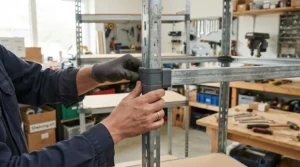
Steel is stronger and stiffer, which is why most 4-tier racks use it. Its weak spot is corrosion where the powder coating chips, so touch up scratches before they rust.
For a unit carrying four shelves of watered pots, I’d lean steel. A PVC frame suits lighter loads like herbs, succulents and small seedling trays. Either way, check the cover too, because the cover is what actually gets exposed to the weather.
Shelving Greenhouse vs Cold Frame vs Windowsill: Which Wins?
A shelving greenhouse, meaning a rack wrapped in a cover, sits between a windowsill and a full structure. A cold frame is the low, ground-hugging cousin: a simple box with a clear lid.
| Option | Capacity | Frost protection | Portability | Best For |
|---|---|---|---|---|
| Windowsill | Very low | None (indoor only) | Total | A few herbs |
| Cold frame | Medium, ground-level | Modest | Low | Hardening off in-ground crops |
| 4-tier shelving greenhouse | High, vertical | Modest | High | Seedlings and potted plants |
| Full backyard greenhouse | Very high | Strong | None | Serious growing |
The table shows why the rack model keeps winning urban buyers. A cold frame beats it for in-ground hardening off, but it can’t stack vertically. A Pure Garden 4-Tier Mini Greenhouse, say, holds far more plants in the same patch of ground. For most apartment and townhouse gardeners, vertical capacity is the deciding factor.
A Compact Garden Structure for Specific Gardeners
As a compact garden structure, a 4-tier unit suits very different people, and the best model changes with the person.
Beginners. Pick the Ohuhu 4-Tier Mini Greenhouse. The review depth means any problem you hit has probably been solved by someone in a forum.
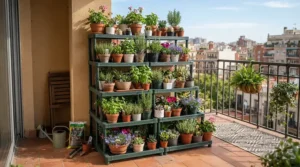
Balcony and condo gardeners. Choose the slimmest footprint, such as the Miracle-Gro 4-Tier Greenhouse or BOTAFLORA 4-Tier Mini-Greenhouse, and anchor it. Wind speeds rise with height, so a high-rise balcony is a harsher environment than ground level.
Seniors or anyone with mobility limits. A rack at waist-to-chest height keeps plants within reach. Locking wheels, like on the Pure Garden 4-Tier Mini Greenhouse, mean you never carry heavy trays.
Serious growers. If you outgrow four shelves, look at the Outsunny 4-Tier Walk-In Greenhouse before jumping to a full backyard structure.
Features That Actually Matter (And Those That Don’t)
Some features earn their place. A zipper door that rolls up fully matters because it’s your thermostat. A flat, stable base matters because wobble leads to spills. And replacement covers matter: replacement 4-tier covers sell separately for the common 27 × 19 × 63 in size, which extends the life of the frame.
Other features are marketing noise. “Weather resistant” claims sound reassuring, but one retailer listing for a comparable small unit rates snow load at only about 10 lb (4.5 kg), which tells you everything about winter use. “Heavy-duty” is similarly vague without a stated load rating.
Wire versus mesh shelves is a quieter question. Wire lets water drain and air circulate, which helps prevent soggy trays, but small pots can tip in the gaps. A cheap sheet of shelf liner or a tray under each pot fixes that for pennies.
What to Expect: Real-World Performance in a Canadian Climate
Set your expectations at the right altitude. A cover-only 4-tier mini greenhouse buffers wind, holds humidity and adds some daytime warmth. It doesn’t heat. On a clear cold night, generally expect protection from light frost and not much more, and on a cold overcast week the cover does little.
The bigger surprise for beginners is overheating. On a sunny April afternoon, a sealed unit can turn into an oven even when the air outside is cool, so crack the door open on bright days.
Because it’s late October as I write this, a seasonal note is in order. A unit like this can stretch your fall greens and tender herbs by a few weeks before the first hard freeze. But it won’t survive a Canadian winter as a growing space. Snow load and wind will tear a light cover, so plan to empty it, clean it and store it flat.
Buy 4-Tier Mini Greenhouse Kits in Canada: A Shopper’s Checklist
If you’re ready to buy 4-tier mini greenhouse kits, a few Canadian realities shape the smart purchase. First, confirm the item ships to your province from a seller that handles returns, because bulky items cost more to send back than to keep. Second, look at the delivered cost and not just the sticker price.
Third, watch for listings that confuse “frame” and “cover” or mismatched dimensions. Compare the cm figures against your measured spot. Fourth, check whether replacement covers are sold for your size, since a torn cover shouldn’t doom a perfectly good frame.
Mistakes I see repeatedly: buying for the biggest size you can imagine instead of the one you’ll fill, ignoring wind, and skipping the return-policy fine print. Over several seasons, a C$60 to C$100 unit with a cover replacement every couple of years usually costs far less than a permanent structure. Prices fluctuate, so check current pricing and never assume a deal is a deal.
Setting Up Your 4-Tier Mini Greenhouse: The First 30 Days
Day 1: Assemble and anchor. Build it on a flat surface, then place it against a south- or southwest-facing wall if you can. Add a brick or a bag of potting mix on the bottom shelf, and stake or tie the frame down.
Days 2–7: Calibrate. Park a cheap min/max thermometer inside and watch the extremes. You’ll learn quickly how far the temperature swings between a sunny afternoon and a cool night.
Weeks 2–4: Start seeds on a schedule. Work backwards from your local last-frost date: peppers and eggplant start earliest, around 8 to 10 weeks out, tomatoes roughly 7 to 8 weeks, and lettuce and brassicas about 6 weeks. Cucumbers and squash go in much later, 2 to 4 weeks before the last frost.
Ongoing: Ventilate and water smart. Open the door on sunny days, and water in the morning so leaves dry before night. Rotate trays between shelves weekly, since the top tier gets the most light.
Before transplanting: Harden off. Over one to two weeks, gradually expose seedlings to outdoor conditions before moving them to the garden.
Real-World Scenarios: Which 4-Tier Mini Greenhouse Fits Which Gardener?
These are illustrative profiles, not personal anecdotes, but they show how the decision framework plays out.
The Toronto condo balcony gardener. Budget is tight, wind is real, and the railing is two metres long. Consider the Miracle-Gro 4-Tier Greenhouse for its narrow footprint, anchored to a heavy planter. With a last frost around early May, seeds go in during March.
The Prairie vegetable grower. The season is short, nights stay cold into late May, and tomatoes need every week. A Pure Garden 4-Tier Mini Greenhouse with wheels lets this gardener roll the whole rack against the house on frost nights. Start seeds under lights indoors, and use the greenhouse as the hardening-off bridge.
The Vancouver Island fall-greens fan. Mild winters mean lettuce and herbs can keep going, and moisture is the enemy. Here a well-ventilated Ohuhu 4-Tier Mini Greenhouse, with its door propped open on dry days, keeps mould in check.
A simple decision rule. If wind is your biggest worry, pick the sturdiest frame and anchor it. If space is your biggest worry, pick the slimmest. If time is your biggest worry, pick the best-reviewed.
Common Problems and Fixes for 4-Tier Mini Greenhouse Owners
Problem: it tips or flaps in wind. Place it against a wall, tie it to a railing or fence, weigh down the bottom shelf and use the stake loops. Keep the zipper fully closed in gusts.
Problem: condensation drips on seedlings. Ventilate more. Moisture trapped overnight is normal, but it should clear by midday.
Problem: seedlings collapse at the soil line. That’s classic damping off, a fungal problem. The University of Minnesota Extension recommends clean, new potting soil and sterilized, well-draining containers. Overwatering and crowding make it worse, and a stuffy sealed greenhouse invites it.
Problem: leaves scorch on sunny days. Open the door, or drape a light shade cloth over the top at midday.
Problem: the cover tears. Check for sharp frame edges and replace the cover with one sized for your frame, since covers are sold separately for popular dimensions.
FAQ: 4-Tier Mini Greenhouse Questions Answered
❓ Can a 4-tier mini greenhouse stay up all winter in Canada?
❓ Where can I buy 4-tier mini greenhouse units in Canada?
❓ Is a PVC frame strong enough for four shelves of pots?
❓ Do I need to anchor a shelving greenhouse on a balcony?
❓ Can I replace the cover if it tears?
Conclusion: Is a 4-Tier Mini Greenhouse Worth It?
For most small-space Canadian gardeners, yes, with eyes open. A 4-tier mini greenhouse buys you a few extra weeks, a vertical nursery and a place to harden off seedlings, all for a price that’s modest next to a permanent structure.
If you want the safest bet, start with the Ohuhu 4-Tier Mini Greenhouse, which has the strongest review evidence. If mobility matters, look at the Pure Garden 4-Tier Mini Greenhouse. If your balcony is narrow, the Miracle-Gro 4-Tier Greenhouse or BOTAFLORA 4-Tier Mini-Greenhouse deserve a look. If you need serious capacity, the Outsunny 4-Tier Walk-In Greenhouse is the stretch option, and the Outsunny 4-Tier Mini Greenhouse with Wheels and Worth Garden 4-Tier Mini Greenhouse fill the middle ground.
Whichever you pick, anchor it, ventilate it and match your seed schedule to your local frost date. You can find yours using the Atlas of Canada plant hardiness map and your regional gardening guides.
✨ Ready to Start Growing Sooner?
🔍 Take your 4-tier mini greenhouse setup to the next level by checking current pricing and availability on the highlighted models above. A little shelter goes a long way toward a bumper harvest your whole family will love! 🌱
Recommended for You
- Cold Frame Greenhouse For Season Extension: 7 Proven Picks (2026)
- Cold Frame Greenhouse: 7 Best Picks For Canadian Gardens 2026
- Pop-Up Greenhouse For Balcony Gardening: 7 Best Picks 2026
Disclaimer: This article contains affiliate links. As an Amazon Associate, I earn from qualifying purchases. If you purchase products through these links, we may earn a small commission at no additional cost to you.
✨ Found this helpful? Share it with your friends! 💬🤗
