
In This Article
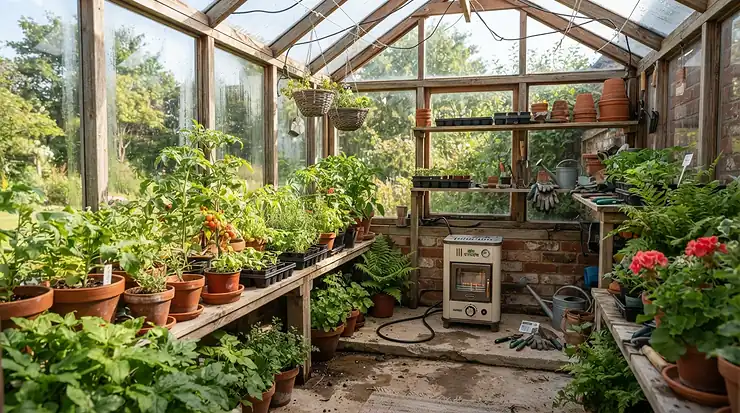
The electric greenhouse heater vs propane greenhouse heater question comes down to one trade. Electric units give clean, dry heat from a plug and a thermostat. Propane units give far more output and independence from the grid, but they add moisture, fumes and a ventilation job. Which side wins depends on your greenhouse size, wiring, and how cold your region gets.
Late October is when this decision stops being theoretical. The first -10°C night arrives, the tomatoes are still hanging on, and your seedlings for spring are already in the queue. A heater is no longer “something to research later.” It’s the thing standing between you and a greenhouse full of mush.
Here’s the good news: you don’t need a commercial setup. Provincial agriculture departments publish greenhouse energy calculations, and the big finding is simple. Heat loss through the covering drives your fuel bill far more than the brand on the heater.
This guide covers seven real heaters, from budget plug-ins to a hardwired 7,500 W unit. It also covers the costs, the safety rules that matter in Canada, and the insulation tricks that make any heater work harder. I’m a researcher and writer here, not a test lab, so everything below comes from specs, published roundups and aggregated review themes. Where I couldn’t verify something, I say so.
Quick Comparison Table: 7 Greenhouse Heaters at a Glance
| Product | Type | Output | Coverage Claim | Price Range (CAD) | Best For |
|---|---|---|---|---|---|
| Caframo True North 9206 | Electric, plug-in | 600/900/1500 W | ~150 sq ft | C$120–C$160 | Dry, well-ventilated small greenhouses |
| Dr. Infrared DR218-1500W | Electric, plug-in | 1500 W | ~150 sq ft | C$100–C$150 | Tight budgets, frost protection |
| VEVOR 1500W Greenhouse Heater (BG-E2A-15) | Electric, plug-in | 1500 W | Small greenhouse | C$70–C$130 | Splash-prone benches |
| Bio Green Palma | Electric, plug-in | 750/1500 W | ~120 sq ft | Mid-C$200s | Precise temperature control |
| Mr. Heater Portable Buddy MH9BX | Propane, radiant | 4,000/9,000 BTU | ~225 sq ft (claimed) | C$120–C$180 | Backup heat during outages |
| Mr. Heater Big Buddy | Propane, radiant | 18,000 BTU max | Larger spaces | C$250–C$320 | Bigger houses with good venting |
| Dr. Infrared DR-975 | Electric, hardwired | 4,700/7,500 W | Up to ~800 sq ft (garage claim) | C$350–C$500 | Large greenhouses with 240 V access |
Looking at the numbers, the plug-in electrics cluster tightly around 1,500 W, which is about 5,100 BTU/hr. That is enough to hold a small, insulated house above freezing but not to chase a -25°C night. The two Mr. Heater models trade the cord for raw output, and the Dr. Infrared DR-975 is in a class of its own at roughly five times the heat of a plug-in unit. Note that coverage claims come from garage and workshop testing, so greenhouse real-world coverage is lower.
💬 Just one click — help others make better buying decisions too!😊
Top 7 Greenhouse Heaters: Expert Analysis
1. Caframo True North 9206 — made-in-Canada steel build with a 5-year warranty
Caframo builds this heater in Canada, and its steel housing is the reason it has a loyal following among boaters and cabin owners.
It offers three heat settings (600, 900 and 1,500 W), roughly 5,125 BTU/hr at maximum, CSA certification, and dual overheat protectors. The anti-freeze mode switches on around 3°C, which means you can leave it running as cheap insurance rather than a space heater you babysit. The thermostat range runs from about 6°C to 55°C.
Here’s the catch most buyers overlook: the manufacturer says it shouldn’t be used in a damp or humid greenhouse. That makes it a better fit for a dry, ventilated hobby house or a potting shed than a mist-heavy propagation space.
Reviewers across boating and greenhouse roundups praise its durability. One greenhouse roundup notes the built-in thermostat is considered uncalibrated and suggests pairing it with an external controller. It also mentions plug and extension-cord failures in some units.
Pros:
- ✅ Made in Canada with CSA certification
- ✅ Three heat settings plus anti-freeze mode
- ✅ Five-year warranty and rugged steel body
Cons:
- ❌ Manufacturer cautions against damp greenhouse use
- ❌ Basic thermostat is less precise than digital probes
Expect around C$120–C$160, so it hovers right at the C$150 line. Check current price before you count on it for a strict budget.
2. Dr. Infrared DR218-1500W — IPX4 splash protection at a bargain price
If your goal is simply “don’t freeze the plants,” this is the heater most budget roundups reach for.
It delivers 1,500 W, a built-in thermostat, heavy-duty metal construction and IPX4 water protection. IPX4 means splashing from any direction won’t harm it. That’s fine for watering-can accidents but not for hosing down a bench beside it. The roughly 150 sq ft coverage claim assumes a reasonably tight structure, so treat it as a mild-weather number, not a -20°C number.
Based on the spec comparison, this is a frost-guard heater. It holds a small, well-insulated greenhouse just above freezing, and it’s not the tool for keeping tropicals at 18°C through a Prairie January. Pair it with the insulation steps later in this guide and it punches above its weight.
Roundup writers repeatedly label it the value pick under US$100. I couldn’t verify a full set of amazon.ca reviews, so check the live listing for current sentiment.
Pros:
- ✅ IPX4 rating suits splash-prone greenhouse benches
- ✅ Built-in thermostat with simple controls
- ✅ Strong value for frost protection
Cons:
- ❌ Coverage claim is optimistic for harsh Canadian cold
- ❌ Plain thermostat without a remote probe
Expect around C$100–C$150, which makes it a solid contender in the under-$150 category.
3. VEVOR 1500W Greenhouse Heater (BG-E2A-15) — adjustable-angle tube element with IPX4
VEVOR sells several 1,500 W greenhouse heaters on Canadian retail sites, and the BG-E2A-15 is the one that includes a separate thermostat.
Its heating-tube element, 25° adjustable angle and IPX4 protection are the standouts. The adjustable angle matters more than it sounds, because you can tilt warm air along a bench row instead of blasting one corner. The overheat shutoff is a baseline safety feature at this price. Other variants in the line use a PTC fan design with low and high modes and tip-over protection, so match the model number to the features you want.
On paper this is a budget workhorse for grow tents and small greenhouses. The tradeoff is a smaller track record than Caframo or Dr. Infrared. I couldn’t verify enough genuine review data to summarize owner sentiment, so read the live listing’s recent reviews and watch for comments about thermostat accuracy and longevity.
Pros:
- ✅ Adjustable angle directs heat along benches
- ✅ IPX4 and overheat protection included
- ✅ Separate thermostat supplied
Cons:
- ❌ Limited verifiable long-term review data
- ❌ Model variants are easy to confuse
Prices fall roughly in the C$70–C$130 range depending on the variant, so confirm on the listing.
4. Bio Green Palma — digital thermostat with an external probe
This is the one that kept showing up in “best overall” lists, and the reason is the thermostat.
The Bio Green Palma pairs two elements (750 W and 1,500 W) with a digital thermostat and an external temperature probe. Roundups cite about 5,118 BTU/hr, IPX4 splash protection and around 120 sq ft of coverage. The probe is the clever bit: you can hang it at plant height, so the heater responds to where your seedlings are, not where the unit sits.
Its fan also circulates air, which helps with the cold-spot problem and keeps condensation from camping on one wall. Bob Vila’s review team gave it 4.8 out of 5 after using it in a small backyard greenhouse, and published reviews often mention how easy it is to run.
Pros:
- ✅ External probe controls temperature at plant height
- ✅ Two element settings for efficiency
- ✅ Fan circulation reduces cold spots
Cons:
- ❌ Priced above the C$150 budget threshold
- ❌ Modest coverage for larger houses
Expect the mid-C$200s based on converted US pricing. It’s worth it if precision matters, but it won’t appear on any budget list.
5. Mr. Heater Portable Buddy MH9BX — Canada-approved portable propane
When the power goes out in January, this is the heater people wish they’d bought in October.
The Mr. Heater Portable Buddy MH9BX is the Canada-approved version of a very popular radiant propane unit. It runs at 4,000 or 9,000 BTU/hr on standard 1 lb cylinders and has built-in safety shutoffs, which one roundup describes as triple redundancy. Coverage claims of around 225 sq ft come from marketing, and a greenhouse will lose heat much faster than a garage.
Here’s what the spec sheet won’t say loudly. At 9,000 BTU/hr, one 1 lb cylinder lasts only a couple of hours. Retail notes also say it isn’t designed for continuous long-term heating. Think backup or short cold snaps, not a six-month primary system.
Reviewers mention a learning curve to priming and lighting but don’t consider it a dealbreaker. Because it burns fuel, it needs fresh air and adds moisture.
Pros:
- ✅ Works without electricity during outages
- ✅ Compact, portable and Canada-approved
- ✅ Two heat settings for flexibility
Cons:
- ❌ Small cylinders run out fast and cost more per unit of heat
- ❌ Adds humidity and requires ventilation
Expect roughly C$120–C$180, which straddles the C$150 line. Check current price, and confirm certified-use wording on the exact listing.
6. Mr. Heater Big Buddy — 18,000 BTU for bigger spaces
This is the heater you buy when 9,000 BTU isn’t enough but a hardwired system is overkill.
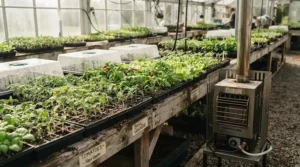
The Mr. Heater Big Buddy tops out at 18,000 BTU/hr, which is roughly equivalent to a 5,300 W electric heater. That makes it the strongest portable propane option in this lineup. Canadian retailers sell it as a standard 18,000 BTU model. Greenhouse roundups list it among the top gas picks, but I couldn’t verify a large pool of owner reviews.
Practical reality: combustion heat is cheap per BTU when you buy propane by the 20 lb tank, but it’s expensive when you feed it 1 lb cylinders. Some owners run it from a larger tank using an adapter hose. Check the manufacturer’s guidance for your model before attempting that.
Moisture is the other issue. Burning propane produces water vapour, so expect more condensation in a tight greenhouse. Crack a vent or run a small fan.
Also verify certification wording on the exact listing, because some Mr. Heater models are certified for outdoor use only in Canada.
Pros:
- ✅ High output for larger greenhouses
- ✅ Independent of the power grid
- ✅ Heats quickly during cold snaps
Cons:
- ❌ Adds moisture and requires fresh-air supply
- ❌ Certification and permitted use need careful checking
Expect roughly C$250–C$320, which is premium for a portable heater. The value comes from output and outage resilience.
7. Dr. Infrared DR-975 — 7,500 W hardwired muscle
For large greenhouses with access to 240 V, this is the electric answer to “I need real heat.”
The Dr. Infrared DR-975 switches between 4,700 W and 7,500 W, which is roughly 16,000 to 25,600 BTU/hr. It’s hardwired on a single-phase 240 V circuit, wall or ceiling mountable, with a remote thermostat. It’s listed cUL/UL, weighs about 31 lb and carries a one-year warranty.
Reviewers on garage-heater roundups praise the heat output but note that the built-in thermostat can cycle off before the room is truly warm, so the separate wall thermostat is the better control. It’s designed for garages, not wet greenhouses, so mount it high and away from spray.
The 800 sq ft claim is for a garage. A greenhouse with a plastic cover loses heat far faster. Treat it as capable of heating a 12 × 24 ft house in moderate winters, not a magic wand.
Pros:
- ✅ Highest electric output in this lineup
- ✅ No combustion fumes or moisture
- ✅ Wall or ceiling mounting frees floor space
Cons:
- ❌ Requires hardwiring by a licensed electrician
- ❌ Garage-oriented design, not greenhouse-specific
Expect roughly C$350–C$500 plus installation costs. It’s the best value for large greenhouses if you already have the electrical capacity.
Practical Setup Guide: Your First 30 Days With a New Heater
A heater is only as good as the first month of setup. Here’s the sequence I’d follow.
Days 1–3: Size the load properly. A quick back-of-envelope formula: covering area (sq ft) × temperature difference (°F) × U-value gives BTU/hr. Standard U-values are roughly 1.2 for single poly and 0.7 for double poly. An 8 × 10 ft gable greenhouse has about 300 sq ft of covering. Holding it at +5°C when it’s -20°C outside is a 45°F difference. With double poly, that’s roughly 9,450 BTU/hr, or about 2,800 W. That’s my own estimate from standard engineering values, not manufacturer data. It also explains why one 1,500 W heater struggles at -20°C.
Days 4–7: Place and test. Put the heater on the cold side but away from water. Run it on a mild evening and watch the thermometer, not the dial.
Days 8–14: Add a controller. An external thermostat with a probe at plant height is the single best upgrade for cheaper heaters.
Days 15–30: Watch for condensation and drips. If propane is your choice, vent daily. If electric, check the cord and plug for warmth, because a hot plug means a bad connection or an undersized extension cord.
Use a dedicated circuit for any 1,500 W electric heater, since one draws about 12.5 amps. Ask a licensed electrician about GFCI protection and continuous-load limits.
✨ Don’t Miss These Exclusive Deals!
🔍 Take your greenhouse to the next level with these carefully selected heaters. Click on any highlighted item to check current pricing and availability. The right heater will help you grow healthy plants through the coldest months!
Real-World Scenarios: Which Heater Fits Which Greenhouse?
Scenario 1: The apartment-balcony hobbyist. You have a 6 × 8 ft lean-to, a nearby outdoor outlet, and a C$150 ceiling. Pick the Caframo True North 9206 or the Dr. Infrared DR218-1500W, add a probe thermostat, and insulate the north wall. Plant hardy greens and overwinter perennials, not tropicals.
Scenario 2: The rural off-grid grower. No reliable power, 10 × 16 ft double-poly house, and winter outages are normal. Pair a Mr. Heater Big Buddy with a CO detector and proper vents. Keep a small electric heater as a secondary backup if a generator is available.
Scenario 3: The market gardener extending the season. A 12 × 24 ft house, 240 V available, and spring seedlings worth real money. The Dr. Infrared DR-975 with a wall thermostat gives dry heat. Add a second small unit like the Bio Green Palma for redundancy.
Scenario 4: The cabin owner with limited visits. You’re gone for weeks. The Caframo True North 9206‘s anti-freeze mode is made for this. Pair it with a smart plug that reports power status so you know it’s alive.
Matching the heater to your usage pattern matters more than picking the “best” model.
Insulation Strategies That Cut Your Heating Bill
Insulation strategies are the cheapest “heater upgrade” you can buy. Extension research shows how big the gap is.
Virginia Tech’s extension guidance says double poly cuts heating costs by about half compared with single poly. It also advises insulating the north endwall and leaving a small air gap behind reflective boards to prevent freezing. University of Vermont trials of retrofits found a soap-bubble system saved 27–43% and a thermal curtain saved 25–31%. A typical plastic house has an R-value of only 1–2.
For a backyard greenhouse, the hobby-scale translation looks like this:
- Double the covering. Add an inflated second layer of poly over glass or single poly.
- Insulate the north wall. Foil-faced boards inside, with a small air gap.
- Seal the leaks. Weatherstrip doors and vents. Gaps are free heat exits.
- Add thermal mass. Dark water barrels soak up daytime sun and release it overnight.
- Hang a night curtain. Aluminized fabric can cut losses sharply when drawn.
Every extra layer reduces light by roughly 10–18%, so balance warmth and growth. Tighter houses also hold more humidity, which matters if you choose propane heating.
How to Choose: Electric Greenhouse Heater vs Propane Greenhouse Heater
Choosing between an electric greenhouse heater vs propane greenhouse heater comes down to six checks:
- Measure your heat loss. Use the BTU formula above. If you need over about 10,000 BTU/hr, plug-in electrics won’t cut it.
- Check your electrical capacity. A 1,500 W heater needs a dedicated circuit; 7,500 W needs hardwiring.
- Decide how much humidity you can tolerate. Propane adds water vapour; electric doesn’t.
- Consider outage risk. If winter storms knock power out, propane is the insurance policy.
- Compare fuel costs locally. Electricity rates vary hugely by province, as do propane prices.
- Verify certifications. Look for CSA or cUL marks and read permitted-use wording.
If you’re torn, a common strategy is electric as the primary and a small propane unit as the storm backup.
Electric Heating vs Propane Heating: Head-to-Head Analysis
| Factor | Electric Heating | Propane Heating | Winner |
|---|---|---|---|
| Upfront cost | Lower for small units | Higher for larger units | Electric |
| Heat output | Limited without 240 V | High, portable | Propane |
| Moisture | None added | Adds water vapour | Electric |
| Outage resilience | Fails without power | Works independently | Propane |
| Fumes/CO risk | None | Needs ventilation and CO alarm | Electric |
| Best For | Dry, small, on-grid houses | Large or off-grid houses | — |
The table makes the tradeoff plain. Electric wins on safety and plant health, while propane wins on raw power and independence. In cheap-hydro provinces, electric is usually cheaper to run too, but where power is expensive, propane can pull ahead. One cost-comparison thread on a gardening forum found propane roughly 40% cheaper at its example rates, so local prices decide it. Do the math with your own bills.
Propane Heating: What the Spec Sheet Won’t Tell You
Propane heating looks wonderfully simple until you meet the chemistry. Burning propane produces carbon dioxide and water: roughly four molecules of water vapour for every molecule of propane. In a tight, insulated greenhouse, that moisture condenses on the covering and drips onto plants.
University of Kentucky extension research warns that unvented heaters need a fresh-air inlet and an outlet. It also notes that their fumes can include ethylene, which causes leaf curl and spotting on tender seedlings. Condensation can also promote disease.
There’s an upside: combustion adds carbon dioxide, which plants use. But that benefit doesn’t outweigh safety, so ventilate regardless. A small circulation fan and a cracked vent do wonders.
Propane heating shines when power is unreliable and output matters most. Just treat it as a system with ventilation, a CO detector and regular checks.
Electric Heating: Power, Circuits and Hidden Costs
Electric heating has no fumes, no fuel deliveries and no combustion moisture. It’s quiet, thermostat-friendly and nearly 100% efficient at the point of use. Every watt becomes heat.
The hidden costs are wiring and running cost. A 1,500 W heater uses about 12.5 amps, which is a lot for a shared 15-amp circuit. An undersized extension cord is the classic failure point. A hardwired 7,500 W unit needs a licensed electrician and possibly a panel upgrade.
Operating cost depends entirely on your rate. At 1,500 W for ten hours, you use 15 kWh, and you can multiply by your own rate for a daily figure. In provinces with low rates this is modest, while in high-rate regions a heated greenhouse can sting.
Pair electric heating with a good thermostat and insulation, and it becomes the cleanest option for most small greenhouses.
Top Greenhouse Heaters Under $150 CAD: Value Analysis
If your ceiling is strict, the top greenhouse heaters under $150 CAD are the plug-in electrics. The Dr. Infrared DR218-1500W, the VEVOR 1500W Greenhouse Heater (BG-E2A-15) and often the Caframo True North 9206 fit or hover near that threshold. The Mr. Heater Portable Buddy MH9BX can land under it during discounts but needs ongoing fuel purchases.
The Bio Green Palma and the larger propane and hardwired models exceed it, so skip them if the budget is firm.
My advice on a tight budget: spend C$100–C$150 on the heater, then budget a bit for an external thermostat and some insulation materials. The combination beats a more expensive heater in a leaky house. Check current price on each listing, because Canadian pricing and stock shift constantly.
Energy-Efficient Greenhouse Heater for Large Greenhouses
An energy-efficient greenhouse heater for large greenhouses starts with a different question: how many BTUs do you actually lose? A 12 × 24 ft house has roughly 800 sq ft of covering. At a 45°F difference with double poly, that’s about 25,000 BTU/hr, or around 7,400 W. That’s almost exactly what the Dr. Infrared DR-975 delivers at its top setting, so it’s marginal in the coldest weather.
For large greenhouses, efficiency comes from layers:
- Zone your heat. Heat the root zone and bench level, not the whole air volume.
- Use two smaller heaters. Redundancy protects you if one fails.
- Consider a heat pump. Cold-climate heat pumps deliver more heat per kWh than resistance heaters, though performance drops in deep cold.
- Insulate aggressively. Every percentage saved applies to a bigger bill.
A single Mr. Heater Big Buddy won’t heat a large house on its own, but two can, with ventilation. For big greenhouses, the real efficiency gain is in the envelope, not the appliance.
Safety, Regulations and Compliance in Canada
Carbon monoxide is the main safety issue with fuel-burning heaters. Health Canada explains that CO is produced when you burn any fuel and can affect you before you notice it. Early symptoms mimic the flu: headache, dizziness and nausea.
This isn’t hypothetical. In a Delta, B.C. incident, dozens of greenhouse workers needed treatment after a gas-powered pressure washer ran without adequate ventilation.
Practical rules:
- Install a CSA-approved CO alarm in or near any greenhouse with a fuel-burning heater.
- Follow the manual’s clearance and ventilation requirements. Mr. Heater manuals specify clearances and warn against enclosed-space use.
- Check certification marks (CSA, cUL) and permitted-use wording. Some models are certified for outdoor use only in Canada.
- Have any permanent gas installation done by a licensed contractor.
- Keep electric cords dry, short and properly rated.
Rules vary by province, so check local requirements.
Long-Term Cost & Maintenance
| Option | Upfront (CAD) | Running Cost Pattern | Maintenance | Best For |
|---|---|---|---|---|
| Plug-in electric (1,500 W) | C$70–C$160 | Predictable, tied to power rate | Dust the vents, check the cord | Small, dry greenhouses |
| Hardwired electric (7,500 W) | C$350–C$500 plus wiring | Higher draw, no fuel deliveries | Annual inspection | Large, grid-connected houses |
| Portable propane (1 lb cylinders) | C$120–C$180 | High cost per unit of heat | Clean burner, check hoses | Short backup use |
| Propane on larger tank | C$250–C$320 plus hose/tank | Lower cost per unit of heat | Leak checks, ventilation | Off-grid or large houses |
The table highlights the real difference. Small propane cylinders are convenient but typically cost several times more per unit of heat than bulk propane. Electric heaters have the lowest maintenance burden but depend on your power rate. A rough rule: if electricity is cheap and your house is small, go electric. If power is unreliable or the house is large, propane or a hardwired unit earns its place.
Over several winters, a heater that suits your greenhouse and your wiring will always beat a “better” one that doesn’t.
FAQ
❓ Is a propane greenhouse heater cheaper to run than an electric one?
❓ Can I use a portable propane heater in a small Canadian greenhouse?
❓ How many watts do I need to heat my greenhouse?
❓ Do cheap greenhouse heaters really have a thermostat?
❓ Will one heater keep my greenhouse above freezing in a deep cold snap?
Conclusion
The electric greenhouse heater vs propane greenhouse heater debate doesn’t have a single winner. Electric wins for small, dry, on-grid houses: it’s safe, quiet and thermostat-friendly. Propane wins when you need serious output or independence from the power grid, as long as you respect ventilation and moisture. A hardwired heater like the Dr. Infrared DR-975 is the strongest electric choice for large houses.
For most Canadian hobby growers, my analysis points to one path. Start with a budget electric such as the Caframo True North 9206 or Dr. Infrared DR218-1500W, add an external thermostat, and spend your next dollars on insulation. Keep a Mr. Heater Portable Buddy MH9BX or Mr. Heater Big Buddy as storm backup if you have proper ventilation and a CO alarm.
The cheapest BTU is the one you never have to burn. Seal, insulate and size correctly first, then pick the heater that matches your wiring and your winters.
✨ Ready to winterize?
Check current prices on your top picks and get your greenhouse cold-snap ready today! 🌱
Recommended for You
- 4-Tier Mini Greenhouse For Apartment Balcony: 7 Best Picks 2026
- 4-Tier Mini Greenhouse: 7 Best Picks For Canada (2026 Guide)
- Cold Frame Greenhouse For Season Extension: 7 Proven Picks (2026)
Disclaimer: This article contains affiliate links. As an Amazon Associate, I earn from qualifying purchases. If you purchase products through these links, we may earn a small commission at no additional cost to you.
✨ Found this helpful? Share it with your friends! 💬🤗
