
In This Article
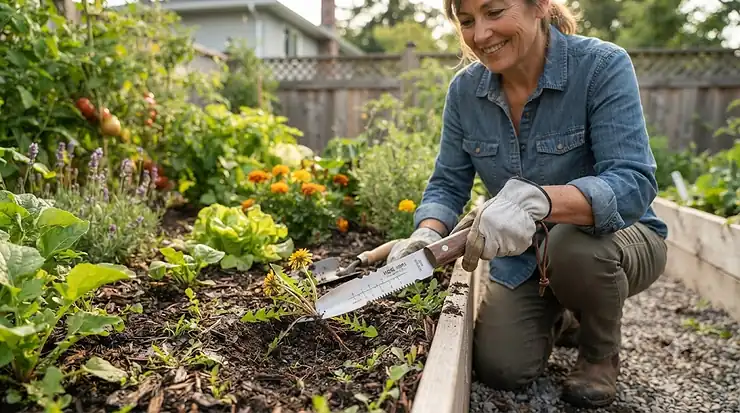
Somewhere between a trowel and a machete sits a tool that Canadian gardeners are quietly obsessing over: the weeding knife hori hori. It looks almost too simple to matter — a single steel blade, one side smooth, one side toothed, no moving parts to jam or rust shut over a Manitoba winter. And yet once you’ve used one to pop a dandelion out root-and-all instead of snapping the top off for the fourth time this week, going back to a flimsy hand fork feels like downgrading from a chef’s knife to a butter knife.
A weeding knife hori hori is a Japanese-style, dual-edged garden tool originally developed for digging in rocky mountain soil, now used across Canada for weeding, dividing perennials, cutting root balls, and measuring planting depth in a single pass. It typically features a 15–18 cm stainless steel blade with one straight edge and one serrated edge, plus a full or partial tang for strength.
That “dual edge” is really the whole story. The flat edge slices cleanly through soil and small roots, while the serrated edge saws through the woody taproots that make dandelions, thistle, and burdock such stubborn opponents in Canadian lawns. It’s also, quietly, a multi-purpose garden knife — gardeners use the same blade to divide hostas, cut twine, open bags of soil amendment, and pry rocks out of raised beds.
Before you buy, it’s worth understanding what you’re actually shopping for versus what a listing photo implies. This guide walks through seven real hori hori knives sold in Canada, breaks down when a hori hori beats a dedicated crack weeder tool or a standard hand weeder, and gives you a practical framework for choosing the right one for your soil, your garden size, and your hands. According to the Canadian Food Inspection Agency, keeping tools like this clean between uses also helps prevent the spread of invasive weed seeds between garden beds — a small habit that pairs nicely with owning one really good blade instead of five mediocre ones.
Quick Comparison Table: Weeding Knife Hori Hori at a Glance
| Product | Blade Length | Handle | Price Range (CAD) | Best For |
|---|---|---|---|---|
| Nisaku NJP650 | 7.25 in (18.4 cm) | Wood | Under C$45 | Traditionalists wanting the original |
| Fiskars Hori Hori | 7 in (17.8 cm) | Softgrip plastic | Under C$35 | Budget-conscious beginners |
| Nisaku NJP651 (HRC58) | 6.75 in (17.1 cm) | Wood, full tang | C$55–C$70 | Heavy clay and rocky soil |
| Radius Garden Ergonomic | 6.5 in (16.5 cm) | Contoured foam | C$40–C$55 | Wrist strain or arthritis |
Even at a glance, the spread tells you something important: price in this category tracks steel quality and tang construction far more than it tracks blade length. Every model above will slice through a dandelion root; what separates a C$30 knife from a C$65 one is whether the tang survives you prying a rock out of clay soil in year three. Budget picks like the Fiskars are genuinely fine for raised beds and container gardens, but if your Canadian backyard has the kind of compacted clay or rocky glacial till common across Ontario and the Prairies, the extra cost of a full-tang, hardened-steel model like the Nisaku NJP651 tends to pay for itself the first time you lever out a stubborn root instead of bending a cheaper blade.
💬 Just one click — help others make better buying decisions too!😊
💬 Already know which style fits your garden? Skip ahead and compare current pricing before it changes.
Top 7 Weeding Knife Hori Hori Picks: Expert Analysis
Choosing a weeding knife hori hori usually comes down to three variables: how tough your soil is, how much your hands can tolerate over a long afternoon, and whether you want the “classic” Japanese-made original or a more affordable Western-market reinterpretation. Below is a Japanese weeding knife review roundup covering seven real, currently available options — three from Nisaku, the Japan-based brand most closely associated with the original design, and four alternatives that each solve a different problem.
| Product | Steel Type | Tang | Sheath Included | Price Range (CAD) |
|---|---|---|---|---|
| 1. Nisaku NJP650 | Stainless steel | Partial | No (sold separately) | Under C$45 |
| 2. Nisaku NJP801 Yamagatana | Stainless steel | Mid-tang | Yes, hard plastic | C$35–C$50 |
| 3. Nisaku NJP651 (HRC58 Tomita) | Hardened stainless (HRC58) | Full tang | Yes, plastic | C$55–C$70 |
| 4. Fiskars Hori Hori | Stainless steel | Extended tang | Yes, hard plastic | Under C$35 |
| 5. Barebones Classic Hori Hori | Stainless steel | Full tang | Yes, leather | C$45–C$60 |
| 6. Barebones Hori Hori Ultimate | Stainless steel, concave | Full tang | Yes, leather | C$60–C$75 |
| 7. Radius Garden Ergonomic Hori Hori | Stainless steel | Full tang | Yes | C$40–C$55 |
Look closely at the tang column and a pattern emerges: the priciest three knives all use full-tang construction, meaning the blade metal runs the entire length of the handle rather than stopping at a narrow tab. That’s not marketing fluff — a partial or mid-tang knife is more prone to snapping at the handle junction when you use it as a lever, which, let’s be honest, everyone eventually does whether the packaging recommends it or not.
✨ Don’t Miss These Exclusive Deals!
🔍 Check current pricing on any of these seven before your next weekend in the yard.
1. Nisaku NJP650 Hori Hori — the original Japanese-made classic
The NJP650 is the knife most gardening writers point to when they say “the original,” and for good reason — Nisaku has been producing hori hori knives in Japan since the design’s earliest export to North America. Its 7.25-inch stainless steel blade carries inch and centimetre depth markings etched directly into the metal, so you’re not guessing how deep that garlic clove or tulip bulb actually needs to go.
At roughly 10 ounces with a 5.25-inch wood handle, it’s light enough for extended weeding sessions but the partial-tang construction means Bob Vila’s testing team flagged some blade flex under hard leverage — worth knowing if your garden beds are more rock than soil. What most buyers overlook about this model is that its lighter build is actually a feature for anyone doing repetitive, fine-detail work like dividing perennials or transplanting seedlings, not just a cost-cutting shortcut.
Reviewers consistently note that the wood handle develops a comfortable, broken-in feel after the first season, though a few mention it can get slick when wet — a leather or rubberized sheath grip is a common workaround gardeners add themselves. Independent testers found it tied for one of the longest blades in its test group at 12.5 inches overall length, which helps with deeper digging tasks.
Pros:
- ✅ Authentic Japanese manufacturing with decades of design history
- ✅ Long 12.5-inch overall length aids deeper digging
- ✅ Clear inch and centimetre depth markings for planting
Cons:
- ❌ Partial tang flexes under heavy leverage
- ❌ Sheath sold separately on some listings
Expect to pay under C$45 at the time of research, and given its reputation, that’s honest value for a Japanese-made original — just budget for a sheath if one isn’t bundled.
2. Nisaku NJP801 Yamagatana — lightest build for all-day comfort
If your gardening sessions run long — three or four hours of weeding beds, not a quick ten-minute tidy-up — hand fatigue becomes the real enemy, not the weeds themselves. The NJP801 addresses that directly with a molded plastic handle and a flared handguard that distributes pressure more evenly across the palm than the flat steel guards found on cheaper knives.
Its mid-tang stainless steel blade includes both smooth and serrated edges plus a depth gauge in 1-inch and 5-millimetre increments, and the whole package ships with a heavy-duty plastic sheath. Based on the spec comparison with the wood-handled NJP650, the plastic handle trades a bit of old-school charm for meaningfully better grip security in wet or gloved conditions — a fair trade for most weekday gardeners.
Testers who put it through rocky-soil work reported the blade retained its edge well and that the handguard genuinely reduced hand strain compared to flat-guard competitors. It’s a knife built around comfort first, cutting power second, which makes it a strong pick for gardeners managing wrist or hand sensitivity without stepping up to a specialty ergonomic model.
Pros:
- ✅ Flared handguard reduces palm and hand fatigue
- ✅ Dual smooth and serrated edges for versatile cutting
- ✅ Comes with a durable hard plastic sheath included
Cons:
- ❌ Plastic handle feels less premium than wood options
- ❌ Mid-tang is sturdier than partial but not full-strength
Priced in the C$35–C$50 range, it sits in the sweet spot between the entry-level NJP650 and the hardened premium models below.
3. Nisaku NJP651 Hori Weeding & Digging Knife (HRC58 Tomita Edition) — hardest steel for tough clay
For gardeners fighting genuinely difficult ground — Southern Ontario clay, Prairie hardpan, or the rocky till common across much of Atlantic Canada — steel hardness matters more than almost any other spec. The NJP651’s HRC58 rating (a measurement of hardness on the Rockwell C scale) puts it meaningfully above the roughly HRC52–55 range typical of budget hori hori knives, which translates directly into an edge that holds up longer between sharpenings.
Paired with full-tang construction, this is the model built to be levered against a rock without flinching. Here’s what to weigh: that hardened steel is also slightly more brittle than softer alternatives, so it rewards controlled cutting and digging motions over reckless prying, even though it can technically take more abuse than a partial-tang budget knife.
Reviewers who’ve compared it directly to softer-steel competitors describe noticeably longer intervals between sharpening sessions, particularly when working sandy or rocky soil that dulls blades fast. It’s a specialist’s tool dressed up as a general-purpose one — worth the premium if your garden regularly wins the “who’s tougher” contest against your current knife.
Pros:
- ✅ HRC58 hardened steel holds an edge far longer
- ✅ Full-tang build survives heavy prying and leverage
- ✅ Authentic Tomita manufacturing pedigree
Cons:
- ❌ Harder steel is marginally more prone to chipping if abused
- ❌ Premium pricing versus standard hori hori models
Expect a C$55–C$70 range, positioning it as the premium pick among the Nisaku lineup rather than an entry-level buy.
4. Fiskars Hori Hori Garden Knife — best budget all-rounder with lifetime warranty
Fiskars built its reputation on affordable, durable hand tools, and its hori hori interpretation leans into that identity rather than trying to out-Japan the Japanese originals. The dual-edged, precision-ground blade pairs a straight cutting edge with a serrated side for sawing through thick root growth, while a forked tip is purpose-built for popping weeds out cleanly rather than shearing off the visible top growth.
The extended-tang stainless steel construction is a genuine step up from the true budget-bin knives that use stick-tang designs prone to snapping. On paper, this means Fiskars is betting that most home gardeners need durability and comfort more than heirloom-grade steel — a reasonable bet, and one backed by the brand’s lifetime warranty, a detail that’s rare at this price point and worth factoring into any value comparison.
Aggregated customer sentiment around this model consistently praises the SoftGrip handle for reducing hand fatigue during long sessions, with the forked tip specifically called out as effective for weeding compared to non-forked hori hori designs. Some reviewers note the blade, while solid, isn’t quite as hard-wearing as premium Japanese steel over years of heavy rocky-soil use.
Pros:
- ✅ Lifetime warranty is unusual at this price tier
- ✅ Forked tip specifically designed for efficient weeding
- ✅ SoftGrip handle reduces fatigue over long sessions
Cons:
- ❌ Steel hardness trails premium Japanese-made models
- ❌ Less ideal for extremely rocky or heavy clay soil
At under C$35 in most listings, it’s arguably the best weeding tool for anyone testing whether the hori hori style suits their gardening habits before investing in a premium option.
5. Barebones Classic Hori Hori Knife — best-looking heirloom-style knife
Barebones built its outdoor-goods reputation on tools that look as good hanging in a shed as they perform in the field, and the Classic Hori Hori is very much in that lineage. A full-tang stainless steel blade with a straight and serrated edge sits in a genuine walnut handle, paired with a leather sheath rather than the molded plastic common on cheaper models.
What most buyers overlook about this category of “lifestyle-grade” garden tool is that the premium materials aren’t purely cosmetic — walnut handles resist the swelling and cracking that cheaper woods can develop after repeated wet-dry cycles across a Canadian gardening season, and a well-oiled leather sheath actually protects the blade edge better than rigid plastic during storage. Based on the spec comparison with entry-level models, the full-tang build also means this knife tolerates the kind of incidental prying that inevitably happens in real gardens, not just controlled cutting motions.
Reviewers frequently mention the aesthetic appeal alongside genuine functional praise, noting the walnut handle feels substantial without being heavy. It’s a strong gift-worthy pick for a gardener who already owns a functional-but-ugly hori hori and wants an upgrade that performs and looks the part.
Pros:
- ✅ Full-tang construction built for real leverage
- ✅ Genuine walnut handle resists warping over seasons
- ✅ Leather sheath protects the edge better than plastic
Cons:
- ❌ Leather sheath needs occasional conditioning to last
- ❌ Priced above comparable stainless-handled alternatives
Sitting in the C$45–C$60 range, it’s a mid-to-premium buy that rewards gardeners who keep tools for a decade, not a season.
6. Barebones Hori Hori Ultimate — most feature-packed hori hori for multitaskers
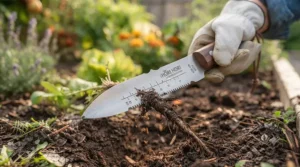
The Ultimate takes the standard hori hori formula and adds genuinely useful extras rather than gimmicks. Its concave blade design — a subtle curve along the cutting face — improves scooping efficiency when transplanting, while a small notched section at the blade’s base doubles as a twine cutter and bottle opener, a detail that sounds like a novelty until you’re three hours into staking tomatoes and need to snip garden twine without hunting for scissors.
The blade carries clear measurement markings for planting depth, and the walnut handle is contoured rather than simply rounded, which several reviewers single out as more comfortable during extended gripping than the straighter handles on competing models. Here’s what to weigh: multi-purpose garden knife features add real utility, but they also add cost, and buyers who only need straightforward weeding may find the Classic model above delivers 90% of the value at a lower price.
Aggregated reviews describe this as a strong pick for gardeners who also camp, fish, or do general outdoor work, since the added utility features extend usefulness well beyond the flower bed. Some retailers bundle the sheath separately from the knife, so it’s worth double-checking the listing before buying.
Pros:
- ✅ Twine cutter and bottle opener notch add real utility
- ✅ Concave blade improves scooping and transplanting
- ✅ Contoured walnut handle suits extended gripping sessions
Cons:
- ❌ Premium price versus the simpler Classic model
- ❌ Sheath and knife sometimes sold as separate bundles
Priced around C$60–C$75, it’s the most expensive pick on this list, best justified if you genuinely use the bonus features.
7. Radius Garden Ergonomic Hori Hori — best ergonomic grip for arthritis or wrist strain
Not every gardener has a pain-free grip, and Radius Garden built its entire product line around that reality. The ergonomic ergonomic (“NRG”) handle design curves to match natural hand position rather than forcing a straight-shaft grip, which several independent testers noted specifically reduced the hand and wrist fatigue that plagues shorter, narrower, or slippery tool handles.
The stainless steel blade retains the expected dual-edge design — straight for slicing, serrated for sawing through roots — but the real differentiator here is entirely in how the tool feels over a two-hour weeding session rather than in the blade specs themselves. Reviewers consistently note this model as the most comfortable option for gardeners managing arthritis, carpal tunnel symptoms, or general wrist sensitivity, a use case none of the other six knives on this list are specifically engineered around.
On paper, an ergonomic handle might look like a minor upgrade over a standard wood or plastic grip, but for the audience it’s designed for, it’s often the difference between gardening comfortably and not gardening at all. That’s a meaningfully different value proposition than blade hardness or steel grade.
Pros:
- ✅ Contoured ergonomic handle reduces wrist and hand strain
- ✅ Full-tang stainless steel blade for durable digging
- ✅ Purpose-built for gardeners managing grip sensitivity
Cons:
- ❌ Ergonomic shape may feel unfamiliar to traditionalists
- ❌ Premium ergonomic design carries a price premium
Expect C$40–C$55, a fair ask for a tool solving a genuine accessibility problem rather than chasing steel bragging rights.
Practical Usage Guide: Getting the Most From Your Hori Hori
Buying the right weeding knife hori hori is only half the job — using and maintaining it properly is what makes it outlast a cheaper tool by years instead of one Canadian growing season.
First-use setup: Before the first dig, wipe the blade with a light coating of food-safe mineral oil, especially on carbon or high-hardness stainless models like the NJP651, which are more prone to surface spotting in humid storage conditions. If your sheath is leather, condition it once before regular use so it doesn’t dry out and crack against the blade edge.
Weeding technique that actually works: Drive the blade in at a slight angle roughly 3–5 cm from the weed’s base, rock it gently to loosen surrounding soil, then use the serrated edge to sever any deep taproot before lifting. This is where most beginners go wrong — they try to pry the whole plant out in one motion, which either snaps the top growth (leaving the root to regrow) or puts unnecessary lateral stress on the blade.
Maintenance schedule: Rinse and dry the blade after each use — soil left to dry on stainless steel accelerates pitting over time. Sharpen every 15–20 hours of active use with a basic sharpening stone (several models, including budget picks, ship with one included). Once a season, check the handle-to-tang junction for any looseness, particularly on partial-tang models.
Common first-30-days mistakes: New owners frequently use the smooth edge for tasks that call for the serrated side (thick roots, tough vines), dulling it faster than necessary. Others store the knife wet in its sheath, which traps moisture against the blade — always let it air-dry for a few minutes before sheathing.
Real-World Scenarios: Which Hori Hori Fits Your Garden?
The condo balcony container gardener: If you’re managing a handful of pots and a small raised bed on a Toronto or Vancouver balcony, soil conditions are usually loose, bagged, and rock-free. The Fiskars or Nisaku NJP650 covers this use case comfortably — you don’t need HRC58 hardened steel to divide basil and transplant tomato starts.
The suburban homeowner with clay soil and an acre lot: Southern Ontario and parts of the Prairies are notorious for dense clay that fights back against every tool. Here, the Nisaku NJP651’s hardened full-tang blade earns its higher price tag, since softer steel dulls fast and partial-tang knives risk snapping when you inevitably use the blade as a small pry bar.
The gardener managing wrist or hand pain: If arthritis, carpal tunnel, or general hand fatigue makes extended gripping painful, spec sheets around blade hardness matter far less than the Radius Garden’s ergonomic handle. Frequency of use (daily deadheading versus weekly weeding) should also push you toward the more comfortable grip regardless of soil type.
Problem → Solution: Fixing Common Weeding Headaches
Problem: Dandelions keep coming back after pulling. Solution: use the serrated edge to sever the taproot at least 5–8 cm below the crown rather than snapping the visible leaves. Any hori hori with a serrated side — all seven picks above qualify — handles this better than a standard hand fork.
Problem: Weeds growing in driveway or patio cracks. Solution: a full hori hori is often overkill here; a dedicated crack weeder tool with a narrow, angled blade reaches into tight joints more effectively. That said, the pointed tip on models like the Nisaku NJP650 can double in a pinch for wider sidewalk gaps.
Problem: Blade won’t hold an edge past a few weeks. Solution: check whether you’re using a lower-hardness budget blade in rocky or sandy soil — this is exactly the scenario the HRC58 Nisaku NJP651 was designed to solve.
Problem: Hand cramps after long weeding sessions. Solution: switch to an ergonomically contoured handle like the Radius Garden model, or add a foam grip sleeve to an existing wood-handled knife as a budget interim fix.
Problem: Rust spots appearing on a stainless blade. Solution: this usually means the knife was sheathed while still damp. Dry thoroughly after every use and apply a light oil coating before extended storage over winter.
✨ Don’t Miss These Exclusive Deals!
🔍 Solve your specific weeding headache with the right pick above — check availability now.
How to Choose a Weeding Knife Hori Hori
- Assess your soil type first. Sandy or loose soil suits any blade hardness; rocky or clay soil justifies paying more for full-tang, hardened steel like the NJP651.
- Match tang construction to how hard you’ll lever the blade. Full tang survives prying; partial tang is fine for pure cutting and slicing tasks only.
- Decide if a sheath and sharpening stone matter to you. Several budget and mid-range models bundle both, saving a separate purchase.
- Consider hand comfort over long sessions. If you garden for hours at a stretch, an ergonomic or SoftGrip handle outperforms raw steel specs in daily usability.
- Check the edge configuration. Confirm the model has both a straight and serrated edge — some cheaper garden knives skip the serration entirely, losing the tool’s main advantage for root-heavy weeding.
- Factor in climate and storage. Leather sheaths need occasional conditioning; plastic sheaths are lower-maintenance for humid or wet Canadian storage sheds.
- Set a realistic budget band. Under C$35 covers genuinely capable entry knives; C$55 and up buys measurably tougher steel and better ergonomics, not just branding.
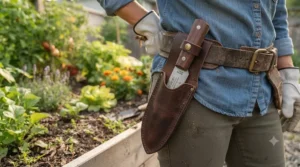
Weeding Knife Hori Hori vs Traditional Garden Tools
| Tool | Best For | Weakness |
|---|---|---|
| Hori hori knife | Weeding, dividing, planting, cutting roots | Not ideal for narrow sidewalk cracks |
| Hand fork/trowel | Loosening soil, light digging | Struggles with tough taproots |
| Dedicated crack weeder tool | Sidewalk/patio joint weeds | Poor for general bed weeding |
| Standard kitchen knife (repurposed) | Emergency substitute | Dulls fast, no depth markings, unsafe grip |
The comparison above makes the hori hori’s appeal obvious: it’s genuinely a multi-purpose garden knife rather than a single-task tool, which is exactly why it’s replaced separate trowels and hand forks in so many Canadian tool sheds. Where it loses to a dedicated crack weeder tool is precision in tight joints — that narrow, angled design simply reaches where a wider hori hori blade can’t. Most experienced gardeners end up owning both, using the hori hori for 90% of bed and border work and the crack weeder as a specialist backup for hardscaping.
Common Mistakes When Buying a Weeding Knife Hori Hori
The single biggest mistake is choosing based on blade length alone. A longer blade sounds like better value, but if it’s paired with partial-tang construction, you’re buying reach at the cost of durability. Reviewers and testers consistently flag tang strength — not blade length — as the spec most correlated with long-term satisfaction.
A second common error is ignoring handle material for climate. A bare wood handle stored in a damp, unheated garage over a Canadian winter can swell, crack, or loosen at the tang over several seasons; a sealed or plastic-handled model tolerates that environment better without extra maintenance.
Finally, many first-time buyers skip checking whether a sheath and sharpening stone are actually included versus advertised as optional add-ons, then get surprised by extra costs at checkout. Always confirm what’s bundled before comparing prices across listings.
Soil Knife Applications Beyond Weeding
Calling this tool a “weeding knife” undersells it — soil knife applications extend well past pulling dandelions. Gardeners use the same blade to divide overgrown perennials like hostas and daylilies by driving the blade straight down through the root ball, to cut through burlap or landscape fabric during bed installation, and to measure planting depth precisely using the etched inch and centimetre markings found on most models, including the Nisaku NJP650 and NJP801.
It also earns its keep at planting time: the pointed tip digs a clean hole for bulbs and transplants faster than a trowel in loosened soil, and the flat side works surprisingly well for tamping soil around a newly placed root ball. For raised-bed gardeners, the blade’s depth markings remove the guesswork from spacing bulbs at the correct depth specified on seed packets — a small detail that measurably improves germination consistency.
Serrated Edge Weeding: Features That Actually Matter (And Those That Don’t)
Marketing copy tends to emphasize steel grade and country of origin, but for actual serrated edge weeding performance, three features matter far more than most buyers realize. First, serration depth and spacing — a shallow, fine serration saws through fibrous roots more cleanly than a deep, coarse one, which tends to tear rather than cut. Second, the transition point between the smooth and serrated sections of the blade, since a poorly finished transition creates a weak point prone to chipping. Third, tang construction, already covered above, which affects durability far more than whether the steel is labelled “premium Japanese” versus a generic stainless designation.
What matters far less than the specs sheets suggest: exact blade length beyond the 6.5–7.25 inch range common across all seven picks here, and cosmetic details like handle colour or sheath stitching pattern. The spec sheet won’t tell you this, but reviewers note that a well-executed 6.5-inch serrated edge outperforms a poorly finished 8-inch blade for actual root-cutting work — length is not the differentiator marketing suggests it is.
Long-Term Cost & Maintenance
Total cost of ownership on a weeding knife hori hori is refreshingly low compared to power tools, but it isn’t zero. Budget models under C$35 typically need replacement or a new blade within 3–5 seasons of regular use, particularly if used in rocky soil beyond their steel’s comfort zone. Premium full-tang, hardened-steel models in the C$55–C$75 range are frequently reported to last a decade or more with basic maintenance — oiling, drying, and periodic sharpening — which works out to a lower true cost-per-year despite the higher upfront price.
Sharpening stones, when not included, run a modest additional cost but pay for themselves many times over versus replacing a dulled blade. Leather sheaths need occasional conditioner (a few dollars, applied a couple of times a year); plastic sheaths need essentially nothing. For a gardener who weeds weekly through a full Canadian growing season, the premium options above generally deliver better cost-per-use than repeatedly replacing a budget knife every few years.
Safety and Storage Considerations
A hori hori is, functionally, a fixed-blade knife, and it deserves the same basic respect as any other bladed tool. Always carry it sheathed when moving between garden areas, and store it out of reach of small children — a point worth taking seriously given how many models ship without a locking sheath mechanism. When transporting one in a vehicle for community garden plots or cottage properties, check your municipality’s local bylaws on transporting edged tools, since rules can vary by province and municipality.
Gloves are worth wearing during heavy root-cutting tasks, since the serrated edge that makes quick work of a taproot can just as easily catch a glove or fingertip during an awkward angle. According to guidance from the City of Edmonton’s weed removal program, using a tool to loosen soil around the root base before pulling — rather than yanking the plant by hand — is also the recommended technique for fully removing invasive root systems, which lines up neatly with how a hori hori is meant to be used.

Frequently Asked Questions
❓ What is the difference between a hori hori and a regular garden trowel?
❓ Can a weeding knife hori hori replace a full set of garden tools?
❓ Is stainless steel or carbon steel better for a hori hori in Canada?
❓ How often should I sharpen my hori hori knife?
❓ Do I need a sheath for a weeding knife hori hori?
Conclusion
A weeding knife hori hori earns its reputation the unglamorous way — not through flashy features, but by quietly outperforming a drawer full of single-purpose tools every time you kneel down to deal with a stubborn root. Whether your soil is loose balcony potting mix or unforgiving Prairie clay, there’s a real, currently available model above built for it: the Fiskars or Nisaku NJP650 for straightforward budget-friendly weeding, the NJP651 for genuinely tough ground, and the Radius Garden ergonomic pick if hand comfort is your priority over raw steel hardness.
The honest truth is that no single “best” answer exists across every garden — the right choice depends on your soil, your hands, and how long you plan to keep the tool. What does stay consistent across all seven picks is the core value proposition: a well-made dual-edge blade solves weeding, dividing, and planting problems that a mismatched drawer of cheaper tools never quite manages on its own.
✨ Ready to stop fighting your weeds with the wrong tool? Compare current pricing on today’s top pick and get digging this weekend.
Recommended for You
- Tool for Removing Dandelions: 7 Picks That Actually Work (2026)
- Washable Gardening Gloves: 7 Best Picks for 2026
- 7 Best Rose Pruning Gloves Thorn Proof for Canadian Gardens (2026)
Disclaimer: This article contains affiliate links. As an Amazon Associate, I earn from qualifying purchases. If you purchase products through these links, we may earn a small commission at no additional cost to you.
✨ Found this helpful? Share it with your friends! 💬🤗
