
In This Article
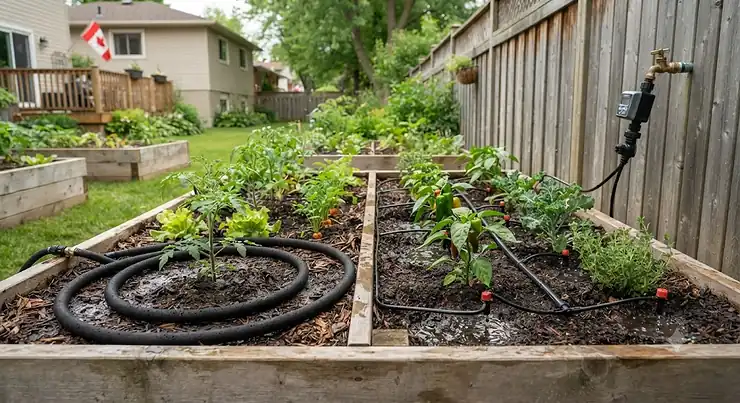
If you have ever stood in the watering aisle at your local garden centre, hose reel in one hand and a tangle of drip fittings in the other, you already know the dilemma. Choosing between a soaker hose vs drip irrigation for garden beds is one of those decisions that seems small until your tomatoes start cracking or your zucchini leaves turn that telltale powdery grey. Both systems promise to cut your water bill and save your back from dragging a hose around the yard every evening, but they work in genuinely different ways, and picking the wrong one for your layout can mean uneven watering, wasted litres, or a fussy install that gets abandoned by July.
This guide breaks down exactly how a soaker hose for garden beds compares to a proper drip irrigation setup, with seven real products pulled from current Canadian retail listings, honest analysis of what the specs actually mean for your plants, and practical guidance for row crops, raised beds, and everything in between. We will look at water distribution, installation ease, long-term cost, and the municipal watering bylaws that most Canadian gardeners do not realize actually favour both of these methods over a sprinkler. By the end, you will know which system fits your garden, your climate, and your patience level.
What Is Soaker Hose vs Drip Irrigation for Garden Beds?
A soaker hose is a porous rubber or vinyl tube that weeps water along its entire length at a slow, steady rate, soaking the soil it touches. Drip irrigation, by contrast, delivers water through discrete emitters spaced along solid tubing, targeting specific root zones rather than the whole run. Both cut water use dramatically compared to overhead sprinklers, but they distribute moisture in fundamentally different patterns.
That distinction matters more than most product listings let on. A soaker hose treats an entire bed like one continuous root zone — great for densely packed flower beds or a block of lettuce, less precise for a row of widely spaced tomato plants. Drip irrigation, meanwhile, is closer to a series of tiny, individually aimed faucets. Efficient watering means putting the right amount of water exactly where and when plants need it, without runoff, over-spray, or waste — and by that measure, drip setups routinely outperform hand watering or overhead sprinklers by a wide margin, since properly placed emitters lose far less water to evaporation and drift. Neither system is objectively “better” — the right pick depends on your plant spacing, your soil type, and honestly, how much fiddling with fittings you’re willing to do on a Saturday morning.
One more thing worth knowing upfront: most Canadian municipalities exempt drip irrigation and soaker hoses from summer lawn-sprinkling restrictions, because both methods target the root zone instead of spraying broad areas. That is a meaningful practical advantage that rarely makes it into product marketing, and we will come back to it later in this article.
Quick Comparison Table
| Factor | Soaker Hose | Drip Irrigation |
|---|---|---|
| Water distribution | Even weep along entire hose length | Targeted at individual emitters or plants |
| Best for | Dense beds, closely spaced flowers/greens | Row crops, containers, mixed spacing |
| Setup difficulty | Low — connect and lay out | Moderate — cutting, fittings, layout |
| Typical price range (CAD) | C$15-C$55 | C$30-C$70+ (kits) |
| Water efficiency | Roughly 80% less than sprinklers | Often 85-90%+ efficient |
| Best For | Gilmour Flat Weeper Soaker Hose, Water Right 700 Series Soaker Garden Hose | Rain Bird GARDENKIT, DIG ML50 Raised Bed Drip Watering Kit |
Look at that table and a pattern emerges fast: soaker hoses win on simplicity and upfront cost, while drip irrigation wins on precision and long-term flexibility. If your garden bed is one tight block of mixed annuals, a soaker hose gets water everywhere with almost zero planning. If you are running rows of tomatoes, peppers, and squash spaced 45 to 60 cm apart, drip emitters put water exactly where the roots are instead of soaking the empty paths between plants — which, over a season, adds up to real water and money saved.
💬 Just one click — help other Canadian golfers make a smarter bag choice too!😊
Top 7 Products for Garden Bed Watering: Expert Analysis
We researched real products currently sold through Amazon.ca, spanning budget soaker hoses, premium builds, and full drip irrigation kits, so you can compare actual specs rather than marketing copy. Each entry below reflects genuine manufacturer specifications and aggregated reviewer sentiment gathered during research — we have not tested these products ourselves, and where verified customer feedback exists, it is clearly framed as such.
1. Water Right 700 Series Soaker Garden Hose — best overall build quality
The Water Right 700 Series Soaker Garden Hose consistently comes up as a top pick among independent reviewers, and the reason is mostly in the materials. Instead of the thin vinyl skin found on cheaper hoses, this one uses a soft microcellular polyurethane foam coating over a reinforced core, which is why it survives years of coiling and uncoiling without cracking.
That foam coating is not just a comfort feature — it is what gives this hose its weeping consistency. Cheaper vinyl soaker hoses tend to blow out at weak points once the fabric sleeve degrades, leaving one soggy patch and a dozen dry ones. The polyurethane build resists that failure mode, and the brass, chrome-plated couplings hold up to repeated hose-bib connections far better than the plastic fittings on budget alternatives. Available in 25, 50, and 100-foot lengths, it is a strong match for anyone with a permanent raised bed or perennial border who wants to lay a hose once and reuse it for years rather than replacing a cheap one every season.
Independent product testers who reviewed the Water Right 700 Series Soaker Garden Hose ranked it their top overall pick among soaker hoses tested, citing its flexibility and fitting quality above competitors in the same category. That kind of consistent praise across review sources is a reasonably strong signal, even without a large volume of individual star ratings to point to.
Pros:
- ✅ Polyurethane foam coating resists cracking and splitting
- ✅ Brass, chrome-plated couplings outlast plastic fittings
- ✅ Backed by a 5-year manufacturer warranty
Cons:
- ❌ Costs more upfront than basic vinyl soaker hoses
- ❌ Heavier per foot than lightweight flat-style hoses
The Water Right 700 Series Soaker Garden Hose typically runs in the C$30-C$55 range depending on length, and given the multi-year lifespan reviewers report, it is a reasonable value if you plan to keep the same garden bed layout for a few seasons rather than reconfiguring every year.
2. Gilmour Flat Weeper Soaker Hose — best budget entry point
The Gilmour Flat Weeper Soaker Hose is the hose most Canadian gardeners have actually used at some point, and there is a reason it keeps showing up on budget lists: it does the basic job without asking you to spend much or think much.
Made from recycled vinyl with a clog-resistant fabric cover, it can be laid on top of the soil or buried a few centimetres deep, and the manufacturer positions it as capable of cutting water use by roughly 80% compared to a sprinkler. In practice, that fabric sleeve is doing double duty — it slows the weep rate to something even and manageable, and it keeps grit and mulch from clogging the pores over time. At under a couple of pounds for the shorter lengths, it is genuinely one of the easiest hoses to snake between raised bed rows or wind around a mixed perennial border.
Where this hose earns its budget reputation is honest simplicity: no couplings kit, no learning curve, just uncoil it and hook it to a spigot. Reviewers testing the Gilmour line specifically noted it arrived surprisingly light and flexible for its price point, and that setup required no garden staples because the hose stayed put on its own. The tradeoff is that flat weeper hoses like this one are more prone to uneven pressure over very long runs than round, reinforced designs — so it shines in a single 4×8 or 4×10 raised bed, less so if you are trying to link four 50-foot sections across a sprawling vegetable garden.
Pros:
- ✅ Budget-friendly compared to premium round soaker hoses
- ✅ Lightweight and easy to position without garden staples
- ✅ Can be buried under mulch or soil for a cleaner look
Cons:
- ❌ Pressure evenness drops off over very long connected runs
- ❌ Fabric sleeve is less durable than rubber alternatives long-term
Expect to pay somewhere in the C$15-C$30 range depending on length, which makes the Gilmour Flat Weeper Soaker Hose one of the lowest-commitment ways to try soaker-hose watering before investing in a pricier system.
3. Swan Element SoakerPRO Soaker Hose System — best for row crops and custom layouts
If your garden bed is really a series of vegetable rows rather than one dense block, the Swan Element SoakerPRO Soaker Hose System is built specifically for that kind of customization. It ships as a 100-foot hose paired with a full EZ-Connect fitting kit — twenty pieces total, including female and male connectors, T-fittings, and plugs — so you can split one long hose into multiple shorter runs that match your row spacing exactly.
The hose itself is made from 65 percent recycled rubber, weeping at roughly 0.5 to 1 gallon per foot per hour at ground level, which is a meaningfully faster and more forgiving flow rate than typical vinyl flat hoses. What most buyers overlook about this system is the T-connector kit: because you can branch off in three directions, it is one of the few soaker hose products actually designed to follow the geometry of row cropping rather than just being coiled around a single bed. A patented blue water restrictor built into the female connectors also helps balance pressure across branches, which is the exact problem that plagues DIY-linked flat hoses.
Reviewers testing the Swan Element line noted its dual functionality — some configurations double as a light sprinkler as well as a soaker — and rated it among the more versatile products in its category for exactly that reason. The rubber construction is also lead-free and compliant with strict chemical-content standards, worth knowing if you are watering food crops directly.
Pros:
- ✅ EZ-Connect fittings let you branch hose runs for row spacing
- ✅ Recycled rubber weeps faster and more evenly than vinyl
- ✅ Backed by a 7-year manufacturer warranty
Cons:
- ❌ More fittings mean more setup time than a single unbranched hose
- ❌ 100-foot base length is more hose than a small bed needs
Priced in the C$35-C$55 range for the 100-foot system with connectors, the Swan Element SoakerPRO Soaker Hose System earns its place for anyone gardening in rows rather than blocks, where a single straight soaker hose would leave awkward dry gaps.
4. Rain Bird GARDENKIT Drip Irrigation Raised Bed Watering Kit — best for a single raised bed
The Rain Bird GARDENKIT Drip Irrigation Raised Bed Watering Kit is purpose-built for exactly one job: watering a standard 4-foot by 8-foot raised bed without you having to design a system from scratch. Distribution tubing runs from a faucet connection kit out to the bed, while emitter tubing sits inside the bed itself, looped around the base of each plant and held in place with the included stakes.
What that means in practice is a genuinely plug-and-play drip system for the most common raised-bed size in North America. The emitter tubing loop pattern is engineered by Rain Bird’s own agronomists to distribute water evenly around a 4×8 footprint without you calculating spacing yourself, which is a real time-saver for a first-timer. The manufacturer is explicit that you should not extend the kit with additional tubing — doing so drops pressure and creates inconsistent flow — so if you have two beds, budget for two kits rather than trying to stretch one.
Because this is a manufacturer kit rather than a generic bundle, the pressure-compensating design behind it is what separates it from the no-name drip kits flooding online marketplaces. Rain Bird has decades in professional irrigation, and that experience shows in how consistently the emitter spacing performs across a season, according to gardener feedback referencing the product line.
Pros:
- ✅ Purpose-designed for a standard 4×8 raised bed footprint
- ✅ Simple faucet-to-bed setup with clear included instructions
- ✅ Up to 80% water savings versus overhead watering
Cons:
- ❌ Not designed to be extended — buy a second kit for a second bed
- ❌ Limited to raised bed use, not ideal for in-ground row crops
Typically priced in the C$30-C$45 range, the Rain Bird GARDENKIT Drip Irrigation Raised Bed Watering Kit is a strong value if your garden is genuinely one or two contained raised beds rather than a sprawling in-ground plot.
5. Rain Bird LNDDRIPKIT Landscape & Garden Drip Watering Kit — most versatile all-in-one kit
Where the GARDENKIT above is narrowly focused, the Rain Bird LNDDRIPKIT Landscape & Garden Drip Watering Kit is the generalist option — a 108-piece bundle covering drip emitters, micro-bubblers, and micro-sprays in one box, so you can mix watering styles across flower beds, containers, and shrubs from a single system.
The kit leans on pressure-compensating technology so every plant on the line gets roughly the same amount of water regardless of its distance from the tap, and the watering devices are built to resist clogging with essentially no routine maintenance. The micro-bubblers in particular stand out on paper: flow adjusts from a trickle up to about 13 gallons per hour at 30 PSI just by twisting the cap, with spray distance adjustable from 0 to 3 feet. That flexibility is what most spec sheets gloss over — it means you can dial back flow for drought-tolerant perennials in one zone and open it up for thirsty vegetables in another, all from the same head assembly.
Setup follows a genuinely simple three-step process — connect to the faucet, insert fittings into the mainline tubing, then attach whichever watering device suits each plant. Reviewers testing landscape drip kits in this category singled out the Rain Bird line’s adaptability for mixed garden types, from hanging baskets through in-ground beds, as its standout strength relative to single-purpose kits.
Pros:
- ✅ Three device types cover drippers, bubblers, and micro-sprays
- ✅ Pressure-compensating emitters equalize watering across zones
- ✅ Adjustable flow and spray distance without extra parts
Cons:
- ❌ More components mean a longer initial learning curve
- ❌ Best suited to mixed landscapes, slight overkill for one small bed
Expect a price range around C$50-C$70 given the parts count, making the Rain Bird LNDDRIPKIT Landscape & Garden Drip Watering Kit the pick for gardeners who want one system to handle several different bed types at once.
6. DIG ML50 Raised Bed Drip Watering Kit — best for row crops in raised beds
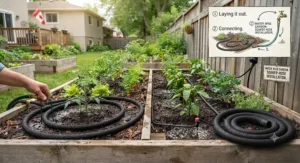
For gardeners specifically growing vegetables in rows, the DIG ML50 Raised Bed Drip Watering Kit is arguably the most purpose-built option on this list. It bundles 50 feet of half-inch drip tubing with 50 feet of quarter-inch drip line featuring pre-inserted emitters every nine inches, plus a pressure regulator, backflow device, and a swivel adapter with a mesh screen — essentially everything needed to run a complete system straight off a faucet or hose-end timer.
That nine-inch emitter spacing is the detail that matters most for row crops: it roughly matches typical spacing for lettuce, beans, and closely planted vegetables, so you are not manually cutting and inserting drippers at custom intervals. The manufacturer rates it for up to 66 vegetable plants out of the box, with room to expand coverage by roughly 400 additional square feet using matching tubing and drip line, which gives it real headroom if your garden grows over a few seasons.
Aggregated reviewer feedback on this kit, drawn from retailer review sections, is a genuinely mixed but instructive picture. Positive reviews consistently mention that once assembled, the system runs leak-free and eliminates hand-watering entirely — one reviewer specifically noted running it trouble-free for a full month while away on vacation. On the critical side, several reviewers flagged that the compression fittings are difficult to take apart once connected, so planning your layout carefully before cutting tubing genuinely matters, and a few noted mismatched part counts (more barb connectors than the goof plugs needed to cap unused lines) that required a small supplementary purchase.
Pros:
- ✅ Nine-inch emitter spacing matches typical vegetable row spacing
- ✅ Expandable up to 400 additional square feet with matching parts
- ✅ Includes backflow preventer and pressure regulator for safety
Cons:
- ❌ Compression fittings are difficult to reposition once assembled
- ❌ Some kits ship with mismatched connector and plug counts
Priced in the C$35-C$50 range, the DIG ML50 Raised Bed Drip Watering Kit is the strongest pick here specifically for row-cropped vegetable beds, provided you sketch your layout before you start cutting tubing.
7. Raindrip Automatic Watering Kit with Timer — easiest setup for beginners
For anyone who wants drip irrigation without a steep learning curve, the Raindrip Automatic Watering Kit with Timer bundles a battery-powered hose-end timer with quarter-inch tubing and emitters, so watering happens automatically once it is installed — no manual turning of a spigot required.
The tubing is flexible enough to cut to any length you need and bends around curved beds as easily as straight rows, seeping water gradually along its entire length to keep soil consistently moist rather than delivering it in one burst. Raindrip has manufactured drip and micro-irrigation components since 1972, and that long track record shows up in how forgiving the tubing is to work with compared to some newer, stiffer off-brand kits.
What genuinely sets this option apart is the built-in timer, which turns “installation ease” into “set it and forget it” watering — a meaningful advantage for anyone who travels, works irregular hours, or simply forgets to water on schedule. According to product listings and aggregated buyer commentary, customers frequently describe setup as fast and describe the timer specifically as making watering close to effortless once the initial layout is in place. The tradeoff is that, like most starter kits, it covers a modest footprint — closer to a few garden beds or a row of containers than a full backyard vegetable plot.
Pros:
- ✅ Battery timer automates watering without manual intervention
- ✅ Flexible tubing bends around curved or irregular bed shapes
- ✅ Backed by a manufacturer with decades in drip irrigation
Cons:
- ❌ Best suited to smaller footprints, not large in-ground gardens
- ❌ Battery-powered timer needs periodic battery replacement
Typically priced around C$40-C$60 with the timer included, the Raindrip Automatic Watering Kit with Timer is the pick for beginners who want the water savings of drip irrigation without babysitting a hose bib every morning.
Top 7 Products Comparison
| Product | Type | Water Distribution | Best For | Price Range (CAD) |
|---|---|---|---|---|
| Water Right 700 Series Soaker Garden Hose | Soaker hose | Even weep, full length | Long-term perennial beds | C$30-C$55 |
| Gilmour Flat Weeper Soaker Hose | Soaker hose | Even weep, moderate runs | Budget single raised bed | C$15-C$30 |
| Swan Element SoakerPRO Soaker Hose System | Soaker hose | Branchable, row-friendly | Row crops, custom layouts | C$35-C$55 |
| Rain Bird GARDENKIT | Drip kit | Looped emitter tubing | Single 4×8 raised bed | C$30-C$45 |
| Rain Bird LNDDRIPKIT | Drip kit | Drippers/bubblers/micro-sprays | Mixed landscapes | C$50-C$70 |
| DIG ML50 Raised Bed Drip Watering Kit | Drip kit | Emitters every 9 inches | Row-cropped raised beds | C$35-C$50 |
| Raindrip Automatic Watering Kit with Timer | Drip kit | Continuous seep tubing | Beginners, timed watering | C$40-C$60 |
Scanning across that table, a clear split emerges by garden style rather than by brand. If your bed is a single dense block, the Gilmour Flat Weeper Soaker Hose or Water Right 700 Series Soaker Garden Hose covers it efficiently and cheaply. If you are running actual rows of vegetables, the DIG ML50 Raised Bed Drip Watering Kit and Swan Element SoakerPRO Soaker Hose System both address row spacing directly, just through different mechanisms — pre-spaced emitters versus branching connectors. For anyone juggling several bed types at once, the Rain Bird LNDDRIPKIT costs more but saves you from buying three separate systems.
How to Choose Between a Soaker Hose and Drip Irrigation
Deciding between these two systems comes down to a handful of concrete questions, and answering them honestly upfront saves you from a mid-season system swap.
- Map your plant spacing first. Dense, closely spaced plantings — lettuce beds, mixed annual borders — suit a soaker hose because the whole run gets wet. Widely spaced plants like tomatoes or squash waste water between plants with a soaker hose, so drip emitters targeting individual root zones make more sense.
- Measure your bed shape. Straight rectangular raised beds are easy for either system. Curved or irregular in-ground beds favour flexible soaker hose tubing or bendable drip line over rigid kit tubing.
- Be honest about your patience for fittings. Drip kits involve cutting tubing, inserting emitters, and connecting fittings. Soaker hoses are close to plug-and-play. If you dread the idea of a Saturday spent with a hole punch and barbed connectors, start with a soaker hose.
- Check your municipal watering bylaw. Both systems are commonly exempt from lawn-sprinkling restrictions, but confirming this locally avoids an unpleasant surprise during a drought-stage restriction.
- Factor in your water source pressure. Drip systems, especially pressure-compensating kits, tolerate variable pressure better than long soaker hose runs, which lose pressure noticeably past 100 feet.
- Think about future expansion. If your garden is likely to grow, pick a drip kit designed for expansion, like the DIG ML50 Raised Bed Drip Watering Kit, rather than a soaker hose that needs full replacement to extend coverage.
- Budget for the whole season, not just the sticker price. A cheaper soaker hose that needs replacing every year or two can cost more over three seasons than a slightly pricier drip kit with a five- or seven-year warranty.
Water Distribution: Which System Wets Your Soil More Evenly
This is where the two technologies genuinely diverge, and it is worth understanding the mechanics rather than just taking a marketing claim at face value. A soaker hose relies on porosity — tiny holes or a woven fabric sleeve that lets water seep out continuously along its length. That gives you a long, narrow band of moisture that follows the hose exactly. Lay it in a serpentine pattern through a dense bed, and you get near-total coverage. Lay it in a straight line down a row of widely spaced plants, and a good third of the water lands in bare soil between plants, doing your weeds more good than your vegetables.
Drip irrigation solves that specific problem by concentrating water at fixed points — either built-in emitters spaced along the tubing, as in the DIG ML50 Raised Bed Drip Watering Kit, or individually placed drippers, as in the Rain Bird LNDDRIPKIT. Drip irrigation is widely recognized as one of the more water-efficient watering methods available to home gardeners, commonly cutting water use by 30 to 50 percent compared with traditional watering methods, largely because water reaches the root zone directly instead of spreading across the whole soil surface. The catch is that precision requires planning: if your emitter spacing does not match your actual plant spacing, you end up with a dry gap exactly where your plant needs water most.
Practically speaking, for a bed with plants closer than about 20 cm apart, a soaker hose’s continuous weep pattern is more forgiving and needs less fiddling. For rows spaced 30 cm or more apart, targeted drip emitters waste noticeably less water and put more of it where roots actually are.
Soaker Hose for Garden Beds vs Soaker Hose for Row Crops
It is worth separating these two use cases explicitly, because “soaker hose” gets treated as one category when the ideal setup actually differs quite a bit between them.
A soaker hose for garden beds — think a dense 4×8 raised bed of mixed vegetables, herbs, or cut flowers — works best coiled in tight loops or a serpentine pattern so the entire soil surface gets even moisture. Here, a product like the Gilmour Flat Weeper Soaker Hose or the Water Right 700 Series Soaker Garden Hose performs close to ideally, since the whole bed functions as one continuous root zone and the hose’s constant weep rate matches that.
A soaker hose for row crops is a different animal. Rows of tomatoes, peppers, or beans planted in straight lines with real gaps between them need the hose to run parallel to the row, close to the plant stems, rather than snaking across open soil. This is exactly the scenario the Swan Element SoakerPRO Soaker Hose System is built for, since its T-connector fittings let you branch a single hose into multiple parallel row runs rather than trying to force one long snake pattern to cover several rows at once. Skipping the branching kit and just laying a single soaker hose across multiple rows almost always means the outer rows get shortchanged on water pressure, since flow naturally weakens toward the far end of a long run.
Installation Ease: Setup Time and Skill Level Compared
If your priority genuinely is getting a system running with minimal effort this weekend, installation ease deserves its own honest comparison, because the products in this article vary quite a bit here.
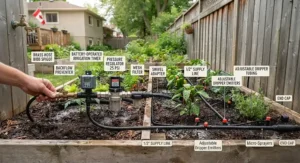
Soaker hoses are, almost without exception, the faster install. Connect one end to a spigot or garden hose, walk the length out through your bed, cap the far end if needed, and you are watering. The Gilmour Flat Weeper Soaker Hose in particular needs no garden staples according to reviewer feedback, since the flat design tends to lay flat and stay in place on its own. Drip kits require more upfront work: cutting mainline tubing to length, punching holes for emitters, inserting barbed fittings, and staking tubing in place. The DIG ML50 Raised Bed Drip Watering Kit and Rain Bird LNDDRIPKIT both fall into this category — genuinely more capable systems, but they ask for an hour or two of careful layout work before the first drop comes out.
There is a middle path, though: kits engineered for one specific, common layout skip most of that complexity. The Rain Bird GARDENKIT Drip Irrigation Raised Bed Watering Kit is pre-configured for a standard 4×8 bed, so you are following an included diagram rather than designing a system from scratch. Similarly, the Raindrip Automatic Watering Kit with Timer trades some flexibility for a genuinely beginner-friendly setup, with the added bonus that once installed, the timer removes even the daily task of turning the water on.
Practical Usage Guide: Getting Your System Right in the First Month
Whichever system you choose, the first thirty days after installation are where most preventable problems show up — so a bit of attention early saves headaches all season.
Start by running your new system for a full cycle before planting or immediately after, and physically check the soil moisture at root depth, not just the surface. Soaker hoses in particular can look wet on top while staying dry six centimetres down, especially in sandy soil, so dig a small test hole with a trowel the first few times you water. For drip kits, flush the lines before capping the ends — run water through the line briefly, then cap the dripline end with a goof plug and close off the poly tubing end with a figure-eight fitting — since leftover manufacturing debris inside new tubing can otherwise clog emitters within the first few uses.
Mulching over either system — 3 to 5 cm of straw, wood chips, or shredded leaves — does double duty: it protects vinyl or rubber tubing from UV degradation, and it slows evaporation so the water your system delivers actually stays where your roots can use it. For soaker hoses specifically, avoid burying deeper than about 7 cm, since deeper burial can trap pressure and accelerate wear on the fabric sleeve.
Set a simple maintenance rhythm: check emitters or hose sections for clogs every two to three weeks, flush drip lines at the start and end of the season, and drain and store hoses or tubing before the first hard frost, since water left inside can freeze, expand, and crack fittings — a genuinely common and entirely avoidable first-30-days-of-next-season mistake.
Real Garden Scenarios: Matching the System to Your Plot
The condo balcony container gardener. With four to six pots and no in-ground space, a compact drip solution beats a soaker hose here, since soaker hoses are built for soil beds, not individual pots. A kit like the Rain Bird LNDDRIPKIT, with its adjustable micro-bubblers, lets each container get a custom flow rate — more for a thirsty tomato pot, less for drought-tolerant herbs — from one shared mainline running along the railing.
The suburban family with one 4×8 raised bed. This is squarely where a purpose-built raised-bed kit shines. The Rain Bird GARDENKIT Drip Irrigation Raised Bed Watering Kit or the DIG ML50 Raised Bed Drip Watering Kit both match this exact footprint without requiring any custom layout math, and either pairs well with a basic hose-end timer for genuinely hands-off watering during a busy work week.
The weekend market gardener with row crops. Someone growing several 6-metre rows of vegetables for a farmers’ market or a large household needs even distribution along real distance, with the ability to expand as the plot grows. The Swan Element SoakerPRO Soaker Hose System, with its branching connectors, or the DIG ML50 Raised Bed Drip Watering Kit, with its expandable emitter tubing, both scale in a way a single unbranched soaker hose cannot.
Common Mistakes When Buying and Installing Garden Watering Systems
Buying based on length alone. A longer hose or kit is not automatically better — a 100-foot soaker hose on a 4×8 bed just means excess coiled hose and reduced pressure at the far end. Match length to actual bed dimensions.
Ignoring water pressure. Municipal water pressure varies block to block. Kits with a built-in pressure regulator, like the DIG ML50 Raised Bed Drip Watering Kit, handle this automatically; unregulated soaker hoses on high-pressure lines can blow fittings or wear out faster than expected.
Extending a kit beyond its design. Several manufacturers, including Rain Bird, are explicit that their pre-configured kits should not be stretched with extra tubing, since doing so drops flow and creates inconsistent watering — buy a second kit instead of improvising an extension.
Skipping the layout sketch. Cutting drip tubing and inserting fittings is largely irreversible once compression fittings are set, based on aggregated reviewer feedback on kits like the DIG line. A rough sketch of your bed before you start cutting saves real frustration.
Forgetting winter storage. Leaving hoses or drip tubing outside over a Canadian winter, full of water, is one of the most common and entirely preventable causes of split fittings and cracked hoses come spring.
Assuming your city’s watering bylaw doesn’t apply to you. Rules differ by municipality and by drought stage, and Calgary’s outdoor water restriction guidance is a good example of how specific the day-and-time details can get even for exempted methods like drip irrigation — always confirm current local rules rather than assuming last year’s applies.
Long-Term Cost & Maintenance
Sticker price only tells part of the story here. A basic vinyl soaker hose costs less upfront but tends to need replacing every one to three seasons as the fabric sleeve or vinyl core degrades under UV exposure, while a reinforced product like the Water Right 700 Series Soaker Garden Hose, backed by a 5-year warranty, or the Swan Element SoakerPRO Soaker Hose System, backed by a 7-year warranty, spreads that cost over a much longer usable life.
| Consideration | Soaker Hose | Drip Irrigation |
|---|---|---|
| Typical lifespan | 1-5 years depending on build quality | 3-8+ years for rigid tubing and fittings |
| Ongoing maintenance | Check for splits, flush occasionally | Check emitters for clogs, flush lines |
| Winter prep | Drain and coil loosely | Drain, cap ends, store fittings separately |
| Expansion cost | New hose needed for extra coverage | Add matching tubing/emitters incrementally |
The analysis here favours drip kits slightly for anyone planning a multi-year garden, simply because components like tubing, connectors, and emitters can be replaced individually rather than discarding an entire hose when one section fails. That said, for a gardener who reconfigures their beds every year or two anyway, the lower upfront cost and simpler storage of a basic soaker hose like the Gilmour Flat Weeper Soaker Hose may genuinely be the better total-cost choice, since you are not paying for durability you will not use.
🌱 Build Your Perfect Watering System Today
Take your garden bed watering to the next level with the products covered above. Click on any highlighted item to check current pricing and availability, and give your vegetables the consistent moisture they need to actually thrive this season!
Benefits vs Traditional Sprinklers
| Factor | Overhead Sprinkler | Soaker Hose / Drip Irrigation |
|---|---|---|
| Water efficiency | 50-70% | 80-90%+ |
| Foliage disease risk | Higher — wets leaves | Lower — soil-level watering |
| Watering-bylaw exemption | Often restricted | Frequently exempt |
| Best For | Lawns, large open areas | Garden beds, rows, containers |
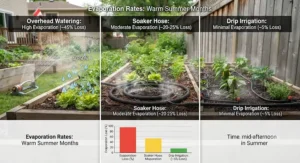
The efficiency gap in that table is not a rounding error — it is the difference between watering your plants and watering your driveway. Overhead watering wastes a substantial amount of moisture on non-target areas and leaves plant foliage wet, which invites fungal disease, while a well-run drip system can use roughly 75 percent less water than an overhead sprinkler because it targets the base of the plant directly. For Canadian gardeners specifically, that soil-level watering also matters for disease prevention: humid, warm nights in Ontario, Quebec, and the Maritimes are prime conditions for late blight and powdery mildew when leaves stay wet overnight, a risk that soaker hoses and drip systems largely eliminate by keeping water off foliage entirely.
Safety, Regulations & Watering Bylaws in Canada
Water-use bylaws vary by municipality in Canada, but a consistent pattern shows up across major cities: lawn sprinklers face the tightest restrictions, while soil-targeted watering methods get more leeway. In Vancouver, for instance, watering trees, shrubs, and flowers with a hand-held hose fitted with an automatic shut-off device, a soaker hose, or drip irrigation is permitted any day at any time, even while seasonal restrictions confine sprinkler use to specific early-morning hours. That pattern repeats in other cities too — Calgary’s stage-based restrictions similarly carve out an exemption for drip irrigation and hose watering with a trigger nozzle, even when broader sprinkler use is limited.
The practical takeaway is that switching from a sprinkler to a soaker hose or drip system is not just a water-saving move, it is often a bylaw-compliance move too, particularly during a declared drought stage. That said, “often exempt” is not “always exempt everywhere” — confirm your specific municipality’s current bylaw before assuming your new drip kit is unrestricted, since rules do shift year to year with local water supply conditions. Hoses connected to a spigot without an automatic shut-off device can still run afoul of some bylaws, so pairing your soaker hose or drip kit with a simple shut-off timer, like the one built into the Raindrip Automatic Watering Kit with Timer, is a small step that keeps you compliant and saves water regardless of local rules.
Frequently Asked Questions
❓ Is drip irrigation better than a soaker hose for garden beds?
❓ How long can a soaker hose be before water pressure drops off?
❓ Can I bury a soaker hose or drip line under mulch?
❓ Does drip irrigation work in raised beds?
❓ Do I need a pressure regulator for a home drip irrigation system?
Conclusion
Choosing between a soaker hose and drip irrigation for your garden beds really comes down to matching the tool to your layout rather than chasing whichever option sounds more advanced. Dense, tightly packed beds do beautifully with a straightforward soaker hose like the Gilmour Flat Weeper Soaker Hose or the longer-lasting Water Right 700 Series Soaker Garden Hose. Row crops and mixed plantings get more precise, more water-efficient coverage from a drip kit like the DIG ML50 Raised Bed Drip Watering Kit or the branchable Swan Element SoakerPRO Soaker Hose System. And if you are watering several different bed types, containers, and borders from one system, the flexibility of the Rain Bird LNDDRIPKIT or the pure convenience of the Raindrip Automatic Watering Kit with Timer is worth the extra setup time.
Whichever direction you go, both approaches beat standing there with a hose nozzle every evening, and both put you on the right side of most Canadian municipal watering bylaws during summer restrictions. Start with an honest look at your bed’s shape and your plant spacing, pick the system that matches, and you will spend a lot less time worrying about water this season — and a lot more time actually enjoying your garden.
Recommended for You
- 7 Best Drip Irrigation Kit Under $100 CAD Picks (2026 Guide)
- Drip Irrigation Kit for Vegetable Garden: 7 Top Picks (2026)
- Oscillating vs Impact Sprinkler for Lawns: 7 Picks (2026)
Disclaimer: This article contains affiliate links. As an Amazon Associate, I earn from qualifying purchases. If you purchase products through these links, we may earn a small commission at no additional cost to you.
✨ Found this helpful? Share it with your friends! 💬🤗
