
In This Article
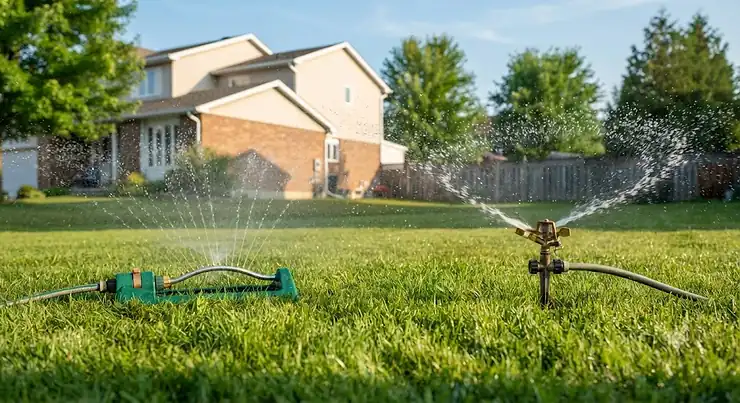
Somewhere between the hardware store aisle and your actual backyard, the oscillating sprinkler vs impact sprinkler for lawns question turns into a genuine standoff. One camp swears by that hypnotic side-to-side arc; the other won’t touch anything that doesn’t go tick-tick-tick like a tiny lawn metronome. Both are right, sort of, and both are wrong for the wrong yard — which is the whole problem with generic advice on this topic.
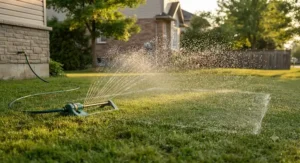
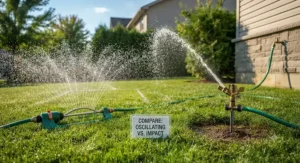
Here’s the short version: an oscillating sprinkler sweeps a fan-shaped curtain of water back and forth across a rectangular patch, which makes it a natural fit for tidy, boxy lawns and narrow side yards. An impact sprinkler — the one with the little metal arm that knocks the stream forward in a circular pattern — throws water farther, tolerates dirtier water supplies better, and shrugs off wind more easily, which makes it the go-to for big, irregular, or sloped properties. Neither is objectively “better.” They’re built for different battles.
This guide walks through seven real, currently sold sprinklers spanning budget zinc impact heads to smart oscillators with built-in timers, then digs into the analysis most Amazon listings skip entirely: which coverage pattern actually suits your lawn size, how Canadian watering bylaws affect your choice, and where each design quietly wastes (or saves) water. We’ll also cover traveling and rotary alternatives, because sometimes the real answer is “neither of the above.”
Quick Comparison Table
| Sprinkler | Type | Coverage Area | Best For | Price Range (CAD) |
|---|---|---|---|---|
| Melnor XT Turbo Oscillating Sprinkler | Oscillating | Up to 4,500 sq. ft. | Rectangular lawns, all-rounder | C$45–C$70 |
| Rain Bird 25PJDA-C Brass Impact Sprinkler | Impact | Up to 41 ft. radius | Irregular shapes, dirty water | C$25–C$35 |
| Orbit Zinc Impact Sprinkler on Step Spike | Impact | Up to 85 ft. diameter | Tight budgets, large open areas | Under C$25 |
| Aqua Joe Indestructible Metal Base Oscillating Sprinkler | Oscillating | Up to 4,400 sq. ft. | Durability on rough terrain | C$30–C$45 |
| Nelson Rain Train Traveling Sprinkler | Traveling | Up to 13,500 sq. ft. | Very large, flat lawns | C$70–C$100 |
| Melnor XT Turbo Oscillating Sprinkler with Digital Timer | Oscillating + timer | Up to 4,000 sq. ft. | Set-and-forget watering | C$65–C$90 |
| Melnor Turbo Rotary Sprinkler with Tripod | Rotary | Up to 80 ft. diameter | Quiet operation, elevated watering | C$40–C$55 |
Best For — Row Summary: choose the Melnor XT Turbo Oscillating Sprinkler for a classic rectangular yard, Rain Bird 25PJDA-C or Orbit Zinc Impact Sprinkler for well water or odd-shaped beds, and the Nelson Rain Train when acreage, not adjustability, is your problem.
Looking at the table, the split isn’t really oscillating-versus-impact so much as shape-versus-shape. Rectangular and square lawns play nicely with the fan pattern of the Melnor XT Turbo Oscillating Sprinkler or the Aqua Joe Indestructible Metal Base Oscillating Sprinkler, while circular or irregular plots — think corner lots, backyards with a shed jutting into the grass, or anything on well water — tend to do better with the Rain Bird 25PJDA-C or Orbit Zinc Impact Sprinkler. If your lawn size measures in acres rather than square feet, none of the fixed-position units above will save you legwork the way the Nelson Rain Train Traveling Sprinkler can.
💬 Just one click — help others make better buying decisions too!😊
Top 7 Oscillating and Impact Sprinklers: Expert Analysis
1. Melnor XT Turbo Oscillating Sprinkler — the rectangular-lawn workhorse
The metal-base version of Melnor’s XT Turbo line has been a garden-centre staple for a reason, and the standout feature is its TwinTouch width-and-range control, which lets you shrink the spray down to a narrow flower bed or stretch it across a 4,500-square-foot rectangle. That range isn’t marketing fluff — it’s a genuine two-axis adjustment most cheaper oscillators skip entirely, and it means one sprinkler can handle a front yard strip one week and a full backyard the next. The 20 precision nozzles run off what Melnor calls a Dirt-Resistant Drive, essentially a bypass that keeps grit from well water out of the gear train — a detail that matters a lot more than it sounds like if you’re on a rural supply. Based on the spec comparison with plastic-base competitors, the metal sled here also resists the classic oscillating-sprinkler sin: walking itself sideways under full water pressure until it’s soaking the driveway instead of the lawn.
This is the sprinkler for someone with a conventional suburban rectangle who wants precision without complexity — not a beginner toy, but not a irrigation-engineer’s project either. Aggregated reviews from retailers like The Home Depot and Bob Vila’s testing coverage consistently flag two things: the adjustable width genuinely earns its keep on narrow side yards, and the plastic width-adjustment tabs are the component most likely to crack after a season or two of rough handling. Reviewers also note that advertised coverage figures run optimistic — expect closer to 3,600–3,900 square feet of even coverage at typical residential water pressure, with the outer edges of the 4,500 sq. ft. rating getting noticeably thinner spray.
Pros:
- ✅ TwinTouch width and range control fits narrow or wide lawns
- ✅ Metal sled base resists tipping and self-walking under pressure
- ✅ Dirt-Resistant Drive tolerates well water without clogging
Cons:
- ❌ Plastic adjustment tabs are a known failure point over time
- ❌ Real-world coverage runs smaller than the advertised 4,500 sq. ft.
At around C$45–C$70 depending on the specific bundle, the Melnor XT Turbo Oscillating Sprinkler lands as solid mid-range value — not the cheapest oscillator on the shelf, but the adjustability alone justifies the premium over bargain-bin plastic models.

2. Rain Bird 25PJDA-C Brass Impact Sprinkler — the irrigation-professional’s classic
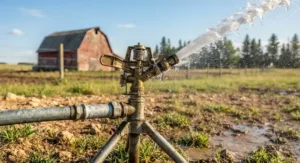
Patterned after Rain Bird’s original 1933 impulse design, the standout here is straight-through flow architecture that keeps the sprinkler running even with sediment-heavy or reclaimed water — a feature most consumer oscillators simply don’t have. The brass, bronze, and stainless-steel build throws water anywhere from 20 to 41 feet depending on the deflector flap setting, and the diffuser screw lets you break the stream into finer droplets for a gentler soak versus a hard-hitting jet. What most buyers overlook about impact sprinklers in general is that their part-circle adjustment (20° to 340° here) makes them genuinely useful for corner lots or L-shaped beds where an oscillator’s rectangle just doesn’t fit the geometry.
This model earns its “professional favourite” reputation honestly: landscapers reach for brass impact heads precisely because the design has barely changed in ninety years, which means parts, troubleshooting guides, and replacement diffusers are everywhere. Aggregated Home Depot reviews are split in an informative way — buyers praise the reach and the classic mechanical tick-tick-tick rhythm, but a recurring complaint involves the spring mechanism weakening under heavy daily use, sometimes within a single season. Homeowners on municipal water with light-to-moderate use report years of trouble-free service; those running it two-plus hours daily report earlier wear.
Pros:
- ✅ Straight-through design handles dirty or well water reliably
- ✅ Full 360° or adjustable part-circle coverage up to 41 ft.
- ✅ All-metal construction outlasts zinc or plastic impact heads
Cons:
- ❌ Spring mechanism can weaken under heavy daily cycling
- ❌ Riser-mounted design needs a hose bib adapter for ground use
Priced in the C$25–C$35 range, the Rain Bird 25PJDA-C Brass Impact Sprinkler is a strong mid-tier pick for anyone who wants the impact-style pattern without committing to a full irrigation system.
3. Orbit Zinc Impact Sprinkler on Step Spike — the budget entry point
The standout feature is right there in the price: a genuinely capable impact head, with an anti-backsplash arm and adjustable deflector shield, at a fraction of the brass alternative’s cost. Coverage runs up to an 85-foot diameter on the step-spike version, which on paper rivals sprinklers costing three times as much. The flow-through outlet means you can daisy-chain two or three of these across a larger property instead of buying one expensive unit, which is a legitimately clever way to cover a big lot on a small budget. Here’s what to weigh, though: zinc isn’t brass, and the die-cast components corrode faster in humid Canadian summers or coastal salt air than the Rain Bird’s metal alloy blend.
This is the sprinkler for a first-time homeowner testing whether impact-style watering suits their lawn before investing in a premium unit, or for anyone who just needs a second or third head to extend coverage across a larger yard. Reviewers on Home Depot and Amazon consistently praise the clog resistance — the flow-through design genuinely shrugs off sediment — while a recurring critique is that the zinc step spike bends in compacted or rocky soil rather than driving in cleanly. It’s a sprinkler built for grass, not gravel-adjacent flower beds.
Pros:
- ✅ Exceptional coverage-to-price ratio, up to 85 ft. diameter
- ✅ Flow-through design allows connecting multiple units in series
- ✅ Anti-backsplash arm keeps water off nearby structures
Cons:
- ❌ Zinc components corrode faster than brass in humid climates
- ❌ Step spike can bend in compacted or rocky soil
At under C$25, the Orbit Zinc Impact Sprinkler on Step Spike is the easiest entry point on this list — an honest budget pick rather than a compromise.
4. Aqua Joe Indestructible Metal Base Oscillating Sprinkler — the durability-first oscillator
Aqua Joe leans hard into its “indestructible” branding, and the standout feature — an extra-long, weatherproof metal base — actually delivers on that promise better than most oscillators in this price tier. The 20 clog-resistant nozzles cover up to 4,400 square feet, with sliding-tab range adjustment and a built-in flow-control knob for fine-tuning water pressure on the fly. What the spec sheet won’t tell you, but reviewers note repeatedly, is that this base survives being dragged across concrete driveways and gravel paths in a way that plastic-sled competitors simply don’t — several long-term owner accounts describe years of daily dragging with the base scuffed but structurally sound.
This model suits households where the sprinkler gets moved constantly — kids, pets, multiple lawn zones — rather than staked once and left alone. Aggregated sentiment from Best Buy and Home Depot reviews is largely positive on build quality and ease of adjustment, with the most common negative theme being the internal oscillation mechanism, which some owners report becoming inconsistent (sticking mid-sweep) after a couple of seasons, even though the metal shell itself holds up.
Pros:
- ✅ Metal base survives dragging across hard surfaces repeatedly
- ✅ Sliding-tab range and flow control offer real customization
- ✅ Built-in clean-out tool simplifies nozzle maintenance
Cons:
- ❌ Internal oscillation mechanism can stick after a few seasons
- ❌ Coverage at low water pressure falls well short of the max rating
Sitting around C$30–C$45, the Aqua Joe Indestructible Metal Base Oscillating Sprinkler is the pick for anyone whose sprinkler leads a hard life.
5. Nelson Rain Train Traveling Sprinkler — the large-lawn specialist
This one isn’t oscillating or impact at all, and that’s exactly the point: for lawns beyond what a stationary sprinkler can reasonably cover, the standout feature is that it moves itself. The cast-iron traveling sprinkler follows your garden hose like a miniature train on tracks, covering up to 13,500 square feet across a 200-foot travel range while adjustable aluminum spray arms handle 15- to 55-foot diameter patterns along the way. An automatic shut-off ramp stops the unit when it reaches the end of the hose, which — based on the spec comparison with manually repositioned sprinklers — eliminates the classic “forgot to move it, now there’s a swamp” problem entirely.
Here’s the honest trade-off: this is a sprinkler for a specific yard profile — large, reasonably flat, with few obstacles — not a general-purpose upgrade. Aggregated reviews from Lowe’s, Walmart, and independent garden-product testers are consistently positive on the core concept but flag a real limitation: the unit can stall or derail in bald patches, sharp hose bends, or on uneven terrain, and heavier hoses slow its travel speed considerably. Owners with four-plus acres describe it as transformative for reducing manual sprinkler-moving; owners who tried it on smaller, bumpier lots report more frequent troubleshooting than watering.
Pros:
- ✅ Covers up to 13,500 sq. ft. without manual repositioning
- ✅ Automatic shut-off prevents overwatering at the hose’s end
- ✅ Durable cast-iron construction built for long-term outdoor use
Cons:
- ❌ Struggles on uneven terrain, thin turf, or sharp hose bends
- ❌ Heavier or longer hoses noticeably slow travel speed
At C$70–C$100, the Nelson Rain Train Traveling Sprinkler costs more upfront than any stationary option here, but for genuinely large lawns it can replace two or three fixed sprinklers outright.
6. Melnor XT Turbo Oscillating Sprinkler with Digital Timer — the set-and-forget option
Bundling the familiar XT Turbo oscillating head with Melnor’s 4-zone digital HydroLogic timer, the standout feature is genuinely practical: up to four independently scheduled start times per day, plus a rain-delay function that pauses watering for up to seven days after precipitation. That rain delay matters more than it sounds — Based on the spec comparison with un-timed sprinklers, it directly reduces the odds of watering a lawn that’s already saturated, which wastes water and can encourage shallow root growth. The 2-way adjustable oscillating head underneath covers up to 4,000 square feet, so you’re not sacrificing the coverage flexibility that makes the base XT Turbo popular.
This bundle is built for the household that wants to “set it and forget it” — vacationers, busy families, or anyone who has ever come home to a lawn that didn’t get watered because life happened. Reviewer sentiment aggregated from Walmart and Home Depot is generally favourable on the convenience factor, with the timer’s programming logic praised as more intuitive than some smart-hose competitors. The most consistent criticism involves water pressure: several owners report the timer’s flow restriction noticeably weakens spray distance compared to running the sprinkler timer-free, which matters most for larger lots near the 4,000 sq. ft. ceiling.
Pros:
- ✅ Four independent start times per day across the schedule
- ✅ Seven-day rain delay reduces wasted watering after storms
- ✅ Combines Melnor’s proven oscillating head with digital control
Cons:
- ❌ Timer can restrict flow, reducing effective spray distance
- ❌ More components mean more potential points of failure
Priced around C$65–C$90 for the bundle, the Melnor XT Turbo Oscillating Sprinkler with Digital Timer costs meaningfully more than the sprinkler alone, but for hands-off convenience it’s hard to beat on this list.
7. Melnor Turbo Rotary Sprinkler with Tripod — the quiet, elevated alternative
Neither a true oscillator nor a classic impact head, this rotary sprinkler’s standout feature is near-silent operation — genuinely useful if you’re watering at 5:30 a.m. before a municipally mandated watering window opens and don’t want to wake the neighbourhood. Six spray patterns (flat, fan, mist, large, mini, and multi) cover up to an 80-foot diameter circle, and the adjustable tripod extends from 27 to 39 inches, which lets the spray clear low shrubs, garden borders, or raised beds that would otherwise block a ground-level sprinkler’s arc. What most buyers overlook about tripod-mounted rotary heads is that the elevation itself improves coverage evenness on lawns with any texture or minor slope, since the water arrives from above rather than skimming sideways.
This is the pick for someone watering ornamental beds mixed with lawn, or anyone in a municipality with strict early-morning or late-evening watering windows where noise is a genuine consideration. Reviewer sentiment aggregated from Melnor’s retail partners and independent garden-product testers highlights the quiet motor and the tripod’s usefulness over taller plantings as the standout strengths, while a recurring complaint targets the spray-distance deflector — described as fiddly to adjust once the water is already running, requiring a shutoff-and-reset approach for precise tuning.
Pros:
- ✅ Near-silent turbo motor suits early or late watering windows
- ✅ Tripod height clears shrubs, borders, and raised beds
- ✅ Six spray patterns adapt to lawns, beds, and mixed plantings
Cons:
- ❌ Spray-distance deflector is fiddly to adjust while running
- ❌ Coverage tops out smaller than full-size oscillating models
At roughly C$40–C$55, the Melnor Turbo Rotary Sprinkler with Tripod rounds out this list as the quiet, versatile alternative for yards that don’t fit neatly into either the oscillating or impact camp.
Practical Usage Guide: Setup, First Use, and Maintenance
Getting any of these sprinklers running well starts before you ever turn on the tap. First, walk your hose path and check for kinks or sharp bends — this matters even more for the Nelson Rain Train Traveling Sprinkler, since a pinched hose can derail its travel entirely, but it also affects flow-restricted oscillators like the Melnor XT Turbo Oscillating Sprinkler with Digital Timer. Second, before your first full watering session, run the sprinkler briefly with the nozzles pointed away from plants to flush out any manufacturing debris or dust that’s collected in the lines — a thirty-second habit that prevents a surprising number of early clogs.
Within the first thirty days, the most common mistake isn’t a hardware failure — it’s mismatched settings. Buyers routinely leave an oscillating sprinkler at its widest, longest setting regardless of actual lawn shape, which wastes water on driveways and sidewalks and defeats the adjustability that justified the purchase in the first place. Take ten minutes with a few sheets of paper or empty tuna cans scattered across the lawn to actually measure your coverage pattern (more on this below) before locking in a schedule.
For ongoing maintenance, a monthly nozzle check keeps things running smoothly: impact sprinklers like the Rain Bird 25PJDA-C Brass Impact Sprinkler and Orbit Zinc Impact Sprinkler on Step Spike benefit from an occasional wipe-down of the deflector arm and spring pivot, while oscillating models need their nozzle rows cleared with the built-in cleaning pin most manufacturers include. At season’s end, drain every unit fully before storage — plastic components in particular are prone to cracking if water freezes inside them over a Canadian winter, and that’s a preventable failure that voids most warranties anyway.
Real-World Scenarios: Matching Sprinklers to Your Yard
The narrow-lot commuter. A townhouse owner with a 20-by-60-foot rectangular backyard and thirty minutes before work each morning doesn’t need 13,500 square feet of coverage — they need precision. The Melnor XT Turbo Oscillating Sprinkler‘s width adjustment fits a strip that size without soaking the neighbour’s fence, and it can run on a basic hose-end timer for a genuinely hands-off routine.
The acreage owner with a well. Someone on five rural acres with well water and sediment concerns is fighting two battles at once: coverage and clog resistance. The Nelson Rain Train Traveling Sprinkler handles the acreage problem, while a budget-conscious approach might pair it with an Orbit Zinc Impact Sprinkler on Step Spike or two for spot coverage near the house, since impact heads’ straight-through design tolerates well-water grit far better than delicate oscillating nozzles.
The busy family juggling a watering bylaw. In municipalities with alternate-day watering restrictions (common across Ontario and much of Western Canada), missing your assigned window means waiting two more days. The Melnor XT Turbo Oscillating Sprinkler with Digital Timer‘s scheduling and rain-delay features directly solve this — set it once at the start of the season, and the household stops thinking about it entirely, short of adjusting for a heat wave.
How to Choose Between an Oscillating Sprinkler and an Impact Sprinkler
- Measure your lawn’s actual shape, not just its area. A 3,000-square-foot rectangle and a 3,000-square-foot L-shape need very different watering patterns — the first suits an oscillator, the second usually needs an impact head’s adjustable arc or two smaller units.
- Check your water source for sediment. Well water or older municipal pipes with occasional grit favour impact sprinklers’ straight-through flow design, which clogs far less than an oscillator’s fine nozzle rows.
- Factor in wind exposure. Oscillating sprinklers’ fine spray drifts more in wind than an impact sprinkler’s heavier stream, so exposed or coastal properties often do better with impact-style watering.
- Consider noise and timing. If municipal bylaws push you toward early-morning or late-evening watering, a quiet rotary or impact sprinkler avoids disturbing sleeping neighbours in ways a loud oscillating motor might not.
- Match lawn size to sprinkler class. Under roughly 4,000 square feet, a quality oscillator usually covers it in one setup; between 4,000 and 6,500 square feet, a mid-tier impact sprinkler often reaches farther per dollar; beyond that, a traveling sprinkler or multiple daisy-chained heads becomes the practical answer.
- Weigh long-term durability against budget. Metal-base oscillators and brass impact heads cost more upfront but resist the cracking and corrosion that shortens the lifespan of budget plastic or zinc alternatives.
- Decide how hands-off you want watering to be. If remembering to turn the tap on and off is a real friction point, a timer-bundled sprinkler removes that variable entirely, at a moderate premium.
Oscillating Sprinkler vs Impact Sprinkler for Lawns: The Detailed Comparison
| Factor | Oscillating Sprinkler | Impact Sprinkler |
|---|---|---|
| Coverage shape | Rectangular fan | Circular or part-circle arc |
| Wind resistance | Lower — fine spray drifts | Higher — heavier stream |
| Water source tolerance | Prone to nozzle clogging | Handles sediment well |
| Noise level | Motor hum, moderate | Mechanical “tick,” moderate-high |
| Typical lawn fit | Square or rectangular lots | Irregular, circular, or large lots |
Reading the table left to right, the pattern is really about geometry meeting physics. An oscillating sprinkler’s back-and-forth fan naturally fills a rectangle efficiently, but that same fine, misting spray is the first thing to scatter in a stiff breeze, which is why exposed properties tend to see disappointing dry patches at the pattern’s edges. Impact sprinklers trade some of that shape precision for raw resilience — a heavier stream reaches farther against wind and shrugs off the kind of sediment that would gum up an oscillator’s delicate nozzle rows within a season. Neither wins on “quiet,” honestly — a turbo oscillating motor’s hum and an impact head’s mechanical tick both carry across a yard at 6 a.m., which is where the tripod-mounted Melnor Turbo Rotary Sprinkler with Tripod earns its keep as the genuinely quiet middle ground.
🔍 Not sure which style fits your yard? Compare the Melnor XT Turbo Oscillating Sprinkler and Rain Bird 25PJDA-C side by side before you decide!
Common Mistakes When Buying a Lawn Sprinkler
The single most common error is buying for advertised coverage rather than effective coverage. Manufacturers test maximum reach under ideal 45–60 PSI water pressure — real household pressure, especially on older plumbing or long hose runs, often falls short, which is why a “4,500 sq. ft.” sprinkler frequently waters closer to 3,600–3,900 sq. ft. in practice. A second mistake is ignoring water source quality entirely; buyers with well water routinely purchase delicate oscillating models, then wonder why the nozzles clog within weeks, when a straight-through impact design would have sidestepped the problem from day one.
Third, shoppers underestimate wind. A sprinkler that performs beautifully in a sheltered backyard demo video can scatter half its water onto a neighbour’s driveway on an exposed, windy lot — a scenario where an impact sprinkler’s heavier stream holds its pattern noticeably better than an oscillator’s fine mist. Finally, many buyers skip checking their municipality’s watering bylaw before purchase, only to discover their new sprinkler’s ideal run time doesn’t fit within an assigned two-hour window — a timer-equipped model, discussed above, solves this retroactively, but checking first saves the extra purchase entirely.
What to Expect: Real-World Performance on Canadian Lawns
Specs on a box rarely translate directly to what actually happens on your grass, and Canadian conditions add their own wrinkles. Cooler spring soil means water penetrates more slowly than the same sprinkler would achieve on warm, dry summer turf, so expect longer run times to reach the same root-zone moisture in May than in July. Regional water pressure also varies meaningfully — older municipal infrastructure in some Ontario and Quebec neighbourhoods runs noticeably below the 45–60 PSI most manufacturers test at, which quietly shrinks every coverage figure on this list by ten to twenty percent.
Wind is the other underrated variable. Prairie properties and anything near open water — the Great Lakes shoreline, the Fraser Valley, coastal Atlantic Canada — see enough consistent breeze that an oscillating sprinkler’s fine spray drifts noticeably, leaving crescent-shaped dry patches downwind even when the pattern looks even on a calm morning. In these conditions, reviewers and irrigation professionals alike tend to favour impact sprinklers’ heavier stream, or recommend running oscillators only during genuinely still early-morning hours.
Water Conservation and Sprinkler Efficiency in Canada
Outdoor watering can account for a substantial share of summer household water use, and the sprinkler you choose has a real effect on how much of that water actually reaches your grass’s roots versus evaporating, drifting onto pavement, or running off. Both oscillating and impact designs lose some water to evaporation simply by spraying it through open air, but the difference in efficiency mostly comes down to how you use them rather than which type you buy: watering during early morning hours (roughly 5:30 to 10 a.m.) cuts evaporation losses significantly compared to midday watering, a principle echoed across Canadian conservation guidance from organizations like the David Suzuki Foundation.
Timer-equipped models — like the Melnor XT Turbo Oscillating Sprinkler with Digital Timer on this list — make consistent early-morning watering effortless, which is precisely where a lot of casual sprinkler use quietly wastes water: running a hose-end sprinkler at 4 p.m. because that’s when someone remembered, rather than at dawn when evaporation is lowest. It’s also worth checking local rules before committing to a watering routine, since many Canadian municipalities enforce alternate-day or scheduled watering bylaws during summer months — Ontario’s Region of Waterloo, for instance, runs a seasonal water conservation by-law restricting outdoor watering to specific days and hours, and similar restrictions exist in many other municipalities across the country. Choosing a sprinkler with genuinely adjustable range and width — rather than one stuck on its widest setting — is itself a conservation measure, since it stops water landing on driveways and sidewalks where it does nothing but run off.
Sprinklers for Large Lawns: Coverage and Water Pressure Considerations
A sprinkler for large lawns faces a different set of constraints than a standard suburban model, and coverage-area marketing numbers become less reliable the bigger the lawn gets. Water pressure drops as you extend hose length, and most residential setups start losing meaningful pressure past 100 feet of hose — which means a sprinkler rated for 4,500 square feet at the tap might only manage 3,000–3,500 square feet effectively once you’re watering the far corner of a large property. For lawns beyond roughly 6,500 square feet, daisy-chaining two or three impact sprinklers — like the Orbit Zinc Impact Sprinkler on Step Spike, whose flow-through outlet is designed for exactly this — often out-performs a single oversized unit, since it distributes water pressure demand rather than concentrating it at one point.
For genuinely expansive, flat properties, the traveling-sprinkler category the Nelson Rain Train Traveling Sprinkler occupies solves the large-lawn problem differently: instead of pushing one stationary unit to throw water farther (which strains water pressure and coverage evenness alike), it physically relocates itself across the property along a hose track. The trade-off, as covered in the product analysis above, is a dependence on relatively flat, obstacle-free terrain — a large lawn with mature trees, garden beds, or noticeable slope will frustrate a traveling sprinkler far more than it would a well-placed pair of impact heads.
Achieving Even Coverage: Understanding Water Coverage Patterns
An even coverage lawn sprinkler sounds like a simple ask, but the physics work against it more than most buyers expect. Every sprinkler — oscillating, impact, or rotary — naturally applies more water near its centre point and less at the pattern’s outer edge, simply because water droplets travelling farther lose momentum and disperse more widely. The result, if you never check it, is a lawn with a lush green ring near the sprinkler and a browner fringe at the coverage boundary, even though the sprinkler is “working fine.”
The fix is a genuinely useful thirty-minute exercise: place four or five identical shallow containers (tuna cans work well) at varying distances from the sprinkler, run it for fifteen minutes, then measure and compare the water depth in each can. This reveals your actual water coverage pattern rather than the manufacturer’s idealized one, and it often shows that overlapping two sprinklers’ outer edges — rather than relying on one unit’s full rated radius — produces far more even results across a real lawn. Oscillating sprinklers with adjustable width and range, like the Melnor XT Turbo Oscillating Sprinkler, make this overlap strategy easier to fine-tune than fixed-pattern impact heads, since you can nudge the fan’s edges to meet a neighbouring zone precisely rather than guessing at radius alignment.
Long-Term Cost & Maintenance
Sprinkler shopping rarely stops at the sticker price, and the honest total-cost-of-ownership picture favours durability over the cheapest upfront option more often than not. A budget zinc impact head like the Orbit Zinc Impact Sprinkler on Step Spike costs under C$25 initially but may need replacing every two to three seasons in humid or coastal climates as the zinc corrodes; a brass equivalent like the Rain Bird 25PJDA-C costs more upfront but reasonably maintained can outlast several zinc replacements, narrowing the real cost gap considerably over five years.
Water bills factor in too, and this is where sprinkler choice compounds with habits. A sprinkler running an extra fifteen minutes daily to compensate for wind-scattered spray or an unmeasured coverage pattern adds up over a full watering season — often more than the price difference between a budget and premium unit. Timer-equipped models carry a higher purchase price but tend to pay that back through more disciplined, evaporation-minimizing schedules; households genuinely committed to hand-timing their watering sessions can achieve similar savings without the extra hardware cost, but in practice, few people maintain that discipline all summer. For a broader look at trimming household water use beyond the sprinkler itself, municipal resources like Calgary’s guide to saving water at home offer a useful year-round checklist.
Frequently Asked Questions
❓ Is an oscillating sprinkler or impact sprinkler better for a large lawn?
❓ How long should I run my sprinkler for a healthy Canadian lawn?
❓ Do impact sprinklers use more water than oscillating sprinklers?
❓ Can I use an oscillating sprinkler on well water?
❓ What's the best sprinkler for an irregularly shaped lawn?
Conclusion
There’s no single winner in the oscillating sprinkler vs impact sprinkler for lawns debate, and honestly, anyone promising you one is oversimplifying. What actually matters is matching the sprinkler’s pattern, durability, and adjustability to your specific lawn — its shape, its water source, its exposure to wind, and the watering bylaw your municipality happens to enforce. A tidy rectangular yard on decent municipal pressure is squarely oscillator territory, where the Melnor XT Turbo Oscillating Sprinkler or its timer-equipped sibling earns its keep. An irregular lot, a windy exposure, or well water with sediment tips the scales toward impact sprinklers like the Rain Bird 25PJDA-C or the budget-friendly Orbit Zinc Impact Sprinkler on Step Spike. And for lawns that dwarf both categories’ practical coverage, the Nelson Rain Train Traveling Sprinkler or a daisy-chained set of impact heads solves a problem neither oscillating nor single-point impact watering can.
Whichever direction you land on, the analysis above — the coverage-pattern test, the early-morning watering habit, the bylaw check — matters more than the brand name on the box. A well-matched, correctly scheduled budget sprinkler consistently outperforms an expensive, mismatched one. Start with your lawn’s actual shape and size, work backward from there, and the right pick tends to become obvious fairly quickly.
✨ Don’t Miss These Exclusive Deals!
🔍 Take your lawn care to the next level with these carefully selected sprinklers. Click on any highlighted product to check current pricing and availability on Amazon.ca. These tools will help you build the even, healthy, water-wise lawn your family will actually enjoy!
Recommended for You
- Watering Can for Large Outdoor Pots: 7 Top Picks for 2026
- 7 Best Watering Cans for Indoor Plants in 2026: Expert Guide
- 7 Best Expandable Garden Hose Under $50 CAD Picks for 2026
Disclaimer: This article contains affiliate links. As an Amazon Associate, I earn from qualifying purchases. If you purchase products through these links, we may earn a small commission at no additional cost to you.
✨ Found this helpful? Share it with your friends! 💬🤗
