
In This Article
Every spring in Canada, the same scene plays out in backyards from Victoria to Halifax. The snow finally retreats, the ground thaws, and eager gardeners head outside with their pruners — often using the wrong tool entirely. I’ve seen it happen too many times: a gardener attacking fresh rose canes with an anvil pruner, leaving crushed stems that turn black within a week. Or someone trying to hack through a thick, dead apple tree branch with a delicate bypass pruner and snapping the blade clean off.
The debate between bypass vs anvil pruners is one of those topics that looks simple on the surface but actually determines the health of your entire garden. In short, bypass pruners work like scissors — two curved blades slide past each other to create a clean, precise slice through living tissue. Anvil pruners drive a single sharpened blade downward onto a flat metal plate, creating a powerful crushing action better suited for dead or dry wood. Choose the wrong one for the wrong job and you’re either damaging your plants or destroying your tools.
For Canadian gardeners specifically, this decision carries extra weight. Our climate runs a wider gamut than almost any country on earth — from BC’s mild coastal winters to Alberta’s brutal -30°C deep freezes, from Ontario’s slushy springs to the Maritimes’ perpetual dampness. The pruning tools you choose need to handle sap-gummed blades in humid summers, corrode-resistant finishes through salt-laden coastal air, and pivot mechanisms that don’t seize up after spending months in an unheated garage.
In this guide, I’ll walk you through the real mechanics behind each cutting mechanism, compare 7 top-rated products available on Amazon.ca, and give you a clear framework for matching the right pruner to your garden type, your budget in CAD, and your Canadian climate. Whether you’re tending a compact Toronto condo garden, maintaining a sprawling rural property in Saskatchewan, or working through the overgrown aftermath of a Québec ice storm, this guide has you covered.
Quick Comparison: Bypass vs Anvil Pruners at a Glance
| Feature | Bypass Pruners | Anvil Pruners | Ratchet Pruners |
|---|---|---|---|
| Cutting action | Scissor-like | Single blade on flat plate | Staged ratcheting mechanism |
| Best for | Live, green wood | Dead, dry branches | Thick/tough material; weak hands |
| Plant tissue impact | Minimal — clean slice | Can crush live tissue | Moderate — depends on mechanism |
| Hand effort required | Moderate | Lower (blade does more work) | Lowest (ratchet multiplies force) |
| Blade maintenance | Needs regular sharpening | Easier to maintain | Moderate |
| Ideal Canadian use | Spring rose pruning, fruit trees | Post-winter deadwood clearing | Arthritis sufferers; heavy clearing |
| Price range (Amazon.ca) | $20–$110+ CAD | $20–$50 CAD | $25–$55 CAD |
| Best For | Precision, plant health | Power, dead material | Accessibility, heavy-duty tasks |
The table above captures the core split well, but here’s what it doesn’t show: the context matters as much as the mechanism. A bypass pruner at $25 CAD will struggle on the same branch that a $30 CAD ratchet anvil model handles in a single squeeze. And using a powerful anvil pruner on your prized Japanese maple — even once — can introduce disease entry points that linger for years. The right pruner for the right job is genuinely the difference between a thriving garden and a stressful one.
💬 Just one click — help others make better buying decisions too! 😊
✨ Don’t Miss These Exclusive Deals!
🔍 Take your pruning game to the next level with these carefully selected products. Click on any highlighted item to check current pricing and availability on Amazon.ca. These tools will help you create a healthier, more beautiful Canadian garden!
Top 7 Pruners for Canadian Gardeners: Expert Analysis
1. Felco F-2 Classic Manual Hand Pruner — The Gold Standard for Serious Gardeners
If there’s one pruner that professional horticulturists, arborists, and passionate home gardeners agree on without much debate, it’s the Felco F-2. Swiss-made since 1945, this bypass pruner has earned its cult status for reasons that become obvious the moment you make your first cut. The hardened steel blade slides through branches up to 2.5 cm (1 inch) in diameter with a precision that genuinely feels satisfying — not like work.
The forged aluminium handles keep the weight down to around 230 g (8 oz), which matters enormously if you’re spending a full Saturday pruning a mature orchard in the Okanagan or working through an overgrown hedge in suburban Mississauga. What most Canadian buyers overlook is the sap groove machined into the blade — in our hot, humid Ontario summers or on BC’s evergreens, sap build-up is a constant problem that turns a good pruner into a sticky, frustrating mess. The Felco F-2’s groove prevents that sticking mid-cut, saving you constant wiping. The replaceable blade and spring mean this pruner can genuinely last decades rather than seasons — when you factor that in, the higher price tag in CAD makes considerably more sense as a long-term investment.
Canadian reviewers on Amazon.ca frequently mention that the forged aluminium handles hold up beautifully through wet coast winters and that the shock absorber — a small rubber cushion between the handles — saves wrist fatigue during extended pruning sessions. This is the pruner I’d recommend to any serious gardener who wants to buy once and stop thinking about it.
✅ Swiss-made precision blade retains edge longer than most competitors
✅ Fully replaceable parts — available through Canadian distributors
✅ Sap groove prevents sticking on resinous Canadian conifers and fruit trees
❌ Premium price in CAD — a real investment for budget-conscious buyers
❌ Sized for medium-to-large hands; may not suit smaller hands without fitting
Price range: Around $70–$110 CAD depending on availability. Verified available on Amazon.ca.
Value verdict: If you garden seriously, this is the last bypass pruner you’ll ever buy.
2. Fiskars SoftGrip Bypass Pruning Shears — The Best Budget Bypass for Canadian Beginners
Fiskars is the Finnish brand that quietly dominates the Canadian garden tool market, available everywhere from Canadian Tire to Amazon.ca, and for good reason. The SoftGrip Bypass Pruning Shears punch well above their price class. The all-steel precision-ground blade handles stems and green branches up to 1.6 cm (5/8 inch) in diameter, and the low-friction coating is legitimately useful — it genuinely helps the blade glide through the sticky, sap-heavy wood you’ll encounter when pruning fruit trees or roses after a warm, damp Canadian summer.
What’s clever about this model is the integrated sap groove, borrowed from professional-grade pruners but offered here at a fraction of the price. The non-slip SoftGrip handle is comfortable through a full afternoon session, and the easy-open safety lock is intuitive enough that you won’t fumble with it barehanded in the garden, but it’s secure enough to not accidentally deploy in your tool bag. For Canadian buyers on a tight budget who want reliable bypass performance for routine garden maintenance — trimming perennials, cutting roses, shaping small shrubs — this is the straightforward answer. It’s backed by a full lifetime warranty, which Fiskars Canada honours without significant fuss.
Canadian reviewers praise the lightweight feel (around 180 g / 6.4 oz) and note it handles spring pruning sessions well, though several mention the blade dulls faster than premium options after a full season of heavy use. The smart move is to grab a basic whetstone alongside this purchase and give it a quick touch-up each spring.
✅ Excellent value for the price — widely available on Amazon.ca
✅ Lifetime warranty honoured in Canada
✅ Low-friction coating reduces sap adhesion in humid conditions
❌ Blade loses its edge more quickly than premium options under heavy use
❌ 5/8-inch capacity means it’s not suitable for anything beyond light-to-moderate branches
Price range: Around $20–$35 CAD. Prime-eligible on Amazon.ca — great for free shipping.
Value verdict: The smartest starting point for any Canadian gardener entering the bypass vs anvil pruners conversation.
3. Fiskars PowerGear2 Bypass Pruning Shears — Maximum Bypass Power for Thick Branches
The PowerGear2 represents Fiskars’ most intelligent engineering in hand pruners. The patented gear mechanism built into the handle multiplies your cutting force by up to 3x compared to standard bypass pruners — which, in real terms, means you can cut through branches up to 2 cm (3/4 inch) in diameter that would tire your hand on a conventional model. This is the pruner I’d hand to any Canadian gardener dealing with established shrubs, mature rose canes, or the kind of woody growth that builds up on a neglected property over several winters.
The contoured rolling handle is an underrated feature. It’s designed to reduce rotational friction as you squeeze, which translates to dramatically less fatigue during extended pruning sessions. If you’ve ever finished a long pruning day with sore palms and tired forearms, you’ll immediately appreciate what this handle geometry does. The hardened steel bypass blade maintains the clean-cut quality essential for plant health, so you’re not trading precision for power — you’re getting both. Available in Canada on Amazon.ca and widely stocked at major retailers, making replacement parts and accessories accessible without cross-border shipping headaches.
✅ Gear mechanism multiplies cutting force — ideal for thick Canadian shrubs and rose canes
✅ Rolling handle design significantly reduces hand fatigue on extended use
✅ Still delivers clean bypass cut quality for living plant tissue
❌ Heavier than basic bypass pruners — around 280 g (10 oz)
❌ The gear mechanism adds a small amount of bulk to handle if you have very small hands
Price range: Around $40–$55 CAD on Amazon.ca.
Value verdict: The smart middle-ground for gardeners who need bypass quality but deal with substantial branch thicknesses regularly.
4. Fiskars Power-Lever Anvil Pruner — The Workhorse for Canadian Deadwood Clearing
If your spring gardening to-do list involves clearing the aftermath of a Canadian winter — storm-snapped branches, frost-killed shrubs, dried perennial stalks that have been frozen solid since November — the Fiskars Power-Lever Anvil Pruner is built exactly for that job. The anvil mechanism drives a single hardened steel blade down onto a flat plate, generating far more cutting force than a comparable bypass model, and the Power-Lever gearing amplifies that force further. It handles dead, dry wood up to 2 cm (3/4 inch) in diameter without the straining effort that a bypass pruner would require on the same material.
Here’s the important distinction that the spec sheet won’t spell out: anvil pruners are not the enemy of plant health when used correctly. The crushing action that damages live tissue is actually ideal for dead wood — the brittle, dried cells don’t “heal,” so crushing versus slicing makes zero biological difference. What you do get with the anvil mechanism is the ability to tackle harder, tougher material with significantly less hand effort. After a particularly harsh Canadian winter — think the kind of February that leaves half your perennial border looking grey and dead — having a reliable anvil pruner makes the cleanup job genuinely manageable rather than exhausting.
Canadian reviewers note that this model holds up well to repeated heavy use and that the blade’s non-stick coating reduces maintenance time between sessions — a small but meaningful benefit when you’re working through a large property.
✅ Power-Lever gearing handles tough deadwood with minimal hand strain
✅ Non-stick blade coating simplifies cleanup after Canadian winter clearing
✅ Excellent value for the anvil category — widely available on Amazon.ca
❌ Not suitable for live, green wood — will damage living tissue
❌ Single-blade mechanism is harder to sharpen precisely than bypass blades
Price range: Around $30–$45 CAD on Amazon.ca.
Value verdict: Every Canadian garden needs at least one good anvil pruner for post-winter deadwood duty — this is the easiest recommendation in the anvil category.
5. gonicc GPPS-1003 Premium Titanium Bypass Pruning Shears — A Serious Mid-Range Contender
The gonicc GPPS-1003 sits in an interesting position in the bypass vs anvil pruners market: it delivers features you’d expect from a pruner costing twice as much, at a price point that makes it one of the best value propositions on Amazon.ca for Canadian buyers. The titanium-coated blade resists corrosion particularly well — an important consideration in coastal BC, the damp Maritimes, or anywhere you’re dealing with repeated wet conditions. The Teflon coating on the blade surface actively prevents sap adhesion, which keeps your cuts clean and reduces the constant wiping that makes pruning tedious.
At 20 cm (8 inches) in total length, the GPPS-1003 is sized for medium-to-large hands, and the comfortable rubber-wrapped aluminium handles provide good grip even with garden gloves on — which matters for the six or seven months of the year when bare-handed Canadian gardening isn’t entirely comfortable. The sap groove design reduces sticking on resinous conifers and fruit trees, and the blade cuts cleanly through stems and branches up to 2 cm (3/4 inch) in diameter. With over 30,000 reviews globally and strong ratings, the track record speaks for itself.
The gonicc brand is less well-known in Canada than Fiskars or Felco, but it ships via Amazon.ca Prime with standard delivery times, and the build quality is genuinely impressive for the price point. Buyers with smaller hands have flagged the 8-inch length as slightly large, but most average-to-large-handed gardeners find it very comfortable.
✅ Titanium + Teflon blade coating offers superior corrosion resistance in wet Canadian conditions
✅ Outstanding value relative to blade quality and build
✅ Available with Prime shipping on Amazon.ca
❌ Sized better for medium-to-large hands — smaller-handed gardeners should check Fiskars first
❌ Less brand recognition in Canada means fewer local service options
Price range: Around $30–$45 CAD on Amazon.ca.
Value verdict: If you want the feel of a premium bypass pruner at a mid-range price, the GPPS-1003 is your best option in this segment.

6. gonicc GPPS-1011 Professional Ratchet Anvil Pruning Shears — For When Strength Meets Strategy
The GPPS-1011 introduces ratchet pruning shears into the bypass vs anvil pruners conversation, and it belongs here because it solves a genuinely common Canadian problem: what do you do with thick, stubborn deadwood that overwhelms even a good anvil pruner on a single squeeze? The three-stage ratcheting mechanism answers that question elegantly. You press once to begin the cut, release, press again for 2x the force, release, press a third time for up to 4x the original cutting power — and the mechanism latches onto the branch at each stage, so you don’t lose your position. It’s particularly effective on the kind of bone-dry, weather-hardened branches you’ll find after a Prairie winter.
Chrome vanadium steel construction adds durability without excessive weight, and the reinforced handle design distributes grip force more evenly than standard anvil models. For Canadian gardeners dealing with arthritis, reduced hand strength, or simply a lot of very tough clearance work, the ratchet mechanism is genuinely life-changing — not an exaggeration. What most buyers overlook is that ratchet pruners also extend the useful lifespan of your hands during a long pruning session, reducing cumulative strain even if strength isn’t an issue. Available on Amazon.ca with Prime delivery.
✅ Three-stage ratchet multiplies cutting force by up to 4x — handles serious deadwood
✅ Ideal for arthritis sufferers or gardeners with reduced hand strength
✅ Chrome vanadium steel body offers good durability at an accessible CAD price
❌ Anvil mechanism only — not appropriate for live green wood
❌ Ratchet adds a small amount of complexity; occasional beginners find it confusing at first
Price range: Around $25–$40 CAD on Amazon.ca.
Value verdict: If heavy-duty clearing is a regular part of your Canadian garden maintenance, this ratchet model earns its place in your tool kit without much debate.
7. Corona RP 3230 Ratchet Hand Pruner — The Professional’s Ratchet Choice
Corona Tools has been making professional-grade pruning equipment since 1928, and the RP 3230 Ratchet Hand Pruner represents that long institutional knowledge in a compact, practical package. The ratcheting mechanism provides staged cutting power with a 2 cm (3/4 inch) cut capacity, and the build quality feels unmistakably professional — there’s a solidity to the pivot and a consistency to the ratchet action that cheaper alternatives don’t quite replicate. Corona’s commitment to quality manufacturing means this pruner is built to be serviced and maintained, not thrown away at the end of a season.
What distinguishes the RP 3230 from the gonicc ratchet model above is the overall feel and precision of the ratchet action. It’s smoother, more controlled, and delivers a more consistent staged cut — noticeable when you’re doing careful clearance work around valued plants where you want power without being ham-fisted. Canadian buyers will appreciate that Corona products are widely supported across North America, which means replacement blades and parts are genuinely findable without waiting for international shipping. Available on Amazon.ca, it’s a worthy option for any serious Canadian gardener who uses their pruners heavily.
✅ Professional-grade build quality with smooth, consistent ratchet action
✅ Well-supported brand with accessible parts across North America
✅ Ideal for both homeowners with heavy clearance needs and professional landscapers
❌ Slightly higher price point than gonicc ratchet alternative
❌ Pure ratchet anvil design means it’s not a substitute for a bypass pruner on live wood
Price range: Around $35–$50 CAD on Amazon.ca.
Value verdict: Worth the premium over budget ratchet alternatives if you use your pruners professionally or very regularly through Canadian gardening seasons.
Practical Usage Guide: Getting the Most from Your Pruners in Canadian Conditions
Understanding the bypass vs anvil pruners distinction is only half the battle — how you use and maintain your tools through Canada’s demanding seasonal cycle determines whether they last one season or twenty.
Spring opening-up: Your pruners have been sitting in a garage or shed through a Canadian winter. Before your first cut in April or May, disassemble the pivot bolt, wipe all metal surfaces with a lightly oiled cloth, and check the blade for any frost-related micro-pitting. Even a brief wipe with camellia oil or food-grade mineral oil will dramatically extend blade life. If the pivot is stiff, a single drop of machine oil in the hinge is all you need.
During the season: Sap adhesion is the silent enemy of clean cuts. After pruning any resinous wood — cedars, pines, fruit trees — wipe your blade with rubbing alcohol or a drop of lemon essential oil (a trick recommended by the Canadian Wildlife Federation’s garden tool care guide) before moving on to the next plant. Transferring sap-borne pathogens between plants is a real disease risk, not a theoretical one. For bypass pruners in particular, a sap-coated blade delivers ragged cuts even when the steel itself is still sharp.
Autumn winterization: Before your tools go into storage, deep-clean the blade using warm soapy water and a nail brush, then dry thoroughly — moisture trapped in the pivot mechanism rusts from the inside out through a Canadian winter, and you won’t know until spring when the blade won’t open. Sharpen the blade (bypass pruners require maintaining the original bevel angle; anvil blades are sharpened flat), then apply a protective coating of machine oil or WD-40. Store hanging, not lying flat on a concrete floor, where moisture from freeze-thaw cycles accelerates rust on any metal surface. A quality bypass pruner stored properly through a Canadian winter will emerge in spring as sharp and functional as it went in.
Sharpening: Bypass pruners should be sharpened on the bevelled face of the cutting blade only — sharpening the flat inner face destroys the geometry that makes the scissor action work. Anvil blades are sharpened flat on both sides. A simple diamond whetstone or pull-through sharpener handles either type and costs under $20 CAD on Amazon.ca.
Real-World Canadian Scenarios: Which Pruner Suits Your Garden?
The bypass vs anvil pruners choice becomes concrete when you match it to actual Canadian gardening situations. Here are three profiles I see most commonly:
The Urban Toronto or Vancouver Condo Gardener: You have a balcony container garden with roses, herbs, and maybe a small dwarf citrus. Your pruning tasks are predominantly live stems, fresh growth, and the occasional rose cane in spring. You need one good bypass pruner — the Fiskars SoftGrip at the $20–$35 CAD range is all you need and it stores easily. You’ll never use an anvil pruner, and a ratchet model would be overkill. Prioritize the lightweight, compact design.
The Suburban Ontario or Alberta Property Owner: You have a mature garden with fruit trees, established rose beds, ornamental shrubs, and a border that needs cutting back every autumn. You need both a bypass and an anvil pruner. My suggested pairing: the gonicc GPPS-1003 bypass for all your live-wood work (strong value for the price, titanium coating handles humid Ontario summers well) and the Fiskars Power-Lever Anvil for your autumn and spring deadwood clearing. Total investment: around $60–$90 CAD — genuinely excellent value for a two-tool kit that covers every pruning task in a typical suburban Canadian garden.
The Rural or Acreage Gardener in Saskatchewan, Manitoba, or Northern Ontario: You’re dealing with established hedges, mature fruit trees with thick branches, post-winter storm cleanup, and a lot of ground to cover. Efficiency and power matter as much as precision. I’d suggest the Felco F-2 as your primary bypass pruner for valued plants and precision work — the replaceable-blade design means you’re never without a sharp tool — plus the gonicc GPPS-1011 Ratchet Anvil for heavy clearing sessions. The ratchet mechanism genuinely reduces the hand fatigue that accumulates over a full day’s work, which matters on a large property.
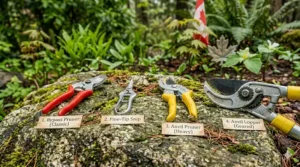
How to Choose Pruning Shears in Canada: A Practical Framework
Selecting from the bypass vs anvil pruners spectrum isn’t complicated once you ask the right questions. Here’s the framework I use:
1. What are you cutting most often? Live green wood → bypass. Dead or dry branches → anvil or ratchet. Mixed tasks → one of each.
2. How thick is the material? Stems under 1.5 cm (1/2 inch) → standard bypass. Branches 1.5–2.5 cm (1/2–1 inch) → PowerGear bypass or ratchet. Over 2.5 cm → loppers or a saw.
3. How strong are your hands? No issues → any type. Mild fatigue → PowerGear or ergonomic grip models. Arthritis or reduced strength → ratchet pruner, full stop.
4. What’s your budget in CAD? Under $35 → Fiskars SoftGrip (bypass) or gonicc ratchet. $35–$60 → Fiskars PowerGear2 or Corona RP 3230. Over $60 → Felco F-2 for a lifetime investment.
5. Canadian climate considerations: Wet coastal conditions (BC, Maritimes) → prioritize stainless or titanium-coated blades for corrosion resistance. Cold Prairie winters → ensure your chosen model can be properly dried and oiled for winter storage. Spring thaw pruning → keep a dedicated bypass for fresh live growth as soon as temperatures allow.
According to Agriculture and Agri-Food Canada’s plant health resources, maintaining clean, sharp tools is one of the primary mechanisms for preventing the spread of bacterial and fungal disease between garden plants — a fact that makes the case for quality bypass pruners on live wood even more compelling.
Bypass vs Anvil Pruners: The Cutting Mechanism Comparison in Depth
The fundamental science here is worth understanding once, because it explains every practical recommendation in this guide. As detailed by botanical sources on pruning mechanics, the cambium layer — the thin growth tissue just beneath the bark — is responsible for wound healing in plants. A bypass pruner’s scissor action creates a clean incision that allows the cambium to form a callus over the cut relatively quickly. An anvil pruner, by contrast, compresses the tissue on the lower side of the cut before the blade severs it, which damages or destroys the cambium zone on that side. On live wood, this slows healing and creates an entry point for pathogens.
The practical result: bypass pruners on live wood produce healing wounds; anvil pruners on live wood produce damaged wounds. On dead wood, none of this applies — there’s no cambium to protect — which is why anvil pruners are ideal for deadwood clearing without any plant health downside.
Ratchet pruning shears add a third mechanism to the bypass vs anvil pruners equation. They use a staged mechanical advantage to multiply hand force over multiple squeezes, typically delivering 3x to 4x the cutting power of a direct-squeeze model. Most ratchet pruners use an anvil cutting head, which makes them best suited to dead, tough material where that power advantage is most needed. The ratchet mechanism is not a substitute for blade sharpness — a dull ratchet pruner still produces a poor cut, just with less effort.
Common Mistakes When Buying Pruners in Canada
Mistake 1: Buying only one type. The most frequent error I see. Bypass and anvil pruners are complementary tools, not competing ones. A garden that involves both living plants and seasonal deadwood clearing needs both types. The good news: you can cover both tasks for under $70 CAD with smart product selection.
Mistake 2: Ignoring corrosion resistance for Canadian conditions. Many cheaper pruners use basic carbon steel blades without protective coatings. In BC’s coastal humidity, Ontario’s wet springs, or the Maritimes’ salt air, an uncoated blade can develop surface rust after a single season of outdoor use. Look for Teflon, titanium, or low-friction coatings — especially on the models you’ll use most frequently.
Mistake 3: Neglecting cross-border warranty realities. Some imported pruners sold on Amazon.ca are technically covered by US-only warranties. Before purchasing, confirm that the warranty is honoured by a Canadian distributor or through Amazon.ca’s own return policy. Felco Canada and Fiskars Canada both have clear Canadian warranty support — a meaningful advantage over lesser-known brands.
Mistake 4: Buying by price alone. A $15 CAD pruner that dulls after one pruning season and then needs replacement is more expensive than a $70 CAD model that lasts a decade. Factor the cost-per-season when making your decision, particularly for your primary bypass pruner.
Mistake 5: Choosing the wrong size for your hands. Pruner handles are not one-size-fits-all. Most standard pruners are sized for medium-to-large hands. If you have small hands, specifically search for “small hand” or “compact” models — Felco offers multiple sizes, and Fiskars has several ergonomic options specifically sized for smaller grips. A poorly fitting pruner accelerates hand fatigue and reduces cutting precision significantly.
✨ Don’t Miss These Exclusive Deals!
🔍 Ready to upgrade your pruning tool kit? Click on any highlighted product name to check current pricing and availability directly on Amazon.ca. Your Canadian garden will thank you this spring!
Long-Term Cost and Maintenance in Canada
The real cost of a pruner over five years is rarely the sticker price. Let’s break it down honestly in Canadian context.
A basic bypass pruner in the $20–$25 CAD range typically needs replacement every 1–2 seasons under regular use — the blade dulls to the point where home sharpening no longer restores the edge, and the pivot wears enough to cause blade wobble. Over five years, you’re spending $50–$75 CAD and generating unnecessary waste.
A mid-range pruner in the $35–$55 CAD range — Fiskars PowerGear2, gonicc GPPS-1003 — typically lasts 3–5 seasons with proper maintenance, sharpenable at home, and available in some cases with replacement blades. Five-year cost: $35–$55 CAD plus maybe $10–$15 CAD for a basic sharpening tool. Significantly better value.
The Felco F-2 at $70–$110 CAD has a known lifespan of 10–20 years or more with regular maintenance and blade replacement. The replacement blade costs around $25–$35 CAD and takes five minutes to swap. Over ten years, your total cost might be $100–$145 CAD — considerably less per year than any budget alternative, and with zero compromise in performance throughout.
For anvil and ratchet pruners, the calculus is somewhat different — these tools see less finicky use and the blades are more forgiving to sharpen at home, so a good mid-range anvil model in the $30–$45 CAD range will serve most Canadian gardeners well for many years without significant additional cost.
FAQ: Bypass vs Anvil Pruners for Canadian Gardeners
❓ Which is better for Canadian rose pruning — bypass or anvil pruners?
❓ Can I use anvil pruning shears on live plants at all?
❓ Are ratchet pruning shears available on Amazon.ca with Prime shipping?
❓ How do I maintain bypass pruners through a Canadian winter?
❓ Do bypass pruners work for pruning thick branches in Canada?
Conclusion: Build Your Canadian Pruner Kit With Intention
The bypass vs anvil pruners debate has a simple answer once you accept that it’s not actually a binary choice. These are two fundamentally different tools designed for different jobs, and the best Canadian gardeners keep both in their shed — just as you wouldn’t use a flathead screwdriver where a Phillips is needed, you shouldn’t reach for an anvil pruner when your roses need trimming, or grab your delicate bypass shears to clear post-winter deadwood.
My practical recommendation for most Canadian gardeners: start with the Fiskars SoftGrip Bypass for an affordable entry into quality bypass cutting, then add a Fiskars Power-Lever Anvil for deadwood clearance. That combination covers 90% of typical garden tasks for under $60 CAD. If you’re ready to invest more seriously, the Felco F-2 as your primary bypass pruner is a purchase you’ll make once and genuinely never regret. For anyone dealing with hand strength challenges, the gonicc GPPS-1011 ratchet model is simply the best accessible solution in this category.
Canada’s growing season is short and precious. Every hour you spend fighting with the wrong pruning tool is an hour not spent actually gardening. Choose your tools thoughtfully, maintain them through our demanding winters, and your garden will show the difference.
✨ Don’t Miss These Exclusive Deals!
🔍 Ready to invest in the right pruning tools for your Canadian garden? Check current pricing and availability on Amazon.ca for any of the products highlighted in this guide. Your spring pruning session will be better for it!
Recommended for You
- 7 Best Pruning Shears in Canada (2026): Tested for Real Gardens
- 7 Best Garden Trowels in Canada (2026): Top Picks & Buying Guide
- 7 Best Window Box Planters Canada 2026
Disclaimer: This article contains affiliate links. As an Amazon Associate, I earn from qualifying purchases. If you purchase products through these links, we may earn a small commission at no additional cost to you.
✨ Found this helpful? Share it with your friends! 💬🤗
