
In This Article
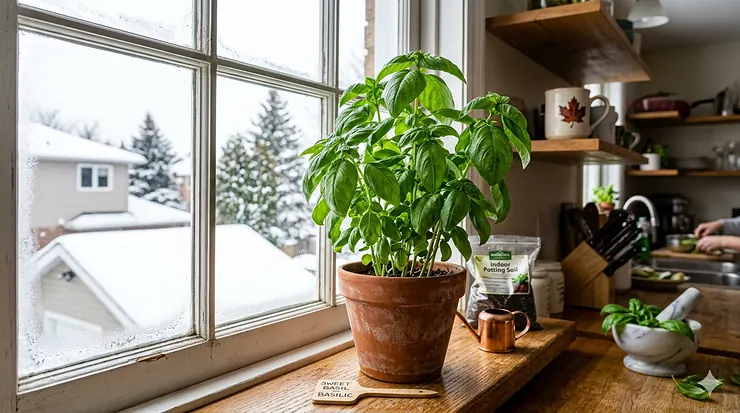
Picture this: it’s minus 20°C outside in February, snow is piling up against your windows, and you’re snipping fresh, aromatic basil leaves from thriving plants on your kitchen counter. Sounds impossible? It’s not. Growing basil seeds for indoor growing has become one of the fastest-growing hobbies among Canadian households, and for good reason.
According to Statistics Canada, 21% of Canadian households grew fruit, herbs, vegetables or flowers indoors in 2021, a trend driven by our country’s notoriously short outdoor growing season. Unlike our American neighbours who enjoy eight-month gardening seasons, most Canadians face frost from October through April — making indoor herb cultivation less of a hobby and more of a necessity if you want fresh flavours year-round.
What is basil seeds for indoor growing? These are specially packaged herb seeds — typically heirloom, non-GMO varieties like Genovese, Thai, lemon, and purple basil — selected for their adaptability to container gardening and indoor conditions. Unlike outdoor garden seeds that need extensive space and seasonal timing, basil seeds for indoor growing thrive in 15-20 cm pots under grow lights or south-facing windows, producing harvestable leaves in as little as 3-4 weeks.
The beauty of starting from seed rather than buying supermarket basil plants? You’ll pay around $4-8 CAD for a packet containing 200-1,750+ seeds versus $4-6 for a single grocery store plant that often dies within two weeks. One seed packet can keep you in fresh basil for an entire year, and you’ll access exotic varieties like Thai basil or purple opal that rarely appear in Canadian stores.
But here’s what most beginners overlook: not all basil seed varieties perform equally well indoors, especially in Canadian homes where winter humidity drops to 20-30% and natural light becomes scarce. Some varieties bolt (flower prematurely) under artificial lighting, while others struggle with the dry air from forced-air heating systems common in Canadian construction. This guide cuts through the marketing fluff to show you which basil seeds for indoor growing actually deliver results in real Canadian conditions — from Toronto condos to Vancouver apartments to rural Manitoba farmhouses.
Quick Comparison Table
| Product | Variety Count | Seed Count | Best For | Price Range (CAD) |
|---|---|---|---|---|
| Sweet Yards Organic Basil Variety Pack | 8 varieties | 2,000+ | Variety enthusiasts | $18-24 |
| HOME GROWN Genovese Basil | 1 variety | 1,750+ | Pesto lovers | $8-12 |
| Gardeners Basics 8-Variety Pack | 8 varieties | 1,600+ | Beginner-friendly | $15-20 |
| Sustainable Seed Co. Deluxe Collection | 5 varieties | 1,000+ | Culinary diversity | $16-22 |
| Survival Garden Seeds Mix | 5 varieties (blended) | 800+ | Space-savers | $10-14 |
| Urban Leaf Basil Variety Pack | 6 varieties | 900+ | Compact growing | $14-19 |
| Organo Republic 7-Variety Pack | 7 varieties | 1,900+ | Budget buyers | $12-16 |
💬 Just one click — help others make better buying decisions too! 😊
Top 7 Basil Seeds for Indoor Growing: Expert Analysis
1. Sweet Yards Organic Basil Seeds Variety Pack — The Premium All-Rounder
If you’re serious about having a symphony of basil flavours at your fingertips year-round, the Sweet Yards Organic Basil Variety Pack stands as the gold standard for Canadian indoor growers. This certified organic collection delivers eight distinct varieties: Genovese, Thai, Lemon, Greek, Cinnamon, Purple Dark Opal, Italian Large Leaf, and Tulsi (Holy Basil) — each in its own resealable packet with clear growing instructions.
What sets this apart for Canadian conditions? The organic certification means these seeds haven’t been treated with fungicides or synthetic coatings — important because indoor humidity control can make untreated seeds more vulnerable to damping off disease. But here’s the trade-off most reviewers don’t mention: organic seeds sometimes show 5-10% lower germination rates than conventional seeds because they lack protective treatments. To compensate, Sweet Yards packs generous quantities (200-300 seeds per variety, totalling 2,000+), so even accounting for typical 80-85% germination, you’ll have more than enough.
The variety selection is particularly clever for Canadian indoor growers. Genovese and Italian Large Leaf thrive under the 12-14 hours of supplemental grow light that most Canadian homes need from November through March. Thai basil — with its distinctive anise flavour and purple stems — is more compact, making it perfect for windowsill cultivation in condos where space is premium. The inclusion of Cinnamon and Lemon basil gives you options beyond the standard Italian varieties, and Tulsi (Holy Basil) brings medicinal properties valued in Ayurvedic tradition.
Canadian customers report strong performance across the board, with most varieties sprouting within 5-7 days at room temperature (20-22°C). The resealable packaging is practical for our long winters — you can start small batches every 3-4 weeks rather than sowing everything at once.
Pros:
✅ Certified organic with no synthetic treatments
✅ Eight distinct flavour profiles from classic to exotic
✅ Generous seed counts (2,000+ total seeds)
Cons:
❌ Higher price point ($18-24 CAD)
❌ Organic seeds may require more careful moisture management indoors
Price range: around $18-24 CAD. For serious herb gardeners who want variety without compromising quality, this pack justifies its premium — you’re essentially paying $2-3 per variety, which is less than a single grocery store basil plant.
2. HOME GROWN Non-GMO Genovese Basil Seeds — The Pesto Powerhouse
There’s a reason Genovese basil dominates Italian restaurants worldwide, and the HOME GROWN Genovese Basil Seeds Pack gives you 1,750+ seeds of this culinary workhorse. If you know you’ll primarily use basil for pesto, caprese salads, and tomato-based dishes — rather than experimenting with exotic Asian or lemon-scented varieties — this single-variety mega-pack makes perfect economic sense.
Genovese (Ocimum basilicum) produces the classic large, rounded leaves with intense sweet-spicy aroma that defines traditional Italian cuisine. What most Canadian growers don’t realize: Genovese actually performs exceptionally well indoors because it’s less prone to bolting (premature flowering) than smaller-leafed varieties like Greek or Spicy Globe basil. This matters enormously when you’re growing under artificial lights — some basil varieties interpret the consistent 12-16 hours of LED lighting as “endless summer” and rush to flower, turning leaves bitter. Genovese stays vegetative longer, giving you 6-8 weeks of prime harvesting before you need to pinch off flower buds.
The 1,750+ seed count might seem excessive for one person, but here’s the Canadian winter strategy: Start 20-30 seeds every three weeks from October through March. Each planting will be ready to harvest about 28-35 days later, creating a continuous rotation so you always have plants at peak production. Store unused seeds in your refrigerator’s crisper drawer in the original resealable foil packet — properly stored, these seeds maintain 70%+ germination for 3-4 years.
Canadian reviewers specifically praise HOME GROWN’s germination consistency. Unlike some budget brands where germination rates crater after a few months, these seeds are packaged for the current growing season with moisture-controlled foil packaging that handles Canadian humidity fluctuations better than simple paper packets.
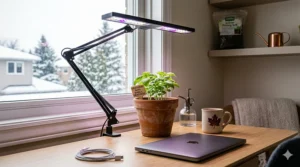
For Canadian urban dwellers dealing with low winter light, pair Genovese with a basic LED grow light (full-spectrum bulbs from any Canadian Tire or Home Hardware work fine — you don’t need expensive horticultural models). Genovese’s large leaves maximize photosynthesis even under less-than-ideal lighting, whereas smaller-leafed varieties struggle to accumulate enough energy in low-light conditions.
Pros:
✅ Massive 1,750+ seed count for year-round succession planting
✅ Slow to bolt, ideal for long-term indoor cultivation
✅ Classic Italian flavour profile for traditional dishes
Cons:
❌ No variety — you’re locked into Genovese only
❌ Large leaves require 15-20 cm pots for best performance
Price range: $8-12 CAD. This is exceptional value for serious pesto makers or anyone who uses basil daily. At roughly $0.007 per seed, you could grow 200 plants for the cost of four grocery store basil bunches.
3. Gardeners Basics 8-Variety Herb Pack — The Beginner’s Best Friend
If you’re new to indoor herb gardening and want a foolproof introduction to basil diversity, Gardeners Basics Basil Seeds for Planting delivers exactly what beginners need: eight popular varieties (Genovese, Large Leaf, Lemon, Thai, Red Rubin, Cinnamon, Sweet, and Purple Opal) with straightforward packaging and no overwhelming complexity.
What makes this particularly beginner-friendly? Each variety packet is clearly labelled with colour-coded packaging and includes basic growing instructions printed directly on the back — no need to download PDFs or watch YouTube videos. For Canadian first-timers who might be intimidated by Latin botanical names or conflicting online advice, this simplicity matters. You open the pack, read the instructions, plant seeds 0.5 cm deep, and most varieties sprout within 4-6 days at typical Canadian room temperature (19-21°C).
The variety selection leans practical rather than exotic. You get the two Italian workhorses (Genovese and Large Leaf) for everyday cooking, aromatic additions (Lemon and Cinnamon) for specialized dishes, colourful options (Red Rubin and Purple Opal) that double as decorative plants, Thai for Asian cuisine enthusiasts, and Sweet basil as the all-purpose backup. This coverage means you can discover your preferences without committing to large quantities of varieties you might not enjoy.
Here’s what experienced Canadian growers appreciate: The seed packaging is dated for freshness and includes a “plant by” date, which helps you prioritize which varieties to start first. Some varieties (particularly Thai and Cinnamon) maintain viability longer than others, so this guidance prevents the frustrating experience of wasting time on seeds that have lost germination potential.
One consideration for Canadian apartments: Eight varieties means eight separate pots if you’re growing them individually. At minimum, you’ll need 15 cm diameter pots for Genovese and Large Leaf, while smaller varieties like Spicy Globe can thrive in 10-12 cm pots. Plan for roughly 1.2-1.5 metres of south-facing windowsill space or one medium-sized LED grow light setup to handle all eight varieties simultaneously.
Pros:
✅ Excellent variety selection for exploring different flavours
✅ Clear labelling and beginner-friendly instructions
✅ Reasonable seed counts (150-250 per variety)
Cons:
❌ Eight varieties require significant growing space
❌ No organic certification (treated with standard fungicides)
Price range: $15-20 CAD. For beginners, this represents solid value — you’re essentially getting a $2.50 sampler of each variety, which is far cheaper than buying individual packets from specialty seed companies.
4. Sustainable Seed Company Deluxe Basil Collection — The Culinary Curator’s Choice
When you want quality over quantity and are willing to pay a bit more for heirloom genetics and educational value, the Sustainable Seed Company Deluxe Basil Collection delivers five carefully selected varieties plus a 34-page guidebook titled “Growing and Using Basil.” This isn’t just a seed pack — it’s a mini-course in basil cultivation and culinary application.
The five varieties included (Genovese, Thai, Lemon, Italian, and Dark Opal) represent the core flavour profiles every serious cook should master. What distinguishes this collection is the heirloom focus: these are open-pollinated varieties that breed true from generation to generation, meaning you can save seeds from your best plants and maintain the same characteristics year after year. For Canadian gardeners interested in seed-saving — which makes particular sense given our short outdoor season — this opens up true self-sufficiency.
The included guidebook is where this pack earns its premium. It covers germination techniques specific to indoor conditions, optimal harvesting methods to maximize yield, preservation techniques (freezing, drying, making pesto), and even recipes developed around each variety. For Canadian winters when you’re spending 5-6 months primarily indoors, having this reference material integrated into your seed purchase saves the hassle of piecing together advice from dozens of websites.
From a practical indoor growing perspective, these five varieties complement each other well. Genovese and Italian provide your everyday cooking needs, Thai adds Asian cuisine capability, Lemon gives you specialty garnish options, and Dark Opal’s purple foliage serves double duty as both culinary herb and decorative houseplant. Unlike variety packs with 8-10 options where some inevitably go unused, this curated selection focuses on varieties you’ll actually use repeatedly.
Canadian reviewers specifically mention the seed quality — germination rates consistently hit 85-90% even in subsequent growing seasons, suggesting careful seed processing and moisture-controlled storage before sale. For our climate, where humidity fluctuates wildly between summer and winter, this attention to seed preservation matters more than in moderate coastal climates.
Pros:
✅ Comprehensive 34-page guidebook included
✅ Heirloom varieties suitable for seed-saving
✅ High-quality seeds with excellent germination rates
Cons:
❌ Only five varieties versus competitors’ 7-8 options
❌ Higher price point for fewer seeds
Price range: $16-22 CAD. This premium positions itself as an educational investment rather than just seeds. If you’re the type who appreciates in-depth growing guides and long-term seed-saving potential, the extra cost makes sense.
5. Survival Garden Seeds Basil Mix — The Space-Saving Solution
Apartment dwellers and condo owners, this one’s for you. The Survival Garden Seeds Basil Mix takes a fundamentally different approach: instead of giving you five to eight varieties in separate packets, it blends five basil varieties (Genovese Italian, Lemon, Lime, Opal, and Thai) into a single packet that you plant together in one container.
Why does this matter for Canadian indoor growers? Space. If you’re working with a single sunny windowsill or one small grow light setup, you might not have room for eight separate pots. This blended approach lets you grow multiple flavours simultaneously in a 25-30 cm diameter container, creating a “basil bouquet” where you can harvest different flavours from the same pot. Imagine snipping sweet Genovese for your pasta sauce, Lemon for fish dishes, and Thai for stir-fries — all from the same planter on your kitchen counter.
The practical challenge: when varieties are blended, you can’t control which seeds go where in the pot. Some gardeners find this randomness charming; others prefer the organizational control of separate varieties. From an indoor growing perspective, the mix works because all five varieties have similar growth requirements (temperature, light, water), meaning they coexist happily without one variety dominating or suffering.
Here’s the Canadian winter advantage: A single blended container is significantly easier to manage under grow lights than rotating several individual pots. You water once, fertilize once, and adjust your light once — rather than maintaining eight separate microclimates. For busy Canadians juggling work, family, and the general chaos of winter, this simplified maintenance can mean the difference between success and abandoning your herb garden by February.
The seed count (800+ seeds) gives you enough for 3-4 large container plantings or 6-8 smaller pots if you want to spread the mix across multiple locations (kitchen, home office, bedroom). At around $10-14 CAD, it’s among the most economical options per seed, though you sacrifice the variety control of segregated packets.
Canadian reviewers note one quirk: the blended packet makes succession planting trickier because you can’t selectively plant more of your favourite variety. If you discover you love Thai basil but rarely use Lime, you’re stuck with the preset ratio. However, for first-time growers still figuring out their preferences, this prevents the common mistake of buying large quantities of a variety you end up disliking.
Pros:
✅ Space-efficient single-pot growing
✅ Simplified maintenance (one watering schedule, one fertilizer routine)
✅ Budget-friendly with good seed count (800+)
Cons:
❌ No control over variety placement in container
❌ Can’t selectively replant favourite varieties
Price range: $10-14 CAD. Best value for urban Canadians with limited space who want flavour variety without the complexity of managing multiple pots.
6. Urban Leaf Basil Variety Pack — The Compact Container Specialist
Urban Leaf has built a reputation around products specifically designed for small-space, indoor, and hydroponic growing — and their Basil Seeds Variety Pack reflects that focus. With six varieties (Thai, Purple, Lime, Lemon, Spicy Globe, and Sweet Italian) selected for compact growth habits, this pack targets Canadian city dwellers in condos, apartments, and homes where every square centimetre of growing space counts.
What makes these varieties “compact”? Most stay under 30-35 cm tall even at maturity, compared to traditional Genovese or Large Leaf varieties that can reach 45-60 cm indoors. This vertical efficiency matters enormously if you’re growing on windowsills or under counter-height grow lights. The included Spicy Globe variety, in particular, forms a dense, rounded bush barely 20-25 cm tall — perfect for 10-12 cm pots that fit three across a standard apartment windowsill.
The flavour selection leans toward specialty applications rather than everyday Italian cooking. Thai basil brings anise-clove notes for Southeast Asian dishes, Purple (likely Purple Dark Opal or Red Rubin) adds visual interest and slightly spicy undertones, Lime and Lemon provide citrus accents for fish and beverages, and Sweet Italian covers your basic cooking needs. The Spicy Globe, despite its small size, packs intense peppery flavour — a little goes a long way, making it economical for garnishes and finishing touches.
From a Canadian indoor growing perspective, these compact varieties offer specific advantages during our dim winters. Smaller plants require less total light energy to thrive, meaning you can get acceptable results from a basic LED bulb rather than investing in expensive full-spectrum grow panels. The reduced leaf surface area also means lower water requirements — helpful in Canadian homes where winter heating drops indoor humidity to 20-30% and soil dries out faster than you’d expect.
Customer feedback from Canadian growers highlights impressive germination rates (typically 80-90% across all six varieties) and the convenience of individual seed packets that let you stagger your planting. Urban Leaf also includes QR codes on each packet linking to variety-specific growing videos — a thoughtful touch for visual learners who prefer video tutorials over written instructions.
One consideration: the seed count per variety is moderate (120-180 seeds typically), which is fine for personal use but might disappoint gardeners wanting to grow large quantities for preservation or gifts. This pack is optimized for “grow what you’ll use fresh” rather than “grow for bulk processing.”
Pros:
✅ Compact varieties ideal for small spaces
✅ Lower light requirements suit Canadian winter conditions
✅ QR codes link to helpful growing videos
Cons:
❌ Smaller seed counts per variety (120-180 seeds)
❌ Specialty flavours, limited everyday cooking varieties
Price range: $14-19 CAD. Best for urban Canadians in apartments or condos where vertical space is limited and supplemental lighting budgets are modest.
7. Organo Republic 7-Variety Pack — The Budget Champion
When you want variety, quantity, and affordability in one package, Organo Republic’s 7 Basil Herb Seeds Variety Pack delivers an almost unbeatable value proposition: 1,900+ seeds across seven varieties for typically around $12-16 CAD. That’s roughly 120-160 seeds per dollar — significantly better economics than premium competitors.
The seven varieties included (Thai, Cinnamon, Lemon, Italian, Genovese, Purple, and Holy Basil) hit the major flavour families without redundancy. You get the Italian classics (Genovese and Italian), aromatic specialists (Cinnamon and Lemon), Asian cuisine support (Thai and Holy), and visual interest (Purple). The generous seed counts mean you can experiment freely without worrying about “wasting” expensive seeds on trial-and-error learning.
What often surprises Canadian buyers: Organo Republic includes detailed online growing guides accessible via QR codes on the packaging, plus a cooking guide with recipe ideas for each variety. This educational component — usually reserved for premium packs — adds significant value for beginners who need more than just “plant seeds, add water” instructions. The growing guides specifically address indoor cultivation, including light requirements, container sizes, and common troubleshooting for apartment conditions.
From a practical standpoint, the generous seed counts enable the succession planting strategy that works best for Canadian indoor growers. Rather than planting all your Genovese seeds at once in October and having them all bolt simultaneously in December, you can plant 30-40 seeds every 2-3 weeks from October through March. This creates a continuous harvest rotation where you’re always cutting fresh leaves from plants at their prime.
The packaging deserves specific mention: each variety comes in a resealable foil-lined packet with clear labelling and a date stamp. Canadian reviewers appreciate this moisture-barrier packaging because it handles our dramatic seasonal humidity swings (summer 60-70%, winter 20-30%) better than paper packets that can allow moisture infiltration during spring thaw.
One caveat: “budget” doesn’t mean “low quality,” but germination rates do trend slightly lower than premium organic packs — typically 75-85% versus 85-95%. For the price difference, that trade-off makes sense. With 1,900+ seeds, even at 75% germination you’re getting 1,425 viable plants, which is more than most home growers will use in several years.
Pros:
✅ Exceptional value (1,900+ seeds for $12-16 CAD)
✅ Seven varieties cover all major flavour profiles
✅ Resealable packets and educational QR codes included
Cons:
❌ Germination rates slightly lower than premium brands
❌ No organic certification
Price range: $12-16 CAD. Absolute best value for Canadian growers who want to experiment with multiple varieties without breaking the budget. Perfect for beginners, bulk growers, or anyone who plans to use basil extensively for cooking and preserving.
Starting Your Basil Seeds Indoors: A Canadian Winter Success Guide
The number one reason Canadians fail at indoor basil growing has nothing to do with the seeds themselves — it’s timing and temperature management during germination. Unlike outdoor spring planting where nature handles the warming, indoor germination requires you to create artificial “spring” conditions in the middle of a Canadian winter.
The germination sweet spot: 20-24°C soil temperature. Not air temperature — soil temperature. This distinction matters because even if your apartment is heated to 21°C, pots sitting on cold windowsills or uninsulated floors can drop to 15-17°C, which delays germination from 5-7 days to 14-21 days and dramatically reduces germination rates.
Here’s the fix Canadian growers use: germinate seeds on top of your refrigerator, on a heating mat designed for seed starting (available at Canadian Tire or Home Hardware for $20-30), or simply place seed trays on a shelf above your basil radiator. Once seeds sprout, then move them to their final growing location with proper lighting.
Lighting requirements post-germination: Basil needs 12-16 hours of light daily. From November through February, even south-facing windows in southern Ontario only provide 8-9 hours of usable sunlight. You must supplement with artificial lighting for success during Canadian winters. The good news: basic LED shop lights from any hardware store work fine. Position them 15-20 cm above your seedlings and raise them as plants grow. Full-spectrum “grow lights” are nice but not necessary — basil is forgiving and responds well to standard 5000K-6500K LED bulbs.
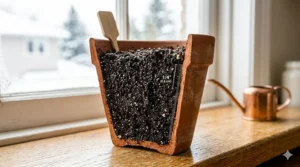
The moisture management challenge: Canadian winter air is brutally dry due to forced-air heating. Your basil soil will dry out faster than you expect. Check moisture daily by pressing your finger 2 cm into the soil — if it feels dry, water thoroughly until it drains from the bottom holes. Then dump the drainage saucer (never let pots sit in water — that’s a fast track to root rot).
Fertilizing strategy: Container soil loses nutrients faster than outdoor garden beds because watering washes them away. Start fertilizing 2-3 weeks after germination with a diluted liquid fertilizer (half-strength of package directions) every 10-14 days. Canadian-available options like Miracle-Gro All-Purpose or fish emulsion work perfectly.
Pinching for bushier plants: This is the secret most beginners miss. When your basil reaches 15-20 cm tall with 3-4 sets of leaves, pinch off the top growth point. This forces the plant to branch sideways instead of growing tall and leggy. Repeat this pinching every 2-3 weeks throughout the plant’s life. A pinched plant will produce 3-4 times more leaves than an unpinched one.
Real Canadian Growers: Who’s Using What and Why
Profile 1: The Toronto Condo Renter (Sarah, 32)
Living situation: 600 square foot one-bedroom, south-facing balcony unusable November-March
Climate challenge: Dry winter air (22-25% humidity) from electric baseboard heating
Solution: Gardeners Basics 8-Variety Pack in 15 cm pots under a single LED shop light
Why it works: Sarah wanted variety but had space for only one growing shelf. She staggers planting two varieties every 3 weeks, creating a continuous rotation. The dry air requires daily moisture checks, but she compensates with a small humidifier running nearby. After eight months, she’s harvested enough basil to give away jars of homemade pesto to friends and never bought grocery store basil again.
Profile 2: The Vancouver Island Family (Marcus and Lisa, 40s, two kids)
Living situation: Suburban house with large south-facing kitchen window
Climate challenge: Coastal moisture creates mildew issues if air circulation is poor
Solution: HOME GROWN Genovese Basil exclusively, started every 3 weeks
Why it works: With two kids who eat pasta 3-4 times weekly, this family goes through basil fast. They don’t need variety — they need volume. The massive 1,750-seed pack lets them keep 6-8 pots in rotation continuously. To prevent mildew (common in Vancouver’s humid climate even indoors), they run a small desk fan on low near the plants for air circulation.
Profile 3: The Rural Manitoba Homesteader (Derek, 55)
Living situation: Farmhouse, harsh winters (-30°C to -40°C), limited natural light November-February
Climate challenge: Extreme cold means windows are poor growing locations (cold drafts)
Solution: Organo Republic 7-Variety Pack under dedicated grow light setup in basement
Why it works: Derek’s strategy is simple efficiency — grow multiple varieties under one light system in the basement where temperature stays stable year-round. The basement’s 18-20°C temperature is perfect for germination without supplemental heat. He preserves the summer harvest by freezing pesto in ice cube trays and dries surplus leaves in a dehydrator. The 1,900-seed count supports his goal of supplying his extended family with herbs through winter.
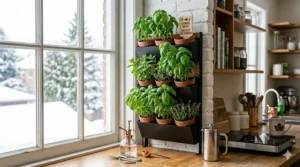
How to Choose Basil Seeds for Indoor Growing in Canada
Selecting the right basil seeds for your Canadian indoor growing setup requires matching variety characteristics to your specific constraints. Here are the decision criteria that matter most:
1. Light availability in your home
If you have only north-facing windows or limited natural light, choose compact varieties like Spicy Globe or Greek basil that require less total light energy to thrive. Conversely, if you’re investing in grow lights, you can successfully grow the larger-leafed Genovese or Italian Large Leaf varieties that reward high-light conditions with abundant harvests.
2. Your heating system and humidity levels
Forced-air heating (common in newer Canadian construction) creates desert-dry conditions that cause some basil varieties to struggle. Thai basil and Genovese handle low humidity better than delicate lemon or lime varieties. If you have a humidifier running or live in a naturally humid climate (coastal BC), you have more flexibility with moisture-sensitive varieties.
3. How much space you can dedicate
A single south-facing windowsill can support 3-4 compact varieties in 10-12 cm pots. If that’s your limit, choose a curated selection like the Sustainable Seed 5-variety pack rather than buying an 8-variety pack where half will go unplanted. Alternatively, go with a blended mix like Survival Garden Seeds that grows multiple flavours in one container.
4. Culinary preferences and usage frequency
If you make pesto weekly, a single-variety pack like HOME GROWN Genovese makes more sense than paying for seven varieties you’ll rarely use. Conversely, if you enjoy experimenting with international cuisines — Thai curries, Vietnamese pho, Mediterranean dishes — variety packs give you appropriate herbs for each tradition.
5. Organic certification importance
Organic seeds cost 20-40% more than conventional ones. For indoor growing where pest pressure is minimal, the main benefit is avoiding fungicide residues on the seeds themselves. If this matters to you (families with young children, health-conscious households), choose certified organic like Sweet Yards. Otherwise, standard non-GMO heirloom seeds from brands like Gardeners Basics or Organo Republic perform equally well indoors at lower cost.
6. Seed-saving intentions
If you want to save seeds from your best plants to replant next season (a smart strategy for Canadian self-sufficiency), choose heirloom open-pollinated varieties like those from Sustainable Seed Company. These breed true from generation to generation. Avoid F1 hybrids (rare in basil but worth checking) that don’t replicate parent characteristics.
7. Budget and experimentation willingness
First-time growers should opt for budget-friendly variety packs (Organo Republic, Survival Garden Seeds) that let you experiment without significant financial risk. Once you know what you like, invest in premium single-variety packs or organic options for your favourites.
Common Mistakes When Buying and Growing Basil Seeds Indoors in Canada
Mistake #1: Buying seeds designed for outdoor gardens
Not all basil seeds are created equal. Some packets are explicitly marketed for “outdoor gardens” and contain varieties that require full summer sun intensity (100,000+ lux) that’s impossible to replicate indoors. Look for packaging that mentions “suitable for containers” or “indoor growing” — these varieties have been selected for tolerance to lower light levels and restricted root space.
Mistake #2: Ignoring germination dates and storage
Basil seeds lose viability over time. A three-year-old packet stored in a hot garage may only achieve 30-40% germination versus 85-90% for fresh seeds. Always check the “packed for” date and store unopened packets in your refrigerator’s vegetable crisper. Once opened, transfer seeds to a small airtight container with a silica gel packet (those little “do not eat” packets from vitamin bottles) and refrigerate.
Mistake #3: Overlooking Canadian winter light requirements
The single biggest failure point: underestimating how little usable light Canadian windows provide November-February. Even “bright indirect light” from south-facing windows in Toronto delivers only 5,000-10,000 lux on cloudy winter days — basil needs 15,000-25,000 lux minimum for healthy growth. Without supplemental lighting, your plants will become leggy, weak, and eventually die. Budget $20-40 for a basic LED shop light as a non-negotiable part of your setup.
Mistake #4: Starting too many varieties simultaneously
Enthusiasm often exceeds practicality. Beginners buy 8-variety packs and plant all eight varieties the first week. By week three, they’re overwhelmed managing eight different growth rates, water needs, and harvesting schedules. Start with 2-3 varieties maximum. Learn their quirks. Then expand to additional varieties once you have a successful routine established.
Mistake #5: Assuming indoor basil is “set and forget”
Outdoor gardens have natural rain, beneficial insects, and seasonal cues that self-regulate many growing factors. Indoor basil requires active management: daily moisture checks, weekly feeding, consistent light cycles, humidity monitoring, and proactive pinching to prevent bolting. The time commitment is modest (10-15 minutes daily), but it’s consistent and non-negotiable.
Mistake #6: Planting in containers without drainage holes
Decorative ceramic pots without drainage are death traps for basil. The roots sit in soggy soil, oxygen levels drop, and root rot develops within 7-10 days. Always use pots with drainage holes. Place a saucer underneath to catch excess water, but empty that saucer within 30 minutes of watering so roots never sit in standing water.
Mistake #7: Buying grocery store basil plants instead of starting from seeds
Those $4-6 “living basil” plants at Loblaws or Save-On-Foods are designed to look good for 10-14 days, not to survive long-term. They’re typically grown in professional greenhouses with perfect conditions, then shocked by the transition to your home. Survival rate past two weeks is under 30%. Seeds cost the same or less and create plants already adapted to your specific home conditions from day one.
Basil Seeds for Indoor Growing vs. Outdoor Garden Varieties
Understanding the fundamental differences between varieties marketed for indoor versus outdoor cultivation helps Canadian growers make smarter purchasing decisions and set realistic expectations.
Light adaptation:
Indoor varieties (often labelled “compact” or “container-friendly”) have been selected for generations to perform adequately under 12-16 hours of artificial light at 15,000-20,000 lux. This is roughly one-third the intensity of full summer sun (50,000-100,000 lux). They compensate by producing smaller but more numerous leaves with higher chlorophyll density. Outdoor varieties grown indoors often become “leggy” — tall stems with sparse, pale leaves reaching desperately for more light.
Root system architecture:
Indoor varieties develop less extensive root systems optimized for 15-20 cm diameter containers. They redirect energy into above-ground leaf production rather than massive underground root networks. Traditional outdoor varieties in containers often become root-bound quickly, leading to stunted growth and premature bolting.
Bolting threshold:
Outdoor varieties are programmed to flower after a certain number of “heat units” accumulate — essentially tracking summer progression. Indoor growing with consistent 20-22°C temperatures year-round can confuse these biological clocks, triggering early bolting. Indoor-selected varieties have been bred for later, more forgiving bolting thresholds that tolerate the constant warmth of Canadian homes.
Pest and disease pressure:
Outdoor basil must defend against aphids, Japanese beetles, slugs, fungal diseases, and dozens of other threats. Breeders select for pest resistance, often at the expense of other traits. Indoor basil faces minimal pest pressure (occasional fungus gnats, rare spider mites), so indoor varieties can prioritize flavour, leaf size, and productivity over pest resistance.
Price comparison in Canadian conditions:
A packet of outdoor garden basil seeds might cost $3-4 CAD and contain 500 seeds of a variety that struggles indoors, producing sparse, bitter leaves before bolting at six weeks. A quality indoor variety pack costs $12-16 CAD but delivers eight varieties specifically adapted for container growing, each producing 8-12 weeks of prime harvesting before bolting. Per successful harvest, the indoor varieties are dramatically more cost-effective.
The hybrid approach:
Some Canadian growers use a hybrid strategy: start seeds indoors in February-March using varieties like Genovese or Thai, grow them indoors until May-June, then transition the same plants outdoors for summer. This works well because you’ve already overcome the tricky germination and early growth phases indoors under controlled conditions. Come October, bring the healthiest plants back inside for continued winter production.
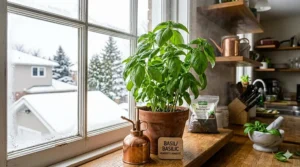
What to Expect: Real-World Performance in Canadian Homes
Let’s set realistic expectations for indoor basil growing in actual Canadian conditions — because Instagram photos of lush 60 cm tall basil plants in December are usually either highly edited or shot in professional greenhouse settings, not typical Toronto apartments.
Germination timeline:
At optimal temperature (22-24°C), expect sprouts in 5-7 days. In cooler conditions (18-20°C, common on windowsills), germination extends to 10-14 days. Some seeds in every packet won’t germinate at all — 80-90% germination is considered excellent, 70-80% is normal, below 70% suggests old or improperly stored seeds.
Seedling phase (weeks 1-3):
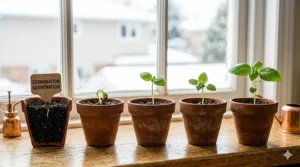
Your tiny sprouts will look fragile and grow slowly. This is normal. Focus on moisture management (keep soil consistently moist but never soggy) and providing adequate light (12-14 hours minimum). Seedlings that stretch tall with sparse leaves are screaming for more light — move them closer to your light source or add supplemental lighting immediately.
Vegetative growth (weeks 3-6):
This is when basil explodes. Under good conditions (proper light, consistent moisture, regular feeding), plants can add 2-3 cm of growth daily. Start pinching the growing tips when plants reach 15 cm tall to encourage bushy, productive growth instead of single tall stems.
First harvest (weeks 4-6):
You can start snipping individual leaves as soon as plants have 3-4 pairs of leaves, but the first substantial harvest typically happens around weeks 5-6. Take no more than one-third of the plant’s total leaf mass at any single harvest to keep it productive.
Peak production (weeks 6-10):
This is your golden window. The plant is mature, bushy (if you’ve been pinching properly), and producing abundant new leaves faster than you can harvest them. A single well-managed Genovese plant can yield 50-80 grams of leaves weekly during this phase — enough for 2-3 batches of pesto or daily cooking use.
Decline phase (weeks 10-14):
Even with perfect care, annual basil varieties eventually bolt (flower). Once flowering begins, leaf production slows and flavour turns bitter. You can delay this by pinching off flower buds religiously, but it’s ultimately inevitable. The Canadian indoor strategy: start new seedlings every 3-4 weeks so you always have plants entering peak production as older ones decline.
Light exposure reality check:
Without supplemental lighting in Canadian winters, expect significantly slower growth and smaller leaves. Plants may survive but won’t thrive. A basic $25 LED shop light from Home Hardware transforms results from “barely alive” to “productive harvest” — it’s the single most important investment after the seeds themselves.
Temperature fluctuations:
Basil tolerates 15-27°C, with ideal growth at 20-24°C. Most Canadian homes naturally fall into this range during winter heating season. The exception: windowsill plants can experience 10-15°C temperature drops at night when cold radiates through the glass. If your plants are near windows, move them a few centimetres back from the glass or add a thin curtain barrier for nighttime insulation.
Humidity challenges:
Canadian winter indoor humidity often drops to 20-30% due to heating systems. Basil prefers 40-60%. You can compensate by grouping plants together (they create their own microclimate), placing pots on trays filled with pebbles and water (pot bottom above water level), or running a humidifier nearby. Browning leaf edges signal humidity stress — address it before the entire plant suffers.
❓ Frequently Asked Questions About Basil Seeds for Indoor Growing
❓ Can I grow basil seeds indoors during Canadian winter without a grow light?
❓ How long do basil seeds stay viable for indoor planting?
❓ Are organic basil seeds worth the extra cost for indoor growing in Canada?
❓ Can I save seeds from my indoor basil plants to replant next year?
❓ What's the difference between Thai basil seeds and regular Genovese for indoor growing in Canada?
Growing Basil Indoors: Your Path to Year-Round Fresh Herbs
After decades of accepting that Canadian winters meant dried herbs from jars, thousands of Canadian households have discovered what Statistics Canada data confirms: indoor herb growing isn’t just possible — it’s practical, economical, and deeply satisfying. The basil seeds for indoor growing you choose today can transform your relationship with cooking, reduce grocery costs by $15-25 monthly (versus buying fresh herbs), and give you a productive, living connection to nature during our long, dark winters.
The key insight successful Canadian indoor growers share: start small, choose varieties suited to your actual conditions (not your aspirational gardening fantasy), invest the modest $40-60 needed for proper lighting and containers, and embrace the learning curve. Your first attempt might yield sparse results. Your second will be better. By your third rotation, you’ll wonder how you ever tolerated grocery store basil’s wilted, flavourless leaves.
Whether you choose the premium diversity of the Sweet Yards Organic pack, the economical volume of HOME GROWN Genovese, the beginner-friendly approach of Gardeners Basics, or the budget-conscious abundance of Organo Republic, you’re joining a growing community of Canadians reclaiming food sovereignty one windowsill at a time. The seeds are ready. Your home has the potential. All that’s missing is your decision to start.
Fresh pesto in February. Caprese salad in January. Thai basil chicken in December. It’s not just possible — it’s waiting for you to plant those first seeds.
Recommended for You
- 7 Best Herb Seed Starter Kits for Canadians (2026 Guide)
- 7 Best Carrot Seeds for Clay Soil in Canada (2026 Guide)
- 7 Best Vegetable Seed Starter Kit Canada Beginners 2026
Disclaimer: This article contains affiliate links. As an Amazon Associate, I earn from qualifying purchases. If you purchase products through these links, we may earn a small commission at no additional cost to you.
✨ Found this helpful? Share it with your friends! 💬🤗
