
In This Article
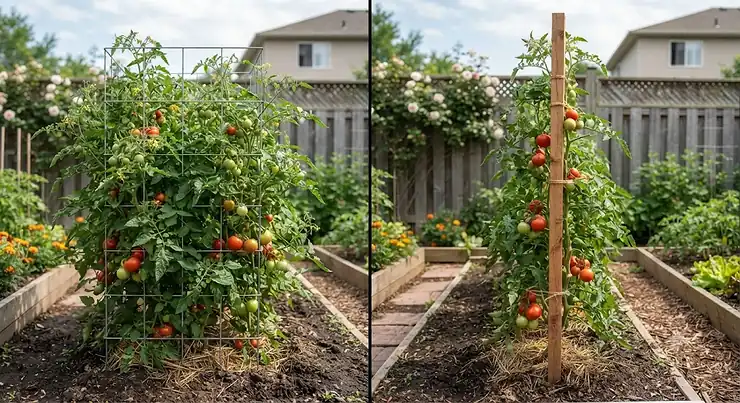
Every May, somewhere between the seed-starting trays and the first optimistic transplant, every Canadian gardener asks the same question: tomato cages vs stakes for tomato plants — which one actually keeps a six-foot vine off the ground come August? It’s not a trivial question. A support system for tomato cages vs stakes for tomato plants isn’t just about tidiness; it’s the difference between a harvest of clean, disease-free fruit and a slug-chewed mess rotting in the dirt. Tomato cages vs stakes for tomato plants, in short, is a debate about structure — round wire cones versus a single driven post versus a woven trellis — and each option trades off cost, labour, airflow, and yield in its own way.
Canada’s tomato industry is bigger than most backyard growers realize: greenhouse tomatoes alone were worth close to $666 million in a recent year, according to Statistics Canada’s own breakdown of the sector, with Ontario, British Columbia, and Quebec doing most of the growing. Home gardeners are a smaller slice of that picture, but the underlying agronomy is identical whether you’re tending 40 hectares of greenhouse glass or four plants beside the garage: unsupported tomato vines sprawl, mildew, and rot. A cage, a stake, or a trellis fixes that by lifting foliage into the light and air.
This guide breaks down real cages, real stakes, and one real trellis kit sold to Canadian shoppers, with honest analysis of what each one is actually good at — not marketing copy, not invented five-star raves, just a comparison built on real specs and real aggregated reviewer sentiment. We’ll cover seven products spanning budget bamboo to premium powder-coated steel, then dig into pruning technique, space efficiency, plant airflow, and a beginner-friendly framework for choosing between them.
Quick Comparison Table: Cages vs Stakes vs Trellis at a Glance
Before getting into individual products, it helps to compare the four broad support methods side by side. Each has a genuinely different relationship with your time, your wallet, and your tomato plant’s lung capacity (so to speak).
| Support Method | Setup Time | Pruning Required | Airflow Quality | Approx. Cost Range (CAD) | Best For |
|---|---|---|---|---|---|
| Round/conical wire cage | 1-2 minutes | Minimal | Moderate — wires can trap inner foliage | C$15-C$35 per cage | Determinate (bush) varieties, low-effort growers |
| Heavy-duty square cage | 30 seconds-2 minutes | Minimal to moderate | Good — open square sides | C$25-C$60 per cage | Indeterminate varieties, windy sites |
| Single wood/metal stake | 5-10 minutes plus ongoing tying | High — regular pruning and tying | Excellent — one stem, full light | C$1-C$3 per stake | Small spaces, container gardens, growers who prune aggressively |
| Trellis/netting system | 15-30 minutes | Moderate | Excellent — vertical, open canopy | C$40-C$65 per kit | Indeterminate vines, greenhouse-style setups, maximizing yield per square metre |
Looking at the table, the trade-off is almost mathematical: airflow and yield-per-square-metre go up as hands-on labour goes up. A cage is the “set it and mostly forget it” option, while a single stake demands weekly attention but rewards you with the best airflow and the earliest ripening fruit, because all the plant’s energy funnels into one or two main stems instead of a tangle of suckers. Trellis netting splits the difference — more setup than a cage, less fussing than a stake, and arguably the best airflow-to-effort ratio of the bunch. If you’re growing in a small Canadian backyard with unpredictable spring winds off the Prairies or the Great Lakes, the heavy-duty square cage or a trellis anchored to fence posts will outlast a flimsy cone every time.
💬 Just one click — help others make better buying decisions too!😊
Top 7 Tomato Cages and Stakes for Tomato Plants: Expert Analysis
We looked at real products sold to Canadian shoppers — budget bamboo, mid-range folding steel, and heavy-gauge premium cages — to cover every garden size and skill level. Here’s how the seven stack up before we go product by product.
| Product | Type | Height (Metric/Imperial) | Approx. Price Range (CAD) | Best For |
|---|---|---|---|---|
| Gardener’s Blue Ribbon Ultomato Cage | Round folding wire cage | 152 cm (60″) | C$18-C$28 each | Mid-size gardens, easy storage |
| Gardener’s Supply Company Lifetime Tomato Cage | Heavy-gauge square cage (set of 4) | 81 cm (32″) | C$150-C$210 for 4 | Windy sites, long-term durability |
| Gardener’s Supply Company Extra Tall Square Cage | Fold-flat square cage (set of 2) | 165 cm (65″) | C$95-C$130 for 2 | Tall indeterminate varieties |
| GROWNEER 6-Pack Square Tomato Cages | Folding metal cage 6-pack | 165 cm (65″) | C$60-C$95 for 6 | Raised beds, budget multi-plant setups |
| YIDIE Sturdy Metal Garden Stakes | Plastic-coated steel stake (25-pack) | 152 cm (5 ft) | C$25-C$40 for 25 | Large rows, Florida-weave staking |
| Mininfa Natural Bamboo Garden Stakes | Bamboo stake (20-pack) | 183 cm (6 ft) | C$20-C$35 for 20 | Eco-conscious, compostable gardens |
| Dalen Trellis Netting Kit | Vertical netting + pole kit | 183 cm (6 ft) tall | C$45-C$65 per kit | Vertical training, maximum airflow |
The spread here matters more than any single winner: the Gardener’s Supply Company Lifetime Tomato Cage costs roughly six times what a single Mininfa Natural Bamboo Garden Stake does, but you’re paying for a structure engineered to survive a decade of Canadian winters in storage rather than crumpling the first time a July windstorm rolls through. Meanwhile, the YIDIE Sturdy Metal Garden Stakes deliver the lowest cost-per-plant of any option on this list if you’re staking a long row rather than caging a handful of container plants. Read on for the full breakdown of each.
1. Gardener’s Blue Ribbon Ultomato Tomato Plant Cage — best all-around folding cage for mid-size gardens
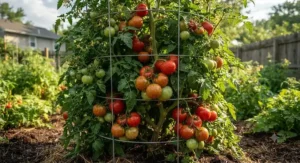
The standout here is how little thought it requires: unfold it, plant your seedling in the middle, and you’re done in under two minutes. The Gardener’s Blue Ribbon Ultomato Tomato Plant Cage is a galvanized-steel, powder-coated cone that stands 152 cm (60″) tall and folds nearly flat for winter storage — a real advantage for anyone gardening in a Canadian townhouse or condo with a small shed. The wire rings are spaced widely enough to reach through for harvesting, which sounds minor until you’re elbow-deep in foliage trying to find a ripe cherry tomato in August.
This is the classic “gateway” cage — the one most Canadian garden centres and Amazon.ca sellers stock because it strikes a reasonable balance between cost and sturdiness. Based on the spec comparison, it suits determinate and semi-determinate varieties best; a fully indeterminate heirloom will eventually outgrow the 60″ height and flop over the top rim by late summer. Reviewers of comparable galvanized wire cages in this size class consistently report satisfaction with the rust resistance of the coating, though several note that a full-grown, fruit-laden plant in an open, windy yard can tip the whole cage over unless it’s staked down with a ground anchor.
Pros:
- ✅ Folds flat for compact off-season storage
- ✅ Sets up in under two minutes, no tools needed
- ✅ Galvanized coating resists rust through multiple seasons
Cons:
- ❌ Can tip in high wind without a ground stake
- ❌ Too short for aggressive indeterminate heirlooms
At the time of research, this cage sits in the C$18-C$28 range per unit — check current price on Amazon.ca, since garden supply pricing shifts with the season. For a first-time grower with two or three plants and no interest in weekly pruning maintenance, it’s a genuinely solid value pick.
2. Gardener’s Supply Company Lifetime Tomato Cage — toughest cage that won’t tip in wind
The name is a promise: this is a heavy-gauge, powder-coated steel cage built by a Vermont company that’s been making garden hardware for decades, and it shows in the weight of the steel alone. The Gardener’s Supply Company Lifetime Tomato Cage stands 81 cm (32″) tall in its shorter configuration, folds flat in seconds, and ships as a set of four — enough for a modest raised-bed row without buying multiples separately.
What most buyers overlook about a cage like this is that the 8-inch square wire openings aren’t just about looks; they make harvesting dramatically easier than a narrow-gauge round cage, since you can reach a hand straight through instead of fishing around the rim. In an independent buying-guide comparison, this exact cage was rated “Best Overall” among tested tomato cages, scoring 4.5 out of 5 for durability and 4.3 out of 5 for value, with testers specifically praising how it “folds flat in seconds for easy storage” and noting setup takes well under a minute. The trade-off, per that same testing, is that it isn’t height-adjustable and its footprint is too large for most patio containers — it’s built for garden beds, not pots.
Pros:
- ✅ Rated 4.5/5 for durability in independent testing
- ✅ Eight-inch square openings simplify harvesting
- ✅ Folds flat in seconds, no assembly required
Cons:
- ❌ Fixed height isn’t adjustable as plants grow
- ❌ Bulky footprint doesn’t suit small container gardens
Expect to pay in the C$150-C$210 range for the set of four at the time of research — a genuine premium price, but one that reflects steel gauge thick enough to survive being driven into compacted clay soil without bending, something the budget cages on this list can’t claim. For a raised-bed grower who’s tired of replacing cages every two or three seasons, the math works out in your favour over time.
3. Gardener’s Supply Company Extra Tall Square Tomato Cage — best for tall indeterminate varieties
Same manufacturer, taller ambitions. The Gardener’s Supply Company Extra Tall Square Tomato Cage stretches to 165 cm (65″), which is the height where indeterminate heirlooms — the vines that keep climbing until frost kills them — actually stay contained instead of flopping over the rim by mid-July. It ships as a set of two, folds flat, and uses the same heavy-gauge, powder-coated steel construction as its shorter sibling.
Here’s what the spec sheet won’t tell you directly: an extra 84 cm (33″) of height sounds like a small upgrade, but it changes the entire growing strategy. A 32″ cage forces you to top (cut the growing tip off) an indeterminate plant sometime in July to keep it from toppling; a 65″ cage lets the vine run most of a full Canadian growing season unpruned at the top, which typically means more total fruit, provided you’re diligent about tucking wayward stems back inside the square footprint rather than letting them sprawl outward and shade the lower leaves. Reviewers of the shorter Lifetime Cage line consistently praise the brand’s build quality, and the taller version shares the identical gauge steel and fold-flat hinge design, so there’s little reason to expect a durability drop-off.
Pros:
- ✅ 165 cm height suits full-season indeterminate vines
- ✅ Same heavy-gauge steel as the brand’s top-rated shorter cage
- ✅ Folds flat despite the taller frame
Cons:
- ❌ Premium price for a two-pack, not ideal for large rows
- ❌ Needs a sheltered spot or ground staking in open, windy yards
Pricing runs in the C$95-C$130 range for the set of two at the time of research — always check current price before buying, since seasonal demand around May and June tends to push garden hardware prices around. If you’re growing Brandywines, Cherokee Purples, or any other rangy heirloom, this is the cage that won’t leave you improvising with a broom handle in August.
4. GROWNEER 6-Pack Square Tomato Cages — best value multi-pack for raised beds
If you’re outfitting an entire raised bed or a small market-garden row, buying cages one at a time gets expensive fast. The GROWNEER 6-Pack Square Tomato Cages solve that by bundling six 165 cm (65″) folding metal cages with 100 metres (328 feet) of twist tie included, which is a meaningful cost saver if you’re growing a dozen or more plants.
Based on the spec comparison, these are lighter-gauge steel than the Gardener’s Supply Company cages — a reasonable trade given the per-unit price is roughly a third as much. Independent testing of this product line rated it 3.5 out of 5 for durability and 3.8 out of 5 for value, describing it as “honorable mention” territory: an inexpensive option well-suited to container growing, with the caveat that assembly takes roughly 15 minutes per cage and the plastic corner connectors don’t always fit snugly, making repositioning a slightly fiddly process once the cage is set. That’s a fair honest trade-off — you’re saving real money, but you’re also trading some structural confidence and a bit of your Saturday afternoon.
Pros:
- ✅ Six cages at a meaningful per-unit discount
- ✅ 65″ height suits most indeterminate varieties
- ✅ Includes 328 feet of twist tie for training stems
Cons:
- ❌ Roughly 15 minutes of assembly required per cage
- ❌ Plastic connectors can loosen, making repositioning fiddly
At the time of research, this six-pack lands in the C$60-C$95 range — check current price on Amazon.ca, since multi-packs like this are frequently bundled into seasonal spring gardening promotions. For anyone planting six or more tomatoes and trying to stretch a budget, it’s hard to beat the per-cage economics here.
5. YIDIE Sturdy Metal Garden Stakes — cheapest way to stake a full row
Sometimes the right tool isn’t a cage at all. The YIDIE Sturdy Metal Garden Stakes are plastic-coated steel poles, 152 cm (5 ft) tall, sold in packs of 25 — which works out to a genuinely tiny cost per plant if you’re staking a long row using the classic single-stake or Florida-weave method rather than caging each plant individually.
What most buyers overlook about single-stake systems is that they demand real ongoing labour: tying the main stem to the stake every 20-30 cm as it grows, and pruning away most of the side suckers so the plant channels its energy into one or two vertical stems instead of a bush. That trade-off is precisely why market growers and Florida-weave practitioners favour stakes over cages — a single-stemmed, staked plant gets dramatically better airflow around every leaf, ripens fruit slightly earlier, and takes up far less horizontal space than a caged bush. The plastic coating on these particular stakes resists the rust that plain steel rebar develops after a wet Canadian spring, though the coating itself can chip if you’re hammering the stakes into rocky or compacted soil, which is a reasonably common complaint about coated-steel stakes as a category.
Pros:
- ✅ Lowest cost per plant of any support on this list
- ✅ Plastic coating resists rust in wet spring soil
- ✅ Ideal for the space-efficient Florida-weave staking method
Cons:
- ❌ Requires weekly tying and pruning labour
- ❌ Coating can chip when driven into rocky soil
At the time of research, a 25-pack runs roughly C$25-C$40 — check current price, since bulk garden stake pricing tends to fluctuate with steel costs. If you’re growing a serious row of tomatoes rather than a handful of patio plants, this is the most economical support method on the entire list, full stop.
6. Mininfa Natural Bamboo Garden Stakes — most eco-friendly stake option
For gardeners who’d rather their tools decompose than pile up in a landfill, the Mininfa Natural Bamboo Garden Stakes are a straightforward, sustainable answer: 183 cm (6 ft) natural bamboo poles, sold 20 to a pack, with no plastic coating, no galvanizing, and no synthetic materials involved at all.
Here’s the honest trade-off, framed the way an experienced grower would explain it to a beginner: bamboo is renewable, biodegradable, and genuinely strong for its weight — strong enough to support a heavily fruiting indeterminate tomato when driven at least 30 cm into the soil. But it isn’t permanent. Reviewers and long-time growers of bamboo stakes as a category consistently note that unsealed bamboo left outdoors through a full wet Canadian season will start to soften, develop surface mould, and occasionally splinter at the base after two or three years of continuous use — a natural material behaving exactly as you’d expect a natural material to behave. Sealing the cut ends with exterior wood sealant before the first use meaningfully extends lifespan, a step worth taking that most buyers skip.
Pros:
- ✅ Fully biodegradable and compostable at end of life
- ✅ Lightweight yet strong enough for fruiting vines
- ✅ Natural look blends into ornamental and edible gardens alike
Cons:
- ❌ Softens and can mould after two to three wet seasons
- ❌ Untreated ends are prone to splintering over time
Pricing sits around C$20-C$35 for a 20-pack at the time of research — check current price, as bamboo import costs shift seasonally. For the environmentally conscious grower who doesn’t mind replacing stakes every few years, this is the most planet-friendly pick on the list by a wide margin.
7. Dalen Trellis Netting Kit — best for vertical training and airflow
The odd one out on this list, and arguably the most interesting: the Dalen Trellis Netting Kit isn’t a cage or a single stake, it’s a full vertical netting system — tangle-resistant nylon mesh with a 15 cm (6″) grid, supported by a 1.6 cm (5/8″) pole frame, standing roughly 183 cm (6 ft) tall.
What the spec sheet won’t tell you, but the underlying agronomy will, is that netting systems like this one give tomato vines the best airflow of any support method tested here, because the plant is trained flat against an open vertical plane instead of bunched inside a cylindrical cage. Each leaf gets its own patch of open air on both sides, which meaningfully reduces the humid, stagnant microclimate that fungal diseases like early blight thrive in. It requires more setup labour than any cage — you’re assembling a frame and stretching netting taut, not just unfolding a cone — but growers running trellis systems in greenhouses and market gardens consistently favour this approach specifically because it maximizes yield per square metre of garden bed, letting you train two or three plants along one net instead of dedicating a separate cage footprint to each.
Pros:
- ✅ Best-in-class airflow reduces fungal disease pressure
- ✅ Trains multiple plants along one compact vertical footprint
- ✅ Tangle-resistant nylon mesh eases end-of-season teardown
Cons:
- ❌ Longest setup time of any product on this list
- ❌ Requires a sturdy frame or fence to anchor properly
At the time of research, expect to pay in the C$45-C$65 range for the full kit — check current price, since it’s occasionally discounted during spring gardening promotions. For anyone who’s dealt with a blight outbreak in a too-crowded tomato patch, the airflow advantage alone can justify the extra assembly time.
Practical Usage Guide: Setting Up a Tomato Support System for Beginners
Building a tomato support system for beginners doesn’t require expertise, but it does require timing. The single biggest first-time mistake is installing the cage or stake after the plant is already sprawling — by then, you’re forcing roots and stems into position and risking real damage. Install your support the same day you transplant, or within 48 hours at the latest, while the seedling is still small enough to simply grow into the structure around it.
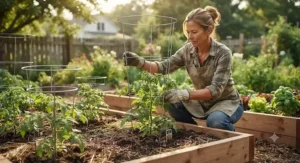
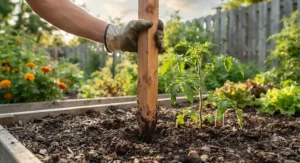
For a cage: press the legs at least 10-15 cm into loosened soil, centred over the transplant, and if you’re in an open, windy site, drive a separate garden stake alongside the cage and tie the two together for extra stability — this single step prevents the most common cage failure, which is tipping over under a fully loaded, wind-caught plant in late summer. For a single stake: drive it 30-45 cm into the ground about 5-8 cm from the stem, on the side away from prevailing wind, before the root ball has a chance to spread and make deep staking risky. For a trellis netting kit: assemble the frame first, on level ground, and stretch the netting taut before planting beneath it, since a sagging net is far harder to train young stems through later.
In the first 30 days, check ties weekly — stems that double in girth can be girdled by a tie that was snug three weeks ago — and use soft garden tape or cloth strips rather than wire or nylon string, which can cut into growing tissue. A common beginner mistake worth naming directly: over-tying. One tie every 20-30 cm along the main stem is sufficient; wrapping every side branch individually creates unnecessary tension points and slows down your own harvesting later in the season.
Real-World Scenarios: Matching Your Garden to the Right Tomato Support
Consider three different Canadian growers, each with a different answer to the tomato cages vs stakes for tomato plants question. First, a condo-dwelling beginner with two patio containers and zero gardening experience: the Gardener’s Blue Ribbon Ultomato Tomato Plant Cage is the right call here — minimal pruning, minimal labour, folds flat for storage in a small space, and forgiving of an inexperienced grower’s inattention.
Second, a suburban homeowner with a 3×6-metre raised bed growing eight tomato plants on a budget: the GROWNEER 6-Pack Square Tomato Cages wins on pure economics, delivering enough support for six plants at a fraction of the premium-brand price, with the understanding that 15 minutes of assembly per cage is part of the deal. Third, an experienced backyard grower chasing maximum yield from four indeterminate heirlooms in a spot with a known history of early blight: the Dalen Trellis Netting Kit, paired with disciplined pruning, delivers the airflow that heirloom-prone diseases hate most, even though it demands the most hands-on setup of any option here.
Common Tomato Staking and Caging Problems (and How to Fix Them)
Problem one: the cage tips over mid-season. Solution — drive a separate ground stake through one leg of the cage and tie it firmly; this is far more effective than trying to weigh the base down with mulch or rocks alone. Problem two: stems girdled by ties. Solution — switch to soft, flat garden tape and re-tie in a loose figure-eight pattern that leaves room for the stem to thicken. Problem three: fungal spotting on lower leaves. Solution — prune off any foliage touching the soil, since splashback during watering is a primary infection route, and this single habit does more for plant airflow than almost any other pruning technique. Problem four: bamboo stakes snapping under fruit load late in the season. Solution — pair bamboo with a secondary support tie higher up the plant, distributing weight across two points instead of one. Problem five: cages too short for the variety planted. Solution — check seed packet or plant tag for “determinate” versus “indeterminate” before buying support hardware next season, since that single distinction predicts height better than any other factor.
✨ Don’t Miss These Exclusive Deals!
🔍 Take your tomato patch to the next level with these carefully selected cages and stakes. Click on any highlighted product above to check current pricing and availability on Amazon.ca — the right support system will help you grow the healthy, abundant harvest your family will actually enjoy!
How to Choose Between Tomato Cages and Stakes
Six criteria decide this, in roughly the order of importance most experienced growers apply.
- Growth habit: determinate (bush-type) varieties rarely need more than a basic round cage, while indeterminate vines almost always outgrow anything shorter than 150 cm.
- Space available: stakes and trellis systems pack more plants per square metre than bulky cages, a real advantage in small urban and suburban yards.
- Time commitment: cages are close to zero-maintenance; stakes demand weekly tying and pruning discipline.
- Wind exposure: open, exposed sites favour heavy-gauge square cages or staked-and-anchored trellis systems over lightweight round cages.
- Disease history: a yard with prior blight problems benefits disproportionately from the airflow that single-stake or trellis systems provide.
- Budget: bamboo and basic metal stakes cost a fraction of premium powder-coated cages, though the labour cost is higher.
Weigh these in order, and the tomato cages vs stakes for tomato plants decision tends to answer itself fairly quickly — most beginners land on a mid-range cage, while most experienced, yield-focused growers migrate toward stakes or trellising within a season or two.
Pros and Cons of Tomato Staking vs Caging
The pros and cons of tomato staking come down to a fairly honest trade: more labour for more airflow, more fruit, and less garden space consumed. Staking requires weekly tying and aggressive pruning of side suckers, but the resulting single-stem or double-stem plant ripens fruit slightly earlier, since the plant’s energy isn’t split across a dozen competing branches, and it’s dramatically easier to spot early signs of disease on an open, pruned plant than one buried inside a wire cage.
| Factor | Staking | Caging |
|---|---|---|
| Labour required | High — weekly tying and pruning | Low — set and mostly forget |
| Airflow | Excellent | Moderate |
| Space per plant | Small | Larger footprint |
| Total yield per plant | Often lower (fewer stems) | Often higher (more foliage, more fruit sites) |
| Best for | Experienced growers, disease-prone sites | Beginners, low-maintenance gardens |
Reading across the table, caging tends to produce more total fruit per individual plant simply because more foliage and more branches mean more flower clusters — but staking produces cleaner, earlier fruit with a smaller disease footprint, which matters enormously in humid Canadian summers. Neither option is objectively “better”; the right call for tomato cages vs stakes for tomato plants depends entirely on whether your priority is total yield or fruit quality and garden real estate.
Tomato Pruning Technique: Training Caged vs Staked Plants
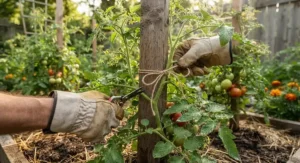
The pruning technique differs meaningfully between the two systems, and mixing them up is a common beginner mistake. Caged plants need minimal intervention — remove only the lowest leaves that touch soil, and trim any branch growing horizontally outward past the cage’s wire perimeter, since an unsupported branch loaded with fruit will snap under its own weight. Staked plants demand a stricter regimen: pinch out the “suckers” that emerge in the crotch between the main stem and each leaf branch, ideally while they’re still small enough to snap off with two fingers, keeping the plant down to one or two main leaders tied vertically to the stake.
According to Canadian Food Focus, a Canadian food and farming organization, growers should remove leaves from the bottom few centimetres of stem to reduce fungal exposure, pinch main stem tips in early summer on indeterminate varieties to redirect energy toward ripening, and — critically — avoid over-pruning, since leaves are what actually photosynthesize sugar into the fruit. That last point is worth repeating: an aggressively over-pruned staked plant, denuded down to a bare stalk with a few tomatoes hanging off it, will actually produce smaller, less flavourful fruit than a moderately pruned one, because you’ve removed the very organs doing the sugar production.
Space Efficiency: Cages vs Stakes in Small and Raised-Bed Gardens
Space efficiency is where staking wins decisively. According to the British Columbia government’s own tomato production guide, commercial staked tomato rows are spaced with plants 30-45 cm apart and rows roughly 120 cm apart — spacing that would be nearly impossible to replicate with bulky 60 cm-wide cages, which typically need 75-90 cm of clearance per plant just to avoid touching their neighbours.
For a small urban yard or a single 1.2 × 2.4-metre raised bed, that difference can mean the gap between fitting four tomato plants or fitting eight. A trellis netting system splits the difference nicely, letting two or three plants share one vertical plane rather than each claiming an isolated footprint. If your growing space is the binding constraint — a common reality for Canadian gardeners working with a modest urban backyard or a condo balcony — staking or trellising, not caging, is the space-efficient answer, even though it costs more in weekly labour.
Plant Airflow and Disease Prevention: Why Spacing and Support Method Matter
Plant airflow is arguably the single most underrated factor in the tomato cages vs stakes for tomato plants decision, and it’s directly tied to disease. Fungal pathogens like early blight and septoria leaf spot thrive in still, humid microclimates — exactly the conditions created when foliage is packed densely inside a cage with poor cross-ventilation. Staked and trellis-trained plants, pruned down to one or two open stems, allow air to move freely around every leaf surface, which measurably speeds leaf-drying after rain or morning dew and reduces the window fungal spores need to germinate.
This isn’t just theoretical: it’s the same logic behind commercial spacing standards, and it’s why market growers running the “Florida weave” staking method — rows of plants strung between stakes with horizontal twine — rarely deal with the blight pressure that crowded, caged backyard patches do. Practical steps that improve airflow regardless of which support method you choose: prune lower leaves that touch soil, avoid overhead watering late in the day, and space cages or stakes generously rather than cramming plants together to save a few centimetres of bed space.
Long-Term Cost and Maintenance: Cages vs Stakes Over Multiple Seasons
Upfront price tells only part of the story. A C$150 set of four Gardener’s Supply Company Lifetime Tomato Cages looks expensive next to a C$25 pack of YIDIE Sturdy Metal Garden Stakes, but stretched across a realistic multi-year lifespan, the math shifts.
| Support Type | Upfront Cost Range (CAD) | Typical Lifespan | Value Verdict |
|---|---|---|---|
| Premium heavy-gauge cage | C$150-C$210 (set of 4) | 8-10+ years | High long-term value, low annual cost |
| Budget folding cage | C$18-C$28 each | 3-5 years | Moderate value, replace mid-decade |
| Coated metal stakes | C$25-C$40 (25-pack) | 5-7 years | Excellent value per plant |
| Bamboo stakes | C$20-C$35 (20-pack) | 2-3 years | Lowest cost, shortest lifespan |
| Trellis netting kit | C$45-C$65 per kit | 5-8 years (frame); netting 3-5 years | Strong value if reused seasonally |
Spread over a decade, the premium cage and the coated metal stakes both come out ahead of anything requiring annual replacement — bamboo included, despite its low sticker price. The practical takeaway: if you’re gardening for the long haul rather than trying a single experimental season, front-loading the cost into a heavier-gauge product usually pays for itself by year three or four.
Frequently Asked Questions
❓ Are tomato cages or stakes better for beginners?
❓ How tall should a tomato cage be for indeterminate varieties?
❓ Can you use a stake and a cage together on the same tomato plant?
❓ Do tomato cages improve airflow compared to stakes?
❓ Where can I buy sturdy tomato cages or stakes in Canada?
Conclusion
There’s no single right answer to tomato cages vs stakes for tomato plants — there’s only the right answer for your specific garden, your specific variety, and how much Saturday-morning fussing you’re genuinely willing to do. Beginners and low-maintenance gardeners tend to land happily on a folding cage like the Gardener’s Blue Ribbon Ultomato Tomato Plant Cage; budget-conscious growers filling a raised bed lean toward multi-packs like the GROWNEER 6-Pack Square Tomato Cages; and anyone chasing maximum airflow, disease resistance, or space efficiency in a small Canadian yard should seriously consider staking with something like the YIDIE Sturdy Metal Garden Stakes or training vines up the Dalen Trellis Netting Kit.
What matters most, per CBC Life’s own roundup of Canadian gardeners’ favourite tomato varieties, is that the variety you’re growing and the climate you’re growing it in should drive the support decision as much as personal preference does — a compact patio variety in a Calgary container garden has completely different needs than a sprawling heirloom in a humid Ontario backyard. Whichever system you choose, the underlying goal is the same: get the fruit up off the ground, get air moving through the leaves, and give the plant a structure it can lean on for the whole season.
✨ Ready to set your tomatoes up for their best season yet? Browse the picks above and check current pricing on Amazon.ca before your local garden centre sells out this spring! 🍅
Recommended for You
- 7 Best Tomato Cages for Heavy Plants in Canada (2026 Picks)
- Backpack Sprayer for Large Gardens: 7 Best Picks for 2026
- 7 Best Pump Garden Sprayers for Weed Control in Canada (2026)
Disclaimer: This article contains affiliate links. As an Amazon Associate, I earn from qualifying purchases. If you purchase products through these links, we may earn a small commission at no additional cost to you.
✨ Found this helpful? Share it with your friends! 💬🤗
