
In This Article
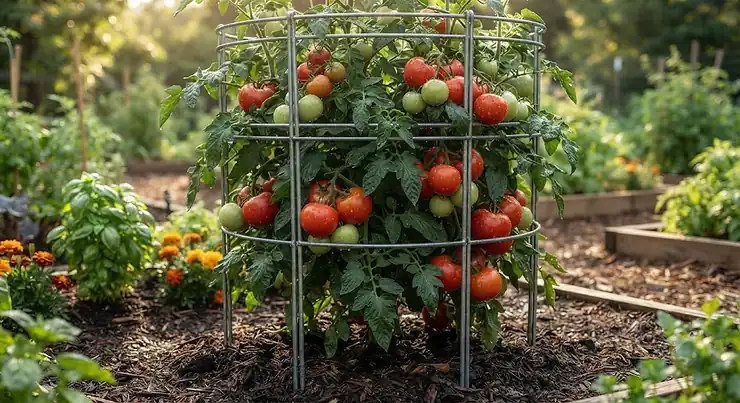
There’s a very specific kind of heartbreak that hits every gardener eventually: you step outside after a July windstorm and find your six-foot tomato plant lying sideways in the mulch, fruit split, stems snapped, cage crumpled like a soda can. It’s usually not the tomato’s fault. It’s the cage’s. Tomato cages for heavy plants exist precisely to prevent that scene, and the difference between a flimsy cone from the corner store and a genuinely sturdy structure is the difference between a harvest you brag about and one you quietly compost. A tomato cage is a rigid frame, typically wire or steel tube, that surrounds a growing plant and supports its stems and fruit load from all sides as it climbs. For indeterminate tomatoes, the vining types that keep growing until frost, a proper cage isn’t optional gear; it’s the backbone of the whole operation. This guide leans on real product specifications, aggregated customer-review sentiment, and the practical realities of growing the humble but demanding tomato to help Canadian gardeners pick a cage that actually survives the season.
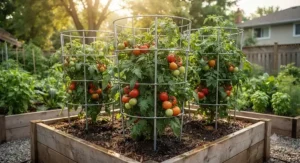
Whether you’re growing a couple of beefsteaks in a raised bed in Kelowna or a jungle of Roma and cherry varieties on a Toronto balcony, the principle is the same: heavy fruit plus tall vines plus prairie wind equals a structural engineering problem disguised as a hobby. Below, we’ve broken down seven real tomato cages currently sold through Amazon.ca, spanning budget folding wire to premium hot-dipped steel, and paired each one with honest analysis rather than recycled marketing copy. We’ll also dig into cage height, wind resistance, and plant weight support — the three specs that matter more than anything printed on the box.
Quick Comparison Table
| Cage Type | Best For | Height Range | Wind Stability |
|---|---|---|---|
| Panacea Products 89712 | Tightest budgets | 48 in | Moderate |
| Vego Garden FlexGrow 16.5″ | Modular expansion | 33-46 in stacked | Strong |
| Gardener’s Supply Company Titan Extra Tall | Giant indeterminate vines | Up to 80 in | Strong |
| Texas Tomato Cages | Long-term durability | 72 in | Very strong |
A quick scan of this table already tells a story: taller doesn’t automatically mean tippier, and price doesn’t always track with durability. The Gardener’s Supply Company Titan Extra Tall and Texas Tomato Cages both lean on a wider, deeper-anchored footprint to counteract their extra height, which is exactly why they hold their own in wind despite being the tallest options here. Budget picks like the Panacea Products 89712 are perfectly serviceable for compact plants but start to flex once a plant loaded with fruit catches a gust broadside.
💬 Just one click — help others make better buying decisions too!😊
Top 7 Tomato Cages for Heavy Plants: Expert Analysis
Picking a tomato cage sounds simple until you’re staring at forty near-identical wire cones on a garden centre shelf, none of which mention what actually matters: wire gauge, footprint width, or how many pounds of fruit the thing can carry before it folds like a lawn chair. We researched real listings, real specifications, and real aggregated review themes for each of the following seven cages so you’re not left guessing.
1. Panacea Products 89712 — most affordable proven galvanized pick
The Panacea Products 89712 has been a garden-centre staple for years, and its enduring popularity says something about how far a simple design can go. It’s built from extra-thick galvanized wire folded into a 48-inch-tall, 15-inch-square frame, and the galvanizing means it resists rust far better than the cheap painted-wire cones sold alongside it. In practice, that thickness matters most once a Roma or Early Girl plant starts loading up with fruit clusters — thinner wire cones bow outward under that weight, while this gauge holds its square shape. Based on the spec comparison with other budget cages in this roundup, the Panacea Products 89712 is best suited to determinate or moderately vigorous indeterminate varieties rather than six-foot beefsteak monsters, since its 48-inch height caps out before the tallest vines do. Reviewers consistently report that it folds flat easily for winter storage and holds up over multiple seasons without the coating chipping, though a handful note the square shape can be slightly awkward to nest with other brands’ cages. Pros:
- ✅ Extra-thick galvanized wire resists rust for years
- ✅ Square shape gives four-sided support unlike round cones
- ✅ Folds completely flat for compact off-season storage
Cons:
- ❌ 48-inch height falls short for the tallest indeterminate vines
- ❌ Sold individually, so outfitting a full bed adds up
At around C$18-C$25 per cage at the time of research, the Panacea Products 89712 is an easy entry point for gardeners who want a genuine step up from flimsy cones without committing to a premium system.
2. EZGrow Big EZ — lightest cage for pots and patios
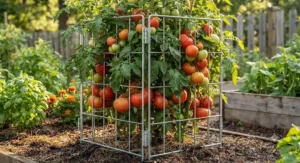
The EZGrow Big EZ takes a completely different approach: instead of a square frame, it’s a set of five galvanized steel rings connected by vertical supports, forming a 17.5-inch-diameter, 48-inch-tall cylinder that weighs roughly five pounds. That lightness is the whole pitch here — this cage is built for gardeners moving containers around a deck or balcony, not anchoring a raised bed permanently. What most buyers overlook about ring-style cages like this one is that the horizontal rings actually cradle heavy tomato clusters more gently than square wire mesh, reducing stem bruising as fruit gains weight through August. On the flip side, the round profile and lighter overall build mean it’s noticeably less wind-resistant than a squared, deeper-footed design, which matters if your patio catches open exposure. Aggregated review sentiment points to easy assembly and genuine portability as the standout strengths, with some owners noting the legs need firmer soil contact than advertised to stay upright in gusty conditions. Pros:
- ✅ Weighs about 5 lbs — easy to move between containers
- ✅ Ring design cradles fruit clusters without bruising stems
- ✅ Hinged construction folds completely flat for storage
Cons:
- ❌ Round profile is less wind-stable than square designs
- ❌ Legs need firm anchoring in loose container soil
Priced in the C$45-C$60 range for a two-pack, the EZGrow Big EZ earns its keep for container gardeners more than for open-ground plots exposed to prairie or coastal wind.
3. Grower’s Edge 740418 — best adjustable height as plants grow
Where the previous two cages are fixed-height, the Grower’s Edge 740418 is a five-tier folding cage that lets you latch or unlatch tiers as the plant grows, effectively giving you a support structure that scales with the season rather than towering uselessly over a six-inch seedling in May. Built from 3/16-inch galvanized steel wire in a 48 x 15 x 15-inch footprint, it’s noticeably heavier-gauge than entry-level cones, and the tiered latch system means you’re not fighting a rigid frame around a plant that’s already sprawling. Here’s what to weigh: the adjustable-tier design adds real flexibility for succession planting, since you can start a cage low and unlatch upper tiers only when the vine actually needs them, but that same latching hardware is one more mechanical part that can wear out after repeated seasons of folding and unfolding. Owners consistently praise the ability to link multiple cages together into custom shapes for sprawling squash or cucumber alongside tomatoes, and note that the galvanized coating shows no rust after outdoor storage through a full winter. Pros:
- ✅ Five latching tiers grow with the plant, not around it
- ✅ 3/16-inch galvanized wire is thicker than most competitors
- ✅ Cages link together for custom multi-plant support shapes
Cons:
- ❌ Latch hardware is a wear point over many seasons
- ❌ Setup takes longer than a single fixed-height cage
At a price in the C$55-C$75 range, the Grower’s Edge 740418 is a smart mid-tier pick for gardeners who’d rather buy one adaptable system than upgrade cages every couple of seasons.
4. Vego Garden FlexGrow 16.5″ — best modular system for heavy fruit loads
The Vego Garden FlexGrow 16.5″ is where this list starts getting serious about raw load capacity. Built from hot-dip galvanized steel wire with a UV-resistant powder coating, the manufacturer rates it to support harvests up to roughly 33 pounds per cage, and the reinforced riveted joints are specifically engineered to resist the bending and sagging that ends up killing cheaper cages by August. What most buyers overlook about modular systems like this one is the connector hardware: because panels attach via dedicated clips rather than a welded or hinged frame, you can stack cages taller for indeterminate vines, or reconfigure them into A-frame trellises for cucumbers the following season, which meaningfully extends the useful life of the purchase beyond a single crop. Based on the spec comparison with fixed cages, the 16.5-inch footprint is genuinely built for large, vigorous plants rather than compact patio varieties — it’s overkill for a container-grown cherry tomato but exactly right for an indeterminate slicer in a raised bed. Aggregated reviews describe the panels as noticeably sturdier than typical dollar-store cages, with several owners specifically mentioning that soft, previously loose garden soil no longer causes leaning once this system is installed. Pros:
- ✅ Rated to support harvests up to about 33 lbs
- ✅ Reinforced riveted joints resist bending under fruit load
- ✅ Modular connectors let you rebuild it into other trellis shapes
Cons:
- ❌ 16.5-inch footprint is more than compact varieties need
- ❌ Connector clips take more setup time than a one-piece cage
Expect a price in the C$65-C$85 range for a two-pack, positioning the Vego Garden FlexGrow 16.5″ as a strong mid-to-premium choice for anyone tired of replacing cages every spring.
5. SORANGEUN 63-Inch — best triangular frame for wind resistance
Height is where the SORANGEUN 63-Inch earns its spot on this list — at 63 inches, it gives indeterminate tomatoes fifteen more inches of climbing room than the standard 48-inch cage, which matters enormously once a plant is still setting new flower trusses in late August. It’s built from thick steel tubing with a green rust-proof plastic coating, and rather than the usual square shape, it uses a triangular three-sided frame. The spec sheet won’t tell you this outright, but a triangular base is inherently more rigid against lateral wind loads than a four-sided square of the same wire gauge — three points create a more stable footprint that resists racking, which is precisely why this cage markets itself around wind resistance. For gardeners in wind-exposed spots — think open prairie yards or coastal properties without windbreaks — that geometry advantage is a genuine, physics-backed reason to choose this over a taller square cage. Reviewers consistently note that the tall height accommodates unpruned indeterminate varieties that other cages simply can’t contain, while a smaller number mention that inserting the steel tube legs into compacted clay soil takes more effort than the packaging suggests. Pros:
- ✅ 63-inch height suits full-season indeterminate vines
- ✅ Triangular frame resists tipping better than square cages
- ✅ Rust-proof coating holds up through repeated seasons outdoors
Cons:
- ❌ Legs need loosened soil for easy installation
- ❌ Taller frame requires more storage space when folded
Priced around C$75-C$95 for a four-pack, the SORANGEUN 63-Inch is arguably the single best value pick here if wind exposure is your primary concern.
6. Gardener’s Supply Company Titan Extra Tall — tallest support for giant indeterminate vines
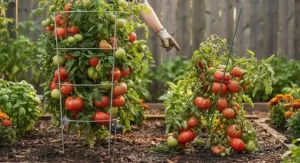
For gardeners growing the kind of tomato plant that eventually needs a stepladder to harvest from, the Gardener’s Supply Company Titan Extra Tall is purpose-built. At 80 inches high on a 19.5-inch-diameter footprint, it uses poly-coated steel-core stakes paired with adjustable polyethylene support rings rather than a rigid welded cage, which lets you reposition the rings upward as the plant genuinely earns the extra height instead of towering emptily over a young transplant. Gardener’s Supply has built its reputation on this category specifically, and the design logic here reflects real horticultural experience: adjustable rings distribute the plant’s growing weight at multiple points along the stem rather than relying on one rigid perimeter, which reduces stress on any single point of contact as fruit accumulates. Based on the spec comparison, this is not the cage for a patio cherry tomato — it’s specifically engineered for the six-to-eight-foot indeterminate heirlooms that regularly outgrow every other product on this list. Aggregated customer sentiment is strongly positive on durability and the tool-free assembly, with the main recurring caveat being that the tall stakes need to be driven deep and firm, since an under-anchored 80-inch structure carrying a loaded vine is genuinely top-heavy in strong wind. Pros:
- ✅ 80-inch height accommodates the tallest indeterminate varieties
- ✅ Adjustable rings reposition as the plant actually grows
- ✅ Poly-coated steel resists weather damage for years
Cons:
- ❌ Requires deep, firm staking to stay upright when fully grown
- ❌ Premium price relative to fixed-frame competitors
At a price in the C$140-C$180 range for a set of three, the Gardener’s Supply Company Titan Extra Tall is squarely a premium investment, best justified by gardeners who consistently grow towering heirloom varieties.
7. Texas Tomato Cages — most durable hot-dip galvanized heirloom pick
If the Gardener’s Supply Company Titan Extra Tall is about height, the Texas Tomato Cages are about sheer longevity. This is the cage aggregated review sentiment across gardening sites repeatedly calls the “heirloom option” — a six-foot, hot-dip galvanized wire cylinder, 24 inches in diameter, assembled from two stackable sections and designed to fold flat for storage without ever developing the weak hinge points that plague cheaper folding designs. The distinction between hot-dip galvanizing and the powder- or plastic-coated wire used on most budget and mid-range cages in this roundup is not marketing fluff: hot-dipping bonds a thick zinc layer to the steel that resists corrosion indefinitely, even through outdoor winter storage, whereas coated finishes can chip at a scratch and rust from that point outward. What most buyers overlook is the total cost of ownership angle — this is genuinely the most expensive cage per unit here, but gardeners and market growers who’ve used them for a decade routinely report zero replacement cost since purchase, which changes the per-season math considerably. The wide 24-inch diameter and tall six-foot stature give heavy indeterminate plants ample room to branch without becoming root-bound against the wire, and the two-section design means you’re not storing an unwieldy six-foot hoop in the garage all winter. Reviewers consistently describe these as the cage they wish they’d bought first, instead of cycling through three seasons of cheaper alternatives beforehand. Pros:
- ✅ Hot-dip galvanizing resists rust indefinitely, unlike coated wire
- ✅ 24-inch diameter gives heavy vines room to branch freely
- ✅ Two-section stackable design still folds flat for storage
Cons:
- ❌ Highest upfront price of any cage in this roundup
- ❌ Overkill for compact or determinate tomato varieties
Expect a price in the C$180-C$220 range for a four-pack, which sounds steep until you spread it across the decade-plus lifespan reviewers consistently report — at that point, the Texas Tomato Cages arguably become the cheapest cage on this list per season of actual use.
Practical Usage Guide: Setting Up and Maintaining Your Heavy-Duty Cage
Buying a sturdy cage solves half the problem; installing it correctly solves the rest. Set the cage in place while the tomato transplant is still small — trying to lower a rigid frame over a four-foot vine in July means snapped branches and a very bad afternoon. Push the legs at least six inches into loosened soil, angling them slightly outward rather than straight down, since a wider base resists tipping far better than a narrow, vertical stance. If your soil is heavy clay, water the planting hole first; dry clay resists leg penetration and is exactly why several reviewers across our seven picks mention installation being harder than expected.
Once the plant reaches roughly knee height, start guiding new growth back inside the cage weekly rather than letting stems escape sideways — an escaped stem loaded with fruit is unsupported dead weight hanging off the structure’s edge. A common first-30-days mistake is under-anchoring: gardeners assume the cage’s own weight holds it steady, then discover otherwise during the season’s first real windstorm. For any cage over 60 inches, consider adding a single garden stake driven alongside the frame and zip-tied loosely to it for extra wind bracing, particularly in exposed yards. As Ontario-based garden writer Steven Biggs notes in his practical staking overview, choosing the right support method should match your specific garden layout rather than following one universal rule — a cage that’s ideal for a sheltered backyard bed may need reinforcement on an open, wind-exposed lot. At season’s end, hose off soil and plant debris before folding cages for storage; residual organic matter left on coated wire accelerates the exact corrosion the coating is meant to prevent.
Real-World Scenarios: Matching a Cage to Your Garden
Consider three fairly typical Canadian gardeners. First, an apartment-dwelling beginner in Vancouver growing two cherry tomato plants on a sixth-floor balcony with strong wind exposure and zero ground soil to anchor into — for this person, the lightweight, round EZGrow Big EZ paired with a heavy container and a bit of extra bracing string makes more sense than an 80-inch cage that would simply catch wind like a sail up there. Second, a suburban family in Winnipeg with a 4×8 raised bed growing four indeterminate beefsteak varieties they’ve grown for years, well aware that prairie summer storms arrive fast and hard — here, the triangular SORANGEUN 63-Inch or the modular Vego Garden FlexGrow 16.5″ genuinely earn their price premium through wind-specific engineering. Third, a semi-serious market gardener near Leamington, Ontario — a region genuinely known for commercial tomato production — running fifteen indeterminate plants across a season and expecting to reuse equipment for a decade: the Texas Tomato Cages‘ total cost of ownership math simply wins here, since the up-front price gets divided across far more harvests than a casual home gardener will ever put a cage through.
The throughline across all three scenarios is that budget, wind exposure, and plant vigour should drive the decision together, not any single factor in isolation. A cheap cage in a sheltered spot might outlast an expensive cage installed poorly in an exposed one.
How to Choose Sturdy Tomato Cages for Indeterminate Tomatoes
What is a sturdy tomato cage for indeterminate tomatoes? It’s a support structure built with thick-gauge wire or steel tubing, a wide anchoring footprint, and enough height to accommodate continuous vertical growth through the full growing season — generally 54 inches or taller, since indeterminate varieties don’t stop climbing until frost.
Choosing correctly comes down to a handful of concrete, checkable criteria rather than gut feeling:
- Match height to growth habit. Determinate tomatoes rarely need more than 42-48 inches; indeterminate varieties should get 54 inches minimum, and 63-80 inches if you don’t plan to prune aggressively.
- Check wire gauge, not just material. A thicker gauge (lower number, or explicitly stated in millimetres) resists bending under fruit weight far better than thin decorative wire, regardless of coating type.
- Prioritize footprint width over height alone. A tall, narrow cage is inherently less wind-stable than a slightly shorter one with a wider base — this is basic physics, not marketing.
- Consider your soil type. Sandy or loose soil needs deeper leg penetration or supplemental staking; dense clay resists installation but anchors legs firmly once they’re in.
- Factor in storage space honestly. A cage that doesn’t fold flat, or folds awkwardly, often ends up left outside year-round, accelerating wear regardless of coating quality.
- Weigh coating type against your climate. Hot-dip galvanized resists corrosion best in humid or coastal Canadian regions; powder-coated steel is perfectly adequate in drier climates with proper winter storage.
- Calculate cost per season, not just sticker price. A cage that lasts twelve seasons at a higher price is frequently cheaper per year than one replaced every third season.
For the horticultural fundamentals behind these criteria — including why certain tomato cultivars are bred for compact versus vining growth in the first place — the Ontario Ministry of Agriculture’s tomato production resources offer solid, regionally relevant background for Canadian growers.

Cage Height Explained: Matching Cage Size to Your Tomato Variety
Cage height is probably the single most misunderstood spec on any tomato cage listing, mostly because gardeners assume “taller is always better” without accounting for what they’re actually growing. Determinate varieties — compact, bushy plants that set most of their fruit within a short window — genuinely don’t need more than 42 to 48 inches of support; anything taller just wastes storage space and money. Indeterminate varieties are the opposite problem entirely: they keep growing and setting new fruit trusses until the first hard frost, and a cage that tops out at 48 inches simply gets outgrown by midsummer, leaving the top three feet of vine flopping over unsupported. On paper this means matching cage height to seed packet growth habit before you ever compare brands, since a beautifully built 48-inch cage is still the wrong purchase for a six-foot heirloom.
The seven cages in this guide illustrate the full spectrum: the Panacea Products 89712 and EZGrow Big EZ top out at 48 inches, comfortably suiting determinate and moderately vigorous varieties. The Grower’s Edge 740418 and Vego Garden FlexGrow 16.5″ offer adjustable or stackable height, letting you scale support as the season progresses. And the SORANGEUN 63-Inch, Gardener’s Supply Company Titan Extra Tall, and Texas Tomato Cages are all built specifically for the tallest indeterminate cultivars, running from 63 to a genuinely towering 80 inches. If you’re unsure which category your seedlings fall into, check the seed packet or plant tag — “indeterminate” or “vining” is your cue to size up.
Wind Resistance and Plant Weight Support: What the Specs Really Mean
Wind resistance and plant weight support are really two sides of the same structural coin, and neither one shows up as a single clean number on most product listings — which is exactly why so many gardeners get surprised by a cage’s real-world performance. A cage’s resistance to wind depends on three factors working together: footprint width, leg penetration depth, and frame geometry. Triangular frames like the SORANGEUN 63-Inch distribute lateral force across three anchor points rather than four, which — somewhat counterintuitively — tends to resist racking (the sideways lean that precedes a full tip-over) better than a square frame of comparable wire gauge, since triangles are inherently rigid shapes in a way that squares are not.
Plant weight support is a related but distinct spec: it describes how much fruit-and-foliage load the frame can bear vertically and laterally before wire bends or joints fail. The Vego Garden FlexGrow 16.5″ publishes a specific rating of roughly 33 pounds per cage, which is unusually transparent — most competitors simply describe themselves as “heavy duty” without a number attached. Reviewers consistently note that a six-foot indeterminate plant loaded with fruit clusters can genuinely approach or exceed 20 pounds of hanging weight by peak season, so a cage rated well below that figure is a real, measurable risk rather than a hypothetical one. The practical takeaway: don’t just look for the word “sturdy” on a listing — look for wire gauge measurements, stated weight ratings where available, and footprint-to-height ratios, since a narrow 80-inch cage genuinely needs a wider base or supplemental staking to be wind-safe at that height.
Heavy-Duty Tomato Cages vs Stakes and Trellises
| Support Type | Setup Effort | Wind Stability | Best For |
|---|---|---|---|
| Cages (e.g. Texas Tomato Cages) | Low — set and forget | High with proper anchoring | Indeterminate, bushy vines |
| Single wooden/metal stakes | Moderate — requires tying | Moderate, depends on stake depth | Determinate, pruned single-stem plants |
| Trellis/Florida weave | High — needs twine and posts | High if properly tensioned | Market gardeners, dense rows |
Cages win on convenience for most home gardeners: there’s no ongoing tying, and the structure supports the plant on all sides rather than one point of contact. Stakes cost less up front and take up almost no storage space, but they demand weekly maintenance — tying and retying stems as the plant climbs — which is exactly the kind of task that gets skipped during a busy July and results in exactly the storm-snapped stems this whole guide is trying to help you avoid. A trellis or Florida weave system, favoured by market growers, delivers excellent support and airflow for dense rows but requires posts, twine, and real setup time that most backyard gardeners simply won’t invest for two or three tomato plants.
For the vast majority of home gardeners growing indeterminate tomatoes in Canada, a genuinely heavy-duty cage like the SORANGEUN 63-Inch or Texas Tomato Cages strikes the best balance: less ongoing labour than stakes, less setup complexity than a trellis system, and — critically — support that keeps pace with a plant that keeps growing all summer.
Tomato Cages for Different Buyer Types
Beginners tend to overbuy on height and underbuy on wire gauge, drawn in by tall listings without checking whether the frame can actually handle a loaded plant — a mid-height, moderately priced option like the Grower’s Edge 740418 is a forgiving first purchase since its adjustable tiers accommodate learning-curve mistakes in plant spacing and pruning. Container and balcony gardeners should prioritize weight and footprint over sheer height, since a tall, narrow cage in a pot is genuinely more likely to tip in wind than a shorter, well-anchored one; the EZGrow Big EZ fits this profile well. Budget-conscious gardeners running several plants at once benefit most from cages sold in economical multi-packs with proven galvanized wire, making the Panacea Products 89712 a sensible way to outfit a full bed without a large upfront outlay. Serious or semi-commercial growers, meanwhile, should think in terms of decade-long cost per season rather than sticker price alone, which is where the Texas Tomato Cages‘ hot-dip galvanizing genuinely pays for itself over time.
Common Mistakes When Buying Tomato Cages for Heavy Plants
The single most common mistake is buying based on height alone without checking wire thickness — a tall, thin-wire cage is arguably worse than a shorter, thick-wire one, since it has more leverage to bend under the same fruit load. A close second is underestimating footprint needs for wind-exposed sites; gardeners in open, unsheltered yards routinely under-anchor cages that would perform fine in a sheltered urban backyard. Buying a single cage for a plant that will eventually need staking reinforcement is another frequent oversight — cages over 60 inches carrying a fully loaded indeterminate vine genuinely benefit from one supplemental stake in windy regions, and skipping that step is how otherwise excellent cages like the Gardener’s Supply Company Titan Extra Tall end up toppled in a storm. Finally, many gardeners assume all “galvanized” coatings are equivalent; hot-dip galvanizing and thin electro-galvanized finishes behave very differently over a decade of outdoor storage, even though both terms appear side by side on competing listings.
Price Range & Value Analysis
| Cage | Price Range (CAD) | Value Verdict |
|---|---|---|
| Panacea Products 89712 | C$18-C$25 | Best entry point per cage |
| EZGrow Big EZ | C$45-C$60 (2-pack) | Best for portability, not wind |
| Grower’s Edge 740418 | C$55-C$75 | Best flexibility for growing plants |
| Vego Garden FlexGrow 16.5″ | C$65-C$85 (2-pack) | Best rated weight capacity |
| SORANGEUN 63-Inch | C$75-C$95 (4-pack) | Best value for wind resistance |
| Gardener’s Supply Company Titan Extra Tall | C$140-C$180 (3-pack) | Best for giant heirloom vines |
| Texas Tomato Cages | C$180-C$220 (4-pack) | Best long-term cost per season |
Looking at the numbers side by side, the real value story isn’t about which cage is cheapest — it’s about matching your actual plant count and growing horizon to the per-unit cost. A gardener replacing a cage every two or three seasons on the Panacea Products 89712 may spend more over a decade than someone who buys the Texas Tomato Cages once and never thinks about it again. Mid-tier options like the Vego Garden FlexGrow 16.5″ land in a genuine sweet spot: modest upfront cost, a stated weight rating, and modular parts that extend usefulness well beyond a single tomato season.
✨ Ready to stop losing tomatoes to a summer storm? Check current pricing on any of these picks and give your vines the backbone they deserve! 🍅
Long-Term Cost & Maintenance
Total cost of ownership rarely shows up on a product page, but it’s the number that actually matters after year three. A C$20 cage replaced every other season costs roughly C$100 across a decade; a C$200 hot-dip galvanized cage bought once and properly stored costs exactly C$200 across that same decade — and that’s before accounting for the plants and fruit potentially lost to a cage that fails mid-season. Maintenance itself is minimal across all seven picks here: rinse soil and plant debris off after harvest, let the frame dry fully before folding, and store it somewhere dry over winter. Coated wire that’s left outdoors year-round in Canadian freeze-thaw cycles degrades noticeably faster than the same product stored in a shed or garage, regardless of brand. For gardeners tracking real numbers, a simple rule holds up well: divide the purchase price by the number of seasons you realistically expect to use it, and compare that per-season figure across cages rather than comparing sticker prices directly.
Features That Actually Matter (And Those That Don’t)
Wire gauge, footprint width, and coating type are the three specs worth genuinely comparing before you buy — everything else is largely secondary. Colour, for instance, is pure cosmetics; a green-coated cage disappears into foliage while a red one stands out, but neither affects performance. “Number of tiers” sounds impressive on a listing but matters less than whether those tiers latch securely, since a wobbly multi-tier cage is arguably less stable than a simpler fixed-height design. Marketing terms like “professional grade” or “premium” carry no standardized meaning in this category — what most buyers overlook is that the actual wire diameter, usually buried in the product description rather than the headline, tells you far more than any adjective the listing uses. Genuinely useful features worth paying attention to include stackability (extends usable life across seasons), a documented weight rating (rare, but valuable when present, as with the Vego Garden FlexGrow 16.5″), and a wide, tapered leg design that penetrates soil without bending — a small detail that makes a real difference during installation.
Safety and Anchoring: Keeping Cages Secure in Canadian Weather
Canadian summers bring a genuinely wide range of wind conditions depending on region, from relatively sheltered urban backyards to wide-open prairie lots that catch every gust unimpeded. Regardless of which cage you choose, anchoring is the single controllable factor that determines whether it survives a storm. Drive legs at least six inches deep — deeper in sandy soil, which offers less grip than clay — and angle them slightly outward from vertical to widen the effective base. For any cage over 60 inches supporting a fully loaded plant, adding one or two garden stakes alongside the frame, tied loosely with soft garden twine, provides meaningful extra wind bracing without restricting the plant’s own growth. Provincial and municipal gardening resources, including seasonal planting guides published by Manitoba’s provincial agriculture publications, consistently recommend staking vulnerable crops as part of routine summer garden maintenance — a reminder that this isn’t optional extra work so much as standard practice for prairie and open-lot gardeners. If your region experiences regular severe thunderstorms, consider temporarily adding extra ground stakes ahead of a forecast storm rather than waiting to see whether the cage holds on its own.
Frequently Asked Questions
❓ What is the best heavy-duty tomato cage for indeterminate tomatoes?
❓ How tall should a tomato cage be for indeterminate tomatoes?
❓ Can a tomato cage really withstand strong wind?
❓ How much weight can a heavy-duty tomato cage support?
❓ Are metal tomato cages worth the extra cost over plastic-coated ones?
Conclusion
Choosing among tomato cages for heavy plants really comes down to answering three honest questions about your own garden: how tall does your variety actually grow, how exposed is your site to wind, and how many seasons do you realistically want this cage to last? Budget-conscious gardeners outfitting a full bed of moderately vigorous plants will do just fine with the Panacea Products 89712 or EZGrow Big EZ. Anyone growing genuinely tall indeterminate varieties in a wind-exposed yard should look hard at the SORANGEUN 63-Inch for its wind-specific triangular geometry, or the Vego Garden FlexGrow 16.5″ for its documented weight rating and modular reuse potential. And gardeners who’ve been burned by cheap, collapsed cages one storm too many — or who simply want to stop thinking about this purchase for the next decade — will find the Gardener’s Supply Company Titan Extra Tall and Texas Tomato Cages genuinely justify their premium pricing through height, rigidity, and corrosion resistance that outlasts everything else on this list. Whatever you choose, remember that the cage is only half the equation; proper installation, deep anchoring, and a bit of supplemental staking in exposed sites do as much for your harvest as the product specs themselves.
✨ Ready to give your tomatoes the support they’ve been missing? Check current prices on the pick that fits your garden and get it in the ground before the next growing spurt hits! 🍅🌬️
Recommended for You
- Backpack Sprayer for Large Gardens: 7 Best Picks for 2026
- 7 Best Pump Garden Sprayers for Weed Control in Canada (2026)
- Soaker Hose vs Drip Irrigation for Garden Beds: 7 Picks (2026)
Disclaimer: This article contains affiliate links. As an Amazon Associate, I earn from qualifying purchases. If you purchase products through these links, we may earn a small commission at no additional cost to you.
✨ Found this helpful? Share it with your friends! 💬🤗
