
In This Article
Every Canadian gardener knows the feeling: you step outside after a June rainstorm and find your prize peony face-down in the mulch, petals scattered like it lost a fight with the wind. Tall flowers — peonies, dahlias, delphiniums, gladiolus — carry blooms that are genuinely heavy relative to their stems, and once a stem bends past a certain point, it rarely straightens back out on its own. That’s the whole problem plant stakes for tall flowers are built to solve, and it’s a bigger deal in Canadian gardens than people expect, given how many regions swing between calm, humid growing weeks and sudden gusty squalls off the Great Lakes or the Prairies.
This guide compares seven real, currently available options — from simple single-stem stakes under C$20 to structural grow-through cages built for dinner-plate dahlias — and explains what actually matters when a support has to hold up real bloom weight through an entire Canadian growing season. We’ll also dig into stakes for peonies and dahlias specifically, since those two plants fail in genuinely different ways, plus decorative plant stakes for flower beds for anyone who wants their supports to look intentional rather than utilitarian. Plant stakes for tall flowers aren’t glamorous, but the right one is the difference between a border that photographs beautifully in August and one that looks like it was hit by a lawnmower.
We researched real products, real specs, and the recurring themes in aggregated customer feedback — not invented reviews — so you can match a support to your actual garden instead of guessing. Let’s get into it.
Quick Comparison Table
| Product | Best For | Height | Material | Price Range (CAD) |
|---|---|---|---|---|
| MTB Single Stem Plant Stakes | Single-stem blooms on a budget | 91 cm (36 in) | Powder-coated steel wire | Under C$20 |
| FEED GARDEN Peony Cages and Supports | All-around peony and dahlia support | 41 cm (16 in) | PVC-coated galvanized steel | C$25-C$35 |
| LEOBRO Plant Support Stakes | Mixed flower beds on a budget | 40 cm (15.8 in) | Green PVC-coated wire | C$20-C$30 |
| TCBWFY Heavy-Duty Plant Support Stakes | Tall, top-heavy dahlia stems | 61 cm (24 in) | 4.5 mm galvanized steel | C$35-C$45 |
| Gardener’s Supply Company Titan Peony Support | Storm-prone, windy gardens | Medium/adjustable | Metal core, polyethylene shell | C$45-C$60 |
| Gardener’s Supply Company Grow-Through Support, Large | Dinner-plate dahlias, big clumps | 76 cm (30 in) | Powder-coated steel grid | C$70-C$90 |
| Metal Flower Garden Stakes (Decorative) | Garden aesthetics, accent stakes | Varies | Powder-coated metal | C$15-C$25 |
Looking at the table, the split is really between structural cages that carry real bloom weight (the FEED GARDEN, LEOBRO, TCBWFY, and both Gardener’s Supply Company supports) and lighter single-stem or purely ornamental options (the MTB Single Stem Plant Stakes and the Metal Flower Garden Stakes). If your border includes dahlias bred for oversized blooms, the taller cages earn their higher price simply by having the leg length to stay anchored once the plant fills in. Budget doesn’t have to mean flimsy here — several of the sub-C$35 options use the same interlocking-ring design as the premium picks, just in smaller packs.
💬 Just one click — help others make better buying decisions too!😊
Top 7 Plant Stakes for Tall Flowers: Expert Analysis
1. MTB Single Stem Plant Stakes — best budget pick for single stems
The MTB Single Stem Plant Stakes solve a narrower problem than the cages further down this list: one heavy bloom, one stem, one simple loop. Each stake is 91 cm (36 in) of powder-coated green steel wire topped with a small ring that cradles a single stalk — amaryllis, lily, gladiolus, or a peony that’s growing as an isolated specimen rather than in a dense clump. Because there’s no cage structure, they push into soil in seconds and disappear visually against foliage, which is exactly the point for a support that shouldn’t compete with the flower it’s holding up.
Based on the spec comparison, this is the right call for container plantings and single specimen stems, not for a full peony bush with a dozen stalks — one stake per stem gets tedious fast in a dense clump, and that’s where a cage-style product earns its keep instead. Reviewers consistently note that the green coating holds up reasonably well through a season but can show surface rust by year two or three if stakes are left in wet soil over winter, so pulling and storing them is worth the ten minutes it takes.
Pros:
- ✅ Nearly invisible against green stems and foliage
- ✅ Fast to install — no cage assembly required
- ✅ Genuinely inexpensive per-stem cost in multi-packs
Cons:
- ❌ Impractical for dense, multi-stem clumps
- ❌ Surface rust possible if stored wet over winter
At under C$20 for a pack of ten or twenty, this is the cheapest real solution on this list, and it’s the right one for anyone whose “tall flower problem” is really just a handful of individual stems rather than a whole bed.
2. FEED GARDEN Peony Cages and Supports — best all-rounder for peonies and dahlias
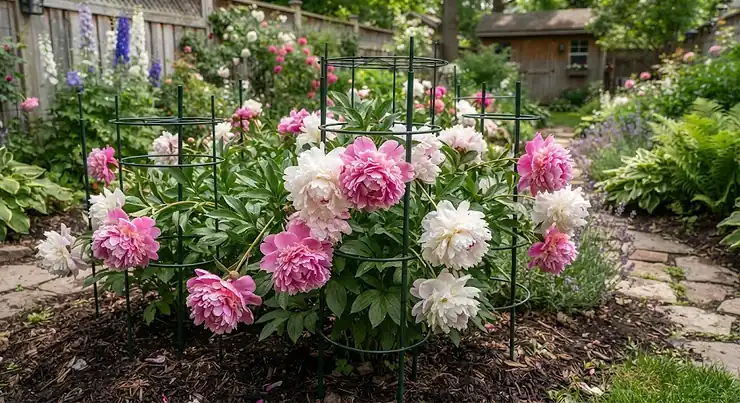
The FEED GARDEN Peony Cages and Supports ship as a six-pack of half-round rings, each 25 cm wide by 41 cm tall (10 in x 16 in), designed to be pushed into the soil around an emerging clump before the foliage fills in. The half-round shape is worth noting: instead of a closed circle, you get an open-backed ring that tucks against a fence, wall, or neighbouring plant, which matters more than it sounds like it should in a tightly planted border.
What most buyers overlook about this style of support is timing — installed early, before stems reach 20-30 cm, the plant grows up through the ring and the ring becomes invisible by June; installed late, you’re wrestling mature stems into a cage and risking snapped growth. For peonies specifically, whose heavy double blooms are the textbook example of bloom weight overwhelming stem strength, this early-install approach is the difference between a tidy mound and a flopped mess after the first heavy rain. Reviewers commonly report that the PVC coating resists the rust that plain galvanized wire develops, though a few users in coastal, salt-air regions mention faster corrosion than inland gardens.
Pros:
- ✅ Half-round design fits tight border spacing
- ✅ PVC coating resists rust better than bare wire
- ✅ Six-pack covers a full peony and dahlia bed
Cons:
- ❌ Must be installed early for best results
- ❌ Faster corrosion reported in coastal, salt-air climates
In the C$25-C$35 range for six rings, this is the strongest all-around value pick if your garden includes both peonies and dahlias, since the height and width suit both without needing two different products.
3. LEOBRO Plant Support Stakes — best value multi-pack for mixed flower beds
The LEOBRO Plant Support Stakes come six to a pack at 25 cm wide by 40 cm tall (10 in x 15.8 in), built from green PVC-coated wire in a similar interlocking-ring format to the FEED GARDEN option, with the added feature of legs that can link together side-by-side for wider clumps or a continuous row along a border edge.
The linking legs are the real story here — based on the spec sheet, a single ring supports one moderate clump, but two or three linked together handle an oversized hosta, a sprawling peony, or a row of dahlias planted close together without buying a separate wide-format cage. That flexibility makes this a genuinely practical pick for a mixed perennial bed where plant sizes vary year to year as the garden matures. Aggregated review sentiment points to the coating being slightly thinner than some competitors, with a handful of buyers noting bent legs after being pushed into compacted or rocky soil, so working the planting hole with a trowel first is worth the extra minute.
Pros:
- ✅ Legs link together for wider, custom-sized support
- ✅ Solid value for a six-pack at this price point
- ✅ Green coating blends into foliage reasonably well
Cons:
- ❌ Thinner wire gauge than some heavy-duty alternatives
- ❌ Legs can bend if pushed into rocky or compacted soil
At roughly C$20-C$30 for six pieces, this sits just below the FEED GARDEN set in price while offering more flexibility for irregular bed shapes, making it a smart pick for gardeners still figuring out their layout.
4. TCBWFY Heavy-Duty Plant Support Stakes — tallest option for dinner-plate dahlias
The TCBWFY Heavy-Duty Plant Support Stakes are the tallest cage-style product on this list at 61 cm (24 in), built from 4.5 mm galvanized wire — noticeably thicker than the 3 mm or so used in most budget peony cages — and sold in packs of ten with interlocking ring segments that stack for extra height as the plant grows.
Here’s what the thicker gauge means in practice: dahlias bred for “dinner-plate” blooms (the American Dahlia Society classifies these as AA giant varieties over 25 cm across) routinely produce stems that a lightweight ring simply bends under once the flower opens fully in humid August weather, so the extra wire thickness on this model directly addresses the failure point that cheaper stakes hit. The stackable segments also mean you’re not locked into one fixed height, which matters because you genuinely can’t predict in April how tall a dahlia tuber will get by September. Reviewers frequently mention that the interlocking joints hold firm even in windy conditions, with a smaller number noting the segments can be fiddly to reassemble after winter storage if pieces get mixed between plants.
Pros:
- ✅ Thickest wire gauge of the budget-to-mid cages tested
- ✅ Stackable height adapts as dahlias grow taller
- ✅ Reported to hold firm in windy, exposed sites
Cons:
- ❌ Segments can be fiddly to reassemble after storage
- ❌ Taller profile is more visible before foliage fills in
Priced around C$35-C$45 for a ten-pack, this is the pick to reach for if dinner-plate dahlias are the specific reason you’re shopping for plant stakes for tall flowers in the first place.
5. Gardener’s Supply Company Titan Peony Support — most weatherproof premium pick
The Gardener’s Supply Company Titan Peony Support takes a different construction approach: a solid metal core wrapped in a polyethylene shell, sold in a set of two, designed specifically to resist the freeze-thaw cycling and UV exposure that gradually weaken plain steel or PVC-coated wire over multiple Canadian seasons.
Based on the materials comparison, the polyethylene shell is the meaningful upgrade over the PVC coating used on cheaper cages — it doesn’t crack or peel the way thin PVC dip-coating can after a few winters in a shed or, worse, left outdoors, and the metal core underneath still provides the rigidity needed to resist bending under real bloom weight from mature peony clumps. Gardener’s Supply Company has built its catalogue specifically around perennial plant support for decades, and that specialization shows in details like a wider base stance for stability in loose garden soil. Reviewers consistently describe these as sturdier underfoot-knock resistance than typical big-box cages, though the higher price point draws occasional comments that a full peony border requires buying several sets, which adds up.
Pros:
- ✅ Polyethylene shell resists cracking better than thin PVC
- ✅ Wider base stance improves stability in loose soil
- ✅ Built by a brand specializing in perennial supports
Cons:
- ❌ Premium price per unit versus multi-packs
- ❌ Covering a full border requires multiple sets
At around C$45-C$60 for a set of two, this is the pick for gardeners who’ve already replaced a few cheap cages and are ready to buy once for a support that should outlast several Canadian winters.
6. Gardener’s Supply Company Grow-Through Support, Large — widest grow-through ring for big clumps
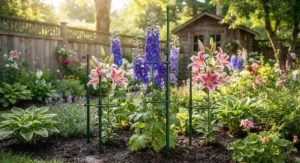
The Gardener’s Supply Company Grow-Through Support, Large scales up the cage concept considerably: a 76 cm tall by 61 cm wide (30 in x 24 in) grid-style grow-through frame with a wide, rounded top ring, sold in a set of three, aimed at genuinely large perennial clumps rather than a single young plant.
What the dimensions mean in real terms is that this support is built for an established peony that’s been in the ground for five-plus years and has bulked out to a metre across, or a cluster of large dahlia varieties planted close together — situations where a 40 cm ring from the budget cages simply can’t encircle the plant’s actual footprint by midsummer. The bouquet-shaped top ring is a deliberate design choice too: rather than a flat grid, the slightly flared top guides stems outward as they grow, spreading the load across more of the frame instead of concentrating weight on one side. Aggregated feedback frequently praises the stability of the wide base for exposed, windy sites, while some buyers note that assembly instructions for connecting the grid sections could be clearer out of the box.
Pros:
- ✅ Wide enough for genuinely large, established clumps
- ✅ Bouquet-shaped top ring spreads load across the frame
- ✅ Reported stability advantage in exposed, windy gardens
Cons:
- ❌ Assembly instructions could be clearer
- ❌ Overkill for a young or small plant
In the C$70-C$90 range for a set of three, this is a meaningful investment, but it’s genuinely the right tool for a large, established peony or dahlia bed rather than a starter garden.
7. Metal Flower Garden Stakes (Decorative Set) — best decorative accent for garden aesthetics
The Metal Flower Garden Stakes are a different category entirely: a six-piece set of colourful, powder-coated metal flower-shaped toppers on rust-resistant stems, built for garden aesthetics rather than structural stem support. They’re not a substitute for a peony cage, and they don’t pretend to be.
What these actually do well is add year-round visual interest to a flower bed during the stretches when nothing is blooming, or dress up the base of a functional cage so the bed reads as intentionally designed rather than propped up with visible wire. Based on the construction, the powder coating on quality decorative stakes resists fading better than painted versions, though — like any painted outdoor metal — direct, intense summer sun will dull the finish over several seasons regardless of coating quality. Reviewers commonly describe these as a low-cost way to add colour to a bed between bloom cycles, with a few noting the thinner decorative stems (as opposed to structural cage legs) can bend if a hose or rake catches them carelessly.
Pros:
- ✅ Adds colour and structure when nothing is blooming
- ✅ Rust-resistant coating suited to outdoor exposure
- ✅ Disguises the visible wire of functional cages nearby
Cons:
- ❌ Provides no real stem support for heavy blooms
- ❌ Thin stems can bend under careless contact
At around C$15-C$25 for six pieces, treat this as a finishing touch layered alongside one of the structural cages above, not a replacement for one.
Practical Guide: Installing and Maintaining Plant Stakes All Season
Getting plant stakes for tall flowers right is less about the product and more about timing. The single biggest mistake gardeners make is waiting until a plant has already flopped to install support — by then you’re bending stems into a cage instead of letting the plant grow through it naturally, and bent stems rarely recover their original strength even if they don’t snap outright.
For peonies and dahlias specifically, install cage-style supports in early-to-mid spring when new growth is 15-20 cm tall, before the foliage canopy closes in. Push legs 10-15 cm into the soil at a slight outward angle for extra grip, then leave the support alone — the plant does the rest of the work by growing up through the ring over the following weeks. For dahlias grown from tubers, a stake driven in at planting time (before the tuber even sprouts) avoids accidentally spearing the tuber later, which is a genuinely common first-season mistake.
Maintenance is minimal but matters: check ring height against plant growth every few weeks through June, since a fast-growing dahlia can outgrow a low support within a season if you bought the wrong height. At season’s end, pull stakes after the first hard frost, hose off soil and residue, and store them dry — Natural Resources Canada’s plant hardiness zone data shows how dramatically freeze-thaw cycling varies across the country, and repeated winter cycling outdoors is what shortens the lifespan of PVC-coated wire fastest. A support stored dry in a shed can easily last five or more seasons; one left outdoors through a Prairie winter may not survive three.
✨ Don’t Miss These Exclusive Deals! 🌸
Take your border from flopped to flawless with the seven supports above — click any highlighted pick to check current pricing and availability before the season’s blooms show up!
Real-World Scenarios: Matching Stakes to Your Garden
Picture three different Canadian gardeners, because the “right” support genuinely depends on the situation. First, a new homeowner in suburban Ontario who inherited three mature peony bushes and wants them staked before the first big June rain — for this scenario, the FEED GARDEN Peony Cages and Supports is the sensible starting point: enough coverage for three plants in one six-pack, sized correctly for standard peonies, and inexpensive enough to try before committing to anything premium.
Second, a dahlia enthusiast on the Prairies growing dinner-plate varieties for a local flower show, dealing with genuinely strong seasonal winds and stems that can reach 1.2 m. This grower needs the height and wire gauge of the TCBWFY Heavy-Duty Plant Support Stakes, possibly paired with the Gardener’s Supply Company Grow-Through Support, Large for the biggest specimens, since undersized support in an exposed, windy site is close to a guaranteed failure by late summer.
Third, a condo-balcony gardener in Vancouver with a handful of container-grown amaryllis and lilies — nothing that needs a full cage, just something to keep individual stems upright without dominating a small container visually. The MTB Single Stem Plant Stakes fit this use case exactly, and pairing a couple with the Metal Flower Garden Stakes adds colour to the container between bloom cycles without adding bulk. Matching the product to the actual plant and site, not just buying the most expensive option, is the real decision that determines whether a support works.
Problem → Solution: Fixing Common Tall-Flower Support Issues
Even with the right stake, specific problems come up repeatedly, and each has a fairly direct fix. If a stem has already started leaning before you noticed, don’t try to force it fully upright in one motion — gently guide it into a cage over two or three days, a little more each day, since a sudden correction on a partially bent stem is what actually causes it to snap.
If a stake keeps working loose in soft or sandy soil, the fix usually isn’t a bigger stake but a deeper one: push legs an extra 5-8 cm deeper than feels necessary, and consider a wider-based option like the Gardener’s Supply Company Titan Peony Support, whose stance is specifically built for stability in loose ground. If blooms are snapping at the point where the stem exits the support ring, the ring is almost certainly too low relative to the flower head — this is a sizing mistake, not a product-quality issue, and it points toward the taller TCBWFY Heavy-Duty Plant Support Stakes or the Gardener’s Supply Company Grow-Through Support, Large for future seasons.
Finally, if a whole bed flopped uniformly after one storm, the underlying issue is usually that no support was installed at all before bloom weight arrived. Prevention, installed early, beats correction every time with these plants.
Buyer’s Decision Framework
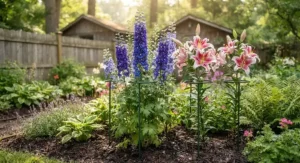
If you’re growing a single specimen peony or a handful of container lilies, choose a single-stem stake like the MTB Single Stem Plant Stakes because a full cage is unnecessary bulk for one stalk. If you’re staking an established, multi-stem peony or a standard dahlia bed, choose a mid-height cage like the FEED GARDEN Peony Cages and Supports or LEOBRO Plant Support Stakes, because their 40 cm-ish rings match typical clump sizes without overbuilding.
If your dahlias are bred for oversized, dinner-plate blooms, choose the taller, thicker-gauge TCBWFY Heavy-Duty Plant Support Stakes, because standard-height rings will be outgrown by midsummer. If your garden sits in an exposed, windy site — a rural Prairie property, an open coastal lot, an unshielded suburban corner — choose the reinforced Gardener’s Supply Company Titan Peony Support or the wide-footprint Gardener’s Supply Company Grow-Through Support, Large, because both are built specifically to resist the lateral force wind adds on top of ordinary bloom weight. And if the goal is finishing a bed’s look rather than solving a structural problem, layer in the Metal Flower Garden Stakes alongside whichever functional support you’ve chosen.
What Are Plant Stakes for Tall Flowers?
Plant stakes for tall flowers are structural supports — rings, cages, or single vertical rods — pushed into soil around a plant to hold heavy stems upright against gravity, wind, and rain before they bend or break under their own bloom weight. They range from simple single-rod stakes for one stem to wide grow-through cages built for entire clumps of large perennials like peonies and dahlias.
The core mechanical problem they solve is straightforward: a flower stem is essentially a column, and columns fail under lateral load once bloom weight shifts the plant’s centre of gravity off-axis. According to horticultural reference material on dahlia growing habits, many cultivated dahlia varieties were specifically bred for larger, showier blooms — which is exactly the trait that makes stem support necessary in the first place, since the wild-type plant never had to carry that much flower weight on an unsupported stalk.
How to Choose Plant Stakes for Tall Flowers
Picking the right support comes down to seven practical factors, roughly in order of importance:
- Match height to mature plant height, not current size. A stake or ring should sit at roughly two-thirds of the plant’s expected mature height, giving stems room to grow through and above the support naturally.
- Size the ring diameter to the clump, not the stem. A single peony clump can span 60-90 cm at maturity; an undersized ring will constrict growth rather than support it.
- Choose wire gauge based on bloom weight, not price alone. Dinner-plate dahlias and double peonies need thicker gauge wire than single-petal varieties or lighter-blooming perennials.
- Consider your site’s wind exposure. Exposed, open sites need a wider base stance and sturdier materials than a sheltered courtyard bed.
- Factor in Canadian climate durability. PVC-coated wire is fine for gardeners who store stakes indoors over winter; polyethylene-shelled options handle being left outdoors better.
- Decide if aesthetics matter as much as function. If the support will be visible before foliage fills in, a decorative option layered alongside a functional one may matter more than it sounds like it should.
- Buy for your largest plant, not your average one. One oversized dahlia in an otherwise modest bed can make an entire multi-pack the wrong height if you sized for the average instead of the outlier.
Stakes for Peonies and Dahlias: Why These Blooms Need Extra Support
Peonies and dahlias fail differently, and stakes for peonies and dahlias that ignore that distinction tend to underperform for one plant or the other. Peonies carry their weight in a dense, dome-shaped clump of stems that all lean outward simultaneously after rain — the classic “flopped umbrella” look — so what they need is a wide ring that constrains the whole clump’s outward spread rather than supporting any single stem.
Dahlias, by contrast, typically grow as fewer, taller individual stalks, each carrying one or a handful of genuinely heavy flower heads at the very top — closer to a top-heavy pole than a spreading dome. That means dahlias need height and per-stem rigidity more than they need wide clump-constraint, which is exactly why the taller, thicker-gauge TCBWFY Heavy-Duty Plant Support Stakes and the tall Gardener’s Supply Company Grow-Through Support, Large are better matched to dahlias than the shorter FEED GARDEN or LEOBRO rings, which suit peonies more naturally. Gardeners who grow both often end up needing two different product types rather than one universal solution — and based on the spec comparison across all seven products here, that’s a reasonable expectation rather than a sign you bought the wrong thing the first time.
Timing differs too: peony supports go in during early spring as the clump emerges from dormancy, while dahlia stakes are best driven into the ground at planting time, before the tuber sprouts, to avoid piercing the tuber later when you can no longer see exactly where it sits underground.
Decorative Plant Stakes for Flower Beds: Balancing Structure and Garden Aesthetics
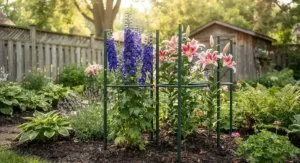
Decorative plant stakes for flower beds serve a genuinely different purpose from structural cages, and conflating the two categories is a common shopping mistake. A decorative stake — like the Metal Flower Garden Stakes on this list — is chosen for garden aesthetics: colour, shape, visual rhythm along a border, something to look at when the bed itself isn’t in bloom. It is not rated, tested, or built to resist bloom weight, and expecting one to hold up a flopping dahlia is setting it up to fail.
That said, the two categories work well together rather than as a forced choice. A common approach among experienced gardeners is to install the functional cage first, sized correctly per the criteria above, then tuck one or two decorative stakes at the base or edge of the same planting once foliage has filled in enough to hide the transition — the structural support does the actual work, while the decorative piece adds a finishing visual layer that keeps the bed from reading as purely utilitarian. According to gardening guidance from the Calgary Horticultural Society, thoughtful bed design in Canadian climates often benefits from layering functional and ornamental elements together rather than treating them as separate projects, which matches exactly this approach.
For anyone shopping primarily on garden aesthetics, colour-coordinating decorative stakes with a home’s exterior trim or an existing garden colour scheme reads as far more intentional than mismatched, purely functional wire left fully visible — small detail, noticeable difference.
Common Mistakes When Staking Tall Flowers
The most frequent mistake, by a wide margin, is installing support too late — after a plant has already started leaning, rather than in spring while stems are still short and pliable. A close second is buying a support sized for the plant’s current height rather than its mature height, which means outgrowing a cage by midsummer right when bloom weight peaks.
A less obvious mistake is over-tightening ties or wire around a stem to force it fully vertical; stems need slight room to flex in wind, and a support that’s too rigid at the contact point can actually cause breakage at the pinch point rather than preventing it. Gardeners also frequently underestimate wind exposure — a site that seems calm on an average day can see genuinely damaging gusts a handful of times per season, and a support rated for a sheltered courtyard simply isn’t built for an open, exposed lot.
Finally, leaving PVC-coated or painted stakes outdoors year-round in climates with significant freeze-thaw cycling shortens their working life considerably compared to storing them dry over winter — a maintenance step that takes minutes but meaningfully extends how many seasons a set of stakes actually lasts.
Plant Stakes vs Traditional Stem Support Alternatives
Before dedicated cages became widely available, gardeners relied on individual bamboo canes tied with twine, or repurposed tomato cages never actually designed for flowering perennials. Those methods still work in a pinch, but they trade off against purpose-built stakes in some fairly consistent ways.
| Method | Stem Support Quality | Setup Time | Visual Impact | Typical Lifespan |
|---|---|---|---|---|
| Bamboo cane + twine | Good for single stems, poor for clumps | Slow (tie each stem) | Visible, rustic | 1-2 seasons |
| Repurposed tomato cage | Fair — wrong shape for most flowers | Moderate | Visible, utilitarian | 3-5 seasons |
| Purpose-built peony/dahlia cage | Strong, matched to plant shape | Fast (push and done) | Disappears under foliage | 3-7 seasons |
| Decorative stakes alone | None — aesthetic only | Fast | Intentional, colourful | Varies by exposure |
The analysis here is fairly clear-cut: bamboo and twine offer real per-stem control and are genuinely cheap, but the labour cost of tying dozens of individual ties across a bed adds up fast, and twine needs replacing or re-tying multiple times per season as stems thicken. A repurposed tomato cage is faster to install than tying twine, but its straight-sided, narrow shape was engineered for a single vining plant, not a wide-spreading peony clump, so it often fights the plant’s natural growth habit instead of accommodating it. Purpose-built cages cost more upfront but win on both setup time and how well they disappear visually once foliage fills in — which, for anyone weighing stem support against garden aesthetics, is usually the deciding factor.
Asked Questions
❓ What is the best way to stake tall peonies without damaging the stems?
❓ How tall should a stake be for dahlias?
❓ Can I reuse plant stakes for tall flowers every year, or do I need new ones?
❓ When should I install plant stakes for tall flowers — before or after blooms open?
❓ Are decorative garden stakes strong enough to support heavy blooms like dinner-plate dahlias?
Conclusion
Getting plant stakes for tall flowers right isn’t complicated once you separate the two things people usually conflate: structural stem support and garden aesthetics. For peonies, a wide, early-installed ring like the FEED GARDEN Peony Cages and Supports handles the classic flopped-clump problem. For dahlias, especially dinner-plate varieties, height and wire gauge matter more, which is where the TCBWFY Heavy-Duty Plant Support Stakes and the Gardener’s Supply Company Grow-Through Support, Large earn their price. Single specimens do better with something as simple as the MTB Single Stem Plant Stakes, and once the structural work is done, a set of Metal Flower Garden Stakes finishes the bed visually without pretending to do a job it was never built for.
None of these choices need to be perfect on the first try — matching a stake to a plant’s actual size and your site’s wind exposure, installed early rather than after the fact, solves the vast majority of flopped-stem problems Canadian gardeners run into every summer. Horticulture programs like the one at the University of Guelph continue to study exactly these plant-structure interactions, and the practical takeaway for home gardeners stays consistent: support early, support to scale, and store it properly over winter.
🌿 Ready to keep your border upright this season? Compare the seven picks above and check current prices before your peonies and dahlias hit peak bloom weight!
Recommended for You
- Tomato Cages vs Stakes for Tomato Plants: 7 Best Picks (2026)
- 7 Best Tomato Cages for Heavy Plants in Canada (2026 Picks)
- Backpack Sprayer for Large Gardens: 7 Best Picks for 2026
Disclaimer: This article contains affiliate links. As an Amazon Associate, I earn from qualifying purchases. If you purchase products through these links, we may earn a small commission at no additional cost to you.
✨ Found this helpful? Share it with your friends! 💬🤗
