
In This Article
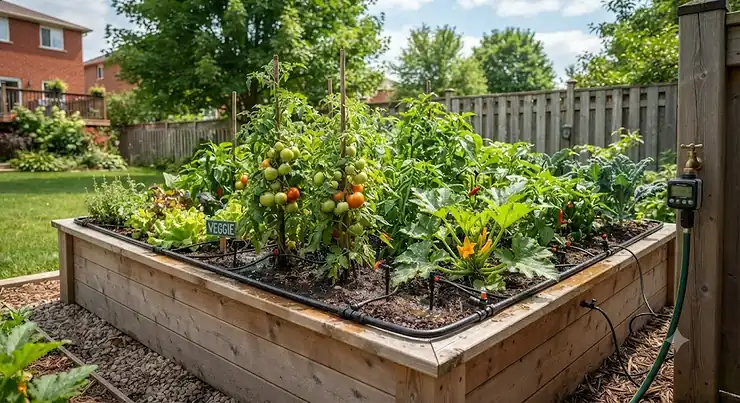
A drip irrigation kit for vegetable garden use is a set of tubing, emitters, and connectors that delivers water in slow, steady drops directly to the base of each plant instead of spraying it overhead. That’s the textbook version, anyway. The lived version is a lot less dramatic and a lot more useful: it’s the difference between standing outside with a hose for twenty minutes every evening and glancing at a timer while you do literally anything else with your summer.
I’ve spent the last few weeks buried in spec sheets, aggregated review data, and Canadian gardening forums trying to answer one deceptively simple question: which kit actually works for a backyard vegetable patch, not a golf course or a commercial farm? Turns out the answer depends heavily on your bed size, your water pressure, and whether you’re the type of gardener who forgets to water for three days during a heat wave (no judgment — most of us are).
Whether you’re running a single 4×8 raised bed in Ontario or a sprawling in-ground plot on the Prairies, the right drip irrigation kit for vegetable garden watering can cut your water use dramatically while producing healthier, more consistent tomatoes, peppers, and beans. Below, we’ll walk through seven real kits sold in Canada, break down what actually matters when comparing them, and cover the practical stuff — emitter spacing, timer compatibility, and water efficiency — that most product listings gloss over entirely.
Quick Comparison Table
| Kit | Best For | Price Range (CAD) | Coverage |
|---|---|---|---|
| Rain Bird GARDENKIT | Single raised bed, beginners | C$45–C$65 | Up to one 4′ x 8′ bed |
| GARDENA Micro-Drip-System | Precision, premium builds | C$110–C$160 | Up to 60 m² |
| Vego Garden Irrigation Kit | Purpose-built raised beds | C$60–C$90 | 25–40 ft tubing (size-dependent) |
| MIXC 230FT Quick-Connect Kit | Large or multiple beds on a budget | C$35–C$55 | Up to 230 ft of tubing |
| Raindrip R560DP | Containers plus a small bed | C$40–C$60 | Up to 20 plants |
Here’s the pattern worth noticing: price climbs fastest with precision and automation, not with sheer tubing length. A budget kit and a premium kit can water roughly the same square footage, but the premium option gives you finer control over exactly how much water lands on each plant. If your garden is one modest raised bed, that precision matters less than it does for a sprawling mixed plot with tomatoes next to lettuce — two crops with wildly different thirst levels.
💬 Just one click — help others make better buying decisions too!😊
Top 7 Drip Irrigation Kits for Vegetable Gardens: Expert Analysis
Every kit here is a real, currently available product — not a hypothetical. We’ve grouped them roughly budget-to-premium, but “best” genuinely depends on your bed layout, so read the “who it’s for” line on each before you decide.
1. Rain Bird GARDENKIT — best all-around pick for a single raised bed
The standout here is the pressure-compensating emitter tubing, which sounds technical but solves a real problem: uneven watering along a long tubing run. This kit is built around a coil of professional-grade brown emitter tubing carrying 70 built-in emitters spaced every 6 inches (about 15 cm), each releasing water at a fixed 0.8 gallons per hour regardless of where they sit on the line. That “regardless of position” part is the whole point — cheaper drip lines lose pressure toward the far end, so the last few plants get shortchanged. Rain Bird’s pressure-compensating design keeps flow consistent from the faucet end to the far corner of a 4-foot by 8-foot (1.2 m x 2.4 m) bed, which is exactly the footprint this kit is sized for. Based on the spec comparison with generic big-box kits, this is one of the few sub-C$70 options using genuine pressure-compensating technology rather than basic drip-hole tubing. Reviewers consistently report that assembly takes under 30 minutes even for first-time users, and that the resin components hold up through multiple seasons without cracking. What most buyers overlook is that the kit ships without a timer — you’ll want to add the Rain Bird Hose End Timer separately if you want true set-it-and-forget-it scheduling.
Pros:
- ✅ Pressure-compensating emitters resist clogging and uneven flow
- ✅ Professional-grade resin components built to last multiple seasons
- ✅ Straightforward faucet-to-tubing setup, beginner-friendly
Cons:
- ❌ Sized for one 4′ x 8′ bed — needs add-ons for bigger plots
- ❌ Timer sold separately, adding to the total cost
At around C$45–C$65 depending on retailer, the Rain Bird GARDENKIT delivers commercial-grade emitter technology at a homeowner price, making it a strong value pick for anyone with exactly one standard raised bed.
2. GARDENA Micro-Drip-System — best for precision watering across mixed plantings
The standout feature is per-plant flow control: every drip head in this German-engineered system adjusts individually, so a thirsty tomato and a drought-tolerant herb sharing the same line can each get exactly what they need. The 13450-20 starter set covers up to 60 square metres (roughly 645 sq ft), using push-fit connectors that snap together without tools, glue, or barbed fittings that eventually work loose. On paper this means a faster, more forgiving install than barbed-tubing systems, and it explains why GARDENA has held onto its reputation as Europe’s leading watering brand for decades. What the spec sheet won’t tell you, but aggregated owner feedback suggests, is that the modular design makes mid-season changes genuinely easy — add a new tomato plant in July and you can splice in a new drip head in minutes rather than re-plumbing a section. The system also pairs directly with GARDENA’s own Water Control timers for full automation, which we’ll cover in more detail later in the timer compatibility section below.
Pros:
- ✅ Individually adjustable drip heads for mixed vegetable and herb beds
- ✅ Tool-free push-fit connectors simplify installation and edits
- ✅ Native compatibility with GARDENA’s automated Water Control timers
Cons:
- ❌ Noticeably pricier than basic drip-hole kits
- ❌ Proprietary fittings mean future expansions should stay within the GARDENA ecosystem
Priced around C$110–C$160, the GARDENA Micro-Drip-System is the kit to reach for if your garden has several different crop types with different water needs, not just one uniform bed of the same vegetable.
3. Vego Garden Irrigation Kit — best purpose-built option for raised beds specifically
Unlike generic drip kits retrofitted onto raised beds, this one was designed around raised-bed geometry from the start — that’s the standout. It uses a combination of gentle mist sprayers and drip heads, each on its own independent valve, so you can dial back flow for delicate seedlings in spring and open it up for established, root-heavy tomato plants by midsummer. The kit comes in small, medium, and large sizes with 25 to 40 feet of tubing depending on bed dimensions, and a single 60 PSI water source can run up to 32 mist sprayers and 8 sprinklers across connected zones. Based on the spec comparison with the Rain Bird kit above, Vego trades some of that pressure-compensating precision for more flexible spray-pattern options — useful if your bed has a mix of leafy greens (which like broader misting) and root vegetables (which prefer targeted drips). Reviewers consistently note quick installation, generally under an hour, though a portion of aggregated feedback flags that connectors can feel slightly finicky during the first setup before everyone gets the hang of the push-fit system.
Pros:
- ✅ Purpose-designed for raised-bed shapes and mixed planting
- ✅ Independent valves let you tune flow per zone or crop
- ✅ Mist and drip heads cover both seedlings and mature plants
Cons:
- ❌ Best-fit dimensions assume Vego-brand beds; other beds need measuring first
- ❌ Some connectors require a careful hand during initial assembly
Running roughly C$60–C$90 depending on kit size, the Vego Garden Irrigation Kit earns its keep if raised beds are your entire growing system rather than a side project next to an in-ground plot.
4. Orbit 91944 / 91945 Tomato Garden Drip System — best low-commitment starter kit
The standout is the name-brand honesty: this is explicitly built as a compact, 10-plant kit rather than something oversold as an all-garden solution. Push-connect fittings mean no barbed ends to fight with, and the whole thing is genuinely built for a raised bed or a dedicated tomato-and-pepper row rather than a full backyard plot. The key spec worth flagging is capacity — ten plants, full stop — which in practice means this kit suits a single 4×4 or 4×8 bed comfortably but will leave you short if you’re running two or three beds. What most buyers overlook is that Orbit sells this kit in two configurations: the base 91944 version and the 91945, which bundles in an automatic watering timer for a modest premium. Aggregated reviewer sentiment consistently praises the low barrier to entry — this is often the first drip kit people buy before deciding whether to invest in something larger — while noting that its 10-plant ceiling means growth-minded gardeners tend to outgrow it within a season or two.
Pros:
- ✅ Push-connect fittings assemble in well under 30 minutes
- ✅ Budget-friendly entry point for first-time drip irrigation users
- ✅ Timer-bundled variant (91945) available for hands-off scheduling
Cons:
- ❌ Ten-plant capacity is limiting for anyone with more than one bed
- ❌ Base kit (91944) needs a separate timer purchase for automation
At approximately C$30–C$50 for the base kit (and C$45–C$65 with the timer bundle), the Orbit 91944 / 91945 is the sensible low-risk pick for someone testing drip irrigation for the first time.
5. MIXC 230FT Quick-Connect Drip Irrigation System — best for covering a large or multi-bed garden cheaply
The standout advantage is sheer coverage per dollar: 230 feet of combined 1/4-inch and 1/2-inch fast-lock tubing is enough to wrap around several raised beds or snake through a good-sized in-ground plot without buying a second kit. The tubing includes adjustable nozzles that swing between a tight drip and a wider mist, which is handy if your garden layout mixes tightly spaced seedlings with more spread-out mature plants. Here’s what the spec sheet won’t spell out clearly: at this length and price point, you’re trading some of the pressure-compensating precision found in the Rain Bird kit for raw flexibility and reach. Reviewers consistently describe the quick-connect fittings as genuinely quick once you understand the layout, though a portion of aggregated feedback flags that first-time installers can feel overwhelmed by the sheer volume of tubing and connectors included in the box — this is not a 15-minute kit for someone who wants minimal assembly.
Pros:
- ✅ Exceptional tubing length for the price, ideal for multiple beds
- ✅ Adjustable nozzles switch between drip and mist patterns
- ✅ Expandable layout suits irregular or sprawling garden shapes
Cons:
- ❌ Longer, more involved setup than single-bed kits
- ❌ Lacks pressure-compensating emitters, so end-of-line flow can dip slightly
Typically priced C$35–C$55, the MIXC 230FT Quick-Connect Kit is the budget-conscious choice for gardeners with more square footage than cash to spend on it.
6. CARPATHEN Drip Irrigation System Kit — best mid-size plot with variable water pressure
The standout spec is pressure tolerance: this kit is rated to operate anywhere from 20 to 45 PSI, a wider window than many budget competitors, which matters if your home’s water pressure fluctuates or you’re running the line off a rain barrel with gravity feed rather than mains pressure. The 100-foot kit combines a barbed 5/16-inch mainline with 1/4-inch distribution tubing and 30 emitters rated up to 40 gallons per hour combined. Based on the spec comparison with the MIXC kit above, CARPATHEN’s barbed mainline connections tend to hold more securely under pressure swings, at the cost of being slightly fussier to disconnect and reconfigure later in the season. What most buyers overlook is that the included sprinkler head option makes this kit more of a hybrid — useful if part of your bed benefits from broader coverage rather than pure point-source drips. Aggregated review sentiment generally describes reliable performance for a mid-size plot, with the caveat that the 100-foot mainline runs out quickly if you’re trying to cover more than two average raised beds.
Pros:
- ✅ Wide 20–45 PSI tolerance suits variable water pressure setups
- ✅ Barbed mainline connections resist accidental disconnection
- ✅ Hybrid sprinkler-and-drip design adds flexibility
Cons:
- ❌ 100-foot mainline is on the short side for larger gardens
- ❌ Barbed fittings are less forgiving to reconfigure mid-season
At around C$30–C$45, the CARPATHEN Drip Irrigation System Kit is a smart pick if your water pressure isn’t perfectly consistent and you want a mid-size plot covered without overpaying.
7. Raindrip R560DP — best for containers paired with a small raised bed
The standout here is the built-in timer, which is unusual at this price point — most budget kits make you buy scheduling hardware separately, but the R560DP bundles it in. The system includes 20 individual drippers designed to water up to 20 plants, making it a natural fit for a patio full of containers plus one modest raised bed, rather than a dedicated in-ground row crop setup. Based on the spec comparison with the Orbit kit above, Raindrip trades some raw plant capacity for built-in convenience — you’re paying for the timer being included rather than for maximum coverage. Reviewers consistently note that the black tubing blends unobtrusively into patio and deck settings, which matters more than you’d think if your vegetable garden shares space with an outdoor living area. What most buyers overlook is that because each dripper waters a single point rather than a continuous line, this kit suits potted tomatoes and peppers noticeably better than a dense row of carrots or lettuce, where a continuous emitter line does a more even job.
Pros:
- ✅ Built-in timer included, unusual at this price tier
- ✅ Twenty individual drippers suit containers and mixed pots well
- ✅ Compact black tubing blends into patio and deck layouts
Cons:
- ❌ Twenty-plant cap is restrictive for a full in-ground garden
- ❌ Point-source drippers less even than continuous line for dense rows
Priced roughly C$40–C$60, the Raindrip R560DP is the pick for anyone whose “vegetable garden” is really a patio full of containers with a small bed on the side.
Top 7 Kits at a Glance: Full Comparison
| Kit | Coverage | Emitter Type | Timer Included? | Price Range (CAD) | Best For |
|---|---|---|---|---|---|
| Rain Bird GARDENKIT | One 4’x8′ bed | Pressure-compensating, 6″ spacing | No (sold separately) | C$45–C$65 | Single raised bed |
| GARDENA Micro-Drip-System | Up to 60 m² | Individually adjustable drip heads | No (compatible add-on) | C$110–C$160 | Mixed plantings, precision |
| Vego Garden Irrigation Kit | 25–40 ft tubing | Mist + drip, independent valves | No (compatible add-on) | C$60–C$90 | Purpose-built raised beds |
| Orbit 91944 / 91945 | 10 plants | Push-connect drippers | Optional (91945) | C$30–C$65 | First-time buyers |
| MIXC 230FT Kit | Up to 230 ft | Adjustable nozzles | No | C$35–C$55 | Large or multi-bed gardens |
| CARPATHEN 100FT Kit | 100 ft mainline | 30 fixed emitters + sprinkler | No | C$30–C$45 | Variable water pressure |
| Raindrip R560DP | 20 plants | Point-source drippers | Yes, built in | C$40–C$60 | Containers + small bed |
Looking at the full lineup, a clear pattern emerges: kits that build in a timer or premium fittings cost more, but they also remove a decision point for buyers who’d rather not shop for compatible accessories separately. If you already own a mechanical or digital hose timer, the CARPATHEN or MIXC kits let you skip that cost entirely. If you’re starting from zero, the Raindrip R560DP or the timer-bundled Orbit 91945 hand you a complete, working system out of the box.
✨ Not sure which bed size you’re working with yet? Measure twice — a kit sized for a 4×8 bed will underperform on a sprawling in-ground plot, and vice versa.
Drip Irrigation for Raised Vegetable Beds: What Actually Changes
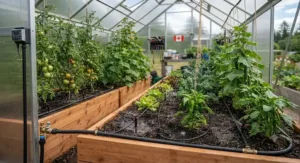
Drip irrigation for raised vegetable beds behaves differently than the same system laid in open ground, and the reason comes down to drainage. Raised beds — especially the metal and cedar-frame kind now common across Canadian backyards — drain faster than in-ground soil because gravity pulls water straight down and out through the base rather than spreading laterally through surrounding earth. That means raised beds typically need more frequent, shorter watering cycles rather than the deep, infrequent soaks that work for row crops in open ground.
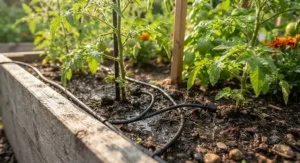
In practice, this changes how you’d configure any of the kits above. A single 4×8 bed does well with a looped emitter line running the full perimeter plus one interior row, rather than a handful of widely spaced point emitters. The Vego Garden Irrigation Kit and Rain Bird GARDENKIT were both designed with this loop-style layout in mind, which is part of why they outperform generic tubing kits stretched loosely across a raised frame. Depth matters too — burying tubing an inch under mulch (rather than leaving it exposed on the soil surface) reduces evaporation loss and UV degradation of the tubing itself, extending its working life by a season or two according to aggregated manufacturer guidance.
Setting Up Your Watering System for Vegetable Garden Success
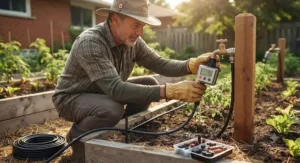
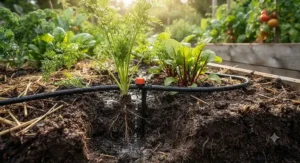
A watering system for vegetable garden use only pays off if it’s installed correctly on day one, so treat setup as a project worth 45 minutes of undivided attention rather than something to rush before dinner. Start by flushing the mainline tubing with water before attaching any emitters — this clears manufacturing debris that would otherwise clog your first few drip points. Next, install a pressure regulator and basic filter at the faucet connection if your kit doesn’t already include one; municipal water pressure in most Canadian cities runs well above the 20–30 PSI most drip emitters are rated for, and skipping this step is the single most common cause of blown fittings in the first week.
Lay your tubing out and let it sit in the sun for an hour before final positioning — PE tubing softens slightly with warmth, making it far easier to bend around corners without kinking. Stake the line every metre or so, and place emitters roughly 5–8 cm from each plant’s stem rather than directly against it, which avoids waterlogging the crown. Run a test cycle for 10 minutes and walk the full length checking for weak spots or missed connections before you mulch over the tubing. In the first 30 days, the most common mistake is leaving the system on the same schedule regardless of rainfall — check soil moisture with a finger test two knuckles deep before every scheduled run during a wet week.
Real-World Scenarios: Matching the Kit to Your Garden
Consider three fairly typical Canadian gardeners. First, a condo-dweller in Toronto with a 2×4 raised bed on a balcony, growing cherry tomatoes and herbs in containers alongside it — this person’s water needs are modest, their budget is tight, and portability matters if they move units. The Raindrip R560DP, with its built-in timer and container-friendly point drippers, matches this profile almost exactly.
Second, a family in Calgary with two full-size 4×8 raised beds growing a mix of tomatoes, peppers, beans, and leafy greens for a household of five. Their water needs vary by crop, their budget is moderate, and they water most days through a hot, dry Prairie summer. The GARDENA Micro-Drip-System‘s per-plant adjustability suits this mixed-crop household well, letting them dial back flow to the greens while keeping tomatoes well-fed.
Third, a retired couple in rural Nova Scotia with a large in-ground vegetable plot spanning roughly 300 square feet, growing potatoes, squash, and corn in long rows. Coverage matters more than precision here, and budget is a real consideration on a fixed income. The MIXC 230FT Quick-Connect Kit delivers the reach this plot needs without the premium price tag of a system built for smaller, denser plantings.
How to Choose a Drip Irrigation Kit for Vegetable Garden Use
Picking the right kit comes down to matching a handful of variables to your actual garden, not to whichever kit has the most five-star reviews. Here’s the process we’d recommend, in order:
- Measure your bed or plot first. Coverage mismatches — a 100-ft kit stretched across a 300 sq ft plot — are the number one source of buyer’s remorse in aggregated review data.
- Check your household water pressure. If it swings widely (common in older homes or rural wells), prioritize kits with a wider PSI tolerance, like the CARPATHEN.
- Decide whether you want a bundled timer. If you’re not confident you’ll remember to water manually, a kit with built-in or easily compatible timer support saves you a second purchase.
- Match emitter type to your crop mix. Uniform rows of one crop suit continuous emitter tubing; mixed containers and beds suit individually adjustable point drippers.
- Factor in future expansion. If you’re likely to add a second bed next year, a modular, push-fit system like GARDENA or MIXC scales more gracefully than a fixed-length kit.
- Read the fine print on capacity. “Waters up to 10 plants” and “covers 60 m²” are very different promises — know which one applies to your garden.
- Budget for accessories. A filter, pressure regulator, and extra stakes rarely cost more than C$15–C$20 combined, but they’re easy to forget until week two.
Emitter Spacing Explained: Getting Water Exactly Where Roots Need It
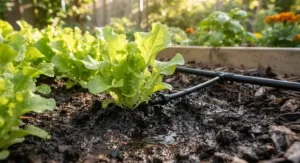
Emitter spacing is the distance between individual drip points along a length of tubing, and it’s one of the most misunderstood specs on any kit’s packaging. Too tight, and you waste water saturating overlapping root zones; too wide, and plants between emitters go thirsty while their neighbours get soaked. The right spacing depends entirely on what you’re growing — closely spaced crops like lettuce, spinach, and carrots generally do well with emitters every 15–20 cm (6–8 inches), roughly matching the Rain Bird kit’s built-in 6-inch spacing. Wider-spaced crops like tomatoes, peppers, and squash, which are typically planted 45–60 cm (18–24 inches) apart, are better served by individual point emitters placed at each plant’s base rather than a continuous drip line, which is exactly the layout the GARDENA and Vego systems are built around.
What the spec sheet won’t tell you is that emitter spacing interacts with your soil type. Sandy soil drains fast and spreads water narrowly, so tighter spacing compensates for that limited lateral movement; heavier clay soil spreads water more broadly underground, so you can generally use wider spacing without leaving dry pockets between emitters. If you’re mixing crop types in one bed — say, lettuce along the edge and tomatoes down the centre — running two different tubing types (fixed-spacing along the edge, adjustable point emitters in the centre) beats trying to force one spacing to serve both.
Timer Compatibility: Automating Your System
Timer compatibility is worth checking before you buy, not after, because not every kit connects to every timer without an adapter. Most drip kits, including the Rain Bird, MIXC, and CARPATHEN systems above, use a standard garden hose thread at the faucet connection, meaning they’ll pair with almost any mechanical or digital hose-end timer on the market, including Rain Bird’s own 1ZEHTMR or a basic Orbit single-outlet model. The GARDENA Micro-Drip-System is a partial exception — while it does accept standard connections, it’s specifically engineered to integrate with GARDENA’s own Water Control timer line, which adds features like flow-rate memory and multi-zone scheduling that generic timers don’t offer.
Two kits — the Orbit 91945 and the Raindrip R560DP — sidestep the compatibility question entirely by bundling a timer into the box, which is worth factoring into any price comparison; a separately purchased mechanical timer typically runs C$20–C$40 in Canada, so a “budget” kit without one isn’t always cheaper once you account for the missing piece. For anyone automating for the first time, a simple mechanical timer with a manual override handles 90% of vegetable garden needs; digital, app-connected timers add rain-delay and multi-schedule features that matter more for larger, multi-zone gardens than for a single raised bed.
Water Efficiency: The Real Numbers Behind Drip vs Sprinkler
Water efficiency is the strongest practical argument for switching to drip irrigation in the first place, and the numbers back it up consistently across agricultural extension research. According to a University of Georgia Extension resource on home vegetable gardens, drip irrigation uses roughly 75% less water than overhead sprinklers, because water goes directly to the root zone instead of soaking non-target soil, evaporating mid-air, or drifting with the wind. The Government of Ontario’s guidance on irrigating vegetable crops confirms that drip systems deliver comparable or slightly higher crop yields than overhead watering while using substantially less water overall, since flow is confined to the plant’s root zone rather than spread across the entire bed surface.
That efficiency compounds with a second benefit: because drip irrigation keeps foliage dry, it reduces the fungal and bacterial diseases that thrive in the damp leaf conditions overhead sprinklers create — a genuine yield protector, not just a water-bill line item. For Canadian gardeners specifically, this matters beyond the environmental angle. Many municipalities enforce summer watering restrictions during dry spells, and as detailed by Canada’s national drought preparedness guidance, water conservation practices — including targeted irrigation methods — are an explicit part of household drought readiness. Most municipal bylaws that restrict lawn sprinkling exempt drip irrigation and hand watering of vegetable gardens outright, meaning a drip kit can keep your tomatoes alive even under a stage-two watering restriction that would shut off your sprinkler entirely.
| Method | Approx. Water Use vs Drip | Foliage Wetness | Typically Exempt from Municipal Restrictions? |
|---|---|---|---|
| Drip irrigation kits (any of the 7 above) | Baseline (most efficient) | Dry | Usually yes |
| Overhead sprinkler | Up to 4x more | Wet | Rarely |
| Soaker hose | Roughly 1.2–1.5x more | Dry | Usually yes |
The takeaway from this comparison is straightforward: soaker hoses come close to drip irrigation on water efficiency but lack the precise, adjustable flow control that kits like GARDENA or Vego offer, while sprinklers lag well behind on both water use and disease risk. If minimizing your water bill and staying compliant with municipal restrictions are priorities, any of the seven drip kits above beats a sprinkler outright.
Common Mistakes When Buying a Drip Irrigation Kit
The most frequent mistake, based on aggregated review patterns across every kit in this guide, is buying based on tubing length alone without checking emitter type or flow rate — 200 feet of tubing with no pressure compensation can water the far end of your garden noticeably worse than the near end. A close second is skipping the pressure regulator, which isn’t always included and is often treated as optional; running unregulated municipal water pressure through emitters rated for 20–30 PSI is a fast way to blow fittings within the first month.
Buyers also frequently underestimate seasonal maintenance. Even the sturdiest kits, including the Rain Bird GARDENKIT, need an end-of-season flush and winter storage indoors in most Canadian climates — leaving PE tubing outside through a hard frost is a reliable way to crack fittings before next spring. Finally, a subtler mistake is choosing a kit’s stated “plant capacity” without accounting for growth; a kit rated for 10 plants assumes mature spacing, and packing seedlings in more tightly at planting time can overwhelm the system’s design once those plants fill out by midsummer.
🔍 Ready to stop guessing and start comparing real specs side by side? Scroll back up to the full comparison table before you decide.
Drip Irrigation vs Soaker Hoses and Sprinklers
Drip irrigation, soaker hoses, and overhead sprinklers solve the same basic problem — getting water to plants — but they do it in genuinely different ways, and the right choice depends on your garden’s layout more than personal preference. Overhead sprinklers cover the widest area with the least setup effort, which makes them tempting, but they’re the least water-efficient option by a wide margin and the most likely to trigger municipal watering restrictions during dry spells, since most bylaws specifically target sprinkler use over lawns and gardens.
Soaker hoses split the difference: they’re cheaper and simpler than any of the seven kits above, and they keep foliage dry like drip irrigation does, but they lack the adjustable, per-plant flow control that makes systems like GARDENA or Vego so effective for mixed plantings. A soaker hose essentially treats an entire row the same way, which works fine for a uniform crop like beans but wastes water on anything planted more sparsely. Drip irrigation kits sit at the precise end of the spectrum — more setup effort upfront, but the most water-efficient and the most adaptable to a garden growing five different vegetables with five different thirst levels. For a small, uniform bed, a soaker hose is a perfectly reasonable budget alternative; for anything larger or more varied, the extra setup time on a drip kit pays for itself within a season.
Long-Term Cost & Maintenance
The upfront price tag on any of the seven kits above is only part of the real cost picture. Replacement emitters, connectors, and end caps typically run C$5–C$15 for a multi-pack and are worth budgeting for annually, since even quality components like Rain Bird’s pressure-compensating emitters can clog with mineral deposits over several seasons in hard-water regions. A basic inline filter, if not already included, adds another C$10–C$20 but meaningfully extends the working life of every emitter downstream of it.
| Cost Factor | Typical Range (CAD) | Frequency |
|---|---|---|
| Replacement emitters/connectors | C$5–C$15 | Annually |
| Inline filter (if not included) | C$10–C$20 | One-time |
| Basic mechanical timer | C$20–C$40 | One-time |
| End-of-season flush kit / winter storage | Minimal (DIY) | Annually |
Weighed against the water savings outlined earlier — up to 75% less water than overhead sprinklers, per the University of Georgia Extension data cited above — most gardeners recoup a mid-range kit’s cost within one to two growing seasons purely on reduced water bills, before even factoring in the yield improvements that come from more consistent moisture at the root zone. The CARPATHEN and MIXC kits offer the lowest total cost of ownership if you already own a timer, while the GARDENA system’s higher upfront cost is offset over time by its more durable, tool-free push-fit connectors, which need less annual replacement than barbed fittings.
Safety, Regulations & Municipal Watering Rules in Canada
Drip irrigation interacts with Canadian water regulations in a mostly favourable way, but it’s worth understanding the basics before you install anything permanent. Most Canadian municipalities impose summer outdoor watering restrictions during dry periods, and as covered in Canada’s official drought preparedness resources, households are specifically encouraged to adopt water-conserving practices — including targeted irrigation and rain barrel collection — as part of broader drought readiness. In practice, this usually means drip irrigation and hand watering of vegetable gardens are explicitly exempt from lawn-sprinkling bans, though exact rules vary by municipality and it’s worth a quick check of your city’s bylaw page before assuming exemption.
Agricultural producers face stricter oversight — the Government of Ontario notes that a formal Permit to Take Water is required for any operation drawing more than 50,000 litres per day from surface or groundwater sources — but this threshold is far beyond what any residential vegetable garden kit in this guide would use in a season, let alone a day. On the safety side, always use a backflow preventer or pressure regulator with a built-in check valve where your kit connects to an outdoor tap, particularly if you’re running fertilizer or compost tea through the line, to avoid any risk of contamination flowing back into household plumbing.
Troubleshooting: Problem → Solution
Problem: Uneven watering, with some plants thriving and others wilting. Solution: Check for a kink or clog near the affected section, and confirm you’re using pressure-compensating emitters (like the Rain Bird GARDENKIT) if your tubing run is longer than about 15 metres, since standard emitters lose pressure over distance.
Problem: Emitters clogging repeatedly within weeks. Solution: Install an inline filter if your kit didn’t include one, and flush the mainline monthly — hard water and garden debris are the two most common clog sources across every kit reviewed here.
Problem: Water pooling at the surface instead of soaking in. Solution: Reduce run time and increase frequency instead; this usually signals clay-heavy soil that needs shorter, more frequent cycles rather than one long soak.
Problem: System works fine in spring but underperforms by midsummer. Solution: Plants have grown and root zones have expanded — reposition point emitters outward from the stem, or add supplemental emitters for larger crops like tomatoes and squash.
Problem: Timer won’t hold a consistent schedule. Solution: Check battery contacts for corrosion (common with mechanical timers left outdoors) and confirm the timer’s thread size matches your kit’s faucet connector exactly, since a loose seal can cause both leaks and erratic timer behaviour.
FAQ
❓ Do I need a timer for a drip irrigation kit?
❓ How much does a drip irrigation kit for a vegetable garden cost in Canada?
❓ Can I install drip irrigation myself, or do I need a professional?
❓ Does drip irrigation work with rain barrels?
❓ How long should I run drip irrigation for vegetables each day?
Conclusion
There’s no single best drip irrigation kit for vegetable garden use across every Canadian backyard — the right pick genuinely depends on your bed size, water pressure, and how much precision your particular mix of crops needs. For a single raised bed, the Rain Bird GARDENKIT delivers professional-grade emitters at a fair price. For mixed plantings that need per-plant control, the GARDENA Micro-Drip-System justifies its higher cost. Purpose-built raised bed growers should look hard at the Vego Garden Irrigation Kit, while first-time buyers testing the waters are well served by the Orbit 91944/91945. Larger or multi-bed gardens get the most coverage per dollar from the MIXC 230FT Kit, variable-pressure setups suit the CARPATHEN system, and container-heavy patios do best with the built-in convenience of the Raindrip R560DP.
Whichever kit you land on, the underlying math stays the same: drip irrigation cuts water use dramatically compared to overhead sprinklers, keeps foliage dry and disease pressure down, and — as CBC’s coverage of drought-stressed BC gardens illustrates — gives your vegetables a fighting chance even when the rain doesn’t cooperate. Measure your bed, match your emitter spacing to your crops, and you’ll spend a lot less of your summer standing around with a hose.
✨ Don’t Miss These Exclusive Deals!
🔍 Take your vegetable garden watering to the next level with the kits featured above. Click through to check current pricing and availability before the season gets busy. A little setup now means healthier, more consistent harvests all summer long! 🥕🍅
Recommended for You
- Oscillating vs Impact Sprinkler for Lawns: 7 Picks (2026)
- Watering Can for Large Outdoor Pots: 7 Top Picks for 2026
- 7 Best Watering Cans for Indoor Plants in 2026: Expert Guide
Disclaimer: This article contains affiliate links. As an Amazon Associate, I earn from qualifying purchases. If you purchase products through these links, we may earn a small commission at no additional cost to you.
✨ Found this helpful? Share it with your friends! 💬🤗
