
In This Article
Let’s be honest: Canada is not a gentle place for garden décor. One February in Winnipeg, or a June hailstorm in Calgary, or the relentless UV blasting off a Toronto rooftop in July — and your beautiful terracotta planter is a pile of shards by spring thaw. That’s where outdoor plastic pots quietly win the argument.
Outdoor plastic pots are lightweight, weather-resistant containers made from engineered polymers — typically polypropylene (PP), polyethylene (PE), or high-grade resin composites — specifically designed for prolonged exposure to sunlight, moisture, and temperature swings. The best ones are UV resistant plastic planters, meaning they contain chemical additives that slow down the breakdown of the polymer chains when hit with solar radiation, preventing the fading, brittleness, and cracking that turns cheap pots into garbage by midsummer. For Canadians, this matters more than almost anywhere: our summer sun is surprisingly intense, and the freeze-thaw cycles we endure from October through April are genuinely brutal on container materials.
What most buyers overlook is the polymer type. Not all plastic pots are created equal. A $6 nursery-grade thin-walled pot is technically “plastic,” but it has zero in common structurally with a double-walled polypropylene planter rated to -30°C. The former will crack after one Ontario winter; the latter can be left on your front porch through a Saskatchewan blizzard and come out looking brand new.
In this guide, I’ve done the research across Amazon.ca, verified Canadian availability, and pulled together the seven best options across every budget tier — from practical budget picks under $30 CAD to premium Canadian-made statement planters in the $150+ range. Whether you’re dressing up a condo balcony in Vancouver, filling a sprawling backyard in Ottawa, or looking for durable plastic planters for deck use at a cottage in Muskoka, there’s a perfect match here.
All prices are in CAD (Canadian dollars) and reflect ranges rather than exact figures, since prices on Amazon.ca fluctuate constantly.
Quick Comparison: Top Outdoor Plastic Pots Available on Amazon.ca
| Product | Material | Key Feature | Size Range | Best For |
|---|---|---|---|---|
| Veradek Block Series Long Box | High-grade PP | Double-walled, -30°C to +50°C | 81 cm L × 25 cm W | Modern deck/patio |
| Veradek Demi Series Round | Plastic-stone composite | Concrete look, UV + crack resistant | 38 cm dia. × 41 cm H | Statement front porch |
| The HC Companies Eclipse Round | UV-resistant PP | Attached saucer, multiple sizes/colours | 20 cm–51 cm dia. | Budget-friendly all-rounder |
| Quarut Whiskey Barrel (4-Pack) | PP resin | Classic barrel design, drainage + saucer | 36 cm dia. × 5 gallons | Cottage/country style |
| ZMTECH 21″ Tall Round (2-Pack) | Thick PE | Shelf inset, modern silhouette | 53 cm H | Contemporary condo balcony |
| Mayne Fairfield Patio Planter | High-density PE | Built-in water reservoir, wood-look finish | 51 cm × 51 cm | Traditional cottage/porch |
| Veradek Block Series Span | High-grade PP | Removable insert bucket, tall rectangular | 76 cm H × 97 cm L | Privacy screen/large shrubs |
Reading the table: The Veradek and Mayne options command a higher price point but deliver materials and engineering that justify every extra dollar in Canadian climates. The HC Companies Eclipse line punches well above its price class for anyone who just needs reliable UV resistant plastic planters without the premium branding tax. The Quarut barrel set is the sleeper pick — genuinely excellent value when you need multiple pots and a farmhouse-style aesthetic.
💬 Just one click — help others make better buying decisions too! 😊
Top 7 Outdoor Plastic Pots for Canadian Buyers: Expert Analysis
1. Veradek Block Series Long Box Planter — Best Overall for Decks
There are outdoor plastic pots, and then there’s the Veradek Block Series Long Box — a product that genuinely makes you do a double-take wondering if it’s concrete. It isn’t. It’s high-grade polypropylene with a double-walled construction, made right here in Canada, rated from -30°C all the way up to +50°C (-22°F to 122°F).
The real-world meaning of that temperature range for Canadians: you can leave this planter on your Quebec deck through a January cold snap and it won’t split, warp, or fade. The double-walled design also acts as insulation for plant roots — a detail that matters enormously when you’re trying to keep a dwarf spruce alive through Calgary shoulder seasons, where temperatures swing 20°C between day and night in April.
At roughly 81 cm long, 25 cm wide, and 41 cm tall (32″ × 10″ × 16″), the Long Box is deep enough for ornamental grasses, lavender, or compact evergreens. The pre-drilled drainage holes prevent waterlogging — critical for anyone who gets the spring deluge that Toronto and Vancouver gardeners know intimately. The double walls also mean you use significantly less soil than a single-wall equivalent, which adds up in cost savings over seasons.
Canadian buyers in condos and townhomes love using two or three of these as a linear privacy screen on narrow decks; the proportions work beautifully for that purpose. Customer reviews consistently praise the sleek, modern look and the resistance to fading after multiple Canadian summers.
✅ Truly rated for Canadian winters — independently verified to -30°C
✅ Double-walled construction saves soil and insulates roots
✅ Made in Canada; quality assurance without cross-border warranty headaches
❌ Taller plants may need added ballast in windy conditions
❌ Premium pricing compared to imported equivalents
Price range: Mid-$80s to low-$100s CAD — exceptional value when you consider it’s a long-term, Canada-proof investment, not an annual replacement. Available on Amazon.ca, Prime-eligible. Check current pricing and availability on Amazon.ca.
2. Veradek Demi Series Round Planter — Best Statement Planter
If the Block Long Box is the workhorse, the Demi Round is the showpiece. Made from Veradek’s patented plastic-stone composite — a blend engineered to replicate the texture of poured concrete while remaining a fraction of the weight — this planter will stop guests cold at your front door. And unlike actual concrete, it won’t crack when the ice comes.
The composite material handles everything from -20°C to +48°C, UV and fade resistant, with a subtle textured finish that genuinely looks premium. Measuring approximately 38 cm in diameter and 41 cm tall (15″ × 16″), it’s the right size for a Japanese maple sapling, trailing rosemary, or a statement ornamental grass clump. The pre-drilled drainage holes are sized correctly — not so large that soil escapes, not so small that water pools.
What makes this special for Canadians specifically: it’s Canadian-designed, built to the climate, and doesn’t require the bilingual label headaches or customs complications that some US-only planters create. This is a planter you buy once and use for a decade.
Customer reviews — including several from verified Canadian buyers — highlight how the planter keeps its colour through multiple seasons, including one reviewer from Edmonton who noted it survived a particularly savage spring where temperatures swung 28°C in 48 hours.
✅ Genuine stone-concrete look at a fraction of the weight
✅ Crack, scratch, UV, and fade resistant — all-season Canadian performance
✅ Canadian-made, no import or warranty complications
❌ Smaller interior volume than the Block Long Box
❌ Premium price point may surprise first-time buyers
Price range: Low-to-mid $60s CAD for the standalone round. Available on Amazon.ca, Prime-eligible.
3. The HC Companies Eclipse Round Planter with Saucer — Best Budget Pick
Here’s the thing about The HC Companies’ Eclipse line: it should not perform as well as it does at this price point. But after more than 35 years of manufacturing horticultural containers (their roots are in growing containers for commercial nurseries), HC has the process dialled in. UV-resistant polypropylene construction, attached saucer, drainage holes, and a clean classic silhouette — available from 20 cm (8″) all the way up to 51 cm (20″) diameter, in a range of colours including teal, rose, white, and warm grey.
The attached saucer is the detail I love most. Canadian decks are often composite or wood, and a planter without a proper saucer is constantly draining tannin-stained water onto surfaces that cost real money. The Eclipse’s saucer is removable for cleaning but snaps on securely — practical design over marketing gimmick.
At the 51 cm (20″) size, this planter has enough volume for a healthy tomato plant, a large perennial clump, or a small shrub. A Canadian reviewer on Amazon.ca noted her 20″ Eclipse survived a full outdoor winter in Ontario — remarkable for a pot at this price tier, though I’d still recommend storing thin-walled budget planters in an unheated garage through the harshest months to extend their lifespan.
The value proposition is straightforward: for urban balconies, seasonal colour planting, or anyone setting up a garden for the first time on a tight budget, the Eclipse delivers.
✅ Exceptional value — proper UV-resistant PP at an entry-level price
✅ Attached saucer protects deck and patio surfaces
✅ Wide size and colour range for flexible styling
❌ Thinner walls than premium composites — move indoors during harsh winters ideally
❌ Less architectural presence than stone-composite options
Price range: Under $25 CAD for smaller sizes; mid-$30s for the 51 cm (20″) size. Multiple sizes available on Amazon.ca.
4. Quarut Whiskey Barrel Planters (4-Pack, 14″) — Best for Cottage & Country Style
Not every Canadian garden wants a sleek modern planter. The Quarut Whiskey Barrel set scratches a totally different itch — the rustic, country-home aesthetic that looks completely at home on a farmhouse porch in Prince Edward County, a Muskoka cottage dock, or beside a vegetable garden in rural Alberta.
Made from PP resin with a detailed moulded barrel-stave texture, these 36 cm (14″) diameter pots hold roughly 19 litres (5 gallons) of soil each — enough for a decent tomato plant, herbs like basil and dill, or cascading petunias. Each comes with a drainage hole and matching saucer, and the 4-pack format means you’re setting up a whole container garden in one purchase.
The PP construction handles UV exposure well, and the raised barrel detail adds enough thickness to the walls that these feel more substantial than many budget alternatives. The imitation wine barrel design means the colour — a rich warm brown — doesn’t show fading as obviously as a flat-pigment planter would, which is smart product design for an outdoor pot category.
For Canadians buying multiple planters for a new garden, this 4-pack represents tremendous value. It ships and is available on Amazon.ca, and the 5-gallon volume per pot is genuinely useful for food gardening, which has exploded in popularity across Canadian suburbs since 2020.
✅ Charming classic barrel design; suits cottage and country aesthetics perfectly
✅ 4-pack means complete garden setup in one order
✅ 5-gallon volume — practical for food gardening
❌ Barrel design may feel dated in modern urban environments
❌ Matching saucers can hold standing water in heavy rain if not emptied
Price range: Mid-$40s to low-$50s CAD for the 4-pack. Available on Amazon.ca.
5. ZMTECH 21″ Tall Round Planters (Set of 2) — Best for Modern Condos & Balconies
Tall, slender, and architecturally decisive — the ZMTECH 21″ Round Planters are what you buy when you want your condo balcony to look like a spread in Azure magazine without spending magazine-feature money. At approximately 53 cm (21″) tall with clean vertical lines, these create genuine visual height on a balcony or front entry, making even a modest outdoor space feel intentional.
Made from thick polyethylene with a matte black finish, each planter includes a drainage hole and a shelf inset that serves double duty: use it to reduce the volume of potting soil needed (a blessing when hauling soil up to the 12th floor), or remove it and use as a conventional drainage tray. A Canadian buyer’s review on Amazon.ca called them “absolutely beautiful” and noted the thick-walled construction — she added a paving stone to each for wind stability on her Toronto balcony, which is smart advice for any tall planter in a high-rise setting.
The 2-pack format means you can flank a front door, bracket a balcony entrance, or place them symmetrically for a composed, architectural look. The matte PE material is UV-stabilised and handles outdoor exposure well through Canadian summers.
What I’d tell a Vancouver condo owner: pair these with architectural foliage plants like tall grasses, Japanese forest grass (Hakonechloa), or a columnar boxwood — plants that match the vertical format and hold their visual impact through the season.
✅ Architectural vertical format transforms a balcony or entry instantly
✅ Shelf inset reduces soil use — practical for upper-floor balconies
✅ 2-pack format for symmetrical placement
❌ Wind stability needs attention — add ballast for balconies above 5th floor
❌ Limited colour options (primarily black)
Price range: Mid-$50s to low-$70s CAD for the 2-pack. Available on Amazon.ca.
6. Mayne Fairfield Patio Planter — Best Premium Traditional Option
Mayne has been a fixture of North American patio design for decades, and the Fairfield planter is the reason. Made from high-density polyethylene (HDPE) with a moulded wood-plank texture, it delivers the visual warmth of wood without the maintenance nightmare of actual wood — no painting, no sealing, no rotting in the rain.
The standout engineering feature is the built-in water reservoir, which sits in the base and wicks moisture upward as the soil dries. This passive sub-irrigation reduces watering frequency by roughly 30–50% — genuinely useful for busy Canadian homeowners who might be at the cottage on weekends when their main home’s front porch pots need water. The Fairfield comes in a 51 cm × 51 cm (20″ square) format and a 51 cm × 91 cm (20″ × 36″) window box version, in both black and white.
The HDPE material is UV-stabilised and rated for year-round outdoor use — Mayne planters are a common sight at Canadian garden centres and have a long track record in our climate. Canadian pricing typically runs slightly higher than US equivalents due to exchange rate and import factors, but you avoid customs hassle, cross-border shipping delays, and potential warranty complications.
This is the planter for a homeowner who wants something that looks genuinely established — like it belongs on a traditional Ontario farmhouse front porch or a classic Westmount townhouse entry.
✅ Built-in water reservoir reduces watering frequency significantly
✅ Premium wood-look HDPE that’s maintenance-free
✅ Long track record in Canadian climates; widely respected brand
❌ Square format limits some planting arrangements
❌ Upper end of price range for plastic planters
Price range: Mid-$60s to low-$90s CAD depending on size. Available on Amazon.ca; Prime-eligible.
7. Veradek Block Series Span Planter — Best for Large Plants & Privacy Screens
The Veradek Span is for people who are serious about their outdoor spaces. Measuring approximately 76 cm tall by 97 cm long by 25 cm wide (30″ H × 38″ L × 10″ W), this is a large plastic pot with drainage that functions as much as a structural element as a planting container. The tall rectangular format is ideal for privacy screening — a pair of Spans planted with tall ornamental grasses creates a genuinely effective visual barrier on a deck or balcony.
The removable insert bucket is the design detail that separates the Span from simpler rectangular planters. It means you can remove an entire planting — soil, roots, and all — for seasonal swaps without disturbing the outer shell. For a Canadian who wants winter greenery (a potted spruce or ornamental kale arrangement), then transitions to summer perennials, this seasonal switchability is genuinely valuable.
Construction is the same high-grade polypropylene used across the Block Series: rated from -30°C to +50°C, UV and fade resistant, double-walled. Made in Canada. Several customer reviews note that the Span can feel unstable when empty in wind — this is common to all tall rectangular planters and is solved by planting with substantial soil weight or adding gravel in the base.
For a downtown Toronto terrace, a Vancouver penthouse deck, or a Montréal condo rooftop, the Span is the kind of investment that completely changes how an outdoor space reads.
✅ Tall rectangular format creates genuine visual privacy
✅ Removable insert bucket allows seasonal planting swaps
✅ Made in Canada; maximum climate performance
❌ Requires substantial soil weight for wind stability
❌ Highest price point in this guide
Price range: Low-to-mid $90s CAD. Available on Amazon.ca; Prime-eligible from Veradek directly.
✨ Don’t Miss These Exclusive Deals!
🔍 Take your outdoor garden to the next level with these carefully selected planters. Click on any highlighted product name to check current pricing and availability on Amazon.ca. These containers will help you create a beautiful, lasting outdoor space that survives — and thrives through — everything a Canadian season can throw at it!
How to Choose the Right Outdoor Plastic Pot for Canadian Conditions
Buying a plastic planter in Canada isn’t the same as buying one in Phoenix or Miami. The decision framework is different. Here’s how to think through it:
1. Prioritise material rating over price per pot. The single most important question to ask: is this pot rated for temperatures below -20°C? Most budget imports are not. Canadian winters — even in Victoria, which Canadians consider mild — drop below freezing regularly. A pot rated to -20°C (roughly the standard for quality polypropylene composites) will handle most Canadian winters without cracking. If you’re in Winnipeg, Saskatoon, or northern Ontario, look for ratings to -30°C.
2. Never skip drainage holes. This is non-negotiable in Canada. Trapped water freezes, expands (ice exerts roughly 57,000 kPa of pressure when forming), and splits pot walls from the inside. Every pot on this list has drainage. Any pot you consider buying must too. If you fall in love with a planter that lacks drainage holes, drill your own — a 10–12 mm drill bit on a cordless drill, done in seconds.
3. Bigger volume equals better plant survival. A larger soil volume insulates roots more effectively against both summer heat and winter cold. What most gardeners overlook is that a container with 40+ litres of potting mix will see far less temperature fluctuation than a 10-litre pot sitting on a sun-baked concrete balcony. If your space allows for large plastic pots with drainage, use them.
4. Wall thickness matters more than marketing claims. Run your hand along the interior wall of a pot. If it flexes significantly with light pressure, it’s too thin for outdoor Canadian use. Quality outdoor planters have walls that feel rigid and substantial. Double-walled construction — used in the Veradek Block Series — is the gold standard.
5. UV stabilisers: ask for specifics. Fade-resistant outdoor pots and UV resistant plastic planters should specify the polymer used. Polypropylene and high-density polyethylene with UV inhibitors are the best choices for longevity. Cheaper polystyrene (PS) pots will degrade visibly within 2–3 seasons of full-sun Canadian exposure. The product listing should mention UV stabilised, UV resistant, or UV protected — generic claims like “weather resistant” without specifying UV protection are a yellow flag.
6. Weight and mobility. If you’ll be moving planters seasonally — which is good practice for extending pot life in Zone 3–4 areas — factor in the weight when fully planted. A 20″ pot with 45 litres of moist potting mix can easily weigh 18–22 kg (40–50 lbs). Consider planters with built-in wheels or invest in heavy-duty pot dollies for your larger containers.
7. Canadian climate zone awareness. Natural Resources Canada provides a Plant Hardiness Zone map (nrcan.gc.ca) that Canadians should consult when choosing both pots and plants. Zone 6 in coastal BC allows year-round outdoor planting with minimal pot protection; Zone 3 in the Prairies means aggressive winterisation is required. The pot that works fine on a Vancouver balcony may need seasonal storage in Regina.
Real-World Canadian Gardener Profiles: Who Buys What
Understanding which pot matches which Canadian life situation is more useful than any spec sheet. Let me sketch three realistic profiles.
Profile 1: The Toronto Condo Dweller Emma has a 12th-floor south-facing balcony in Liberty Village. She gets intense summer sun — a full 8+ hours of direct exposure daily from May through September — and moderate winter exposure (her balcony is somewhat sheltered but still sees -15°C nights). She wants durable plastic planters for deck that look architectural and modern, and she can’t haul heavy soil easily.
Best match: ZMTECH 21″ Tall Planters (Set of 2) for vertical presence, plus a few HC Companies Eclipse 12″ for herbs and colour. The ZMTECH’s shelf inset reduces soil weight. Total spend in the $90–$110 CAD range gets her a complete, cohesive balcony garden.
Profile 2: The Westboro (Ottawa) Family Homeowner David has a traditional front porch and a sunny back deck. He wants front porch statement pots that can stay out year-round (Ottawa winters hit -25°C regularly) and back deck planters for tomatoes and herbs. He has a car, can lift, and wants something that’ll last 10 years without rebuying.
Best match: Veradek Demi Series Round Planters for the front porch (rated to -20°C, concrete look, genuinely frost-resistant), and Quarut Whiskey Barrel 4-Pack for the back deck vegetable garden. Total investment around $120–$150 CAD — spread over a decade, that’s $12–$15/year.
Profile 3: The Kelowna Wine Country Gardener Sylvie has a large back yard with a full deck, gets hot BC Interior summers with moderate winters (Zone 6b). She wants large privacy planters along the deck perimeter and plans to leave them outside year-round.
Best match: Veradek Block Series Span Planters — two of them, flanking the deck’s perimeter, planted with tall ornamental grasses. The rated temperature range is overkill for Kelowna winters but ensures decade-long longevity. Spend: around $200 CAD for the pair, worth every cent for the privacy and visual transformation.
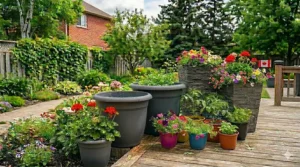
Winterising Your Outdoor Plastic Pots: A Canadian Survival Guide
This is the section Amazon product listings will never give you. Canadian winters are the real test of a planter’s character — and how you prepare your containers before freeze-up directly determines how long they last.
Step 1: Drainage first, always. Before the first hard frost hits, ensure every planter’s drainage hole is clear and unobstructed. Plug-free drainage means water flows out rather than pooling at the base. Pooled water that freezes can exert enough pressure to crack even quality polypropylene pots over time.
Step 2: Remove annual plants and excess soil from thinner pots. If you’re using budget-tier single-walled planters (like smaller HC Companies Eclipse sizes), remove the plants and empty at least half the soil before freeze-up. This reduces the water content and therefore the ice pressure inside the pot through freeze-thaw cycles. Quality double-walled composites like the Veradek Block Series can typically stay fully planted.
Step 3: Elevate pots off paving. Place pots on pot feet, bricks, or wooden spacers so they sit 2–3 cm off the deck or concrete surface. This serves two purposes: it prevents the pot from freezing to the surface (which causes damage when you try to move it in spring), and it maintains drainage flow even when snow and ice accumulate.
Step 4: Store non-UV-stabilised pots in an unheated garage or shed. UV damage accumulates through summer, making plastic more brittle. In winter, that brittleness is exploited by thermal contraction. A pot that’s been UV-degraded for three seasons is far more vulnerable to frost cracking than a UV-stabilised one. If you have any doubt about your pots’ UV rating, store them indoors — even an unheated garage sits well above the -30°C threshold where quality PP fails.
Step 5: Use lightweight potting mix, not garden soil. This is critical and chronically underappreciated. As noted by Canadian planter specialists, lightweight potting mix drains well before freeze-up. Heavy clay-based soil or topsoil holds water like a sponge, dramatically increasing the ice pressure exerted on pot walls. Always use bagged potting mix in containers.
Step 6: Group pots for mutual insulation. Clustering pots together reduces the exposed surface area of each individual container, slowing heat loss and providing some root protection through mutual thermal mass. It’s the plant equivalent of huddling together in a blizzard — and it actually works.
Outdoor Plastic Pots vs. Terracotta, Ceramic & Concrete: The Real Canadian Verdict
Let me address this head-on because the comparison comes up constantly: are plastic pots really better than “real” materials for Canadian gardens?
The answer is nuanced and depends entirely on how you define “better.”
Terracotta: Beautiful, classic, porous. And in Canadian winters, genuinely problematic. Unglazed terracotta absorbs moisture from the soil and the atmosphere. When temperatures drop below freezing, that moisture expands as ice, and the porous walls simply cannot contain the force. The result: cracking, flaking, and shattering that’s distressingly common in Zones 4 and colder. You can extend terracotta’s life by sealing the interior with pool paint, as horticulturalists recommend, but it’s a maintenance step plastic pots simply don’t require.
Glazed ceramic: More frost-resistant than raw terracotta, but still porous enough that repeated Canadian freeze-thaw cycles eventually win. Many glazed ceramics marketed as “frost-proof” are tested to mild-climate conditions — fine for Atlanta, marginal for Montreal.
Concrete: Superb thermal mass, excellent for insulating roots, essentially immune to UV degradation. The trade-offs: genuinely heavy (a large concrete urn can weigh 40–80 kg unfilled), expensive, and impossible to move once placed. For permanent garden installation, concrete is outstanding. For a balcony or moveable deck setup, it’s impractical.
High-quality plastic/resin composite: Handles freeze-thaw cycles through flexible polymer movement rather than rigid resistance. Lightweight, UV-stabilised (in quality versions), often deliberately engineered for cold climates. The honest weakness: lower-grade plastics degrade in UV and become brittle in cold, which is why the UV stabiliser specification matters so much. A quality Canadian-made polypropylene composite outlasts mid-grade terracotta or glazed ceramic in a Winnipeg winter — full stop.
The smart Canadian approach: use UV resistant plastic planters for outdoor year-round use, and reserve terracotta or ceramic for indoor or sheltered covered porch settings where they won’t face direct freeze exposure.
| Material | Frost Resistance | UV Resistance | Weight | Canadian Verdict |
|---|---|---|---|---|
| Quality plastic/PP | ✅ Excellent | ✅ (if UV-stabilised) | Light | Best for outdoor year-round |
| Terracotta | ❌ Poor | ✅ Good | Medium | Indoor/sheltered only |
| Glazed ceramic | ⚠️ Marginal | ✅ Good | Heavy | Covered porch only |
| Concrete | ✅ Excellent | ✅ Excellent | Very Heavy | Permanent installation only |
| Fiberglass | ✅ Excellent | ✅ Good | Light-Medium | Premium outdoor alternative |
When looking at the comparison above, the material choice becomes clear: for the combination of frost performance, UV resistance, portability, and price-per-decade-of-use, quality outdoor plastic pots are the practical champion for most Canadian gardening situations. The concrete option remains compelling for permanent ground-level installations, but loses decisively on mobility and price once you account for installation.
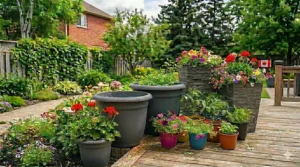
Common Mistakes Canadians Make When Buying Outdoor Plastic Pots
Mistake 1: Buying based on photo, ignoring polymer type. A planter that photographs beautifully may be made from cheap polystyrene (PS) — a rigid, brittle polymer that degrades rapidly in UV and cracks at the first real Canadian winter. Always check the product listing for the polymer type: polypropylene (PP) or polyethylene (PE) with UV stabilisers are what you want. If the listing says “plastic” without specification, treat it as PS until proven otherwise.
Mistake 2: Assuming “frost-proof” means Canadian frost. Some planters are tested in mild-climate conditions and labelled frost-proof at temperatures barely below 0°C. True Canadian frost-proof performance requires testing to at least -20°C, ideally -30°C for Prairie and northern buyers. Always look for a specific temperature rating rather than a generic “frost-proof” claim.
Mistake 3: Choosing pots without adequate drainage for Canadian rainfall. British Columbia’s Lower Mainland receives over 1,000 mm of annual rainfall — much of it in long, sodden autumn periods when pots need to drain freely or roots will rot. Ontario and Quebec get heavy spring deluges. Drainage holes that are too small or positioned flush against the pot base (rather than slightly raised) will cause waterlogging. All seven planters in this guide have adequate drainage; verify this with any pot you buy elsewhere.
Mistake 4: Ignoring Amazon.ca vs. Amazon.com availability. Some sun-proof plastic containers reviewed on American sites simply do not ship to Canada, ship at prohibitive cost, or carry US-only warranties. When I researched this guide, I verified Amazon.ca availability for every product listed. Don’t order from Amazon.com assuming Canadian delivery — always check Amazon.ca first.
Mistake 5: Overlooking pot size relative to plant root depth. Weather-durable planters don’t help your plants if the container volume is wrong. A 10″ pot for a tomato plant is setting yourself up for failure — tomatoes need at least 30–40 cm of root depth and 40+ litres of soil for a full growing season. Matching pot depth and volume to the plant’s root requirements is as important as the pot’s weather rating.
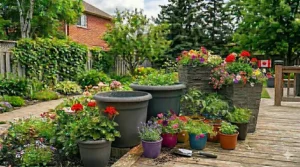
FAQ: Outdoor Plastic Pots in Canada
❓ Are outdoor plastic pots safe to use year-round in Canadian winters?
❓ What does UV resistant mean on an outdoor plastic pot?
❓ Do large plastic pots with drainage ship to Canada on Amazon.ca?
❓ Are there Canadian-made outdoor plastic pots available?
❓ How do I stop my outdoor plastic pot from fading in the sun?
Conclusion: Invest Once, Enjoy for Years
Here’s the truth that the spring garden centre rush hides: most Canadians buy too many cheap planters and replace them every two to three years, spending far more in aggregate than if they’d bought quality weather-durable planters from the start. A $90 Veradek Block Long Box, cared for through proper drainage and winterisation, will outlast four or five cycles of $20 import planters — and look dramatically better the whole time.
The outdoor plastic pot market has genuinely matured. The best options available on Amazon.ca in 2026 — engineered polypropylene composites, double-walled constructions, plastic-stone blends — are nothing like the brittle, fading, crumbling “plastic pots” of two decades ago. They handle Canadian winters not by being tough in the fragile-rigid way terracotta tries to be, but by being intelligently flexible — materials that move with freeze-thaw stress rather than fighting it and losing.
My overall recommendation for most Canadian buyers: start with one or two Veradek Block Series Long Boxes for a modern outdoor focal point, add a 4-pack of Quarut Barrel planters if you’re growing food, and fill in smaller spaces with the HC Companies Eclipse line. That combination covers every aesthetic and practical need from a Halifax back garden to a Calgary condo balcony.
The Canadian garden season is short. Make every container count.
✨ Ready to shop? Click any highlighted product to check current pricing and availability on Amazon.ca. Your best outdoor plastic pots for 2026 are waiting.
Recommended for You
- Best 20 Gallon Grow Bags for Fruit Trees in Canada 2026
- Best 10 Gallon Grow Bags for Potatoes Canada 2026
- Best 10 Gallon Fabric Pots Canada 2026 – Top 7 Picks
Disclaimer: This article contains affiliate links. As an Amazon Associate, I earn from qualifying purchases. If you purchase products through these links, we may earn a small commission at no additional cost to you.
✨ Found this helpful? Share it with your friends! 💬🤗
