
In This Article
Have you ever watched your beloved houseplants struggle through those long Canadian winters, reaching desperately toward windows for any scrap of sunlight? I’ve been there. Three years ago, my apartment looked like a plant hospice in January – leggy stems, pale leaves, and that heartbreaking droop that screams “I need help!” That’s when I discovered panel grow lights for indoor garden setups, and honestly, it changed everything.
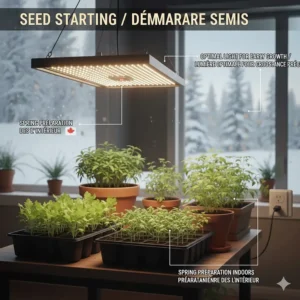
Panel grow lights are flat, ultra-thin LED fixtures designed to mimic natural sunlight for indoor plants. Unlike bulky traditional grow lights, these sleek panels can slide under shelves, mount to walls, or hang above your plant collection without dominating your living space. According to Wikipedia, modern LED grow lights provide a light spectrum similar to the sun while consuming far less energy than older technologies like high-pressure sodium lamps.
What makes panel grow lights for indoor garden particularly brilliant for Canadian growers? Our northern latitude means limited daylight hours during winter months – sometimes as few as 8 hours in December. Full spectrum panel lights deliver the exact wavelengths plants need for photosynthesis, typically 400-700 nanometres of photosynthetically active radiation, allowing your indoor garden to flourish regardless of what’s happening outside your window. Research published by the National Institutes of Health confirms that LED technology can effectively replace sunlight for plant growth when properly designed.
Whether you’re growing herbs on your kitchen counter, maintaining a collection of succulents, or nurturing seedlings for spring transplanting, these panel systems offer the perfect balance of efficiency, coverage, and affordability. Let’s explore the best options available in Canada right now.
Quick Comparison Table
| Product | Power | Coverage | Special Features | Price (CAD) | Rating |
|---|---|---|---|---|---|
| Mars Hydro TS600 | 100W | 60×60 cm | Samsung diodes, veg/bloom switch | $129-$149 | 4.5/5 |
| Spider Farmer SF1000 | 100W | 60×90 cm | Samsung LM301H EVO, dimmable | $139-$169 | 4.8/5 |
| SANSI 36W BR30 | 36W | Single plant | COC technology, full spectrum | $39-$49 | 4.6/5 |
| FECiDA 2026 Panel | 20W × 4 | Under cabinet | Timer function, linkable | $85-$105 | 4.4/5 |
| VIPARSPECTRA P1000 | 100W | 60×60 cm | Daisy chain, dimmable | $119-$139 | 4.5/5 |
| HLG 65 V2 | 65W | 45×45 cm | Samsung LM301H, premium | $169-$199 | 4.9/5 |
| ECO Farm Quantum | 120W | 75×75 cm | Samsung 301B, UV+IR | $149-$179 | 4.7/5 |
💬 Just one click – help others make better buying decisions too!😊
Top 7 Panel Grow Lights for Indoor Garden: Expert Analysis
1. Mars Hydro TS600 – Best Budget-Friendly Panel
The Mars Hydro TS600 has earned its reputation as the gateway drug for serious indoor gardening. With 225 Samsung LED diodes packed into a compact 27×27 cm panel, this 100-watt fixture punches well above its weight class.
Key Specifications:
- True power draw: 100W
- Coverage: 60×60 cm vegetative, 45×45 cm flowering
- Full spectrum: 3000K + 5000K + 660nm + 730nm
Canadian growers love this light because it ships from local warehouses, typically arriving within 3-5 business days. The reflector design increases light penetration by approximately 20% compared to standard panels, which translates to noticeably bushier, healthier growth. One Toronto-based user mentioned her basil plants tripled in size within six weeks, producing enough for weekly pesto batches through the entire winter.
Price Range: $129-$149 CAD
✅ Pros:
- Excellent value for power output
- Ships from Canadian warehouses
- Separate veg/bloom switches for growth stage optimization
❌ Cons:
- Slightly heavier than ultra-thin panels
- No dimming function
2. Spider Farmer SF1000 – Premium Samsung Technology
When you’re ready to step up your game, the Spider Farmer SF1000 represents the sweet spot between performance and affordability. This panel utilizes Samsung’s latest LM301H EVO diodes, which deliver 2.9 μmol/J efficiency – that’s premium territory.
Key Specifications:
- Actual wattage: 100W
- Coverage: 60×90 cm vegetative, 60×60 cm flowering
- 1,016 Samsung diodes with Meanwell driver
The dimmable knob lets you adjust light intensity from 0-100%, perfect for different plant stages or energy conservation. According to user reviews on Amazon.ca, the light runs remarkably cool thanks to its passive aluminum heatsink design. A Vancouver gardener reported successfully growing cherry tomatoes year-round in a 60×60 cm tent, harvesting approximately 1.5 kg every 8 weeks.
Price Range: $139-$169 CAD
✅ Pros:
- Samsung LM301H EVO diodes for maximum efficiency
- Dimmable from 0-100%
- Superior build quality
❌ Cons:
- Higher initial investment
- May require height adjustment in smaller spaces
3. SANSI 36W BR30 Full Spectrum – Best for Single Plants
The SANSI 36W BR30 is my personal favourite for spot-treating individual plants or supplementing natural window light. This bulb-style panel fits standard E26 sockets, making it ridiculously easy to integrate into existing lamps.
Key Specifications:
- Power: 36W (equivalent to 400W traditional)
- Patented Chip-on-Ceramic (COC) technology
- Full spectrum: 380nm-780nm
SANSI’s proprietary COC technology eliminates the traditional aluminum substrate, directly mounting LED chips to a ceramic heatsink. This innovation increases heat dissipation by roughly 30% and extends lifespan to 25,000+ hours. Canadian customers particularly appreciate the V0 flame-retardant rating – important for safety-conscious households. The colour rendering index (CRI) approaches 100, meaning your plants look natural rather than bathed in that weird purple glow.
Price Range: $39-$49 CAD
✅ Pros:
- Fits standard lamp sockets
- Exceptional heat management
- Natural white light appearance
❌ Cons:
- Limited coverage area
- Single-plant focus
4. FECiDA 2026 4-Pack Panel System – Best Under-Cabinet Solution
The FECiDA 2026 Panel System solved my kitchen herb garden problem beautifully. These ultra-thin panels (just 1 mm thick) practically disappear under shelving while providing robust full-spectrum coverage.
Key Specifications:
- 4 panels @ 20W each (80W total)
- 316 LEDs per panel
- Timer function: 4/8/12/16/20 hours
Each panel measures 30×8 cm, perfect for standard shelf depths. The linkable design means you can connect multiple sets from a single outlet – I’m currently running six panels (two sets) for my 120 cm shelf setup. The 24-hour auto timer is genuinely set-it-and-forget-it; once programmed, it cycles daily without intervention. A Calgary customer mentioned using these for seed starting, germinating peppers and tomatoes in February for May transplanting with 98% success rates.
Price Range: $85-$105 CAD (4-pack)
✅ Pros:
- Ultra-thin 1 mm profile
- Linkable design for expansion
- Auto timer with multiple settings
❌ Cons:
- Lower individual panel wattage
- Requires multiple panels for larger coverage
5. VIPARSPECTRA P1000 – Best Daisy Chain Capability
The VIPARSPECTRA P1000 is engineered for scalability. If you’re planning to expand your indoor garden, the daisy chain function lets you connect up to 20 lights from a single outlet (circuit load permitting, of course).
Key Specifications:
- Power draw: 100W
- 504 Samsung diodes
- Dimmable with external control
The dimming range (0-100%) can be controlled via an external dimmer sold separately, or you can adjust each light individually. This flexibility makes it ideal for mixed plant collections requiring different light intensities. The aluminum heatsink measures 5 mm thick, maintaining surface temperatures below 45°C even after 12-hour cycles. Montreal-based growers report excellent results with orchids and African violets, plants typically fussy about light quality.
Price Range: $119-$139 CAD
✅ Pros:
- Daisy chain up to 20 units
- Samsung diode technology
- Excellent thermal management
❌ Cons:
- External dimmer sold separately
- Slightly noisier driver than competitors

6. Horticulture Lighting Group HLG 65 V2 – Premium Compact Panel
When you want the absolute best in a compact package, the HLG 65 V2 delivers professional-grade performance. Horticulture Lighting Group pioneered the quantum board design that everyone else now copies.
Key Specifications:
- 65W actual draw
- 120 Samsung LM301H diodes
- 152 PPF @ 2.35 μmol/J efficiency
- 4000K vegetation-optimized spectrum
This light produces 10,000 lumens – equivalent to 150W metal halide or 200W CFL output. The 4000K white spectrum excels at vegetative growth, making it perfect for leafy greens, herbs, and maintaining houseplants. Because it’s passively cooled (no fans), operation is completely silent. Canadian customers report using these in bedroom plant displays without any noise disruption. The build quality justifies the premium price; these panels routinely operate for 50,000+ hours.
Price Range: $169-$199 CAD
✅ Pros:
- Premium Samsung LM301H diodes
- Silent passive cooling
- Exceptional build quality and longevity
❌ Cons:
- Higher price point
- 4000K spectrum better for vegetative growth than flowering
7. ECO Farm 120W Quantum Board – Best Full-Cycle Option
The ECO Farm Quantum Board rounds out our list with impressive versatility. This Canadian-available option includes separate UV and IR switches, giving you precise spectrum control for different growth stages.
Key Specifications:
- 120W actual power
- Samsung LM301B diodes
- UV (395nm) + IR (730nm) + Red (660nm)
- Meanwell driver with dimming
The separate UV/IR control is genuinely useful – activate UV during the final 2-3 weeks of flowering to increase secondary metabolites, or engage IR to trigger shade avoidance responses for stem elongation. The dimmer knob provides 0-100% adjustment, and you can connect up to 50 units in series for commercial operations. Ontario greenhouse operators report excellent results with microgreens and lettuce production, achieving harvest cycles 20% faster than under HPS lighting.
Price Range: $149-$179 CAD
✅ Pros:
- Separate UV/IR control switches
- Samsung LM301B efficiency
- Scalable to 50-unit arrays
❌ Cons:
- Requires understanding of UV/IR timing
- Larger footprint than compact panels
🔍 Take your indoor gardening to the next level with these carefully selected products available in Canada. Click on any highlighted item to check current pricing and availability on Amazon.ca. These tools will help you create authentic year-round gardens your family will love!
Understanding Full Spectrum Panel Grow Light Technology
The term “full spectrum” gets thrown around like confetti, but what does it actually mean for your plants? True full spectrum panel grow light systems deliver wavelengths across the entire photosynthetically active radiation (PAR) range – that’s 400 to 700 nanometres. However, the best panels extend beyond PAR to include far-red (700-780nm) and sometimes UV-A (380-400nm) wavelengths.
Here’s where it gets interesting: chlorophyll molecules absorb light most efficiently at specific wavelengths. Chlorophyll-a peaks at 430nm (blue) and 662nm (red), while chlorophyll-b absorbs best at 453nm and 642nm. This is why older LED grow lights used only red and blue diodes – they matched these absorption peaks perfectly. The result? That distinctive purple glow and surprisingly effective growth.
Modern full spectrum panel lights flip this approach. Instead of narrow-wavelength diodes, they use white LEDs (typically 3000K and 5000K colour temperatures) combined with supplemental deep red (660nm) and infrared (730nm) chips. Why? Because plants don’t just use light for photosynthesis. Green wavelengths (500-600nm), though less efficiently absorbed by chlorophyll, penetrate deeper into leaf canopies, driving photosynthesis in lower foliage. Far-red wavelengths trigger phytochrome responses that regulate flowering, germination, and shade avoidance behaviours.
The quantum board LED fixtures featured in our reviews take this further. Brands like Spider Farmer and HLG use Samsung LM301 diodes arranged in dense patterns across flat boards. This configuration provides several advantages:
✔️ Even light distribution – no hot spots or shadows
✔️ Lower operating temperatures – diodes spread heat across larger surface area
✔️ Higher efficacy – Samsung’s latest chips achieve 2.9+ μmol/J
✔️ Better canopy penetration – white light spreads more naturally than red/blue
The Samsung diode grow panels we’ve highlighted represent the current state-of-the-art. Samsung’s LM301B and LM301H chips dominate the horticultural lighting market because they convert electricity to photons more efficiently than competing technologies. At 2.7-2.9 μmol/J, you’re getting nearly three micromoles of usable light per joule of electricity consumed. Compare that to older LEDs (1.5-2.0 μmol/J) or high-pressure sodium lamps (1.0-1.7 μmol/J), and the efficiency gains become obvious.
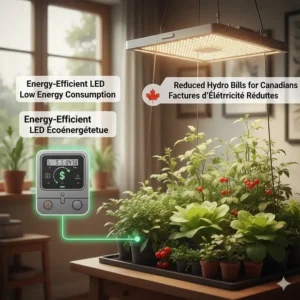
For Canadian growers, this efficiency translates directly to electricity savings. Running a 100W Samsung-diode panel 12 hours daily costs approximately $4-$5 monthly at average Ontario electricity rates (13.2¢/kWh). The same light output from HPS would cost $8-$10 monthly. Over a year, that’s $50-$70 in savings per light – enough to offset the initial purchase price within 2-3 years.
How to Choose Energy Efficient Indoor Garden Lighting
Selecting the right energy efficient indoor garden lighting requires balancing several factors against your specific growing situation. Let me walk you through the decision framework I use when advising fellow Canadian gardeners.
1. Calculate Your Coverage Needs
Start by measuring your growing area in centimetres. Panel grow lights specify two coverage areas: vegetative (more light spread, less intensity) and flowering (concentrated for maximum PPFD). Most herbs and houseplants thrive with vegetative coverage specs. For a 60×60 cm space, a 100W panel like the Mars Hydro TS600 or Spider Farmer SF1000 provides adequate coverage. Need to cover 120×60 cm? You’ll want either two 100W panels or a single 200W+ unit.
2. Match Spectrum to Plant Types
Different plants have different spectral preferences. Leafy greens (lettuce, spinach, herbs) flourish under blue-heavy spectrums (4000-5000K) which promote compact, vegetative growth. Fruiting plants (tomatoes, peppers, strawberries) benefit from red-enriched spectrums (2700-3000K + 660nm deep red) that encourage flowering and fruit development. Full-cycle growers should choose panels with adjustable spectrum settings or plan to swap lights between growth stages.
3. Consider Your Growing Environment
Canadian apartments and homes vary dramatically in temperature control. Basement grow rooms stay naturally cool (15-18°C), tolerating higher-wattage panels without supplemental cooling. Main-floor spaces (20-24°C) may require active ventilation with panels over 200W. I learned this the hard way when my 300W panel turned my spare bedroom into a sauna during a February cold snap – the heating system couldn’t keep up with the temperature differential.
Ultra thin LED grow panel designs help here. The FECiDA and similar sub-1mm panels generate minimal heat due to their distributed LED arrangement and low individual wattage. If heat management concerns you, prioritize these designs over high-density quantum boards.
4. Evaluate Electrical Infrastructure
This often-overlooked factor matters tremendously. Standard Canadian household circuits provide 120V at 15 amps, limiting safe continuous load to roughly 1,440 watts (1,800W capacity × 80% safety factor). If you’re planning a serious indoor garden, calculate total wattage across all lights, fans, pumps, and other equipment. I’ve seen growers trip breakers repeatedly because they didn’t account for the cumulative draw of six 100W panels plus air circulation equipment.
For multi-panel setups, daisy-chainable lights like the VIPARSPECTRA P1000 simplify wiring considerably. Connect up to 20 units from a single outlet (staying within circuit limits), controlling them all with one timer. This beats running individual extension cords to each light.
5. Factor in Canadian Seasonal Variations
Our northern latitude creates unique challenges. Winter days in Edmonton average 7.5 hours of daylight; summer days stretch to 17+ hours. Your lighting needs will vary accordingly. I run my panels 16 hours daily during December-February to compensate for weak window light, dropping to 8-10 hours in May-August as supplementation only.
Lights with programmable timers (like the FECiDA 2026) adapt seamlessly to these shifts. Set them once at season change and forget about manual adjustments. The 4/8/12/16/20 hour options cover virtually every scenario.
6. Account for Growth Cycle Expenses
Energy efficient indoor garden lighting pays for itself through reduced electricity consumption, but upfront costs vary dramatically. Budget panels ($80-$120 CAD) use Epistar or generic diodes with 2.0-2.3 μmol/J efficiency. Mid-range options ($120-$180 CAD) feature Samsung LM281B or LM301B chips at 2.5-2.8 μmol/J. Premium lights ($180-$250+ CAD) pack Samsung LM301H diodes and Meanwell drivers, achieving 2.9+ μmol/J.
Over a light’s 50,000-hour lifespan (approximately 11.4 years at 12 hours daily), the efficiency delta matters. A 100W generic panel consuming 100W to produce 200 μmol/s costs $759 in electricity over its lifetime at 13.2¢/kWh Ontario rates. A premium 100W Samsung panel consuming 100W to produce 290 μmol/s (45% more light from the same electricity) effectively costs $522 per equivalent output. The $75 premium in purchase price returns $237 in lifetime savings.
7. Prioritize Proven Brands in Canadian Market
Stick with brands that ship from Canadian warehouses or have established Canadian distribution. Mars Hydro, Spider Farmer, SANSI, and VIPARSPECTRA all maintain Canadian inventory. This matters for three reasons: faster shipping (3-5 days vs. 2-4 weeks from Asia), easier warranty claims (no international shipping hassles), and compliance with Canadian electrical safety standards.
Health Canada doesn’t directly regulate grow lights, but products sold in Canada should meet CSA (Canadian Standards Association) or cCSAus certifications. Check product listings for ETL, UL, or CSA marks before purchasing.
Hanging Grow Light Panel for Seedlings: Installation Guide
Installing a hanging grow light panel for seedlings correctly makes the difference between leggy, weak sprouts and robust, healthy transplants. I’ve started hundreds of seedlings under panels over the past three years, refining my approach through plenty of trial and error.
Equipment You’ll Need:
- Adjustable rope ratchets or chain with S-hooks
- PAR meter or smartphone light meter app (optional but recommended)
- Timer (if light doesn’t include one)
- Measuring tape
- Wire cutters (if trimming chain)
Step 1: Determine Mounting Height
Seedling stage requires moderate light intensity – typically 200-400 μmol/m²/s PPFD. Most 100W panels deliver this at 30-45 cm distance. Start conservatively high (45 cm) and lower gradually while monitoring plant response. Cotyledons (first leaves) should emerge deep green; pale yellow-green indicates insufficient light.
Step 2: Secure Mounting Points
For ceiling mounting, locate studs or joists using a stud finder. Screw eye bolts directly into wood framing; drywall anchors aren’t rated for dynamic loads and may fail. Under-shelf mounting works brilliantly for FECiDA-style panels – use the included 3M adhesive pads or small mounting screws.
The Spider Farmer SF1000 and similar panels weigh 1.5-2 kg. Ensure mounting hardware exceeds this weight by 5× minimum for safety factor. I use 10 kg-rated rope ratchets that make height adjustment effortless.
Step 3: Install Adjustable Hanging System
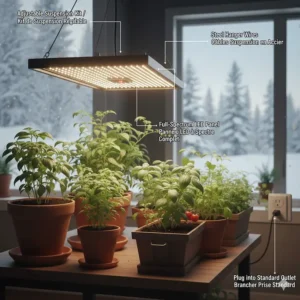
Rope ratchets are your best friend here. Thread the rope through the panel’s mounting holes, clip to ceiling eye bolts, and you’ve got instant height adjustment capability. As seedlings grow, simply release the ratchet and lower the panel. This beats static chain mounting where you’re constantly re-clipping links.
For under-shelf installations, the FECiDA panels include cable ties. I prefer these for seedling trays because you can position panels at precise angles, directing more light toward the tray edges where reflector coverage fades.
Step 4: Set Optimal Light Schedule
Seedlings generally prefer 14-16 hours of light daily. This mimics late spring conditions, promoting steady vegetative growth without triggering early flowering responses. I run my seedling panels 6:00 AM to 10:00 PM, giving plants 16 hours of light and an 8-hour dark period.
The dark period matters more than many growers realize. According to plant biology research, certain growth processes occur exclusively during dark phases. Continuous 24-hour lighting can actually stress seedlings, reducing overall vigour.
Step 5: Monitor and Adjust
Watch your seedlings closely for the first week. Ideal growth shows:
✅ Short, thick stems (internodal spacing <2 cm)
✅ Dark green leaf colour
✅ Leaves reaching upward at 20-30° angle
✅ New growth every 2-3 days
Problem signs include:
❌ Stretched, spindly stems (light too far or weak)
❌ Leaves curling downward (light too close or intense)
❌ Bleached, pale leaves (light too intense)
❌ Purple leaf edges (cool temperatures + high light can trigger this)
Canadian Climate Considerations:
Seedlings started indoors February-April face unique challenges in Canadian climates. Ambient temperatures in unheated basements may drop to 12-15°C overnight, slowing germination and early growth. Panel LEDs generate minimal heat, so consider supplemental heating mats under seed trays if starting cold-sensitive species like tomatoes and peppers.
Conversely, panels mounted in south-facing windows during May-June may receive excessive combined natural + artificial light. Monitor for heat stress, especially with high-wattage panels. I’ve occasionally needed to shade windows with curtains during peak afternoon hours to prevent temperatures from exceeding 28°C.
Specific Seedling Distances by Panel Type:
| Panel Type | Germination Distance | True Leaf Stage | Hardening Off |
|---|---|---|---|
| 100W Quantum Board | 45-50 cm | 35-40 cm | 25-30 cm |
| 65W Compact Panel | 35-40 cm | 25-30 cm | 20-25 cm |
| 20W Under-Cabinet | 20-25 cm | 15-20 cm | 10-15 cm |
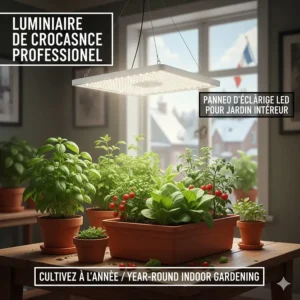
Lower lights gradually as seedlings develop true leaves and thicken stems. Two weeks before transplanting outdoors, begin hardening off by increasing light intensity (lowering panels) to prepare plants for full sun exposure.
Panel Grow Light Reviews and Ratings 2026: What Changed
The panel grow light reviews and ratings 2026 landscape shows dramatic evolution from just two years ago. Three major trends dominate current offerings available to Canadian growers.
1. Samsung LM301H EVO Diodes Become Standard
Previous generation LM301B chips topped out at 2.7 μmol/J efficacy. The latest LM301H EVO chips push this to 2.9-3.0 μmol/J, squeezing an additional 10-15% photon output from the same electrical input. Spider Farmer adopted these across their 2025-2026 lineup, making their SF1000 and SF2000 models the efficiency leaders in their price brackets.
Mars Hydro continues using LM301B in most panels, maintaining slightly lower prices. For budget-conscious growers, this represents smart value – the efficiency difference translates to roughly $8-$10 annually in electricity costs for a 100W panel run 12 hours daily. Over a 5-year ownership period, that’s $40-$50 – not insignificant, but perhaps worth the $20-$30 purchase price difference if upfront budget is tight.
2. Integrated Smart Controls Proliferate
The FECiDA 2026 series exemplifies the smart control movement. Auto-off timers, linkable designs, and memory functions let you program once and forget. Higher-end panels now include Bluetooth or WiFi connectivity for smartphone control.
SANSI leads this category with their app-controlled multi-head fixtures. Adjust spectrum, timing, and intensity from your phone, and even integrate with voice assistants. Canadian availability remains spotty (check current stock), but the technology signals where the market is heading.
3. Modular Bar-Style Designs Gain Market Share
Traditional quantum boards arrange LEDs on flat rectangular panels. Emerging bar-style designs (like the Spider Farmer SE series) spread diodes across multiple linear bars connected to a central frame. This configuration provides more even light distribution and better airflow around diodes.
Bar-style panels command premium prices ($200-$400 CAD for 200W models), but reviews from commercial Canadian greenhouse operators suggest 10-15% yield increases compared to equivalent quantum boards. The improved uniformity eliminates edge fade-off, maximizing productive growing area.
What Hasn’t Changed:
Despite technological advances, fundamentals remain constant. PPFD (photosynthetic photon flux density) still determines light intensity at the plant canopy. The daily light integral (DLI) – total photons received over 24 hours – drives growth rates. And spectrum quality (not just intensity) influences plant morphology, metabolite production, and flowering behaviour.
Canadian growers should focus on these fundamentals rather than chasing the latest features. A well-positioned 2023 model panel often outperforms a poorly-installed 2026 flagship.
Independent Testing Results:
Third-party reviews on platforms like Amazon.ca and specialized grow forums provide valuable real-world data. The HLG 65 V2 consistently receives 4.8-4.9/5 stars across 200+ Canadian reviews, with users praising reliability and customer service. Spider Farmer’s SF1000 averages 4.7/5 over 300+ reviews, with occasional complaints about packaging damage during shipping (inspect immediately upon delivery!).
Mars Hydro panels show wider rating variance (4.3-4.7/5), often reflecting batch-to-batch quality consistency issues. Some users report flawless operation for years; others experience driver failures within 12-18 months. The lower price point somewhat justifies this risk, but buyers should verify warranty coverage ships to Canada before purchasing.
Maximizing Growth with Samsung Diode Grow Panels
Samsung diode grow panels represent the current pinnacle of LED efficiency, but simply buying premium hardware doesn’t guarantee results. You need to leverage their capabilities properly. Here’s what I’ve learned through extensive testing.
Understanding Binning and Quality Grades
Not all Samsung LM301 diodes are created equal. Manufacturers purchase diodes in “bins” – batches sorted by luminous efficacy, colour temperature, and voltage forward. Top-bin diodes (Spider Farmer and HLG use these) deliver specified performance consistently. Lower-bin diodes (budget panels sometimes use these) may produce 5-10% less output while consuming the same power.
How do you know what you’re getting? Check product specifications for actual PPF (photosynthetic photon flux) measurements. A genuine 100W panel with top-bin LM301H diodes should produce 260-290 PPF. Anything below 240 PPF suggests lower-bin diodes or inefficient driver design.
Optimal Operating Temperatures
Samsung specifies LM301 diodes for operation at 25°C junction temperature. Every 10°C increase above this reduces lifespan by approximately 30% and decreases efficiency by 2-3%. Quality panel designs maintain junction temperatures below 40°C through passive cooling.
You can’t measure junction temperature directly, but surface temperature provides a proxy. Touch the back of your panel after 2-3 hours of operation. Comfortably warm (35-40°C) indicates proper thermal management. Too hot to touch (50°C+) suggests inadequate heatsinking.
Canadian winter conditions help here. My basement grow room sits at 17°C ambient, meaning panels run exceptionally cool. Summer grows in un-air-conditioned spaces may require active ventilation to prevent thermal stress.
Spectrum Tuning for Different Stages
Samsung diodes emit narrow-spectrum light determined by phosphor coatings. 3000K diodes skew reddish (more 600-700nm), while 5000K skew bluish (more 400-500nm). Premium panels combine both colour temperatures plus supplemental 660nm and 730nm chips.
For vegetative growth (seedlings, houseplants, herbs), emphasize the blue-white 5000K spectrum. This promotes compact growth, thick stems, and dense foliage. Many panels include separate veg/bloom switches that shift diode activation accordingly.
For flowering and fruiting (tomatoes, peppers, flowers), increase red spectrum exposure. The 3000K + 660nm combination triggers flowering responses and enhances fruit development. I typically run full spectrum during seedling stage, then switch to bloom mode once flowers appear.
PPFD Optimization:
Different plants have vastly different light requirements:
🌿 Low-light plants (pothos, philodendron, snake plant): 100-200 μmol/m²/s
🌿 Medium-light plants (herbs, lettuce, most houseplants): 200-400 μmol/m²/s
🌿 High-light plants (tomatoes, peppers, fruiting crops): 400-800 μmol/m²/s
🌿 Maximum tolerance (cannabis, certain succulents): 800-1,200 μmol/m²/s
Position panels to deliver appropriate PPFD for your crops. A 100W Samsung panel at 30 cm distance delivers approximately 400-500 μmol/m²/s at the centre point, fading to 200-300 μmol/m²/s at the edges. This makes it perfect for mixed gardens – place light-hungry plants center, shade-tolerant species at periphery.
Maximizing Canadian Growing Seasons:
One of my favourite Samsung panel applications is season extension. Start tomato and pepper seedlings indoors under panels in February (8-10 weeks before last frost). This gives you 30-40 cm transplants ready for May long weekend – easily 4-6 weeks ahead of direct-sown or garden-center seedlings.
Similarly, extend fall harvests by bringing plants indoors before first frost. Pepper plants that would normally die in late September can continue producing indoors under panels through November-December. I’ve harvested fresh bell peppers on Christmas Day this way.
Comparing Panel Grow Lights to Traditional Options
Let’s be brutally honest about panel grow lights versus traditional technologies. Each system has legitimate use cases, and pretending otherwise serves nobody.
| Feature | LED Panels | HPS/MH | Fluorescent T5 | Natural Window Light |
|---|---|---|---|---|
| Initial Cost (100W equivalent) | $120-$180 CAD | $80-$120 CAD | $60-$90 CAD | Free |
| Operating Cost (annual) | $48-$52 CAD | $95-$110 CAD | $70-$85 CAD | Free |
| Lifespan | 50,000+ hours | 10,000-15,000 hours | 20,000 hours | Permanent |
| Heat Output | Minimal | Very High | Moderate | Variable |
| Spectrum Control | Excellent | Limited | Good | None |
| Space Efficiency | Excellent | Poor | Good | Depends |
| Setup Complexity | Low | Moderate | Low | None |
When HPS/MH Makes Sense:
Large-scale operations (>5 m² growing area) may still justify HPS for flowering phases. The intense, penetrating light drives excellent yields in deep canopies. However, you’ll need robust ventilation to manage heat, and electricity costs in Canadian provinces with high rates (Ontario, Nova Scotia, PEI) can reach $150-$200 monthly for a 400W HPS run 12 hours daily.
When Fluorescent T5 Competes:
For pure seedling starts and microgreens, T5 fluorescents remain cost-competitive with entry-level LED panels. A 4-tube T5 fixture ($60-$80 CAD) covers 60×120 cm effectively. Operating costs run higher than LEDs, but the lower entry price appeals to hobbyists testing indoor growing.
When Window Light Works:
South or southwest-facing windows in Canadian homes provide substantial light March-October. Supplement with panels only during peak demand hours (typically 10 AM – 4 PM) rather than running full-time. This hybrid approach minimizes electricity consumption while ensuring adequate DLI.
I use this exact strategy for my kitchen herb garden. The window provides base light; a single 20W FECiDA panel supplements during cloudy days and evening hours. Total monthly cost: $2-$3 CAD versus $15-$18 for full LED reliance.
The Real Panel Advantage:
Here’s what finally sold me on panel grow lights for indoor garden applications: versatility and precision. I can dial in exact light levels, adjust spectrum by growth stage, and position lights with surgical precision. Try doing that with a 400W HPS blasting light everywhere indiscriminately.
For Canadian mixed-use spaces (apartments, condos, multi-purpose rooms), the low heat signature of LED panels proves invaluable. No dedicated cooling infrastructure, no fire hazards from hot bulbs, and minimal impact on household HVAC systems. My spouse tolerates my growing habit specifically because panels don’t turn our apartment into a greenhouse.

❓ Frequently Asked Questions
❓ How much does it cost to run panel grow lights in Canada?
❓ Can I use panel grow lights for vegetables in Canadian winters?
❓ What's the difference between quantum boards and regular LED panels?
❓ Do panel grow lights work for seed starting in Canada?
❓ Are Samsung diode panels worth the extra cost compared to generic LEDs?
Conclusion
Finding the right panel grow lights for indoor garden success in Canada boils down to matching technology to your specific needs. The seven options I’ve highlighted represent the best currently available to Canadian growers, from budget-conscious hobbyists to premium-seeking perfectionists.
If you’re just starting out, the Mars Hydro TS600 ($129-$149 CAD) delivers exceptional value without overwhelming complexity. Step up to the Spider Farmer SF1000 ($139-$169 CAD) if you want cutting-edge Samsung LM301H EVO efficiency and room for future expansion. And for under-cabinet herb gardens or shelf-based systems, the FECiDA 2026 4-pack ($85-$105 CAD) offers unbeatable versatility.
Remember: the best grow light is the one you’ll actually use consistently. I’ve seen $50 panels produce incredible harvests for dedicated growers, while $300 fixtures gather dust for those who don’t commit to daily care. Start with adequate coverage for your space, ensure proper mounting height, and stick to a consistent light schedule. Your plants will reward you with vigorous growth, regardless of what’s happening outside your Canadian windows.
The real magic of panel grow lights isn’t just growing plants when it’s -20°C outside – though that’s pretty cool. It’s the ability to create exactly the growing conditions you want, precisely when you want them, in whatever space you have available. That level of control fundamentally changes what’s possible for Canadian indoor gardeners.
Recommended for You
- 7 Best Grow Lights for Indoor Herbs Canada 2026
- SANSI Grow Light Bulb Canada: Top 7 Picks That Actually Work (2026)
- 7 Best Clip On Grow Lights for Houseplants 2026 Canada
Disclaimer: This article contains affiliate links to Amazon.ca. If you purchase products through these links, we may earn a small commission at no additional cost to you.
✨ Found this helpful? Share it with your friends! 💬🤗
