
In This Article
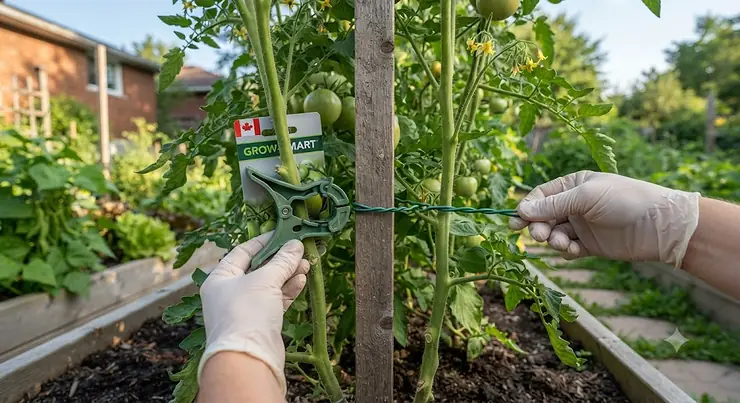
Reusable plant clips vs twist ties for gardening is the choice between a hinged plastic ring that snaps around a stem and a support, and a wire-cored strip you wrap and twist shut. Both hold plants upright. Clips win on speed and reusability; twist ties win on flexibility, price, and odd-shaped jobs.
That’s the short version. The long version is more interesting, because the humble plant fastener is one of those garden tools nobody thinks about until a July thunderstorm snaps a tomato vine clean in half at the exact spot where a too-tight tie had been quietly strangling it for six weeks.
The twist tie — a thin wire wrapped in paper or plastic — dates back to 1961, when it was invented for the baking industry to close bread bags. Gardeners borrowed it, and it’s been living in kitchen drawers and potting sheds ever since. The plastic trellis clip is the newer arrival, lifted from commercial greenhouse growers who clip thousands of tomato vines to overhead strings every season and need something faster than fiddling with wire.
So which belongs in your garden? The honest answer to reusable plant clips vs twist ties for gardening depends on what you grow, how often you’ll re-fasten, and how much single-use clutter you’re willing to toss in the bin each fall. This guide walks through seven real products sold to Canadian shoppers — three clip packs, three tie-style fasteners, and one hook-and-loop hybrid — with honest analysis built on real specs and real aggregated reviewer sentiment, not invented raves. We’ll also dig into reusability, ease of use, plant growth accommodation, and the genuinely eco-friendly plant fastening options worth your money.
Quick Comparison Table: Clips vs Twist Ties at a Glance
Before the product-by-product deep dive, here’s how the main fastener styles stack up on the things that actually matter once the seedlings are in the ground.
| Fastener Type | Setup Speed | Reusability | Stem Safety as Plant Grows | Approx. Cost Range (CAD) | Best For |
|---|---|---|---|---|---|
| Hinged plastic trellis clip | 2-3 seconds per clip | High — 3-5+ seasons if stored indoors | Good — fixed ring leaves slack if sized right | C$10-C$22 per 100-300 | Tomatoes, cucumbers, vines on strings or stakes |
| Plastic-coated wire twist tie | 10-15 seconds per tie | Low to moderate — kinks after a few reuses | Fair — can girdle if forgotten | C$5-C$12 per spool | Odd shapes, thick bundles, quick fixes |
| Foam-padded soft wire tie | 5-10 seconds | High — multi-season | Very good — cushion spreads pressure | C$8-C$15 per pack | Roses, climbers, young fruit trees |
| Hook-and-loop plant tape | 5-10 seconds | High — re-open dozens of times | Very good — easy to loosen | C$12-C$20 per roll | Adjustable ties, tomatoes, staked perennials |
| Stretch vinyl tie tape | 10 seconds | Low — usually single-season | Good — stretches with growth | C$10-C$18 per roll | Grafting, grapevines, flexible ties |
Reading across the table, there’s a clear pattern: the fasteners that cost a little more upfront (clips, hook-and-loop, padded wire) are the ones you’ll still be using in 2029, while the cheapest option — a basic twist-tie spool — trades long-term reusability for flexibility and a tiny sticker price. Stem safety tracks the same line; anything with a fixed ring or a soft, wide contact surface is far less likely to girdle a growing stem than a thin wire that someone twisted tight in May and forgot about. If you grow mostly tomatoes and cucumbers on stakes or strings, clips are the fast lane; if your garden is a mix of roses, trellised clematis, and a few staked dahlias, a combination of padded ties and hook-and-loop tape will serve you better.
💬 Just one click — help others make better buying decisions too!😊
Top 7 Reusable Plant Clips and Twist Ties: Expert Analysis
We looked at real fasteners listed for Canadian shoppers, spanning bulk plastic clips, padded wire ties, hook-and-loop tape, and a classic twist-tie spool. Here’s the lineup at a glance before we go product by product.
| Product | Type | Pack Size | Approx. Price Range (CAD) | Best For |
|---|---|---|---|---|
| VASLON Plastic Tomato Clips | Hinged plastic clip | 100 pcs (200-pc option) | C$10-C$18 | Small to mid-size vegetable gardens |
| FANDAMEI Plant Support Clips | Hinged clip, ~2.5 cm (1″) inner diameter | 300 pcs | C$13-C$22 | Thicker stems, big tomato and squash plantings |
| Piteno Tomato Clips | Hinged plastic clip | 300 pcs | C$12-C$20 | Bulk trellis and string-training setups |
| VELCRO Brand Garden Ties | Hook-and-loop tape, 65% recycled content | 15 m x 1.3 cm (50 ft x ½″) | C$12-C$20 | Adjustable ties you’ll loosen all season |
| Luster Leaf Rapiclip Soft Wire Tie | Foam-padded wire tie | 20 pre-cut ties | C$8-C$15 | Roses, climbers, young trees |
| Gardener’s Blue Ribbon Sturdy Stretch Tie | Stretch vinyl tape | 45 m (150 ft) roll | C$10-C$18 | Grapevines, grafts, flexible stems |
| Luster Leaf Rapiclip Garden Plant Twist Tie | Plastic-coated wire twist tie | 30 m (100 ft) spool | C$5-C$10 | Budget all-purpose tying |
The spread tells a story: for roughly the price of one roll of the VELCRO Brand Garden Ties, you can buy 300 Piteno Tomato Clips — but those two products solve different problems. Clips are about speed and repetition on a single crop; hook-and-loop and padded wire are about adjustability on plants that thicken, sprawl, or need re-positioning. The Luster Leaf Rapiclip Garden Plant Twist Tie remains the cheapest way into the game, which is exactly why it’s worth understanding its limits before you buy it by default.
1. VASLON Plastic Tomato Clips — best starter pack for home vegetable beds
The appeal here is simplicity: a hinged ring that snaps shut around the stem and the stake in one squeeze. The VASLON Plastic Tomato Clips come as a 100-piece pack (with a 200-piece version for bigger gardens), in white plastic designed for tomatoes, vines, and climbing vegetables.
On paper, a hinged clip like this means your fastening time drops from 10-15 seconds per wire tie to a two-second snap — and that difference compounds fast. Twelve tomato plants, clipped every 25-30 cm as they climb, can easily need 80-100 fasteners over a season. Just as importantly, the ring has a fixed inner size, so it can’t be over-tightened by an enthusiastic helper the way a twist tie can. White plastic also reflects sunlight rather than absorbing it, which helps a little with heat and UV breakdown compared to darker clips.
We couldn’t independently verify a large product-specific review pool for this exact listing at the time of research. Across this style of hinged clip, though, the themes commonly reported by gardeners are consistent: huge time savings and easy removal, balanced against occasional hinge breakage after a couple of seasons of sun exposure.
Pros:
- ✅ Two-second snap-on fastening saves real time
- ✅ Fixed ring can’t be cranked too tight
- ✅ White plastic stays cooler and resists sun fade
Cons:
- ❌ Too small for mature, thick main stems
- ❌ Hinges can weaken after years of UV exposure
At the time of research, the 100-pack sits in roughly the C$10-C$18 range — check current price on Amazon.ca. For a typical backyard bed of four to eight tomato plants, it’s the lowest-friction way to test whether clips suit your gardening style.
2. FANDAMEI Plant Support Clips — roomiest ring for thick stems
Size matters with clips, and this is the pack that takes it seriously. The FANDAMEI Plant Support Clips are marketed with a 2.5 cm (1″) inner diameter, sold in a hefty 300-piece bag and pitched at tomatoes, cucumbers, squash, and climbing flowers.
Why does that inner diameter matter? Because a tomato stem that’s pencil-thin in June can be thumb-thick by August, and the clip has to hold both the stem and the stake or string inside the same ring. A roomier 2.5 cm opening leaves enough slack for that growth — this is what plant growth accommodation looks like in practice. The trade-off is that on a very thin seedling or a slim bamboo cane, a bigger ring can slide down the support unless you position it just under a leaf node or branch junction, which acts as a natural stopper.
We couldn’t verify detailed individual reviews for this exact listing at the time of research. What’s consistently noted across larger-ring clips is that they’re easier to open and close with garden gloves on, and that they suit mature plants better than dainty seedlings.
Pros:
- ✅ 2.5 cm ring leaves room for stem thickening
- ✅ 300-piece bag covers a large garden
- ✅ Easier to open with gloves on
Cons:
- ❌ Can slip down thin stakes without a node stopper
- ❌ Overkill for herbs and delicate seedlings
Expect the 300-pack to land in the C$13-C$22 range at the time of research — prices may vary. For anyone growing indeterminate tomatoes or vining squash, the bigger ring is the smarter long-term buy.
3. Piteno Tomato Clips — best bulk value for string trellising
When you’re training a row of vines up hanging strings, quantity is king. The Piteno Tomato Clips come 300 to a pack, designed for grape vines, tomatoes, and vegetables grown upright on strings, stakes, or trellis netting.
This style of clip comes straight from commercial greenhouse practice, where growers clip vines to vertical twine rather than tying them. What most home gardeners overlook is how well that system scales down: one string per plant anchored overhead, a clip every 25-30 cm, and the vine climbs cleanly without a single knot. When the season ends, you pop the clips off, soak them in a mild bleach solution to kill any lingering disease spores, and bag them for next year. That’s reusability in its purest form — the same 300 clips can outlast several packs of twist ties.
Detailed reviews for this specific listing weren’t independently verifiable at the time of research. Category-wide, gardeners frequently report that bulk clips are excellent value but that quality control varies from batch to batch, with a few clips occasionally arriving with stiff or brittle hinges.
Pros:
- ✅ Lowest cost per clip in this roundup
- ✅ Ideal for commercial-style string training
- ✅ Easy to sanitize and reuse each spring
Cons:
- ❌ Batch-to-batch hinge quality can vary
- ❌ Plastic still ends up in landfill eventually
At the time of research, a 300-pack runs roughly C$12-C$20 — check current price. If you’re outfitting a greenhouse, a hoop house, or a long row of trellised cucumbers, this is the economical workhorse.
4. VELCRO Brand Garden Ties — most adjustable reusable tie
Here’s the fastener that blurs the line between clip and tie. The VELCRO Brand Garden Ties are a 15 m (50 ft) roll of 1.3 cm (½″) hook-and-loop tape that you cut to length, wrap around stem and support, and press closed — no knots, no twisting.
The practical magic is adjustability. When a stem thickens, you peel the tape open and re-close it with more slack in about three seconds. That makes it one of the best tools for plant growth accommodation in this entire roundup. The brand states the product contains 65% recycled material, a genuine plus in the eco column. One detail worth knowing: the plant-specific garden ties use a softer loop and gentler hook than the brand’s general-purpose ONE-WRAP straps, according to a hook-and-loop distributor’s published comparison — so buy the garden version for living stems.
Reviewer sentiment is strong: at the time of research, this exact 50 ft roll held a 4.7-out-of-5 average from 741 reviews on a major North American home improvement retailer’s site, with the knot-free, adjustable design as the recurring praise.
Pros:
- ✅ Re-opens and re-adjusts in seconds
- ✅ 65% recycled content per the manufacturer
- ✅ Cut-to-length suits any stem size
Cons:
- ❌ Loop fibres collect soil and seeds over time
- ❌ Higher cost per tie than clips or wire
Pricing sits in the C$12-C$20 range at the time of research — check current price and Amazon.ca availability, as stock can come through third-party sellers. For gardeners who hate re-tying, it’s the most forgiving option on the list.
5. Luster Leaf Rapiclip Soft Wire Tie — gentlest wire tie for roses and climbers
Think of this as the twist tie that went to finishing school. The Luster Leaf Rapiclip Soft Wire Tie is a pre-cut wire tie wrapped in a soft foam cushion, sold in packs of 20 — built for plants where bark damage is a real concern.
That foam jacket is the whole point. A thin bare twist tie concentrates pressure on a narrow line; a padded tie spreads it across a wider, softer contact patch. For a climbing rose on a trellis, a young apple whip on a stake, or a clematis that sulks at the slightest injury, that difference is the line between a healthy cane and a scarred one. The wire core also means you can shape it into loops or hooks that clips and tape can’t manage — handy for tying a heavy cane to a fence wire at an awkward angle.
We couldn’t verify a large, detailed review pool for this exact 20-pack at the time of research. Among foam-padded ties generally, the common praise is gentleness on bark and multi-season reuse; the common complaint is that foam can degrade and crumble after several years of sun.
Pros:
- ✅ Foam cushion protects delicate bark
- ✅ Wire core bends into custom shapes
- ✅ Reusable across multiple seasons
Cons:
- ❌ Only 20 ties per pack
- ❌ Foam can break down after long sun exposure
At the time of research, expect roughly C$8-C$15 per pack — check current price and availability. For ornamental climbers and young trees, the extra cost per tie is cheap insurance.
6. Gardener’s Blue Ribbon Sturdy Stretch Tie — best for fast-thickening vines
Not every fastener should hold still. The Gardener’s Blue Ribbon Sturdy Stretch Tie is a 45 m (150 ft) roll of stretchy vinyl tape that expands as the stem inside it grows.
That stretch is a clever answer to the girdling problem. Rather than relying on you to come back and loosen a tie in August, the tape itself gives as the stem swells, which is why stretch tape is a long-time favourite for grapevines, grafts, and berry canes. It also ties in a simple knot, so there’s no wire to poke fingers or rust in wet spring soil. The honest limitation: stretch tape is typically a one-season product. Once it’s been knotted and stretched, re-using it is fiddly, so it sits on the single-use side of the reusability ledger — though one roll lasts a long time.
We couldn’t independently verify detailed, recent review data for this exact roll at the time of research. What’s commonly noted about vinyl stretch tape as a category is its gentleness and generous roll length, alongside the drawback that it can become brittle after a season of UV exposure.
Pros:
- ✅ Stretches automatically as stems thicken
- ✅ No wire to rust or poke
- ✅ 150 ft roll lasts several seasons of tying
Cons:
- ❌ Knotted pieces are hard to reuse
- ❌ Vinyl can turn brittle in strong sun
At the time of research, this roll lands in roughly the C$10-C$18 range — prices may vary, and Amazon.ca availability can fluctuate. For vineyard-style or grafting jobs, it’s a smart specialist tool.
7. Luster Leaf Rapiclip Garden Plant Twist Tie — cheapest all-purpose tie
The classic, and still the cheapest ticket in. The Luster Leaf Rapiclip Garden Plant Twist Tie is a 30 m (100 ft) spool of green, plastic-coated wire that you cut to whatever length the job needs.
Its superpower is versatility. A twist tie can bundle a clump of floppy peonies, anchor a drip line to a stake, secure a label, or hold a cucumber tendril against a wire fence — jobs where a fixed-size clip is useless. Green coating blends into foliage, and a spool of 30 m translates into dozens of ties for a few dollars. Here’s the catch the spec sheet won’t mention: thin wire is the fastener most likely to girdle a stem, because it’s so easy to twist tight and forget. Reuse is also limited; after three or four twists, the wire kinks and the coating starts to crack, which exposes bare metal to rust.
We couldn’t verify detailed individual reviews for this exact spool at the time of research. Across coated-wire twist ties generally, gardeners praise the price and flexibility while flagging stretching under heavy loads and coating wear over time.
Pros:
- ✅ Lowest upfront cost in the roundup
- ✅ Cut-to-length for any odd job
- ✅ Green coating blends into foliage
Cons:
- ❌ Easy to over-tighten and girdle stems
- ❌ Kinks and cracks after a few reuses
At the time of research, a spool costs roughly C$5-C$10 — check current price. Keep one in the shed for odd jobs, but don’t make it your main tomato fastener.
Practical Usage Guide: Getting the Most From Clips and Ties
Good fasteners used badly still hurt plants. Here’s the setup routine that makes either option work.
Placement and spacing
Fasten the first clip or tie about 20-25 cm above the soil once the transplant is established, then add another every 25-30 cm as the plant climbs. Place each clip just below a leaf node or branch junction so the node acts as a shelf — this stops clips from sliding down smooth stakes or strings.
The figure-eight rule for ties
With twist ties, stretch tape, or hook-and-loop, cross the tie between stem and stake in a figure-eight. The crossover keeps the stem from rubbing directly against the stake, and it leaves a small cushion of slack. Aim for enough room to slide a finger between stem and tie.
Weekly check (first 30 days and beyond)
A tomato stem can nearly double in girth in a month of warm weather. Once a week, run your hand along each plant and loosen anything snug. Clips largely handle this themselves if sized correctly; twist ties do not.
End-of-season care
This is where reusability is won or lost. Strip every clip and reusable tie before the first hard frost, soak them for 10 minutes in a 1:9 bleach-to-water solution to kill fungal spores such as early blight, rinse, dry fully, and store them in a dark bin indoors. Sunlight is the enemy of plastic hinges and foam; a winter in a dark basement doubles their working life.
Common first-month mistakes
Clipping too tight a stem into too small a ring, twisting wire ties with pliers, and leaving fasteners on dead plants over winter top the list. Each one shortens either the plant’s life or the fastener’s.
Real-World Scenarios: Which Fastener Fits Your Garden?
Let’s match three typical Canadian growers to the right tool.
Scenario 1: The balcony grower in Vancouver
Four tomato plants in large containers, a few bamboo canes, and limited storage. Here, the VASLON Plastic Tomato Clips are the easy call — a 100-pack covers several seasons, clips store in a sandwich bag, and they come off in seconds when the season ends. Pair them with a short length of the VELCRO Brand Garden Ties for the one or two spots where a clip won’t sit right.
Scenario 2: The prairie backyard in Saskatoon
A 3 x 6-metre bed with 12 indeterminate tomatoes on 1.8 m stakes and a short, intense growing season. Speed matters, and stems get thick fast. The FANDAMEI Plant Support Clips make sense: the roomier 2.5 cm ring handles late-summer stem growth, and the 300-piece bag covers every plant plus the cucumbers climbing the fence.
Scenario 3: The rose-and-orchard gardener in the Niagara region
Climbing roses, a pair of young pear trees on stakes, grapevines on an arbour. Clips are the wrong tool here. The Luster Leaf Rapiclip Soft Wire Tie protects rose canes and young bark, while the Gardener’s Blue Ribbon Sturdy Stretch Tie handles the grapevines, which thicken quickly through summer. A spool of the Luster Leaf Rapiclip Garden Plant Twist Tie covers labels and drip lines.
The lesson across all three: most gardens benefit from two fastener types, not one.
Problem → Solution Guide: Fixing Common Fastening Headaches
Problem 1: Clips slide down the stake. Solution: position each clip directly under a leaf node or branch junction, or wrap a single turn of hook-and-loop tape around a smooth stake as a “stopper” just below the clip.
Problem 2: A twist tie has bitten into the stem. Solution: cut it off immediately — don’t untwist and risk tearing the tissue. Re-fasten above the wound with a wider, softer option such as the VELCRO Brand Garden Ties or a padded Luster Leaf Rapiclip Soft Wire Tie. Most stems recover if the bark isn’t fully girdled.
Problem 3: Clip hinges snap in spring. Solution: that’s UV fatigue from outdoor storage. Store clips indoors in the dark, and retire any clip that feels chalky or stiff when you open it.
Problem 4: Stems outgrow the clip mid-season. Solution: move to a larger-ring clip such as the FANDAMEI Plant Support Clips, or switch the lowest, thickest section of stem to adjustable hook-and-loop tape.
Problem 5: Wind rips plants off their supports. Solution: increase fastener frequency to every 20 cm on exposed sites, and use ties on the lower, heavier third of the plant where leverage is greatest. Clips can pop open under extreme load; a knotted stretch tie from the Gardener’s Blue Ribbon Sturdy Stretch Tie roll won’t.
✨ Don’t Miss These Exclusive Deals! 🔍
Take your vegetable garden to the next level with these carefully selected clips and ties. Click on any highlighted item to check current pricing and availability. These tools will help you grow the healthy, upright, blemish-free harvest your family will love!
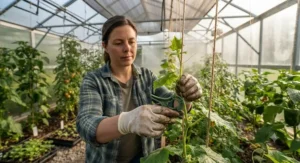
Reusable Garden Clips: What Makes a Good One
Not all reusable garden clips are created equal, and the differences are easy to miss in a product photo.
Material
Most clips are polypropylene, the same tough, flexible plastic used in commercial greenhouse clips. Good polypropylene clips flex thousands of times at the hinge before failing. Cheaper blends can be brittle straight out of the bag — a quick test is to open and close a few clips 20 times each when the pack arrives.
Ring size
A 2 cm ring suits seedlings and thin canes; a 2.5 cm (1″) ring suits mature tomato stems paired with a stake or string. If you can only buy one size, choose the larger — you can always position it under a node to stop slipping, but you can’t make a small ring grow.
Hinge and latch design
Look for a latch that clicks firmly shut and opens with a thumb press. A latch that needs a fingernail to pry open will slow you down when you’re removing 200 clips in October.
Colour
White and light green clips run cooler in direct sun than dark ones, which slows UV breakdown and reduces heat against tender stems.
Bought with those four points in mind, reusable garden clips from packs like the Piteno Tomato Clips or VASLON Plastic Tomato Clips can realistically serve three to five seasons, which is what shifts the math against disposable twist ties.
Eco-Friendly Plant Fastening Options Worth Considering
Canada has a plastic problem, and garden sheds contribute their share. According to the Government of Canada, of the almost five million tonnes of plastic waste Canadians threw away in 2021, only 7% was recycled. Small plastic garden items — cracked clips, snipped twist ties, knotted tape — rarely make it into recycling streams at all.
So what do genuinely eco-friendly plant fastening options look like?
Reuse beats recyclability
The greenest fastener is the one you use for ten years. A single bag of durable clips, cared for properly, replaces dozens of spools of twist ties over a decade. That’s why reusability is the first eco criterion, ahead of material.
Recycled content
The VELCRO Brand Garden Ties contain 65% recycled material according to the manufacturer — a meaningful step, and the product is designed to be re-opened and re-used many times over.
Natural fibres
Jute and sisal twine are fully compostable and gentle on stems. They’re single-season by nature, since they weaken as they rot, but at season’s end you can toss the plant, twine and all, into the compost. For annual crops, that’s hard to beat.
Avoid
Thin plastic-coated wire is the least eco-friendly option: it mixes metal and plastic, can’t easily be recycled, and fragments into small plastic flakes as the coating cracks.
The practical approach for most Canadian gardens: durable clips or hook-and-loop for the long-lived plants and supports, compostable twine for annual crops you’ll pull and compost, and wire twist ties only for the odd jobs nothing else can do.
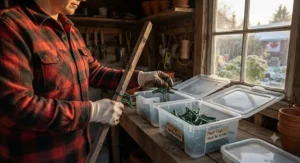
Reusability: How Many Seasons Each Fastener Really Lasts
Reusability sounds like a yes-or-no feature, but in practice it’s a sliding scale shaped by material, UV exposure, and how you store things over winter.
Plastic clips
With indoor storage, good polypropylene clips commonly last three to five seasons. The failure point is almost always the hinge, which becomes chalky and brittle after long UV exposure. Leave them on dead vines in the snow all winter and you may lose a third of them by spring.
Hook-and-loop tape
Hook-and-loop ties can be opened and closed many times within a season, and a single strip can often be reused for several years. What degrades their reusability is debris: soil, fine roots, and seed fluff lodged in the hooks. A stiff brush and a rinse restore much of the grip.
Foam-padded wire ties
These typically hold up for multiple seasons, though the foam jacket is the weak point after years in direct sun.
Standard twist ties
Plastic-coated wire manages a few reuses before kinking and cracking. Paper-coated twist ties are effectively one-and-done once wet.
Stretch vinyl tape
Largely single-season once knotted, though a long roll spreads its cost thin.
The takeaway: reusability depends as much on your end-of-season habits as on the product. Strip, sanitize, dry, and store in the dark, and even modest clips will surprise you.
Ease of Use: Speed, Dexterity, and Gloved Hands
Ease of use is the reason most gardeners switch to clips and never look back. A clip closes in a single squeeze; a twist tie needs two hands, a twist, and usually a trim of the excess.
Speed per fastener
Clips: two to three seconds. Hook-and-loop: about five seconds once pre-cut. Twist ties and stretch tape: 10-15 seconds, including cutting. Across 100 fastenings in a season, that’s the difference between a few minutes and nearly half an hour — every time you re-fasten.
Dexterity and accessibility
For gardeners with arthritis or reduced grip strength, clips and hook-and-loop are markedly easier than twisting fine wire. Larger-ring clips like the FANDAMEI Plant Support Clips are also easier to handle with gloves than small, stiff ones.
Removal
Clips pop off; hook-and-loop peels open. Twist ties often need to be untwisted slowly or cut off, especially once they’ve tightened against a thickened stem.
Where ties win on ease of use
Awkward geometry. Tying a cane to a horizontal fence wire, bundling several stems together, or fastening to a thick post are all jobs where a flexible tie is simply easier than any fixed-size clip.
In short, ease of use favours clips for repetitive vertical training and ties for everything irregular — which is exactly why so many seasoned gardeners keep both on hand.
Plant Growth Accommodation: Avoiding Girdling and Stem Damage
Plant growth accommodation is the fastener’s ability to leave room for a stem that’s constantly getting thicker — and it’s the single biggest factor for plant health.
Girdling happens when a tie cuts off the flow of water and sugars through the outer layers of the stem. It rarely kills a plant overnight; instead, you see wilting above the tie, a dented stem, and sometimes a clean break in the first strong wind. Thin wire twist ties are the classic culprit because they’re so easy to over-tighten.
According to the University of Saskatchewan’s gardening guide, indeterminate tomatoes can reach up to 1.5 metres tall in a Saskatchewan summer and must be staked, while determinate bush types generally don’t need staking. That tall, fast-growing habit is exactly where plant growth accommodation matters most — a vine climbing that far in one short season thickens rapidly at the base.
How each fastener handles growth
- Fixed-ring clips: good, if the ring is sized with slack from day one.
- Hook-and-loop tape: excellent — re-adjust in seconds.
- Stretch tape: excellent — expands on its own.
- Foam-padded ties: very good — cushion spreads pressure.
- Bare twist ties: fair to poor — depend entirely on you remembering to loosen them.
If you’re the type who gardens in bursts and might skip a weekly check, choose the fasteners that accommodate growth passively: large-ring clips, stretch tape, or loosely wrapped hook-and-loop.
Benefits of Reusable Plant Clips vs Traditional Twist Ties and Twine
Here’s how modern reusable fasteners compare with the traditional methods many of us grew up with.
| Factor | Reusable Plant Clips | Traditional Twist Ties | Natural Twine | Best For |
|---|---|---|---|---|
| Speed | Fastest | Slow | Slowest | Clips for big plantings |
| Reusability | 3-5+ seasons | A few reuses | Single season | Clips for longevity |
| Growth accommodation | Good with right ring size | Fair — needs checking | Good if loosely tied | Clips or twine |
| Versatility | Limited to stem + support | Very high | High | Ties for odd jobs |
| End-of-life | Landfill (after years) | Hard to recycle | Compostable | Twine for zero waste |
Looking at the table, reusable plant clips win on speed and longevity, which makes them the natural choice for anyone training dozens of vines each year. Twist ties still hold an edge in versatility, while natural twine wins the end-of-life column outright. For most gardens, the smart play in the reusable plant clips vs twist ties for gardening debate isn’t choosing one — it’s assigning each to the job it does best.
How to Choose Between Reusable Plant Clips vs Twist Ties for Gardening
Follow these steps and the right choice tends to become obvious.
- Identify your main crop. Tomatoes, cucumbers, and vines on stakes or strings favour clips; roses, trees, and ornamentals favour padded or soft ties.
- Count your fastenings. Over roughly 50 per season, the time savings of clips add up quickly.
- Check stem thickness at maturity. Choose a 2.5 cm ring for mature tomato stems; smaller rings only for herbs and seedlings.
- Consider your support type. Strings and thin stakes suit clips; thick posts, fences, and wire suit ties.
- Be honest about maintenance. If weekly checks won’t happen, pick fasteners that accommodate growth on their own.
- Weigh eco priorities. Durable, reusable options beat single-use wire over any multi-year window.
- Plan storage. Clips and reusable ties need a dark, dry bin over winter to reach their full lifespan.
Work through those in order and reusable plant clips vs twist ties for gardening stops being a debate and becomes a shopping list.
Common Mistakes When Buying Plant Clips and Ties
Even experienced gardeners trip over a few predictable pitfalls.
Buying rings that are too small
It’s the most common clip mistake. A small ring looks neat on a June seedling and becomes a choke collar by August. Choose a larger ring like the one on the FANDAMEI Plant Support Clips when in doubt.
Assuming “reusable” means indestructible
Reusability is conditional. Clips left outdoors all winter lose that advantage quickly. Budget for indoor storage, or you’re buying a single-use product at a reusable price.
Using general-purpose straps on living stems
Heavy-duty hook-and-loop cable straps grip harder than plant-specific versions and can abrade soft stems. The plant-oriented VELCRO Brand Garden Ties are the right choice for living plants.
Relying on one fastener for everything
A garden full of only twist ties means slow work and girdling risk; a garden full of only clips leaves you stuck on fences, posts, and bundles. Keep a primary fastener and a secondary one.
Buying bulk before testing
A 300-pack is great value — unless the hinges on that batch are brittle. Test a handful the day it arrives, while returns are still easy.
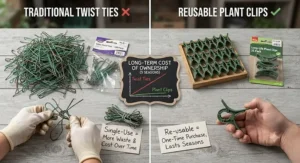
Long-Term Cost and Value: Clips vs Ties Over Five Seasons
Upfront price is misleading when one product lasts five seasons and another lasts one. Here’s a rough five-year view for a garden using about 100 fastenings per season.
| Fastener | Approx. Upfront Cost (CAD) | Typical Lifespan | Est. 5-Season Cost (CAD) | Best For |
|---|---|---|---|---|
| Piteno Tomato Clips (300 pcs) | C$12-C$20 | 3-5 seasons | C$12-C$40 | Best long-term value |
| VASLON Plastic Tomato Clips (100 pcs) | C$10-C$18 | 3-5 seasons | C$10-C$36 | Small gardens |
| VELCRO Brand Garden Ties (15 m) | C$12-C$20 | Multiple seasons; strips reusable | C$24-C$40 | Adjustable ties |
| Luster Leaf Rapiclip Garden Plant Twist Tie (30 m) | C$5-C$10 | ~1 season of main use | C$25-C$50 | Odd jobs only |
The numbers flip the sticker-price intuition: the cheapest spool of the Luster Leaf Rapiclip Garden Plant Twist Tie ends up costing as much or more over five years than a bag of Piteno Tomato Clips, before you count your time. Clips and hook-and-loop win on total cost of ownership provided you store them properly, while twist ties earn their place as a cheap specialist tool rather than a main fastener. These estimates assume reasonable care; outdoor winter storage can halve the lifespan of any plastic product.
FAQ
❓ Are reusable plant clips worth buying over twist ties?
❓ What size plant clips should I buy for tomatoes?
❓ Where can I buy reusable plant clips in Canada?
❓ Can I buy biodegradable plant ties instead of plastic ones?
❓ Which is cheaper long term: plant clips or twist ties?
Conclusion
The reusable plant clips vs twist ties for gardening question doesn’t have a single winner — it has a winning combination. For tomatoes, cucumbers, and anything climbing a stake or string, reusable clips such as the VASLON Plastic Tomato Clips, the roomier FANDAMEI Plant Support Clips, or the bulk Piteno Tomato Clips deliver unmatched speed and genuine multi-season reusability. When you need adjustability, the VELCRO Brand Garden Ties are the most forgiving fastener on the list. For roses and young trees, the padded Luster Leaf Rapiclip Soft Wire Tie protects bark, and the Gardener’s Blue Ribbon Sturdy Stretch Tie grows with fast-thickening vines. The humble Luster Leaf Rapiclip Garden Plant Twist Tie still earns a spot in the shed — just not as your main tomato fastener.
Whatever mix you choose, the habits matter as much as the hardware: fasten loosely, check weekly, and strip and sanitize everything before the snow flies. And if you’re weaving tomatoes in rows, the Florida-weave method described by Seeds of Diversity Canada cuts down on individual fasteners altogether — proof that sometimes the best tie is the one you don’t need.
✨ Ready to upgrade your garden toolkit? 🌱
Browse the highlighted picks above, check current pricing and availability on Amazon.ca, and set your plants up for a stronger, healthier season before planting time rolls around!
Recommended for You
- 7 Best Plant Ties For Delicate Stems In 2026 (Gentle Picks)
- 7 Best Garden Trellis Under $40 CAD For 2026
- 7 Best Trellis For Cucumbers Picks in Canada 2026
Disclaimer: This article contains affiliate links. As an Amazon Associate, I earn from qualifying purchases. If you purchase products through these links, we may earn a small commission at no additional cost to you.
✨ Found this helpful? Share it with your friends! 💬🤗
