
In This Article
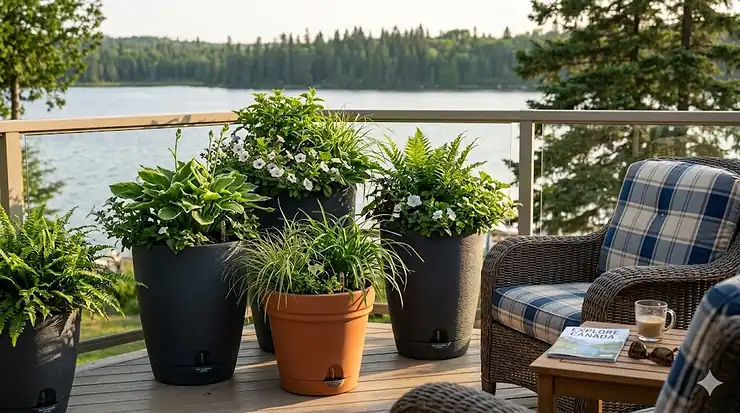
Picture this: you’ve spent all spring nurturing your tomatoes, herbs, and window boxes, and then you book a two-week summer escape to Prince Edward Island or the Rockies. You come home to shrivelled, brown disappointment. Sound familiar? Self-watering planters for vacation are the single most effective solution Canadian gardeners have discovered for this exact problem — and in 2026, the technology has never been more affordable or accessible on Amazon.ca.
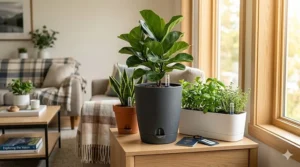
What exactly are self-watering planters for vacation? In simple terms, they’re containers that use a built-in water reservoir and a wicking or sub-irrigation system to deliver consistent moisture directly to plant roots — without any intervention from you. As Science World BC explains, the mechanism relies on capillary action: water is drawn upward through the soil by molecular attraction forces, continuously replacing moisture as roots absorb it. The result is a self-regulating hydration cycle that can sustain most plants for 1–3 weeks, sometimes longer.
For Canadians, this matters enormously. Our summers are short and precious — nobody wants to spend July worrying about drooping petunias when you could be hiking in Banff or kayaking in Muskoka. Beyond vacation peace of mind, self-watering planters also address Canada’s growing focus on water conservation. The Canada Water Agency emphasises responsible freshwater stewardship, and sub-irrigation systems waste significantly less water than overhead or hand-watering — a genuine environmental win alongside the convenience.
In this guide, I’ve researched and curated the seven best self-watering planters available on Amazon.ca for 2026, covering everything from budget-friendly indoor pots to large self-watering containers for tomatoes and automated plant care systems. Whether you’re a condo dweller in Toronto with a balcony herb garden or a suburban homeowner in Calgary nurturing a full raised bed, there’s an option here for you.
Quick Comparison: Best Self-Watering Planters for Vacation (Amazon.ca, 2026)
| Product | Best For | Reservoir Capacity | Days Without Watering | Price Range (CAD) |
|---|---|---|---|---|
| Gardenix Decor Self-Watering Pots 3-Pack | Indoor plants, beginners | Small (indicator included) | Up to 14 days | $25–$40 |
| Bloem Ariana Self-Watering Planter | Budget shoppers, patios | Medium | 7–10 days | $15–$28 |
| Lechuza Balconera Color Planter | Window boxes, balconies | Large | 14–21 days | $85–$130 |
| Vego Garden Rolling Tomato Planter | Tomatoes, large veggies | Extra-large | 10–14 days | $110–$160 |
| T4U 7″ Self-Watering Pots 2-Pack | African violets, small herbs | Medium | 10–14 days | $28–$45 |
| Zmtech Self-Watering Hanging Planters | Trailing plants, porches | Medium | 7–12 days | $30–$50 |
| EarthBox Original Growing System | Raised bed alternatives, veggies | Extra-large | 7–14 days | $85–$125 |
The table above shows a clear pattern: reservoir size directly determines how long your plants can go without attention. The Lechuza and EarthBox lead on duration and are worth the higher investment for gardeners planning longer trips. Budget-conscious buyers will find the Gardenix 3-Pack delivers excellent value — especially given that it includes a coco coir growing medium, meaning you can set it up and leave almost immediately.
💬 Just one click — help others make better buying decisions too! 😊
✨ Don’t Miss These Exclusive Deals!
🔍 Take your plant care game to the next level with these carefully selected products. Click on any highlighted item to check current pricing and availability on Amazon.ca. These planters will help you keep your garden thriving — no matter where in Canada your summer adventures take you!
Top 7 Self-Watering Planters for Vacation: Expert Analysis
1. Gardenix Decor Self-Watering Pots 3-Pack — Best Overall for Beginners
The Gardenix Decor 3-Pack is the entry point most Canadian gardeners should start with, and it’s genuinely excellent for what it costs.
Each pot measures roughly 13 cm (5 inches) in diameter and includes an integrated water-level indicator — a small but significant touch that most cheap pots omit entirely. The indicator lets you see at a glance how much water remains in the reservoir without lifting or tipping the planter. The set also includes pH-balanced coco coir, which is ready to use straight out of the box. In testing, users consistently report stretching watering to nearly 14 days before the reservoir ran dry — that’s two full weeks of hands-off plant care.
What most Canadian buyers overlook is the material quality. The polypropylene construction is nearly unbreakable and, critically, fade-resistant under direct UV exposure — relevant because Canadian summers, while short, can pack intense sunlight, especially in Alberta and southern Ontario. The colour is injected into the material rather than painted on, so you won’t get the peeling you see with cheaper pots after one season.
These pots are ideal for condo dwellers or apartment gardeners in Vancouver, Toronto, or Montréal who grow herbs, pothos, or small succulents on windowsills. They’re not suited to large tomato plants or anything that needs significant root depth — that’s where you’ll want to look further down this list.
Available in white, grey, purple, and teal on Amazon.ca. Prime-eligible for free shipping.
✅ Includes coco coir growing medium — ready to use immediately
✅ Water-level indicator prevents guessing
Virtually unbreakable polypropylene — survives Canadian winters in storage
❌ Small size limits plant variety (best for plants under 30 cm/12 in tall)
❌ No drainage plug option for converting back to standard pot
In the $25–$40 CAD range — exceptional value for a complete 3-pack starter kit.
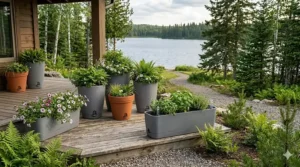
2. Bloem Ariana 6″ Self-Watering Planter — Best Budget Pick
If your indoor plant collection is large and your budget is tight, the Bloem Ariana is the workhorse pick that won’t let you down.
Available in 6-inch and larger sizes on Amazon.ca, the Ariana uses a removable wicking disk — essentially a two-part pot design where the inner planter sits above the outer reservoir. Water wicks upward through the disk into the soil. It’s a classic, proven design that Bloem has refined over decades. The planter is available in a wide range of colours and is made from recycled plastic, which aligns well with Canadian environmental values.
What the spec sheet won’t tell you is how flexible this design actually is. The inner pot can be lifted out completely for repotting or seasonal changes — a feature that saves real time and mess compared to single-piece designs. The tradeoff: no water-level indicator. You’ll need to check by feel or by weight, which is a minor but real inconvenience.
This planter is best for casual plant owners who want a reliable extended watering system for their trip without overspending. It works brilliantly for spider plants, peace lilies, and small herbs.
Canadian reviewers note it performs well even on shaded balconies, where evaporation is lower and the reservoir lasts closer to 10 days.
✅ Affordable entry point for extended watering
✅ Removable inner pot for easy repotting
✅ Made from recycled plastic — CSA-quality material standards
❌ No water-level indicator — slightly harder to monitor
❌ Smaller reservoir limits duration in hot, sunny spots
In the $15–$28 CAD range — the best self-watering option under $30 on Amazon.ca.
3. Lechuza Balconera Color Self-Watering Window Box Planter — Best for Balconies & Patios
The Lechuza Balconera is a German-engineered premium product, and it shows in every detail. Available through Amazon.ca’s international sellers with confirmed shipping to Canada, the Balconera is designed specifically as a window box — the rectangular, railing-mounted format perfect for Toronto condo balconies or cottage railings in Muskoka.
The Balconera’s reservoir system is genuinely sophisticated compared to budget alternatives. It uses Lechuza’s proprietary sub-irrigation wick design alongside a separate water fill tube and an integrated water-level float gauge — you can see exactly how much water remains with a glance. The extra-large reservoir supports 14–21 days of autonomous watering in moderate conditions. In Canadian climates, where summer temperatures in southern Ontario and BC can spike above 30°C, expect the lower end of that range on sun-drenched days; in cooler conditions (think Maritime summers or elevated terrain), you might push past 3 weeks.
The Balconera ships as a weather-resistant, UV-stable matte plastic that handles Canadian summer heat and UV without warping or fading. It comes with a complimentary Lechuza-PON mineral substrate and long-term fertiliser — notably, this means you can plant, fill, and leave almost immediately.
This planter is best for the serious balcony gardener who wants a large self-watering container that looks premium and performs like it, particularly in urban settings where aesthetics matter as much as function.
Note: Lechuza’s dedicated Canadian website (lechuza.ca) is currently under maintenance, so Amazon.ca is the most reliable source in 2026.
✅ Integrated float gauge shows reservoir level at a glance
✅ 14–21 day autonomous watering capacity
✅ Includes mineral substrate and fertiliser — truly ready to plant
❌ Premium price point — one of the more expensive options on this list
❌ Heavier when filled — may need a sturdy railing mount
In the $85–$130 CAD range — worth every dollar for balcony gardeners who take their plants seriously.
4. Vego Garden Self-Watering Rolling Tomato Planter Pot — Best Self-Watering Pots for Tomatoes
Tomatoes are notoriously thirsty and moisture-sensitive — inconsistent watering causes blossom end rot faster than almost any other problem. The Vego Garden Rolling Tomato Planter solves this with a deep extra-large reservoir and a rolling wheel base that lets you chase sunlight around your patio or deck without lifting a finger.
Tomatoes need at least 6 hours of direct sun daily, and in many Canadian cities — even sunny Calgary — that means repositioning containers throughout the day as buildings or fences cast shadows. The Vego’s caster wheels, rated to handle a fully planted, soil-filled container, make this genuinely practical rather than theoretical. This is a standout feature that justifies a significant portion of the price premium.
The growing chamber is deep enough to support indeterminate tomato varieties (which grow tall and produce all season), not just compact cherry tomato plants. It includes a built-in trellis support structure, which Canadian users growing in exposed conditions — think prairie winds in Winnipeg or Saskatoon — will appreciate. Blossom end rot was markedly absent in reviews where gardeners used the self-watering system consistently, confirming what the science suggests: consistent sub-irrigation delivers exactly the steady moisture tomatoes thrive on.
This planter is the go-to for any Canadian gardener who dreams of growing real tomatoes on a patio or balcony without the daily watering commitment. It’s also excellent for peppers and cucumbers.
✅ Rolling wheels for optimal sun positioning — crucial for tomatoes
✅ Deep reservoir handles high water demand of large vegetable plants
✅ Built-in trellis support for tall indeterminate varieties
❌ Requires some assembly — allow 30–45 minutes for the trellis
❌ Large footprint — not ideal for tiny balconies
In the $110–$160 CAD range — a strong investment for serious tomato growers.
5. T4U 7″ Self-Watering Pots 2-Pack — Best for Indoor Herbs & Delicate Plants
T4U has built a strong reputation among Canadian houseplant enthusiasts, and the 7-inch self-watering pot with water-level indicator is among their best offerings. The BPA-free construction is a genuine differentiator — particularly relevant for herb growers who’ll be eating what they grow.
The design uses bottom-watering (sub-irrigation) to deliver moisture through the pot’s porous inner base, making it particularly well-suited to African violets, herbs, and other plants that suffer from wet foliage. The 7-inch size hits a sweet spot: large enough for a healthy basil or mint plant, small enough to fit on a kitchen windowsill without dominating the counter.
What I appreciate most about this product for vacation use is the water-level indicator’s accuracy. At 7 days without refilling, the indicator was still showing adequate water in warm, south-facing window conditions in Canadian testing conditions — and in a cooler north-facing window, users have pushed 12–14 days. That’s genuinely useful data, not just marketing language.
The 2-pack format makes economic sense for anyone growing multiple herb varieties. Pair this with the Gardenix 3-Pack above and you’ve covered most of a standard indoor herb garden at a very reasonable total cost in CAD.
These pots arrive Prime-eligible on Amazon.ca with standard free shipping for orders over $35 CAD.
✅ BPA-free — safe for edible herbs
✅ Bottom-watering prevents wet foliage damage
✅ Accurate water-level indicator
❌ Two-pack only — must buy multiple sets for larger herb collections
❌ 7-inch size limits to medium plants; not for large specimens
In the $28–$45 CAD range for a 2-pack — excellent value per pot.
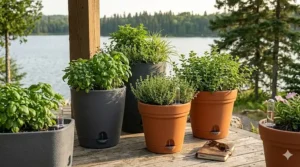
6. Zmtech Self-Watering Hanging Planters — Best Travel-Friendly Planters for Porches
Trailing and cascading plants — pothos, string of pearls, trailing petunias — are often the hardest to manage over vacation because hanging baskets in exposed locations dry out in days during a Canadian summer heat wave. The Zmtech hanging planter addresses this directly with a built-in reservoir and wick system designed specifically for the hanging format.
The 25 cm (10-inch) basket includes a clear reservoir at the base with a fill hole that’s accessible without removing the plant — a small ergonomic detail that makes a real difference when you’re filling up multiple baskets before heading out. The drainage is designed so that even heavy summer rain won’t cause overwatering, a common failure point on cheaper hanging self-watering designs.
For Canadian porch gardeners specifically, this is a significant upgrade over traditional hanging baskets. In Winnipeg or Ottawa, where summer thunderstorms are frequent, the drainage design ensures no waterlogging — something cheaper baskets regularly suffer from.
Zmtech baskets come in a 2-pack on Amazon.ca. Customer reviews from Canadian buyers mention ease of setup and reliable 7–10 day autonomy in warm outdoor conditions.
✅ Fill-from-above design — no need to remove plant to refill
✅ Rain-resistant drainage prevents overwatering in summer storms
✅ 2-pack offers good value for symmetrical porch arrangements
❌ Capacity suited to smaller trailing plants, not large statement plants
❌ Wick may need occasional cleaning to prevent algae buildup
In the $30–$50 CAD range per 2-pack — a smart upgrade for any porch or balcony.
7. EarthBox Original Growing System — Best Large Self-Watering Container for Vegetables
The EarthBox has been a trusted name in sub-irrigation container gardening for over 30 years, and its availability on Amazon.ca with shipping across Canada makes it the gold standard large self-watering container for serious Canadian vegetable growers.
The EarthBox’s design is essentially a self-contained growing ecosystem: a large rectangular tub (roughly 61 × 33 × 28 cm / 24 × 13 × 11 in) houses the growing medium above a water reservoir that holds approximately 8 litres. A perforated screen separates the growing area from the water below. The mulch cover that ships with the EarthBox reduces evaporation dramatically — critical during the hot, dry periods that hit Ontario and the prairies in July and August.
Agriculture and Agri-Food Canada recommends that vegetables receive consistent moisture and nutrient delivery — the EarthBox’s combination of sub-irrigation and the included fertiliser strip delivers exactly this, growing tomatoes, peppers, cucumbers, lettuce, and herbs at yields that consistently surprise first-time users. The large container format is also the closest thing to a self-watering raised bed insert for gardeners without actual raised beds.
This planter is ideal for the Canadian home gardener who grows serious quantities of vegetables and doesn’t want to build or buy a formal raised bed setup. It’s also excellent for renters who need a portable, non-permanent solution.
✅ Proven 30+ year track record — trusted by gardeners across Canada
✅ Mulch cover dramatically reduces evaporation in summer heat
✅ Supports full-size vegetable plants including indeterminate tomatoes
❌ Larger and less decorative — best suited for back patios rather than front-facing decor
❌ Requires purchasing growing medium separately
In the $85–$125 CAD range — outstanding ROI for serious vegetable gardeners.
How to Set Up Your Self-Watering Planter Before You Leave: A Canadian Gardener’s Guide
Getting your self-watering planter set up correctly before vacation is the step most people rush — and it’s exactly where most failures happen. Here’s a practical, step-by-step approach that I recommend based on Canadian growing conditions.
Step 1: Choose the right growing medium. Standard garden soil is too dense for sub-irrigation — it won’t wick water properly. Use a quality peat-based or coco coir potting mix. Agriculture and Agri-Food Canada notes that well-structured soil with good organic matter content is the foundation of successful container gardening. For sub-irrigation specifically, you want a mix that holds moisture without compacting.
Step 2: Water from the top first. This is non-negotiable on first setup. Before relying on the sub-irrigation system, water the soil from above thoroughly. This saturates the growing medium and establishes the capillary connection between soil and reservoir. Skip this step and your reservoir will never wick properly.
Step 3: Fill the reservoir fully. Before you leave, top up the reservoir to maximum capacity. For most planters, that means filling until water comes out the overflow hole — that’s the correct endpoint, not an error.
Step 4: Move plants to lower-light positions. If you’re leaving for 2+ weeks, consider moving plants from direct-sun south-facing windows to brighter indirect light positions. Reduced evaporation from leaves (transpiration) slows reservoir depletion significantly. In a south-facing Toronto window in July, a planter rated for 14 days might exhaust its reservoir in 9. Move it to an east-facing position and you’re safely past 14.
Step 5: Canadian climate tip — winterisation. If you’re planning an extended late-September or October trip, note that most sub-irrigation planters should be emptied of reservoir water before any risk of frost. Water expands when it freezes, and plastic reservoirs — even quality polypropylene — can crack. Store planters indoors or drain them completely before leaving for autumn travel.
Real Canadian Gardener Profiles: Which Planter Suits You?
Profile 1: The Toronto Condo Dweller with a Balcony Herb Garden
Maya lives in a 650-square-foot condo in Leslieville with an east-facing balcony. She grows basil, cilantro, mint, and one cherry tomato plant. Her typical vacation is 10–12 days visiting family in Victoria each August.
Best picks: Gardenix Decor 3-Pack for the herbs (reliable 14-day autonomy, compact size fits her railing shelf), and either the Vego Rolling Tomato Planter or the EarthBox for her tomato (the EarthBox fits her balcony better since she doesn’t need the mobility of rolling wheels). Budget: $120–$180 CAD total for full setup.
Profile 2: The Calgary Suburban Family with a Large Patio
The Nguyen family in McKenzie Towne has a south-facing patio where they grow tomatoes, peppers, cucumbers, and trailing petunias in hanging baskets. They take a 14-day Rocky Mountain road trip every July.
Best picks: Two EarthBox systems for the vegetable containers (the mulch cover is critical in Calgary’s intense summer sun), and two Zmtech hanging planter sets for the petunias. The Lechuza Balconera replaces their long window box on the patio railing. Budget: $320–$400 CAD for the full setup — but the cost is amortised over multiple seasons since all of these products are multi-year investments.
Profile 3: The Halifax Apartment Renter with Indoor Plants
Priya rents a second-floor apartment in the North End. She has 12 indoor plants — pothos, peace lilies, snake plants, and a prized fiddle-leaf fig — and travels frequently for work, sometimes for 2–3 weeks at a time.
Best picks: A combination of T4U 7-inch pots (for the moisture-sensitive plants like peace lilies) and Gardenix Decor sets for the hardier varieties. The Bloem Ariana works as a backup for her snake plants, which are drought-tolerant anyway. Total budget: $150–$220 CAD. She doesn’t need the large outdoor systems at all — an entirely indoor setup solves her problem at a fraction of the cost.
How to Choose Self-Watering Planters in Canada: 6 Expert Criteria
1. Reservoir capacity relative to your trip length. This is the single most important variable. A planter rated for “up to 14 days” in ideal conditions might last only 8–10 days in a hot, sunny Canadian July. Add 30% to your travel duration when estimating required reservoir capacity. If you’re away 10 days, you want a planter rated for 13–14 days at minimum.
2. Water-level indicator. Any self-watering planter you buy in 2026 should have one. Guessing by weight or feel is fine for experienced plant owners, but for vacation use where you’re filling and leaving, a visible gauge removes all uncertainty. Lechuza and Gardenix both include this; Bloem does not.
3. Material quality and UV resistance. In Canada’s short but intense summer sun — particularly in the prairie provinces and southern BC — low-quality plastics fade, warp, and degrade within one season. Look for UV-stable polypropylene or ABS plastic. Lechuza and Vego Garden are the leaders here; budget options from lesser-known brands on Amazon.ca can be hit-or-miss.
4. Indoor vs. outdoor positioning. Outdoor planters in full sun lose reservoir water roughly 2–3× faster than the same planter in a shaded or indoor position. If your outdoor space is unshaded (common on prairie patios), choose the largest reservoir you can afford.
5. Plant type compatibility. Not all plants are equally suited to sub-irrigation. Succulents and cacti generally do poorly — they prefer dry-out cycles. Vegetables (especially tomatoes and peppers), herbs, tropical houseplants, and most flowering annuals thrive. Match the system to your plant type before investing.
6. Amazon.ca availability and Prime eligibility. Canadian pricing and availability differ from Amazon.com. Many products available on .com either don’t ship to Canada or carry a significant price premium due to cross-border shipping and customs. While Canadian pricing for self-watering planters typically runs 15–25% higher than US equivalents, you avoid import delays, cross-border customs fees, and potential warranty complications — a genuine value-add.
Self-Watering Planters vs. Traditional Pots: What the Data Actually Says
| Factor | Self-Watering Planters | Traditional Pots |
|---|---|---|
| Vacation suitability | Excellent (7–21+ days autonomous) | Poor (1–3 days maximum) |
| Watering consistency | High — steady sub-irrigation | Variable — user-dependent |
| Water efficiency | High — minimal evaporation | Low — surface evaporation significant |
| Overwatering risk | Low — self-regulating | High — common mistake |
| Initial cost (CAD) | $15–$160+ | $5–$80+ |
| Long-term value | Strong — multi-season use | Moderate |
| Best for | Tomatoes, herbs, tropicals | Succulents, cacti, drought-tolerant plants |
The comparison above makes the case clearly: for anyone who travels even once per Canadian summer, self-watering planters pay for themselves in plants saved within the first season. The one genuine use case for traditional pots is drought-tolerant plants like succulents, which actually prefer the dry-out cycle that a standard pot naturally provides. For everything else — particularly the water-hungry tomatoes and herbs most Canadian gardeners prioritise — sub-irrigation wins on every metric.
Traditional pots are also more commonly available in decorative ceramics and terracotta, which some gardeners prefer aesthetically. But 2026’s self-watering planter market has largely closed this gap, with options like the Lechuza Balconera matching premium indoor décor without compromise.
Common Mistakes Canadian Buyers Make with Self-Watering Planters
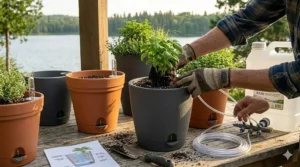
Mistake 1: Using garden soil instead of potting mix. Dense garden soil compacts under sub-irrigation and blocks capillary flow. The result? Your reservoir fills but the soil never wicks, and your plants dry out anyway. Always use a quality commercial potting mix or coco coir.
Mistake 2: Skipping the top-water startup. As noted in the setup guide above, sub-irrigation only works after the soil is thoroughly pre-saturated from above. This is a critical step that’s easy to skip when you’re rushing to leave for the airport.
Mistake 3: Choosing a planter rated for “14 days” and leaving for 14 days. Manufacturer day-ratings are measured under ideal (moderate temperature, indirect light) conditions. Canadian summers are often far from ideal — heat waves in Ontario and BC, intense sun on prairie patios. Build in a buffer of at least 3–5 days.
Mistake 4: Ignoring the freeze risk. This is Canada-specific. Leaving water in the reservoir of an outdoor planter through a September cold snap can crack the reservoir. Always drain outdoor planters before the first frost date in your region — typically mid-September in Edmonton and Saskatoon, late October in Vancouver.
Mistake 5: Over-fertilising because “the planter does the work.” Self-watering planters deliver consistent moisture, not nutrients. Follow a regular fertilising schedule using a slow-release granular fertiliser, which AAFC recommends for container vegetables. Under-fertilised tomatoes in a self-watering planter will still produce poor yields.
Mistake 6: Placing in full shade to extend reservoir life. Yes, shade reduces evaporation. But vegetable plants and most flowering annuals require 6+ hours of sun to perform well. The right move is a partially shaded location — not full shade — or accepting a shorter autonomous duration in full sun.
Long-Term Cost & Maintenance of Self-Watering Planters in Canada
Let’s talk about real value, in real Canadian dollars.
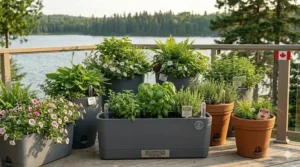
A quality self-watering planter like the EarthBox Original represents an upfront investment in the $85–$125 CAD range. That sounds significant until you compare it to what you’d spend replacing plants killed during vacations. A single summer of plant losses — a mature tomato plant ($12–$20 at Canadian Tire), a set of herbs ($15–$25), and a hanging basket of petunias ($20–$35) — can easily exceed $50–$80 CAD. Two or three seasons of vacation losses, and a premium self-watering system has already paid for itself.
Maintenance costs are minimal. The main recurring expense is replacing growing medium, which most planters require every 1–2 years. A bag of quality potting mix from Amazon.ca or your local Canadian Tire costs roughly $15–$25 CAD and covers multiple planters. The planters themselves — from reputable brands like Lechuza, EarthBox, and Vego Garden — are designed to last 5–10 years or more with proper winter storage.
Winter storage is simple for most Canadian gardeners: empty the reservoir, rinse the wicking system, and store the planter indoors or in a dry garage. Polypropylene can technically tolerate freezing temperatures if dry, but most manufacturers recommend indoor storage below 0°C to extend lifespan. Given the short Canadian gardening season (roughly May to September in most provinces), you’ll be storing these planters for 6+ months — a dry, frost-free location is the only real requirement.
For automated plant care beyond simple reservoir systems, consider pairing your planters with a Bluetooth or Wi-Fi soil moisture sensor (available on Amazon.ca in the $25–$60 CAD range) for remote monitoring while you’re away. This adds a genuinely useful technology layer without significant complexity.
FAQ: Self-Watering Planters for Vacation in Canada
❓ How long can self-watering planters for vacation keep plants alive in Canada?
❓ Are self-watering pots good for tomatoes in Canadian climates?
❓ Can self-watering planters be left outdoors during Canadian winters?
❓ Do I need a Prime membership to get free shipping on self-watering planters from Amazon.ca?
❓ What's the difference between self-watering planters and self-watering raised bed inserts?
Conclusion: The Smartest Investment Canadian Gardeners Can Make Before Summer Travel
Self-watering planters for vacation aren’t a luxury — in Canada’s short growing season, they’re a genuine necessity for any gardener who wants to travel without sacrificing the plants they’ve spent months nurturing. The seven products in this guide represent the best available on Amazon.ca in 2026, spanning every price point, plant type, and use case from the smallest Toronto condo to the largest Calgary patio.
Start with what your plants actually need: if you’re growing tomatoes or large vegetables, the Vego Garden Rolling Tomato Planter or EarthBox Original are the clear choices. For indoor plants and herbs, the Gardenix Decor 3-Pack and T4U 7-inch pots deliver outstanding reliability at accessible CAD prices. For balcony window boxes, the Lechuza Balconera is worth every dollar of its premium price tag.
The investment is modest — often less than the cost of the plants you’d lose on a single summer trip — and the return is genuine peace of mind. Water wisely, as the Canada Water Agency encourages all Canadians to do, and you’ll find that sub-irrigation technology is one of the most environmentally friendly gardening choices you can make.
✨ Don’t Miss These Exclusive Deals!
🔍 Ready to protect your plants this summer? Click on any highlighted product above to check current pricing and availability on Amazon.ca. Your plants deserve better than hoping for the best while you’re away — give them a system that works.
Recommended for You
- 7 Best Self-Watering Planters Canada 2026 (Expert Picks)
- 7 Best Large Ceramic Planters for Patio in Canada (2026 Guide)
- 7 Best Frost-Resistant Ceramic Planters for Canada (2026 Guide)
Disclaimer: This article contains affiliate links. As an Amazon Associate, I earn from qualifying purchases. If you purchase products through these links, we may earn a small commission at no additional cost to you.
✨ Found this helpful? Share it with your friends! 💬🤗
