
In This Article
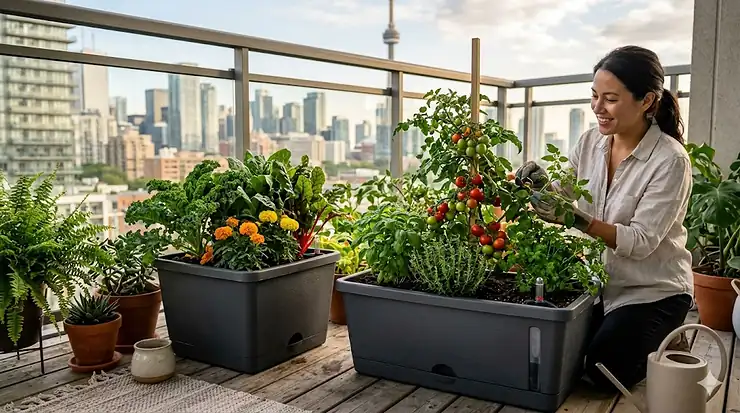
Let’s be honest — keeping plants alive through a Canadian summer that lasts maybe four months, followed by a freeze that arrives without warning, is not exactly a relaxing hobby. You water too much and rot the roots. You miss one hot week in August and come home to a garden that looks like it survived a desert crossing. If that sounds familiar, self-watering planters might just change your relationship with gardening entirely.
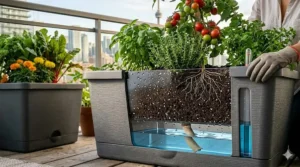
Self-watering planters — sometimes called sub-irrigation containers or water reservoir planters — are containers built with a hidden reservoir at the base that delivers moisture directly to the root zone through capillary action. The plant draws exactly as much water as it needs, when it needs it. No guessing, no overwatering, no frantic hosing after a long weekend at the cottage. According to Wikipedia’s overview of sub-irrigated planters, this bottom-up watering method closely mimics how plants access moisture naturally from the ground — making it one of the most efficient and plant-friendly irrigation approaches available to home gardeners.
For Canadians, this matters even more than it might in other climates. Our growing seasons are compressed. Balcony gardeners in Toronto condos or Vancouver apartments need a system that works reliably without daily maintenance. Anyone growing tomatoes on a Calgary deck during a 30°C heat wave can’t afford inconsistent soil moisture. And if you travel — even for a long weekend — traditional pots are basically a death sentence for anything leafy. A quality self-watering planter buys you two weeks or more between refills, in most conditions.
In this guide, I’ve rounded up the 7 best self-watering planters available on Amazon.ca in 2026, tested against Canadian use cases: outdoor vegetable growing, balcony flowers, winter storage, condo-sized spaces, and budget-conscious buyers. All prices are in CAD. Let’s dig in. 🌱
Quick Comparison: Top Self-Watering Planters Canada 2026
| Product | Best For | Size | Price Range (CAD) | Amazon.ca Available |
|---|---|---|---|---|
| Lechuza Classico 35 LS | Indoor/Outdoor Premium | 35 cm dia. | $$$ (mid-$80s–$110s) | ✅ Yes |
| Mayne Fairfield 20″×36″ Rectangle | Outdoor Patios | 20″×36″ | $$$ (mid-$100s–$160s) | ✅ Yes |
| Algreen Allegro Tall Square 27″ | Canadian Seasons Outdoor | 27″ square | $$ ($70–$100) | ✅ Yes (also Canadian Tire) |
| Keter Urban Bloomer 12.7 Gallon | Vegetable Balcony Beds | Large raised bed | $$ ($80–$120) | ✅ Yes |
| Bloem Ariana 16″ Self-Watering | Budget Indoor/Outdoor | 16″ round | $ (under $35) | ✅ Yes |
| Tropow Tall Self-Watering Planter Set of 2 | Patio Décor, Pairs | 22.4″ tall | $$ ($60–$90) | ✅ Yes |
| Lechuza Balconera 80 Window Box | Balcony/Railing | 80 cm long | $$$ ($120–$160) | ✅ Yes |
The table above tells a clear story: there’s a legitimate self-watering planter for every Canadian budget and space. What it doesn’t tell you is that the $30 Bloem and the $150 Lechuza serve completely different gardeners — and buying the wrong one is the most expensive mistake in this category. The analysis below breaks that down properly.
💬 Just one click — help others make better buying decisions too! 😊
✨ Don’t Miss These Exclusive Deals!
🔍 Take your garden to the next level with these carefully selected planters. Click on any highlighted item to check current pricing and availability on Amazon.ca. These tools will help you grow thriving plants your family will love all season long!
Top 7 Self-Watering Planters for Canadian Gardeners: Expert Analysis
1. Lechuza Classico 35 LS Self-Watering Planter
The Lechuza Classico LS is the gold standard for indoor-outdoor self-watering planters, and there’s a very good reason you see it on every “best of” list year after year. Made in Germany from high-quality UV-resistant poly resin, the 35 cm (roughly 14 inches) diameter version hits the sweet spot between tabletop and floor planter — big enough for a healthy fern or medium tropical, small enough for a condo balcony rail shelf.
The magic is in the engineering. Lechuza’s sub-irrigation system uses a wick that bridges the sealed reservoir and the LECHUZA-PON mineral substrate, pulling moisture upward on demand. The water-level indicator is visible without digging into the soil — a small but genuinely useful feature when you’re managing six pots on a busy patio. What most Canadian buyers overlook is that the high-gloss finish on the LS series holds up exceptionally well in freeze-thaw cycles if you drain the reservoir before the first hard frost. Leave water in any ceramic or resin reservoir over a Canadian winter and you’re cracking it by spring.
This planter is best for condo and apartment dwellers who want something that genuinely looks as good as it performs — an Instagram-worthy pot that also eliminates plant death during that two-week trip to the Maritimes. Customers consistently rate Lechuza’s watering reliability at the top, with many noting they’ve had the same planter for four or more years without degradation. The trade-off is real: Lechuza pricing runs noticeably higher than generic brands, and while Canadian pricing on Amazon.ca runs slightly above US equivalents, you avoid cross-border shipping fees and customs headaches.
Pros:
✅ Best-in-class sub-irrigation wick system
✅ Removable plant insert makes seasonal replanting easy
✅ UV-resistant, indoor/outdoor rated
Cons:
❌ Among the pricier options in the mid-$80s to $110s CAD range
❌ Reservoir must be drained before Canadian winter storage
Price range: Mid-$80s to $110s CAD depending on size — check current price on Amazon.ca.
2. Mayne Fairfield 20″×36″ Rectangle Self-Watering Planter
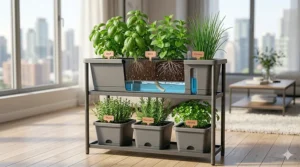
If you have an outdoor patio, deck, or front entrance in Canada and want something that looks like it belongs on a Pottery Barn catalogue but costs a fraction of the price, the Mayne Fairfield Rectangle Planter is worth serious consideration. Available directly on Amazon.ca in both white and black polyethylene finishes, this 20″ × 36″ (approximately 51 cm × 91 cm) container is impressive in scale — it holds enough soil volume to grow a serious run of annuals, herbs, or shallow-root vegetables across an entire summer.
The built-in water reservoir underneath the planting zone feeds roots from below, keeping soil consistently moist without the boom-and-bust cycle that outdoor watering typically creates. What makes the Mayne Fairfield stand out from cheaper rectangle planters is the quality of the polyethylene used — it’s the same material Mayne uses in their garden furniture, and it genuinely resists fading, cracking, and warping across the full swing of a Canadian season. Mayne also offers free shipping to Canadian provinces directly from their site, though Amazon.ca is often faster for Prime members.
My honest take? This is the planter for someone who wants a “done” look for their front porch or deck — no repainting, no winter sealing, no replacing every three years. It’s heavy when planted (plan accordingly before choosing a rooftop or weak-floored balcony), but that heft signals legitimate construction quality. Canadian buyers report it holds up through -20°C winters without cracking when the reservoir is emptied — a critical step that the product page buries in small print, but I’ll say it clearly: drain it before November.
Pros:
✅ Large planting volume, great for herbs and flowers
✅ Fade- and crack-resistant polyethylene construction
✅ Ships and sold by Amazon.ca
Cons:
❌ Heavy when fully planted — not balcony-friendly
❌ Limited colour options (white and black only)
Price range: Mid-$100s to $160s CAD — check current price on Amazon.ca.
3. Algreen Allegro Tall Square 27″ Self-Watering Planter
Algreen Products is a Canadian brand — and that matters more than people realize. Their planters are designed and tested with Canadian weather in mind, their warranty service is accessible without international shipping hassle, and their customer support is straightforward to reach. The Allegro Tall Square is one of their flagship outdoor self-watering designs: a clean, contemporary 27″ (68.5 cm) tall square planter built from UV-additive resin that actively resists sun bleaching over multiple seasons.
The sub-irrigation reservoir on the Allegro is notably large for its size class, which means you’re refilling less often — genuinely useful if you’re doing a road trip and leaving plants unattended. The overflow drain and plug system is smart too: in Canadian summers where we can get surprise downpours, you can leave the drain open outdoors so the reservoir doesn’t flood during a heavy rain, then close it again during dry spells to conserve water. That dual-mode functionality is something cheaper planters simply don’t offer, and it’s the kind of thoughtful design that comes from a company that actually tests in Canadian conditions.
Algreen backs the Allegro with a 10-year warranty — exceptional in this product category. The planter is available at Home Depot Canada, Canadian Tire, and Amazon.ca, giving you flexible purchase options. For budget-mid buyers who want a Canadian-made product that’ll outlast the garden trends, this is my strongest recommendation.
Pros:
✅ Canadian brand, 10-year warranty
✅ Overflow drain/plug for Canadian rain management
✅ Available at Canadian Tire, Home Depot, and Amazon.ca
Cons:
❌ Style is utilitarian — not the most decorative option
❌ Tall profile can be top-heavy; needs a sheltered spot in windy areas
Price range: $70–$100 CAD — check current price on Amazon.ca.
4. Keter Urban Bloomer 12.7-Gallon Raised Garden Bed Self-Watering Planter
The Keter Urban Bloomer occupies a unique category: it’s not really a traditional planter, it’s a miniature raised garden bed with a built-in self-watering system — and it’s one of the best things to happen to balcony vegetable growing in Canada in recent years. With 12.7 gallons (about 48 litres) of soil capacity and a wood-look resin exterior, it gives condo and apartment gardeners the depth and volume needed to actually grow food rather than just ornamental plants.
The self-watering gauge is built into the side panel — you can see at a glance whether the reservoir needs a top-up without digging around in the soil or tipping the planter. Keter’s drainage plug design is ideal for Canadian outdoor use: open it when rain is forecast, close it during a dry stretch. In my experience, this feature alone saves most beginner vegetable gardeners from the single biggest failure mode — root rot after a wet Canadian June. The heavy-duty resin is UV-protected and rated for extended outdoor exposure, holding its woodgrain appearance even after several seasons.
At roughly 12.7 gallons, this bed supports tomatoes (compact determinate varieties work best), herbs, peppers, lettuce, kale, and shallow-root vegetables comfortably. It’s the go-to recommendation for someone in an Ottawa or Montréal apartment who wants to grow actual food, not just flowers. Keter Canada sells directly and maintains product pages on their .ca site, and the Urban Bloomer is available on Amazon.ca. Canadian buyers report it assembles in under 20 minutes with no tools.
Pros:
✅ Large soil volume — actually grows vegetables
✅ Built-in water gauge and drainage plug
✅ Wood-look exterior suits patio furniture aesthetics
Cons:
❌ Too large for small balconies (check your weight limits)
❌ Not ideal for deep-root crops like carrots or parsnips
Price range: $80–$120 CAD — check current price on Amazon.ca.
5. Bloem Ariana 16″ Self-Watering Planter
The Bloem Ariana is the gateway drug to self-watering planters — and I mean that as a compliment. If you’ve never tried sub-irrigation and you’re not ready to spend $90+ CAD to test the concept, the Ariana gives you a genuinely functional self-watering experience for under $35. Available in a range of sizes from 6″ to 20″ (15 cm to 50 cm) and several colours including charcoal, white, and earthy tones, it’s the kind of versatile, no-fuss pot that works equally well on a kitchen windowsill or a back patio.
The self-watering mechanism uses a simple internal drainage disc that keeps the reservoir separated from the root zone — basic compared to Lechuza’s wicking system, but perfectly adequate for most common houseplants, herbs, and annuals. It’s frost-proof resin, which is specifically relevant for Canadian buyers: you can leave it outdoors on a covered porch through a mild frost without it cracking (though I’d still empty the reservoir before serious winter). The UV protection holds reasonably well for 2-3 seasons before fading becomes noticeable, which is fair at this price point.
The Bloem Ariana shines for renters, first-time gardeners, and anyone who wants to try self-watering containers without a major commitment. It’s available at Canadian Tire as well as Amazon.ca. If you buy one and love it — and most people do — you’ll find yourself upgrading to a Lechuza or Algreen for bigger plants within a season. Think of the Ariana as a proof of concept.
Pros:
✅ Best value entry-point for self-watering in Canada
✅ Frost-proof resin, suitable for Canadian seasons
✅ Available in multiple sizes and colours
Cons:
❌ Simpler disc mechanism vs. true wick/sub-irrigation
❌ Colour fades after 2-3 outdoor seasons
Price range: Under $35 CAD — check current price on Amazon.ca.
6. Tropow Self-Watering Tall Planter Set of 2 (22.4″)
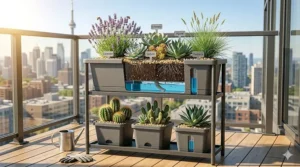
Here’s the honest truth about tall planters: most of them look great but water terribly. Tropow figured this out and built a tall planter set that actually takes the reservoir seriously. The 22.4″ (57 cm) tall round planters come as a set of two, include built-in wheels for repositioning (underrated feature on a Canadian balcony where you chase the sun across the season), and feature a visible water level monitor on the side so you’re never guessing about reservoir status.
The water level gauge on Tropow planters is positioned externally, which sounds minor until you’re managing 10 pots on a deck and trying to do a quick morning check. It adds a level of convenience that more expensive brands sometimes skip. The drainage hole and tray system works well for Canadian outdoor use — excess water from summer rains drains properly rather than pooling and drowning roots.
Tropow planters are best suited for the gardener who wants matching, good-looking pairs for a patio or front entrance — they’re sold as two, they’re priced together, and the matching wheel trays give a cohesive look that’s genuinely satisfying. They work well for ornamentals, tall herbs like rosemary, and dwarf ornamental grasses. Canadian customers report good quality for the price, with some noting the wheels are particularly useful on decking where sliding planters causes scratching. At $60–$90 CAD for a pair, this is excellent value.
Pros:
✅ Set of 2 — great value pairing
✅ Built-in wheels for seasonal repositioning
✅ External water level monitor
Cons:
❌ Not ideal for heavy root vegetables
❌ Lighter plastic than premium brands — less cold-weather durability
Price range: $60–$90 CAD for a set of 2 — check current price on Amazon.ca.
7. Lechuza Balconera 80 Self-Watering Window Box Planter
Window box gardening in Canada is one of those things that looks effortless on Pinterest and feels deeply frustrating in reality — window boxes dry out faster than any other container type, hanging in the sun with limited soil volume and constant wind exposure. The Lechuza Balconera 80 was designed to solve exactly this problem. At 80 cm (about 31.5 inches) long, it’s their signature balcony railing box, built with Lechuza’s full sub-irrigation system in a form factor specifically engineered for high-evaporation environments.
The reservoir in the Balconera 80 is proportionally larger relative to the planting volume than in most window boxes — Lechuza calculated this deliberately to account for the increased evaporation rate in exposed, elevated positions. In Canadian conditions, this means your hanging box of petunias or herbs can typically go a week between reservoir top-ups even in mid-July heat, versus the one-to-two-day watering schedule traditional window boxes demand. The railing bracket system is adjustable and fits most standard balcony railings, which matters in Canada where every building seems to have a slightly different rail gauge.
The Balconera 80 is available on Amazon.ca, ships from Canada-based fulfillment, and qualifies for Prime shipping. It’s a meaningful investment in the mid-$120s to $160s CAD, but for someone who has killed three window boxes of petunias in a single Ottawa summer, it genuinely pays for itself in saved plants and watering time.
Pros:
✅ Designed specifically for high-evaporation balcony environments
✅ Lechuza sub-irrigation system — proven, reliable
✅ Adjustable railing bracket included
Cons:
❌ Premium price in the mid-$120s–$160s CAD
❌ 80 cm length may be too large for smaller balcony railings
Price range: Mid-$120s to $160s CAD — check current price on Amazon.ca.
How Self-Watering Planters Work: The Science Behind Sub-Irrigation 🔬
Understanding how self-watering planters actually function makes you a better planter buyer — because once you know the mechanism, you can spot a well-designed one versus a gimmick instantly.
The core principle is capillary action: the same force that pulls water up through a paper towel or moves sap up a tree trunk. In a self-watering planter, a wick or soil column bridges the sealed water reservoir at the bottom and the growing medium above. As plant roots absorb moisture from the soil, a moisture gradient is created — drier soil pulls water upward from the reservoir to restore balance. The plant, in effect, controls its own watering schedule. The system is “demand-driven,” as Smart Garden Guide describes it: the plant takes only what it needs, preventing both drought stress and root rot simultaneously.
Most quality self-watering planters use one of two delivery methods. The first is a wick system, where a fibrous cord draws water from the reservoir directly into the soil. Lechuza’s LECHUZA-PON system is the premium version of this — the mineral substrate is specifically formulated to maintain ideal capillary flow, which is why Lechuza planters perform better than cheaper wicking alternatives. The second is a soil column or perforated insert method, where a section of moist growing medium sits partially in the reservoir, wicking upward through the whole soil mass. This is what Algreen, Bloem, and Keter primarily use.
There’s one rule every Canadian gardener needs to know for outdoor use: always open the overflow drain when your planter lives outside. A heavy summer storm can fill a 4-litre reservoir in minutes. Without an open drain, that reservoir overflows into the soil and you get exactly the waterlogging you were trying to avoid. For winter: drain the reservoir completely before freeze-up. Any water left in a sealed reservoir will expand when frozen and crack even the toughest resin.
Canadian Gardener Profiles: Which Self-Watering Planter is Right for You?
This is the question that actually matters. The same planter that’s perfect for a Vancouver condo is completely wrong for a Saskatchewan acreage — and vice versa. Here are three real-world Canadian scenarios with specific recommendations.
Profile 1: The Toronto Condo Balcony Gardener You have a 60 sq ft (5.6 m²) south-facing balcony in a downtown Toronto highrise. You want flowers for colour and maybe some herbs for cooking. Your biggest challenge is wind exposure, inconsistent watering (you travel for work), and a balcony weight limit. Best choice: Lechuza Classico 35 LS for 2-3 showcase plants, plus Bloem Ariana 12″ for herbs. The Lechuza holds up in wind, and the Bloem is lightweight enough that weight limits aren’t a concern. Total budget: $150–$200 CAD.
Profile 2: The Ottawa Backyard Vegetable Grower You have a 10×12 ft back patio and want to grow tomatoes, peppers, and herbs through the short Ontario growing season (May through September). You want maximum yield for minimum watering effort. Best choice: Keter Urban Bloomer for tomatoes and peppers (the deep soil volume is critical for fruit-producing plants), plus Algreen Allegro for herbs and flowers alongside it. The Keter’s water gauge makes managing peak-summer irrigation easy when temperatures hit 35°C.
Profile 3: The Calgary Snowbird You spend two weeks every July back east visiting family, and you’ve lost entire container gardens to neglect. You want outdoor planters that genuinely survive two weeks unattended in 28°C Alberta heat. Best choice: Mayne Fairfield Rectangle Planter for large plantings (the generous reservoir buys extra days) and Lechuza Balconera 80 for any balcony railing boxes. These are the two products in this guide with the largest reservoir-to-soil-volume ratios — exactly what an extended-absence gardener needs.
How to Set Up a Self-Watering Planter for the Canadian Growing Season
Getting the setup right matters as much as choosing the right planter. Here’s what the product listings won’t tell you, from experience.
Step 1: Choose the right potting mix. Standard garden soil is a common and damaging mistake. Heavy soil compacts in containers, blocking the capillary flow that the entire self-watering system depends on. Use a lightweight, peat- or coir-based mix with added perlite. Avoid anything labelled “topsoil” or “garden mix.” In Canada, brands like Pro-Mix HP or Miracle-Gro Potting Mix work well in self-watering containers.
Step 2: Prime the soil before relying on the reservoir. For the first 7–14 days after planting, water from the top as well as filling the reservoir. This ensures the growing medium is fully saturated top-to-bottom, establishing the capillary column the reservoir relies on. If you skip this step and go straight to reservoir-only watering, the dry upper soil zone won’t wick moisture upward effectively. As Root and Vessel notes, this initial top-watering “primes” the system and ensures capillary action begins immediately.
Step 3: Open the overflow drain for outdoor use. Any planter living on a Canadian patio or balcony should have its drain plug removed or its overflow hole open. Surprise rainstorms are not rare in Canadian summers.
Step 4: Winterize properly. By mid-October in most Canadian provinces, empty and dry your self-watering planter reservoirs completely. Store lightweight plastic planters like Bloem indoors; heavier resin planters like Algreen or Mayne can usually overwinter outside if emptied, but bring them into a sheltered space (garage, shed) if possible to extend their lifespan by several years.
Step 5: The 2-week refill check. Once your system is established, most quality self-watering planters need reservoir refills every 1-2 weeks in warm weather, and every 3-4 weeks in cooler spring or fall conditions. When in doubt, trust the water level indicator rather than the calendar.
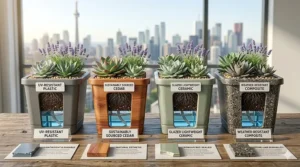
How to Choose Self-Watering Planters in Canada: 6 Criteria That Actually Matter
There are approximately 400 self-watering planters on Amazon.ca. Here’s how to filter meaningfully.
1. Reservoir size relative to container volume. The ratio matters more than the absolute size. A large planter with a tiny reservoir is worse than a medium planter with a proportionally generous one. Lechuza and Mayne generally have the best ratios. Look for products that specify reservoir capacity, not just overall dimensions.
2. Drainage system quality. Any planter going outdoors in Canada needs a functional overflow or drainage system. Non-negotiable. A sealed reservoir with no overflow will flood in the first serious rainstorm.
3. Material rating for freeze-thaw cycling. “UV-resistant” is not the same as freeze-thaw resistant. Look for “frost-resistant” specifically, or check Canadian reviews. Algreen explicitly rates their products for Canadian temperatures; Lechuza uses shockproof poly-resin that holds up well when properly emptied.
4. Water level indicator visibility. External gauges (Tropow, Keter) are more practical than internal ones when managing multiple planters. Small detail, real quality-of-life difference across a season of gardening.
5. Warranty and Canadian service. A 10-year warranty from a Canadian brand (Algreen) is meaningfully better than a 1-year warranty from an overseas brand with no Canadian service presence. Ask yourself: if this cracks in year two, how painful is the resolution?
6. Weight and balcony compatibility. Canadian balconies are typically rated at 40 psf (194 kg/m²) by the National Building Code of Canada. Large planters filled with wet soil can weigh 30–50+ kg. If you’re on an upper-floor balcony, weigh your planting before choosing the largest available container.
Self-Watering Planters vs. Traditional Pots: What the Comparison Actually Tells You
| Feature | Self-Watering Planters | Traditional Pots |
|---|---|---|
| Watering frequency | Every 1–3 weeks | Every 1–3 days in summer |
| Water efficiency | Uses ~50% less water | Significant evaporation and runoff |
| Root health | Consistent moisture, less rot risk | Boom-and-bust moisture cycle |
| Vacation tolerance | 1–2+ weeks unattended | Plants at risk after 3–4 days |
| Setup complexity | Initial soil priming required | Plant and water |
| Cost | $25–$160+ CAD | $5–$60+ CAD |
| Best for | Busy gardeners, balconies, veggies | Low-budget, starter gardeners |
The numbers above are compelling, but the real story is behavioural. Traditional pots require you to be consistent — and most of us aren’t. Self-watering containers tolerate inconsistency by design. For the Canadian growing season specifically, where a May cold snap and a July heat wave can occur in the same month, having a planter that buffers against those extremes is a genuine advantage over traditional pots. The higher upfront cost typically pays back within a single season through reduced plant replacements alone.
Common Mistakes Canadian Buyers Make With Self-Watering Planters
🚫 Mistake 1: Leaving water in the reservoir over winter. This is the single most common reason for planter cracking. Water expands as it freezes. Even “frost-resistant” resin will eventually fail after repeated freeze-thaw cycles with a full reservoir. Empty them by mid-October everywhere in Canada.
🚫 Mistake 2: Using garden soil instead of proper potting mix. Heavy soil compacts in containers and breaks the capillary column. Your self-watering planter becomes a regular pot with a stagnant reservoir below it — which then breeds fungus and root disease. Always use a lightweight coir- or peat-based potting mix.
🚫 Mistake 3: Skipping the initial top-water priming phase. Filling the reservoir and walking away is the most common first-week mistake. The soil needs to be fully saturated from the top down before the wicking system can activate. Water from above for the first two weeks.
🚫 Mistake 4: Choosing a planter based on looks rather than reservoir-to-volume ratio. Many attractive self-watering planters have token reservoirs that hold less than a litre. That’s barely a day’s water for a thirsty tomato plant in July. Check specifications before buying.
🚫 Mistake 5: Ignoring overflow drainage for outdoor use. Canadian summers include significant rainstorms. Without an open drain, a full reservoir plus heavy rain creates waterlogged conditions that damage roots just as effectively as underwatering.
Long-Term Cost and Value of Self-Watering Planters in Canada
Let’s run the real numbers, because this is a question that Canadian gardeners ask and rarely see answered directly.
A mid-range traditional pot in Canada costs $15–$25 CAD. A basic self-watering planter like the Bloem Ariana starts around $25–$35 CAD. The price gap at entry level is small. At mid-range, a good traditional planter might cost $40 CAD; a comparable Algreen self-watering runs $70–$90 CAD. The premium is real — about 50-100% more.
But factor in: the average Canadian gardener loses 2-3 container plants per season to over- or under-watering. At $8–$15 CAD per annuals pack or herb plant, that’s $15–$45 CAD in plant losses per year. In two seasons, a quality self-watering planter pays the price difference through reduced plant replacements alone.
Water efficiency matters too. Self-watering containers typically use around 50% less water than overhead-watered traditional pots, because there’s no surface evaporation and no runoff. In provinces with municipal water bills or water restrictions during summer droughts (increasingly common in BC, Alberta, and Ontario), this is a meaningful ongoing saving. Algreen’s Canadian website notes their sub-irrigation system significantly reduces water use over traditional watering, which aligns with what Environment and Climate Change Canada recommends for water-wise residential landscaping practices.
Over a five-year horizon, a $90 CAD Algreen self-watering planter with a 10-year warranty, zero plant replacement costs, and reduced water use almost certainly delivers better total value than three rounds of cheap traditional pots.
FAQ: Self-Watering Planters in Canada
❓ Do self-watering planters work for vegetables in Canada's short growing season?
❓ Can I leave a self-watering planter outside in a Canadian winter?
❓ Are self-watering planters available with Prime shipping on Amazon.ca?
❓ How long can plants survive unattended in a self-watering planter?
❓ What potting soil works best with self-watering planters in Canada?
Conclusion: The Smarter Way to Garden in Canada 🇨🇦
Self-watering planters are not a luxury accessory for devoted gardeners — they’re a practical solution to the specific challenges of Canadian container gardening: compressed seasons, variable weather, vacation absences, and balcony growing where daily watering is genuinely impractical.
The best choice depends on your situation. For premium indoor-outdoor performance, Lechuza Classico LS remains the benchmark. For serious vegetable growing in a compact space, the Keter Urban Bloomer is hard to beat. For a proudly Canadian-made product with exceptional warranty coverage, Algreen Allegro is the recommendation. And if you’re new to self-watering containers and want to try the concept without a major commitment, the Bloem Ariana proves the system works without a significant investment.
Whatever you choose, the combination of sub-irrigation technology and Canada’s short but intense growing season is genuinely powerful. Your plants will thrive more consistently, you’ll water far less, and you might actually enjoy gardening again instead of feeling like you’re constantly trying to catch up.
✨ Don’t Miss These Exclusive Deals!
🔍 Ready to transform your garden this season? Click on any highlighted product to check current pricing and availability on Amazon.ca. Happy growing! 🌿
Recommended for You
- 7 Best Large Ceramic Planters for Patio in Canada (2026 Guide)
- 7 Best Frost-Resistant Ceramic Planters for Canada (2026 Guide)
- 7 Best Plastic Planters for Canadian Winters 2026 (Freeze-Proof)
Disclaimer: This article contains affiliate links. As an Amazon Associate, I earn from qualifying purchases. If you purchase products through these links, we may earn a small commission at no additional cost to you.
✨ Found this helpful? Share it with your friends! 💬🤗
