
In This Article
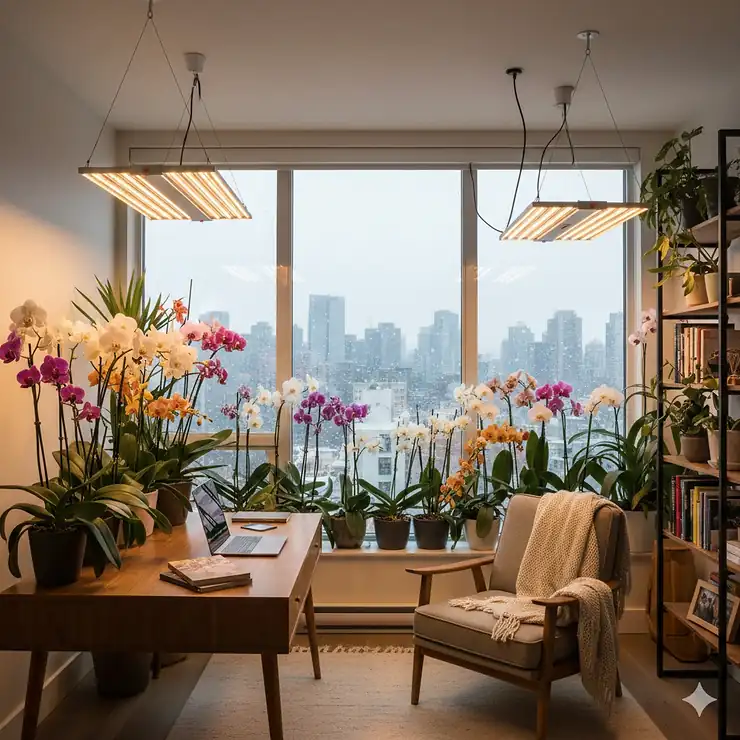
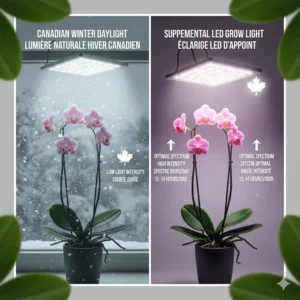
If you’ve ever watched a Phalaenopsis sit stubbornly on your windowsill for two years without throwing a single spike, chances are the light was the culprit — not your watering routine, not your fertiliser, and definitely not bad luck. Understanding orchid LED grow light requirements is honestly the single biggest game-changer for Canadian growers, especially during those long, dim winters from November through March when natural sunlight barely grazes our windowsills.
I’ve been growing orchids indoors in Canada for years, and let me tell you — the moment I added a proper LED grow light to my setup, my collection transformed. Plants that hadn’t bloomed in 18 months suddenly shot up spikes. Leaves turned a healthy, medium green. Root systems exploded.
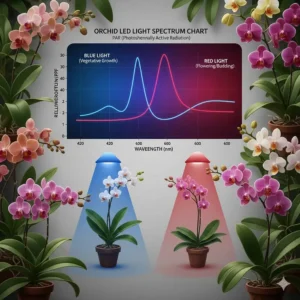
So, what exactly do orchids need in terms of light? In simple terms, orchid LED grow light requirements centre around three things: intensity (measured in PPFD — Photosynthetic Photon Flux Density), spectrum (the colour wavelengths your light emits), and duration (how many hours of light per day your plant receives). Most Phalaenopsis orchids, for example, thrive at 100–200 µmol/m²/s PPFD under a full-spectrum LED running 12–14 hours daily. Higher-light genera like Cattleyas push that up to 300–500 µmol/m²/s.
This guide covers the top 7 LED grow lights available on Amazon.ca that meet these orchid LED grow light requirements, along with everything you need to know to set up a thriving indoor orchid collection — no greenhouse required. 🌸
Quick Comparison Table: Top 7 LED Grow Lights for Orchids in Canada
| Product | Wattage | Coverage | PPFD (Approx.) | Price (CAD) | Best For |
|---|---|---|---|---|---|
| Spider Farmer SF-1000 | 100W | 2×2 ft | Up to 600 µmol/m²/s | ~$200–$230 | Mid-level collectors |
| Mars Hydro TS1000 | 150W | 3×3 ft | Up to 650 µmol/m²/s | ~$145–$175 | Mixed collections |
| Mars Hydro TS600 | 100W | 2×2 ft | Up to 450 µmol/m²/s | ~$85–$110 | Beginners |
| Barrina T5 2ft (4-Pack) | 40W | Shelf strips | Moderate, ~120 µmol | ~$50–$70 | Shelf/windowsill Phals |
| VIPARSPECTRA XS1500 Pro | 150W | 2×2 / 3×3 ft | Up to 720 µmol/m²/s | ~$175–$210 | Serious hobbyists |
| AGLEX K1000 LED | 100W | 2×3 ft | Up to 500 µmol/m²/s | ~$130–$160 | Budget to mid-range |
| VIVOSUN T5 2ft (4-Pack) | 60W | Shelf strips | Moderate, ~150 µmol | ~$65–$85 | Multi-shelf setups |
💬 Just one click – help others make better buying decisions too! 😊
Top 7 Orchid LED Grow Lights: Expert Analysis
1. Spider Farmer SF-1000 — Best Overall for Canadian Orchid Growers
The Spider Farmer SF-1000 is arguably the gold standard for serious indoor orchid enthusiasts who want genuine performance without jumping to commercial-grade setups. At 100 watts actual draw, it uses Samsung LM301H EVO diodes — the same premium chips found in grow lights costing twice as much — delivering a full-spectrum output that closely mimics natural sunlight.
Key Specs:
- 100W actual power draw
- Samsung LM301H EVO diodes, full-spectrum white + 660nm red + 730nm far-red
- Coverage: 2×2 ft (flower) / 3×3 ft (veg)
- Dimmable with daisy-chain capability
Price: ~$200–$230 CAD on Amazon.ca |
Availability: In stock, ships from Canadian fulfillment
Canadian orchid growers report excellent results using the SF-1000 at 18–24 inches above Phalaenopsis collections, with PPFD values in the ideal 150–300 µmol/m²/s range at that height — right in the sweet spot for triggering rebloom. The 730nm far-red diodes are a standout feature, as far-red light helps signal the end of a light cycle and can assist in encouraging flower spike development.
✅ Samsung diodes for superior efficiency and longevity
✅ Dimmable — critical for dialling in the right PPFD for orchids
✅ 3-year warranty with Canadian service support
❌ Higher upfront cost than budget options
❌ Focused beam means you need proper height adjustment for even coverage
2. Mars Hydro TS1000 — Best for Mixed-Genre Orchid Collections
The Mars Hydro TS1000 is a 150-watt full-spectrum LED grow light that punches well above its price point and has become a favourite in the Canadian indoor plant community. Its patented reflector design increases light intensity by up to 20%, and the dimming feature lets you tailor output precisely for everything from low-light Phals to moderate-light Dendrobiums in the same room.
Key Specs:
- 150W, full-spectrum sunlike diodes (730–740nm IR, 3200–4200K, 5200–6800K)
- Patented 120° reflector
- Coverage: 3×3 ft
- Daisy-chain compatible
Price: ~$145–$175 CAD on Amazon.ca |
Availability: Typically in stock, Prime eligible
The TS1000 shines (no pun intended) when you’re growing multiple orchid species together. Hang it a bit higher for Phals and Paphs on lower shelves, a bit closer for your Cattleyas and Oncidiums. Canadian buyers love the energy efficiency — running roughly 150W continuously for 14 hours/day costs only about $0.25–$0.30 CAD per day at average provincial electricity rates.
✅ Dimmable and daisy-chain for scalable setups
✅ Excellent coverage for a 3×3 ft growing area
✅ Energy-efficient for long Canadian winters
❌ Not Samsung-diode based (uses proprietary diodes)
❌ Slightly warm colour temperature may not suit all aesthetics
3. Mars Hydro TS600 — Best Budget Pick for Beginners
If you’re just starting your orchid journey and don’t want to drop $200 CAD on a first grow light, the Mars Hydro TS600 is the most honest budget option on Amazon.ca. At just 100 watts with a clean full-spectrum output, it delivers respectable PPFD values for a Phalaenopsis shelf setup without breaking the bank.
Key Specs:
- 100W actual power draw
- Full-spectrum: 730–740nm IR + white spectrum
- Coverage: 2×2 ft
- 110–130V (Canadian voltage compatible ✅)
Price: ~$85–$110 CAD on Amazon.ca |
Availability: In stock, fast Canadian shipping
The TS600 is a solid starter light that covers a small collection of 3–5 orchids perfectly well. It lacks the dimming function of its bigger siblings, which is a limitation when you want to fine-tune PPFD, but for standard Phalaenopsis care at 12–14 hours/day, it does the job reliably. Beginner Canadian orchid growers consistently leave positive feedback about its simplicity and low running cost.
✅ Most affordable full-spectrum LED on this list
✅ Compact, lightweight, easy to hang anywhere
✅ Full-spectrum output triggers reliable growth and some rebloom
❌ No dimming function — PPFD fixed by hanging height only
❌ Best for 2×2 ft max; not suitable for larger collections
4. Barrina T5 LED Grow Light Strips 2ft (4-Pack) — Best for Shelf/Windowsill Setups
The Barrina T5 LED Grow Light Strips are the unsung heroes of the orchid hobbyist world. These 2ft, 5000K white-spectrum LED strips are magnetic, linkable, and plug-and-play — making them ideal for those growing Phalaenopsis on wire shelving units that have become enormously popular in the Canadian orchid community.
Key Specs:
- 40W total (4 × 10W strips), 5000K daylight white spectrum
- 96 LEDs per strip, plug and play
- Linkable up to 16 strips in series
- 3 mounting modes (magnetic, clips, tape)
Price: ~$50–$70 CAD on Amazon.ca |
Availability: In stock, widely available across Canada
The 5000K colour temperature is an excellent match for orchid LED grow light requirements during vegetative growth phases, encouraging compact, healthy leaf development. Because these strips sit close to plants (ideally 15–25 cm / 6–10 inches above the canopy), they deliver surprisingly useful PPFD in the 100–150 µmol/m²/s range — plenty for Phalaenopsis and Paphiopedilum. Canadian growers love them for multi-shelf orchid racks.
✅ Incredibly affordable per strip
✅ Magnetic installation means zero tools needed
✅ Individual on/off switches on each strip
❌ Not dimmable
❌ Moderate PPFD — not strong enough for high-light Cattleyas or Vandas
5. VIPARSPECTRA XS1500 Pro — Best for Dedicated Orchid Grow Rooms
If you’re serious enough to dedicate a closet, spare room, or grow tent to your orchid collection, the VIPARSPECTRA XS1500 Pro deserves a serious look. At 150 watts with next-generation lens technology, it achieves one of the highest PPFD ratings in its price class on Amazon.ca — up to 720 µmol/m²/s at 12 inches — giving you the headroom to serve even your most light-hungry Cattleyas and Vandas.
Key Specs:
- 150W actual power draw with new-gen lens
- Full-spectrum + 660nm red + 730nm IR far-red
- Coverage: up to 3×3 ft
- Dimmable with daisy-chain support
Price: ~$175–$210 CAD on Amazon.ca |
Availability: In stock, ships to all Canadian provinces
What sets the XS1500 Pro apart is its lens-enhanced light penetration. Light reaches deeper into multi-layered canopies, which matters if you’re stacking orchid pots or growing taller sympodial orchids. The dimmer gives you complete control to dial PPFD down to the 100–200 µmol/m²/s range that Phals prefer, or crank it up for Cattleyas.
✅ Industry-leading PPFD for this price range
✅ New-gen lens improves light penetration and uniformity
✅ Suitable for the full range of orchid light needs
❌ Larger footprint than other options
❌ May require a light timer purchased separately for automated schedules
6. AGLEX K1000 LED Grow Light — Best Mid-Range Dimmable Option
The AGLEX K1000 LED Grow Light is a newer player that’s gained a loyal following among Canadian indoor plant growers for its versatility and honest value. At 100 watts with dimmable output, SMD LEDs, and an IP65 waterproof driver, it’s a smart pick for the humidity-rich environments that orchids (and their growers) prefer.
Key Specs:
- 100W, SMD LED full-spectrum sunlike output
- IP65 waterproof driver — ideal for high-humidity orchid spaces
- Coverage: 2×3 ft
- Dimmable + daisy-chain capable
Price: ~$130–$160 CAD on Amazon.ca |
Availability: In stock, 2026 upgraded model available
The IP65 waterproof rating on the driver is a feature you’ll genuinely appreciate if you’re misting regularly or running a humidifier near your orchid setup. Many grow lights are damaged by humidity over time — this one resists it. The full sunlike spectrum supports healthy leaf development and reliable blooming cycles for epiphytic orchid species throughout Canada’s dry winter months.
✅ IP65 waterproof driver — safe for high-humidity orchid environments
✅ Dimmable for precise PPFD control
✅ Good coverage footprint for mid-sized collections
❌ Less brand recognition than Spider Farmer or Mars Hydro
❌ SMD diodes less efficient than Samsung LM301H
7. VIVOSUN T5 LED Grow Light Strips 2ft (4-Pack) — Best for Multi-Shelf Orchid Racks
The VIVOSUN T5 LED Grow Light Strips at 60W across a 4-pack offer a step up from Barrina’s output while maintaining the shelf-strip form factor that orchid growers love. At 5000K full-spectrum and SGS-compatible build quality, they’re a reliable long-term choice for anyone running multiple wire-shelf growing areas.
Key Specs:
- 60W total (4 × 15W), 5000K full-spectrum
- T5 LED strip format, linkable
- SGS quality certification
- 5000K, suitable for vegetative and bloom support
Price: ~$65–$85 CAD on Amazon.ca |
Availability: In stock
With 15W per strip versus Barrina’s 10W, VIVOSUN delivers noticeably stronger PPFD at the same hanging distance — a meaningful difference for pushing Phalaenopsis into rebloom. Canadian buyers in provinces with limited winter daylight (looking at you, British Columbia and the Prairie provinces) will appreciate the stronger output during the dark months of January and February.
✅ Higher wattage per strip than most competitors
✅ SGS quality certification adds reliability assurance
✅ Linkable for easy scaling across shelf systems
❌ Slightly pricier per strip than Barrina
❌ Not dimmable
✨ Don’t Miss These Exclusive Deals!
🔍 Take your orchid growing to the next level with these carefully selected LED grow lights available on Amazon.ca. Click on any highlighted product name to check current pricing and availability. These tools will help you create a thriving, blooming orchid collection — even through Canada’s darkest winters! 🍁
Understanding Orchid LED Grow Light Requirements: The Science Made Simple
Before you buy anything, it helps to speak the language. According to the American Orchid Society, light influences essentially all aspects of orchid growth and flowering, from photosynthesis to spike development. Here’s what the numbers actually mean for you.
PPFD (Photosynthetic Photon Flux Density): This measures how many light photons actually land on your plant’s leaves per second, expressed in µmol/m²/s. It’s the most important number for orchid growers. Phalaenopsis need 100–200 µmol/m²/s, Dendrobiums and Oncidiums want 150–300, and high-light genera like Cattleyas and Vandas thrive at 300–500 µmol/m²/s.
DLI (Daily Light Integral): This is your PPFD multiplied by the number of hours of light per day. Phalaenopsis orchids perform well at a DLI of 4–6, meaning you need to balance both intensity and duration. Running a moderate-power LED for 14 hours/day can achieve the same DLI as a stronger light running for 10 hours.
Spectrum: Full-spectrum LEDs that include blue wavelengths (400–500nm) for vegetative growth, red (600–700nm) for flowering, and far-red (730nm) for spike initiation are ideal. The American Orchid Society notes that a spectrum mimicking natural sunlight gives the most consistent results for blooming.
Best Light Spectrum for Flowering Orchids: What Wavelengths Actually Trigger Blooms?
Not all light is created equal when it comes to coaxing your orchids into bloom. The best light spectrum for flowering orchids combines several key wavelength ranges working together:
Blue light (450–500nm) encourages compact, healthy leaf structure and prevents the leggy growth that happens when Phals stretch toward inadequate light. Aim for roughly 15–20% blue content in your spectrum.
Red light (620–660nm) is the primary driver of photosynthesis and is strongly linked to flowering initiation. LEDs with a strong 660nm peak tend to trigger more reliable bloom cycles.
Far-red light (720–730nm) is where things get interesting. Far-red wavelengths interact with phytochrome receptors in the plant, essentially signalling “end of day” and encouraging the plant to switch from vegetative mode to reproductive mode. This is why LEDs with 730nm diodes — like the Spider Farmer SF-1000 and VIPARSPECTRA XS1500 Pro — tend to produce more reliable spiking behaviour in Phalaenopsis.
White light (3000K–5000K) fills in the green and amber portions of the spectrum that plants use for deeper canopy penetration and overall photosynthetic efficiency.
Phalaenopsis Grow Light Setup: A Step-by-Step Guide
Setting up a proper Phalaenopsis grow light setup doesn’t need to be complicated. Here’s how to get it right from the start:
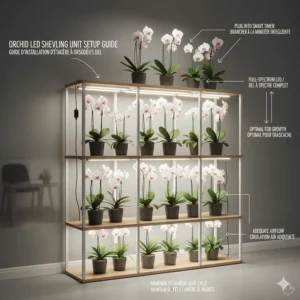
- Choose your light based on collection size. 1–5 plants: Barrina or VIVOSUN T5 strips under a shelf. 6–15 plants: Mars Hydro TS1000 or VIPARSPECTRA XS1500 Pro hung from a rack. 15+ plants: Spider Farmer SF-1000 or a combination of the above.
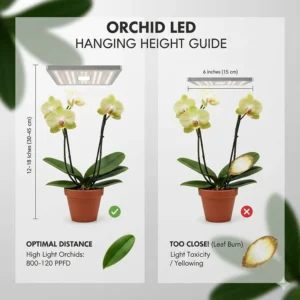
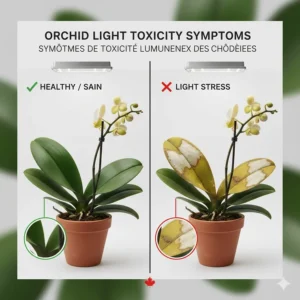
- Set your hanging height. For Phalaenopsis, start at 45–60 cm (18–24 inches) above the leaf canopy and adjust based on leaf colour — medium green is perfect, yellowing means too much light, dark green means too little.
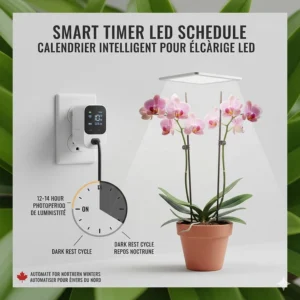
- Set a timer. 12–14 hours on, 10–12 hours off. Consistency matters more than perfection. A basic mechanical outlet timer from any Canadian hardware store works great and costs under $15 CAD.
- Check leaf colour weekly. This is your most reliable PPFD meter without buying an actual PPFD meter. Healthy Phals have medium green, slightly glossy leaves.
- Trigger spike development. In autumn (September–November in Canada), allow nighttime temperatures to drop to 16–18°C for 4–6 weeks while maintaining the same light schedule. This temperature differential combined with proper lighting is the most reliable way to initiate Phalaenopsis spiking.
Orchid Rebloom Lighting Strategy: How to Get Stubborn Plants to Spike Again
Every Canadian orchid grower has that one plant — the beautiful Phalaenopsis you bought in full bloom three years ago that’s refused to flower again since. Here’s the honest orchid rebloom lighting strategy that actually works.
First, rule out the obvious: is the plant root-bound, over-watered, or being fertilised with too much nitrogen? These are separate issues. Assuming your plant is otherwise healthy, the rebloom strategy centres on three pillars.
Increase light gradually. Over two to three weeks, increase your LED’s PPFD by moving it 5–8 cm closer, or by bumping up the dimmer setting if your light supports it. Target 150–200 µmol/m²/s for Phals specifically. Research published in horticultural literature shows that nearly all Phalaenopsis in the high-light treatment group produced flower spikes, compared to just 77% in medium light and only 2% in low light conditions.
Introduce a night temperature drop. Canada’s autumn season makes this almost automatic if your plants are near an exterior wall. A drop to 16°C at night for four to six weeks is the classic Phalaenopsis rebloom trigger. Your LED light schedule remains unchanged during this period.
Extend your photoperiod to 14 hours if needed. Some growers in northern Canada — where December daylight can be as little as 8 hours — find that bumping the timer to 14 hours in mid-autumn helps maintain the DLI needed for spike initiation without cranking up intensity.
Epiphytic Plant Light Needs: Why Orchids Are Different from Your Other Houseplants
Understanding epiphytic plant light needs is key to breaking away from generic grow light advice that was written for succulents, herbs, or vegetables. Orchids — specifically the epiphytic species that make up the vast majority of commonly grown varieties — evolved growing attached to tree branches in the tropical forest canopy. This gives them a very specific relationship with light.
In their natural habitat, epiphytic orchids receive bright, filtered, ever-changing light as the sun moves through the sky and canopy leaves shift in the breeze. They’re never in direct, unshaded sun (which would scorch them), and they’re never in deep shade (which starves them of the energy needed to bloom). The light they receive is dappled, diffused, and consistent in spectrum. According to Wikipedia’s article on orchids, the family is one of the two largest families of flowering plants and grows across diverse habitats from rainforests to arctic tundra — but the popular indoor varieties are predominantly tropical epiphytes with these moderate, filtered light needs.
Full-spectrum LEDs do an excellent job of replicating this natural filtered-light environment when used at the correct PPFD and duration. The key is avoiding the “blast it with light” approach that works for cannabis or tomatoes — orchids are genuinely sensitive to both overexposure and underexposure, and the sweet spot is narrower than for most other houseplants.
Orchid Spike Development Lighting: Timing Your Setup for Maximum Results
Orchid spike development lighting is where the magic really happens — and where a lot of Canadian growers make timing mistakes that cost them a full bloom season. Here’s how to think about it seasonally.
Summer (June–August): Maintain 12 hours of LED light at moderate PPFD. This is the vegetative growth phase. New leaves and roots are the priority, not blooms. Don’t try to force spiking in summer — it won’t work well for most Phalaenopsis.
Early Autumn (September–October): This is your golden window. Keep the same 12–14 hour light schedule but allow natural temperature fluctuations to bring nighttime temps down. If you’re near a window in Edmonton, Calgary, or Winnipeg, this happens naturally by mid-September.
Late Autumn (November–December): Add supplemental LED light if you don’t already have it. Canadian daylight in late November is often under 8 hours — far too little for spikes to develop without supplementation. This is when your grow light setup earns its keep.
Winter (January–February): Once you see a spike developing, maintain consistent 12–13 hour light cycles and stable temperatures. Avoid moving the plant or dramatically changing light conditions — this causes bud blast, where developing buds drop before opening.
Humidity and Light Balance Orchids: Why You Can’t Ignore Moisture Alongside Your LED Setup
One thing that surprises new orchid growers is how interconnected humidity and light balance orchids share. Light and humidity are not separate variables — they directly influence each other’s effect on your plant.
Higher light intensity increases your orchid’s rate of transpiration (water loss through leaves). If you ramp up your LED intensity to trigger spiking but forget to account for increased moisture loss, you’ll see leaf edges brown and root tips die back — classic signs of dehydration stress. In Canada, where winters are already bone-dry due to indoor heating, this becomes a real problem by December.
Aim for 50–70% relative humidity around your orchids when running LED grow lights at full intensity. Practical tools for Canadian homes include:
- A cool-mist ultrasonic humidifier placed near (not directly under) your grow light setup
- A humidity tray filled with pebbles and water beneath your pots (not touching the roots)
- Grouping multiple orchid plants together to create a microclimate of slightly elevated humidity through mutual transpiration
If you’re running your grow light in a sealed grow tent, a small clip fan to circulate air prevents stagnant humid pockets that promote fungal issues on orchid roots and leaves.
How to Choose the Right LED Grow Light for Orchids in Canada: 5-Step Guide
- Identify your orchid species. Low-light (Phals, Paphs): budget T5 strips or entry-level panels. Moderate-light (Dendrobiums, Oncidiums): mid-range dimmable LEDs. High-light (Cattleyas, Vandas): premium full-spectrum panels with strong PPFD.
- Measure your growing space. Count your orchid pots and measure the shelf or table they occupy. Match your light’s coverage area to your space — don’t buy a 5×5 ft light for 3 plants on a windowsill.
- Prioritise dimming capability. A dimmable LED lets you dial in the exact PPFD for your species. This single feature is worth paying extra for, especially for mixed collections.
- Look for full-spectrum with far-red. Confirm your chosen light includes 660nm and 730nm wavelengths for reliable bloom support.
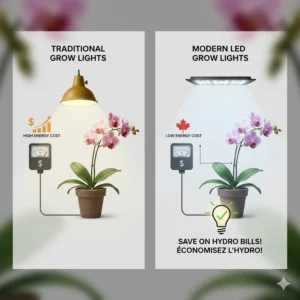
- Factor in Canadian operating costs. Calculate approximate electricity cost: (wattage ÷ 1000) × hours/day × your province’s kWh rate × 30 = monthly cost in CAD. At Ontario’s average rate (~$0.15/kWh), running a 150W light 14 hours/day costs roughly $9.45 CAD/month — very reasonable.
LED vs. Fluorescent vs. Traditional Lights for Orchids: Is LED Really Worth It in Canada?
| Feature | Full-Spectrum LED | T5 Fluorescent | Incandescent |
|---|---|---|---|
| Energy Efficiency | ⭐⭐⭐⭐⭐ Excellent | ⭐⭐⭐ Good | ⭐ Poor |
| Heat Output | Very Low | Moderate | High |
| Lifespan | 50,000+ hours | 10,000–20,000 hours | 1,000–2,000 hours |
| Spectrum Quality | Full + far-red | Good but limited IR | Poor |
| Dimmable Options | Yes (most models) | Rarely | No |
| Initial Cost (CAD) | $50–$230 | $30–$120 | $5–$30 |
| Long-Term Value | ⭐⭐⭐⭐⭐ | ⭐⭐⭐ | ⭐ |
The verdict? LED wins comprehensively for Canadian orchid growers, primarily because of electricity cost savings over long winters and the availability of far-red wavelengths that fluorescents simply can’t provide.
✨ Ready to Upgrade Your Orchid Setup?
🔍 Click on any product listed in this guide to check real-time pricing and Canadian availability on Amazon.ca. Your orchids have been waiting for this upgrade! 🌺🇨🇦
Setting Up Your Orchid LED Grow Light: Common Mistakes to Avoid
Buying the right light is only half the battle. Here are the pitfalls that trip up even experienced Canadian growers:
Hanging the light too close. This is the #1 mistake. Phalaenopsis leaves bleach and develop brown spots when PPFD exceeds 500 µmol/m²/s — much lower than the threshold for vegetables. Always start at 45 cm (18 inches) above the canopy and move up if leaves yellow.
Running lights 24 hours. Orchids need a dark period. A 24-hour photoperiod disrupts the plant’s circadian rhythm and can actually inhibit flowering. Always use a timer set to 12–14 hours maximum.
Ignoring seasonal adjustment. In Canada, it’s tempting to set your timer in October and forget about it. But your orchids benefit from slight adjustments — 12 hours in summer transitioning to 14 hours in winter keeps DLI consistent despite the shorter days.
Using “grow lights” designed for cannabis. Many LED panels sold on Amazon.ca are calibrated for high-PPFD crops. While they work, they often need to be hung much higher than their instructions suggest for orchids, and the spectrum may be skewed toward flowering wavelengths at the expense of vegetative blue light.
FAQ: Orchid LED Grow Light Requirements in Canada
❓ What PPFD do Phalaenopsis orchids need under LED lights in Canada?
❓ How many hours a day should orchid LED grow lights run in Canada?
❓ What is the best light spectrum for flowering orchids under LED?
❓ How much does it cost to run an orchid LED grow light in Canada per month?
❓ Can I use a regular LED bulb for orchids instead of a grow light?
Conclusion: Getting Orchid LED Grow Light Requirements Right Transforms Your Collection
Growing orchids in Canada doesn’t have to be an exercise in frustration. Once you understand orchid LED grow light requirements — the right PPFD for your species, a full spectrum that includes the critical far-red wavelengths, and a consistent 12–14 hour daily photoperiod — everything clicks into place. Plants that sulked for years suddenly come alive.
Whether you start with the budget-friendly Mars Hydro TS600 at around $85 CAD, build out a multi-shelf setup with Barrina T5 strips, or invest in the best-overall Spider Farmer SF-1000 for around $215 CAD, every option on this list is a meaningful upgrade over relying on Canada’s dark winter windows alone.
Light is the one input your orchids cannot compensate for on their own. Get it right, and the blooms will follow.
✨ Start Growing Better Orchids Today!
🔍 Check current prices and availability on Amazon.ca for all 7 grow lights featured in this guide. Great deals and fast Canadian shipping await — your next spike could be just weeks away! 🌸🍁
Recommended for You
- Grow Lights for Blooming African Violets: 7 Best Picks in Canada 2026
- How to Choose Grow Lights for Indoor Plants in 2026 (Canada Guide)
- Full Spectrum vs Purple Grow Lights Which is Better | 2026 Guide Canada
Disclaimer: This article contains affiliate links to Amazon.ca. If you purchase products through these links, we may earn a small commission at no additional cost to you.
✨ Found this helpful? Share it with your orchid-loving friends! 💬🤗
