
In This Article
Top 7 Polycarbonate Greenhouse Kits for Cold Winters: Expert Analysis
Each kit below gets the same treatment: what the specs mean in practice, who it actually suits, and what buyers consistently report. Where a manufacturer makes a claim I can’t verify, I’ll say so rather than pass it along as fact.
1. Sylviera 6x4FT — best budget seedling shelter
If your winter ambitions start with seed trays and end with a few pots of hardy herbs, this compact 1.8 x 1.2 m (6 x 4 ft) kit is the low-risk entry ticket. The listing describes 4 mm twin-wall panels on an aluminum frame, plus a vent window and a built-in hygrometer. Four millimetres sits at the thin end of twin-wall. The trapped air gap is smaller than in the 6 mm sheets that carry the R~1.6 figure quoted by greenhouse suppliers, so thermal retention is modest. In plain terms, you’re buying a frost buffer, not a heated winter room. Snow-load claims also vary from listing to listing, so I’d treat any figure as unproven and plan on sweeping the roof by hand.
Based on the spec comparison, this kit suits first-timers and patio gardeners who want to start seeds six to eight weeks early, not anyone hoping to harvest tomatoes in January. At roughly 2.2 m² (24 sq ft), the tiny air volume warms fast on a sunny morning but swings just as fast after dark. On the retail listings I could verify, it appears as a best-seller with around 100 reviews. I couldn’t confirm a trustworthy aggregate score on Amazon.ca, so read the most recent cold-weather reviews yourself.
Pros:
- ✅ Very low entry cost for a real aluminum frame
- ✅ Hygrometer included for humidity tracking
- ✅ Small footprint sidesteps most permit worries
Cons:
- ❌ Thin 4 mm panels limit winter warmth
- ❌ Snow-load claims inconsistent across listings
Expect around C$180–C$300; for a starter structure that’s fair value, provided you accept the thin glazing.
2. Outsunny 6.2′ x 8.3′ — sliding door that ignores snowdrifts
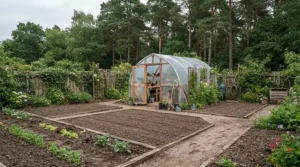
Most kits this size swing their doors outward, which is charming until a drift parks itself in front of one. This 1.9 x 2.5 m walk-in uses a sliding door instead, along with an aluminum alloy frame, a rooftop vent, rain gutters and polycarbonate panels, according to the Best Buy Canada listing. The slider means you can reach your plants after a storm without first excavating the entrance. The gutters are handy in spring for filling rain barrels, though in deep winter they mostly collect ice. Notably, even the listing advises protecting the structure from heavy snow and cleaning the panels gently. That’s an honest hint this is a hobby-grade build.
My read: it suits gardeners in moderate-snow regions who value convenience and a roomy 4.7 m² (about 51 sq ft) floor over maximum structural muscle. Panel thickness and a snow-load rating weren’t clearly stated in the listing I found, and that gap matters, so confirm both before ordering. Review volume on the pages I could verify was thin, so I can’t summarize reliable buyer sentiment. I’d rather say that than guess.
Pros:
- ✅ Sliding door avoids drift-blocked entrances
- ✅ Roomy walk-in floor space
- ✅ Rooftop vent and rain gutters included
Cons:
- ❌ Snow-load rating not clearly stated
- ❌ Gutters collect ice in deep winter
Typically in the C$350–C$550 range, with availability varying by retailer, so confirm the Amazon.ca listing; reasonable value if you add your own bracing.
3. HOOYEAH 6×8 FT — lockable door for windy, nosy yards
Wind finds loose doors the way toddlers find puddles. This 1.8 x 2.4 m (6 x 8 ft) walk-in answers with a locking door and a roof vent on an aluminum frame. A latch that actually locks matters in January: it keeps the door from flapping open in a gale and keeps curious critters out of your spinach. About 4.5 m² of floor lands in the sweet spot where you can fit a potting bench and still stand upright. Where the specs get vague is insulation. Listings call it a winter kit without spelling out panel thickness or a tested snow load.
Here’s what to weigh. The kit appears in several 2026 roundups, but those are affiliate-driven too, so I’d discount the cheerleading. One roundup did flag that heat retention drops overnight in cold climates, which fits the physics of thin twin-wall panels and a single vent. Add water barrels for thermal mass and clear the roof after every storm, and it becomes a decent shoulder-season workhorse. Without those habits, it’s a spring-and-fall tool with winter ambitions.
Pros:
- ✅ Locking door resists wind and wildlife
- ✅ Practical 6×8 footprint with roof vent
- ✅ Rust-resistant aluminum frame
Cons:
- ❌ Overnight heat loss flagged by reviewers
- ❌ Panel thickness and snow load unclear
Roughly C$350–C$550 is fair for the floor space, as long as you supply your own bracing.
4. Sylviera 8x10FT — bigger air volume, steadier nights
Size is a thermal retention strategy: more air and more soil mean slower temperature swings. This 2.4 x 3.0 m (8 x 10 ft) kit, about 7.4 m², pairs 4 mm, 720 g/m² twin-wall panels with a reinforced aluminum frame and a thermometer-hygrometer, according to the listings. The brand claims the panels keep up to 85% of internal warmth and block 99.9% of UV. Treat both as manufacturer claims, not lab results. Larger Sylviera models list 20 psf of snow load and 45 mph wind resistance, so confirm the 8×10’s own figures before buying.
On paper, 20 psf (about 0.96 kPa) is middling for much of Canada, which means you’d brace this kit from the inside and clear the roof regularly. Where it earns its keep is interior volume: a bench, a few water barrels and a hardy winter bed all fit without elbow wars. Buyer sentiment is mixed-to-decent. One retail listing shows roughly 155 reviews, a larger sibling sits near 4.1 stars from almost 500 ratings, and a small-sample 8×14 model scores 3.0 from 13. One reviewer found it decent once built but not worth the assembly effort.
Pros:
- ✅ Larger volume steadies overnight temperatures
- ✅ Thermometer and hygrometer included
- ✅ Strong value per square metre
Cons:
- ❌ Reviews describe slow, fiddly assembly
- ❌ 4 mm panels cap insulation
Around C$500–C$700 is good value for the floor area, assuming you budget a few hours and a patient helper.
5. Palram – Canopia Mythos 6×10 — brand backing, tidy twin-wall
Retail listings describe this 1.8 x 3.0 m (6 x 10 ft) walk-in as twin-wall polycarbonate on an aluminum frame, with a galvanized base and roof vent. The maker says its panels use only virgin material that won’t turn brittle or discolour. If true, that matters for long-term UV durability. The 5.6 m² footprint stretches along a fence nicely. Snow-load figures are where things get slippery. Most 6×10 listings state 15.4 lb/ft² (about 0.74 kPa), while some smaller Mythos listings cite 35 lb/ft². I’d plan around the lower number.
Here’s the analytical take: the Mythos 6×10 suits gardeners in moderate-snow or coastal regions who want an established brand and available replacement parts. It doesn’t suit the “let the snow pile up” crowd. One retail page lists 51 reviews, with 43 at four or five stars and seven at one or two. One buyer reported losing the greenhouse in winds around 80 km/h, below its 90 km/h rating. It’s a blunt reminder that anchoring beats the number on the box, and anchor kits are sold separately for most Canopia models.
Pros:
- ✅ Established brand with replacement parts
- ✅ Narrow, fence-friendly 6×10 layout
- ✅ Mostly positive buyer ratings
Cons:
- ❌ 15.4 psf rating modest for snow country
- ❌ Wind loss report stresses need for anchors
Plan on roughly C$500–C$900 depending on seller; fair value in milder regions, tight in deep-snow ones.

6. Palram – Canopia Hybrid 6×8 — clear walls, light-first design
The Hybrid mixes 4 mm twin-wall roof panels with crystal-clear walls above 90% light transmission, per the Canadian Tire listing. More light reaches seedlings in dim November, but a single-layer wall loses heat faster than twin-wall. Listed snow load is 15.4 lb/ft², and wind resistance reaches 90 km/h only with the separately sold anchor kit. Gardeners under cloudy winter skies may love the light. Gardeners under heavy snow may regret the thin margins.
My analysis: it suits west-coast or Maritime-style winters, where grey skies are the enemy and snow is occasional. Review sentiment on the Canadian Tire page is mixed. Of roughly 64 reviews, 44 are four or five stars, 12 are three stars and eight are one or two. Two separate reviews raise snow trouble: one buyer reported the roof collapsing after a storm despite snow-resistance marketing, and another said local snow and wind exceed what it can handle. Two anecdotes aren’t a lab test, but they match the modest rating.
Pros:
- ✅ Clear walls deliver excellent winter light
- ✅ 4 mm twin-wall roof diffuses sun
- ✅ Frame praised for easy construction
Cons:
- ❌ Single-layer walls lose heat faster
- ❌ Reviewers report snow-related roof failures
Roughly C$700–C$1,100 feels steep unless light quality is your priority.
7. Backyard Discovery Willow 9×6 — the heavy-snow stretch pick
Backyard Discovery states that this cedar-framed, four-wall polycarbonate walk-in passed its Pro-Tect testing for up to 2,800 lb of snow, about 30 inches, and 100 mph winds when properly anchored. Cedar matters beyond looks. Wood conducts far less heat than aluminum, so the frame doesn’t act as a cold bridge, and four-wall panels trap more air than standard twin-wall. At about 5 m² (54 sq ft), the footprint is modest. My rough arithmetic: 2,800 lb over 54 sq ft is around 50 psf, more than double the 15–20 psf quoted for the metal-framed kits above. The figures aren’t measured the same way, though, so treat the comparison as directional.
The trade-offs are price and upkeep. This is the one pick likely to touch or exceed the C$1,200 ceiling, and cedar wants a protective finish every few years. Roundups describe buyer sentiment as overwhelmingly positive, but I couldn’t verify a clean review count. Check the current ratings on Amazon.ca before deciding.
Pros:
- ✅ Highest stated snow load on this list
- ✅ Cedar frame limits cold bridging
- ✅ Four-wall panels improve insulation
Cons:
- ❌ Price may exceed the C$1,200 ceiling
- ❌ Cedar needs periodic staining or sealing
Expect roughly C$1,100–C$1,600; if it lands near your limit, it’s still the best match for heavy-snow zones.
Top 7 Comparison: Specs, Prices and Review Signals
| Kit | Size | Glazing & Frame | Listed Snow Load | Price Range (CAD) | Review Signal | Best For |
|---|---|---|---|---|---|---|
| Sylviera 6x4FT | 1.8 x 1.2 m | 4 mm twin-wall, aluminum | Varies by listing | C$180–C$300 | ~100 reviews, score unverified | Seed-starting |
| Outsunny 6.2′ x 8.3′ | 1.9 x 2.5 m | Polycarbonate, aluminum alloy | Not clearly stated | C$350–C$550 | Thin data | Convenience seekers |
| HOOYEAH 6×8 FT | 1.8 x 2.4 m | Polycarbonate, aluminum | Not clearly stated | C$350–C$550 | Overnight heat loss noted | Windy yards |
| Sylviera 8x10FT | 2.4 x 3.0 m | 4 mm twin-wall, aluminum | ~20 psf (sibling listings) | C$500–C$700 | Mixed to decent | Larger space |
| Palram – Canopia Mythos 6×10 | 1.8 x 3.0 m | Twin-wall, aluminum | 15.4 psf (some listings 35) | C$500–C$900 | 43 of 51 rated 4–5 stars | Milder winters |
| Palram – Canopia Hybrid 6×8 | 1.8 x 2.4 m | 4 mm roof, clear walls | 15.4 psf | C$700–C$1,100 | 44 of 64 rated 4–5 stars | Low-light winters |
| Backyard Discovery Willow 9×6 | 2.7 x 1.8 m | Cedar, four-wall panels | 2,800 lb (brand-tested) | C$1,100–C$1,600 | Positive, count unverified | Heavy snow |
The numbers tell a clear story: stated strength rises with price, but only the Backyard Discovery Willow 9×6 publishes a snow figure that approaches real Canadian conditions. The Sylviera 8x10FT and Mythos 6×10 sit in a middle band where careful snow clearing does the heavy lifting. If your budget is firmly capped at C$1,200, the practical choice is a mid-range kit plus internal bracing, not the cheapest option.
Practical Guide: Winterizing Your Greenhouse Before the First Snow
It’s mid-October, so this weekend’s to-do list writes itself. These steps are the practical value no product listing gives you.
- Anchor first. Wind takes greenhouses more often than snow does. Bolt the base to a level frame, concrete blocks or ground anchors, and use the manufacturer’s anchor kit if one exists.
- Seal the leaks. Add weatherstripping around doors and vents, and cap the open ends of panel channels so insects and moisture stay out.
- Add thermal mass. Two or three black-painted water barrels along the north wall soak up daytime sun and release it overnight, smoothing temperature swings.
- Brace the roof. Check your manual first, then consider a simple support post under the ridge. A little extra stiffness makes a big difference when wet snow arrives.
- Set a snow routine. Use a soft push broom or roof rake from outside, and clear after every 5–10 cm. Don’t wait for a rating to be tested.
- Ventilate on sunny days. Even at -5°C, a cracked roof vent beats the condensation and mould that come from sealing everything tight.
In the first 30 days, the classic mistakes are overwatering (cold soil dries slowly), skipping ventilation, and letting drifts bank against the walls. Those drifts add load and block your sunlight. Fix those three, and your snow load worries shrink considerably.
✨ Don’t Miss These Exclusive Deals!
🔍 Take your winter growing to the next level with these carefully selected greenhouse kits. Click on any highlighted item to check current pricing and availability. These picks will help you create a thriving cold-season garden your family will love! 🌱

Real-World Scenarios: Matching a Kit to Your Winter
Specs only matter when they meet a real yard. Here are three buyer profiles and the kit logic behind each.
The prairie homeowner with a C$1,200 ceiling. She gets heavy snow, hard wind and a 5 m² corner. The Backyard Discovery Willow 9×6 is the stronger structure but may exceed her budget. A realistic alternative is the Sylviera 8x10FT with internal bracing, thermal-mass barrels and a strict clearing routine. She gains floor space but must accept more maintenance.
The coastal gardener with grey skies. His winters are wet, mild and dim, so light matters more than a heavy snow rating. The Palram – Canopia Hybrid 6×8, with its clear walls, fits that profile well. On the rare snowy week, he should sweep the roof early rather than trust the 15.4 psf rating.
The condo-balcony beginner. She has about C$300 and wants to start seeds in late winter. The Sylviera 6x4FT is the low-stakes choice, and its tiny footprint keeps permit questions off the table. She won’t grow tomatoes in January, but she’ll beat the garden centres by weeks.
Each profile shows the same principle: match your worst weather, not your average weather, to the kit.
How to Choose a Polycarbonate Greenhouse for Cold Winters
To choose a polycarbonate greenhouse for cold winters, match panel thickness, frame, roof shape and anchoring to your local snow load and hardiness zone, and let price come last. Here’s the seven-step version:
- Find your zone and ground snow load. Your municipality can tell you its design snow figure. Everything else flows from that number.
- Choose panel thickness for your goal. 4 mm suits seed-starting, while 6–10 mm twin-wall is better for deeper cold because the larger air gap slows heat loss.
- Pick the frame deliberately. Aluminum is light and rust-proof but conducts heat, while cedar insulates better and needs upkeep.
- Favour a steep or arched roof. Snow sheds off pitch faster than it does off flat planes, which reduces how often you’ll shovel.
- Check ventilation and door design. A roof vent prevents winter condensation, and a sliding door beats an outward swing in drift country.
- Plan the base and anchors. A level, well-drained foundation matters as much as the kit itself.
- Confirm size against local rules and budget. Under about 10 m² often simplifies permits, but verify with your municipality.
Snow Load: What the Ratings Really Mean for Canadian Backyards
Snow load is the weight of accumulated snow a roof can carry, and it’s the number most likely to decide whether your greenhouse survives February. The National Building Code of Canada bases roof design on a 1-in-50-year ground snow load for each location, which you’ll find in the tables of the National Building Code of Canada 2020. Hobby kits aren’t engineered to that code, so treat their ratings as rough guidance, not guarantees.
One kilopascal equals about 20.9 lb/ft², which lets you translate kit ratings into the units Canadian codes use:
| Kit Rating | Roughly in kPa | Best For |
|---|---|---|
| 15.4 psf | ~0.74 kPa | Mild-snow regions: Mythos 6×10, Hybrid 6×8 |
| 20 psf | ~0.96 kPa | Moderate snow with active clearing: Sylviera 8x10FT |
| ~50 psf (my estimate) | ~2.4 kPa | Heavy snow: Backyard Discovery Willow 9×6 |
Many Canadian cities carry design ground snow loads above 1 kPa, so a 15–20 psf rating sits below the code values for much of the country. That’s why snow clearing isn’t optional with the lighter kits. As a rough guide, a foot of light powder may weigh only a few pounds per square foot, while wet, packed snow of the same depth can reach 15–20 lb/ft². Clear early and often, and brace the ridge if your manual allows.
Thermal Retention: What Twin-Wall Polycarbonate Really Buys You
Thermal retention comes down to R-value, the measure of how well a material resists heat flow. Supplier data put 6 mm twin-wall at roughly R 1.6, 8 mm at about 1.7 and 10 mm near 1.9, with 16 mm multi-wall reaching about 2.5. By comparison, single-pane 3 mm glass sits around 1.0. That means twin-wall roughly halves the heat loss of single glass at similar sun exposure.
Here’s the reality check: insulation slows heat loss, it doesn’t create heat. An unheated kit with 4 mm panels typically buys you a few degrees on a clear night, which is enough to protect hardy crops like kale, spinach and carrots under row cover, but not tomatoes in January. Thermal retention improves dramatically with simple additions:
- Water barrels or jugs as thermal mass
- Weatherstripped doors and vents
- A second layer of row cover over plants
- An insulated north wall
Frames matter too, since aluminum can bridge cold straight through the structure. If thermal retention is your top priority, the cedar-framed Backyard Discovery Willow 9×6 and its four-wall panels have the edge on paper. Among the budget kits, size helps, which is why the Sylviera 8x10FT holds temperatures more steadily than its 6×4 sibling.
Polycarbonate Greenhouse vs Glass Greenhouse: Which Wins in a Cold Climate?
The polycarbonate greenhouse vs glass greenhouse debate isn’t about which material is better. It’s about which compromises you can live with. Glass offers superior clarity and the longest lifespan, but it’s heavy, fragile and a poor insulator. Polycarbonate gives up some transparency, since you see shapes and shadows rather than through it, and gains insulation, impact resistance and a far lighter frame. In a cold climate with hail, snow slides and curious kids, that trade usually favours polycarbonate.
| Feature | Twin-Wall Polycarbonate | Single-Pane Glass |
|---|---|---|
| Insulation (R-value) | ~1.6–1.7 | ~1.0 |
| Light transmission | ~80% | ~90–95% |
| Impact resistance | Very high | Low |
| Weight / framing cost | Light, cheaper frame | Heavy, stronger frame needed |
| Lifespan | 10–15 yr warranties, 20+ with care | Longest |
| Best For | Cold winters, snow, families: Sylviera 8x10FT, Mythos 6×10 | Show gardens, mild climates |
The table shows why the polycarbonate greenhouse vs glass greenhouse question rarely favours glass in Canadian winters: roughly 70% more insulation per layer, plus survival odds when ice falls off the roof. Glass wins on light for sun-hungry crops and on longevity, but you’ll pay for heavier framing. Cost-wise, polycarbonate generally sits above plastic film and below glass, which makes it the sensible middle path.
Polycarbonate Greenhouse for UV Protection: What the Panel Label Doesn’t Tell You
A polycarbonate greenhouse for UV protection depends on one thing most listings gloss over: the co-extruded UV layer. Standard polycarbonate resin isn’t suited to long-term sun exposure, so quality sheets carry an anti-UV layer applied as a coating or co-extrusion. That’s explained on Wikipedia’s polycarbonate page. Without it, panels yellow and turn brittle, losing the impact resistance that made them attractive in the first place.
Here’s how to separate real protection from marketing:
- Check the warranty. A 10-year warranty against yellowing is a common benchmark.
- Look for the UV-facing side. Panels are typically installed with the UV-protected face outward, and flipping them defeats the layer.
- Ask about virgin material. Some suppliers warn that recycled content can cloud and yellow sooner.
- Treat percentages cautiously. Claims like 99.9% UV blocking, as stated on Sylviera 8x10FT listings, are manufacturer claims, not independent tests.
A polycarbonate greenhouse for UV protection also diffuses harsh summer light, reducing leaf scorch. That’s a bonus when spring sun hits seedlings through glass-clear panels. If long-term durability matters most, favour brands that publish warranty terms, such as the makers of the Mythos 6×10.
Common Mistakes When Buying a Polycarbonate Greenhouse for Cold Winters
Experts see the same errors repeated, and almost all are avoidable:
- Trusting a single snow-load figure. Ratings assume even loading, while real storms drift and pile. Cross-check against your local code value.
- Buying 4 mm panels for deep-winter growing. They suit season extension, not midwinter harvests.
- Skipping anchors. The wind loss reported for the Mythos 6×10 is a cautionary tale.
- Ignoring door direction. An outward swing into a drift is a daily annoyance.
- Forgetting ventilation. Sealed greenhouses grow condensation and mould, not tomatoes.
- Underestimating assembly time. Several reviews of kits like the Sylviera 8x10FT describe long, frustrating builds, so block out a full day.
Long-Term Cost & Maintenance
The sticker price is only the opening bid. Budget for a level base, anchors, thermal-mass barrels and perhaps a CSA-certified heater. Spread over a decade, a C$600 kit costs roughly C$60 a year, and that’s before any plant savings. Using midpoint prices, my arithmetic puts the Sylviera 8x10FT near C$80 per square metre of floor, compared with about C$270 for the Backyard Discovery Willow 9×6. You pay for strength and cedar, not just space.
Panels can outlast their warranties. Twin-wall often lasts 20 years or more with proper care, though warranties usually cover 10–15 years. Clean them gently with mild soap and a soft cloth. Avoid ammonia and acetone, which can damage polycarbonate. Each autumn, tighten bolts, check end caps and replace worn seals.
Safety, Regulations and Compliance in Canada
Rules vary by municipality, but small accessory structures often escape a full building permit. In Ontario, for instance, buildings under about 10 m² are generally exempt, though zoning setbacks still apply. Every kit here falls under that size, but confirm locally before you pour a base. Larger structures face stricter requirements. Recent updates to the National Farm Building Code, reported by Farmtario, tightened wind, snow and fire provisions for large farm buildings and raised costs. A hobby greenhouse isn’t covered, but the trend shows how seriously codes treat snow.
If you add heat, choose CSA-certified equipment and a GFCI-protected outdoor circuit, and hire a licensed electrician for permanent wiring. Combustion heaters need proper ventilation to avoid carbon monoxide. Finally, check your home insurance, since some policies treat snow-related collapses differently.
FAQ
❓ How much snow can a polycarbonate greenhouse hold?
❓ Do you need to heat a polycarbonate greenhouse in a Canadian winter?
❓ Does a polycarbonate greenhouse need a building permit in Canada?
❓ Can you upgrade a kit to thicker 8 mm twin-wall panels later?
❓ Where is the best spot for a polycarbonate greenhouse in winter?
Conclusion
A polycarbonate greenhouse for cold winters isn’t a luxury. It’s a season-extender that pays for itself in the first few harvests of hardy greens. The honest takeaway from the research is that no kit under C$1,200 is storm-proof by itself. Your snow clearing, anchoring and thermal-mass habits do as much work as the product.
If you live in heavy-snow country, the Backyard Discovery Willow 9×6 is the strongest on paper, though its price may breach your limit. For balanced value, the Sylviera 8x10FT offers the most space per dollar, provided you brace it and budget assembly time. The Mythos 6×10 suits milder regions and brand-conscious buyers, while the Hybrid 6×8 rewards low-light winters. For tight budgets, the Sylviera 6x4FT, Outsunny 6.2′ x 8.3′ and HOOYEAH 6×8 FT cover starter and shoulder-season needs. Whichever you choose among the top polycarbonate greenhouse kits under $1200 CAD, confirm current pricing and specs on Amazon.ca before you order.
Recommended for You
- Polycarbonate Greenhouse Kit: 7 Best Buys, No Regrets 2026
- 10×12 Greenhouse For Serious Gardeners: 7 Proven Picks 2026
- 8×10 Greenhouse For Small Farms: 7 Proven Picks For 2026
Disclaimer: This article contains affiliate links. As an Amazon Associate, I earn from qualifying purchases. If you purchase products through these links, we may earn a small commission at no additional cost to you.
✨ Found this helpful? Share it with your friends! 💬🤗
