
In This Article
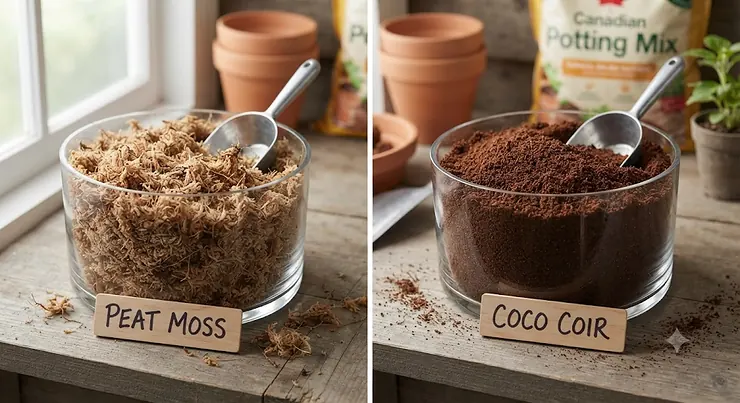
Stand in the soil aisle of any garden centre from Halifax to Kelowna in April and you’ll see it happen: someone picks up a compressed brick of peat, turns it over, puts it back, and reaches instead for a wrapped block that looks suspiciously like a coconut had a very bad day. That small hesitation is peat moss vs coco coir for potting mix playing out in real time, and it’s a bigger decision than the packaging suggests. Both materials do the same basic job — they hold water, they hold air, and they give plant roots something soft to push through — but they get there through completely different biology, and that difference shows up in your watering can, your wallet, and your conscience.
Here’s the 45-word version if you’re skimming: peat moss is decomposed sphagnum moss harvested from northern bogs, prized for its acidity and moisture-holding power but slow to renew; coco coir is a byproduct of the coconut industry, near pH-neutral, faster-draining, and marketed as the renewable alternative — though “renewable” comes with real asterisks.
This guide digs into seven real products sold in Canada, breaks down what the spec sheets actually mean for your containers, and gives you an honest verdict on where each medium earns its keep. A peat bog is a unique, valuable ecosystem in its own right, and because peat regenerates so slowly, harvesting it raises real sustainability questions — questions that CBC has reported on directly in coverage of Canadian soil experts weighing in on the practice. We’ll get into that, along with water retention, renewability, and soil acidity — the three factors that decide whether your tomatoes sulk or thrive.
Quick Comparison: Peat Moss vs Coco Coir at a Glance
| Factor | Peat Moss | Coco Coir |
|---|---|---|
| pH level | Acidic (3.5–4.5 raw) | Near-neutral (5.5–6.8) |
| Water retention | Excellent, but resists re-wetting once fully dry | Very good, re-wets easily |
| Renewability | Slow (0.5–1mm regrowth per year) | Fast (byproduct of annual coconut harvest) |
| Drainage/aeration | Moderate; compacts over time | Strong; holds structure longer |
| Typical price (CAD) | Around C$20–C$35 per bag | Around C$15–C$35 per bag or brick |
| Best for | Acid-loving plants, seed starting blends, long-term moisture | Seedlings, houseplants, sustainability-minded gardeners |
Look at that table long enough and a pattern emerges: peat moss wins on raw water-holding capacity and natural acidity, which is exactly why it’s been the backbone of commercial growing mixes for a century, but coco coir claws back ground on renewability and ease of rehydration. Neither medium is objectively “better” — the right call depends on what you’re growing and how often you’re willing to babysit the watering can. If you’re raising blueberries or azaleas, peat’s acidity does work coco coir can’t match without added sulfur; if you’re starting seeds in tiny cells that dry out fast, coco coir’s willingness to absorb water again after drying out saves you from the classic peat problem of watering that just beads up and runs off.
💬 Just one click — help others make better buying decisions too!😊
Top 7 Peat Moss & Coco Coir Products: Expert Analysis
1. PRO-MIX Premium Potting Mix — MYCOACTIVE root-boosting technology
The PRO-MIX Premium Potting Mix is the bag most Canadian gardeners have already touched without realizing it — Premier Tech’s peat comes from bogs certified under the Veriflora sustainability program, and the formula blends that peat with coconut fibre rather than picking a side in the peat-versus-coir debate. The 9L bag combines Canadian sphagnum peat moss with coir for water retention, plus a mycorrhizal inoculant that colonizes root hairs to extend their effective surface area. In practice, that means seedlings establish faster and tolerate the occasional missed watering better than they would in a straight peat mix, because the fungal network is doing extra scavenging for moisture and nutrients underground. This is the pick for gardeners who want peat’s structure without abandoning coir’s sustainability angle entirely — a hybrid approach that splits the difference rather than forcing a choice. Reviewers consistently report strong germination rates and note the mix stays fluffy rather than compacting hard after a season of watering, though a handful mention the bag runs light for the price compared to bulkier bagged soils.
Pros:
- ✅ Blends peat and coir so you get both moisture retention and renewability
- ✅ Mycorrhizae inoculant supports faster, more resilient root systems
- ✅ Sourced from Veriflora-certified sustainable peat operations
Cons:
- ❌ Smaller bag size means more frequent repurchasing for large containers
- ❌ Premium formulation costs more than straight peat or straight coir
Expect to pay in the C$15–C$20 range at the time of research, and given the added mycorrhizae and dual-medium blend, it’s a fair value for anyone who can’t decide between the two camps and would rather not.
2. Lambert Canadian Sphagnum Peat Moss — pure, OMRI-listed peat for purists
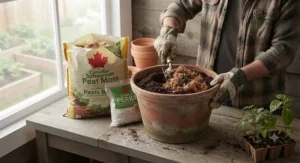
Lambert Canadian Sphagnum Peat Moss is about as close as you’ll get to the raw material itself — a 2.2 cubic foot compressed bale made entirely of Canadian sphagnum, harvested and processed by a Quebec-based producer that’s been in the business for decades. The particle size runs 0 to 10 millimetres, giving it a fine, fluffy texture once fluffed up, and the pH sits between 5.4 and 6.4 with electrical conductivity low enough that it won’t shock tender roots with salt buildup. Because this is straight peat with no additives, it’s the product to reach for when you want full control over your blend — mix it with perlite and compost yourself rather than trusting a pre-formulated bag. What most buyers overlook about single-ingredient peat like this is that it’s actually more customizable than a bagged mix, since you decide the ratios instead of the manufacturer. Aggregated reviewer sentiment points to consistent quality and a bag that expands generously once broken apart, with the recurring caveat that dry peat is genuinely dusty and benefits from a light misting before you start working with it.
Pros:
- ✅ 100% Canadian sphagnum peat, OMRI listed for organic gardening
- ✅ Low electrical conductivity reduces risk of root burn
- ✅ Compressed bale is compact and easy to store before use
Cons:
- ❌ No added perlite or nutrients — you’re building the blend yourself
- ❌ Dry peat dust requires a mask or misting during handling
Priced around C$20–C$30 for the compressed bale, this is a strong value if you’re blending your own potting soil at scale rather than buying pre-mixed bags every season.
3. HollandBasics Premium Sphagnum Peat Moss Professional Mix (HB4) — high-porosity blend with 30% perlite
HollandBasics Premium Sphagnum Peat Moss Professional Mix takes the raw-peat approach of the Lambert bale and does the blending work for you, folding in over 30% perlite for drainage plus a mycorrhizae inoculant, all balanced to a workable pH out of the bag. The 10-litre size is aimed squarely at container and indoor growers who don’t want to measure out amendments themselves. On paper, this means faster drainage than straight peat — that 30% perlite ratio is noticeably higher than most bagged mixes, which typically sit closer to 10–20% — and it shows in practice as a mix that’s harder to overwater. Based on the spec comparison with unblended peat, HB4 sacrifices a little of peat’s raw water-holding capacity in exchange for aeration, which is a reasonable trade for anyone whose past struggle has been soggy, suffocated roots rather than drought-stressed ones. It suits succulent growers, herb gardeners, and anyone repotting tropicals who’s been burned by a heavier mix before. Reviewer sentiment aggregated from garden forums and Amazon leans positive on drainage performance, with occasional notes that the perlite ratio makes it a poor match for moisture-loving ferns without extra amendment.
Pros:
- ✅ 30%+ perlite content delivers noticeably faster drainage
- ✅ Mycorrhizae and balanced pH included, ready to use
- ✅ Well suited to indoor containers prone to overwatering
Cons:
- ❌ Less moisture retention than straight peat for thirsty plants
- ❌ Perlite dust can float to the surface after repeated watering
At around C$25–C$30 for 10 litres, it lands in the mid-range and earns that price through the pre-blended convenience rather than raw material cost alone.
4. Happy Trees Coco Coir Loose Coconut Fiber Growing Medium — triple-washed, ready to plant
Happy Trees Coco Coir Loose Coconut Fiber Growing Medium ships as a loose, already-hydrated fibre rather than a compressed brick, which matters more than it sounds like it should — no soaking, no breaking apart dense blocks, just open the bag and pot up. The company triple-washes the coir specifically to strip out salt and reduce electrical conductivity, addressing coco coir’s best-known weakness: raw, unwashed coir can carry enough residual sodium and potassium to stunt sensitive seedlings. At 9 quarts (10L), it’s pH-balanced out of the bag and marketed as peat-free and organic, which lines up with what reviewers report — noticeably less “adjustment period” for plants compared to cheaper, unwashed coir bricks. What the spec sheet won’t tell you, but reviewer patterns suggest, is that loose coir like this tends to dry out slightly faster at the surface than peat-based mixes, simply because coir fibre doesn’t hold a crust the way peat can, so surface-level dryness isn’t always a sign the root zone needs water. This makes it an easy recommendation for beginner houseplant owners who want a low-fuss, peat-free medium without wrestling a brick.
Pros:
- ✅ Triple-washed for low salt and EC — safer for sensitive seedlings
- ✅ Ready to use straight from the bag, no soaking required
- ✅ Peat-free and pH-balanced for consistent plant response
Cons:
- ❌ Loose format takes up more storage space than compressed bricks
- ❌ Surface can look dry before the root zone actually needs water
Expect a price in the C$20–C$25 range, which is reasonable given the pre-washing step most competitors skip.
5. Burpee Organic Coconut Coir Concentrated Seed Starting Mix — compressed brick built for germination
Burpee Organic Coconut Coir Concentrated Seed Starting Mix ships as a dense, dehydrated brick that expands to 16 quarts once you add water — a format that solves a real problem for anyone who’s ever tried to cram a bulky bag of seed-starting mix onto a shelf over winter. Burpee is a household name in North American seed starting, and this coir-based formula leans on coconut coir for seed starting specifically because coir’s fine, uniform texture creates the kind of consistent seed-to-medium contact that improves germination rates versus chunkier peat blends. Reviewers consistently note excellent germination performance and appreciate how the compressed format stores flat until planting season actually arrives. Here’s what most buyers overlook: coir’s naturally near-neutral pH means it won’t fight most vegetable and flower seedlings the way raw acidic peat sometimes can, which is one reason coir has become the default choice for seed-starting specifically, even among gardeners who still use peat for their main containers. The trade-off is that a single brick, while concentrated, doesn’t go as far as a full bag of loose growing medium once you’re potting up more than a few dozen cells.
Pros:
- ✅ Compact dehydrated brick saves storage space until needed
- ✅ Near-neutral pH suits a wide range of vegetable and flower seeds
- ✅ OMRI-listed and well suited to organic seed-starting programs
Cons:
- ❌ One brick covers seed trays, not large containers, without buying more
- ❌ Requires a soak-and-expand step before it’s usable
Priced around C$15–C$20 per brick, it’s an efficient buy for anyone running a spring seed-starting operation on a windowsill or under grow lights.
6. General Hydroponics CocoTek Brick — chip-and-fibre blend for serious growers
Coir itself — also called coconut fibre — is extracted from the husk between a coconut’s outer coat and its hard inner shell, which is worth knowing before you buy, since it explains why quality varies so much between brands: some process the fibre more thoroughly than others. General Hydroponics CocoTek Brick targets a slightly more advanced audience — hydroponic and container growers who want to fine-tune their own aeration-to-retention ratio rather than accept a one-size-fits-all bag. The brick itself is a roughly 70% coir, 25% chip blend, meaning it combines fine coco fibre (excellent water retention) with chunkier coco chips (excellent aeration), and growers can further customize by buying separate coir-only and chip-only bricks to mix their own ratio. Based on the spec comparison with simpler loose coir products, this is the closest coco coir gets to peat-and-perlite-style customization — you’re not stuck with a fixed blend. Reviewers report strong germination rates and describe the price as reasonable for the quality, though a recurring theme in aggregated feedback is that the compressed brick needs a genuinely thorough rinse before use, since coir products in general can carry residual salts that basic soaking doesn’t always fully remove. Growers running reusable containers or hydroponic systems where salt buildup is a real long-term concern tend to rate this one highest, precisely because the coarser chip content resists compaction over multiple growing cycles better than fine coir alone.
Pros:
- ✅ Chip-and-fibre blend lets growers dial in their own aeration ratio
- ✅ Resists compaction better than fine coir alone over repeated cycles
- ✅ Popular with hydroponic growers who need consistent structure
Cons:
- ❌ Needs a thorough rinse cycle to fully clear residual salts
- ❌ More setup effort than a ready-to-use bagged mix
At roughly C$25–C$35, it sits at the premium end of this list, justified by its versatility for growers who repot or recirculate nutrients often.
7. Verdana Coco Coir Potting Soil Brick — best yield-per-dollar in this lineup
Verdana Coco Coir Potting Soil Brick is the volume play: a 10-pound compressed brick that expands to roughly 72 quarts, or 18 gallons, once fully hydrated — enough growing medium to fill a genuinely large number of containers from one compact block. It’s marketed directly as a peat moss alternative, and the core pitch is straightforward: coconut coir as a renewable resource that supports moisture retention, drainage, and aeration all at once, without the storage headache of a bulky bag of topsoil. What the spec sheet doesn’t spell out, but the yield math implies, is that this brick’s cost-per-litre of finished growing medium beats most loose bagged coir and even undercuts many peat products once you account for the sheer expansion ratio. That makes it the value pick for anyone filling raised beds, multiple large planters, or a whole balcony’s worth of pots on a budget. Reviewers describe the expansion as reliable and the texture as clean, with the honest caveat that breaking apart a fully dry 10-pound brick by hand takes real effort — a hatchet or a hose on high pressure speeds things up considerably.
Pros:
- ✅ Expands to 72 quarts from one compact 10-pound brick
- ✅ Strong cost-per-litre value for filling multiple containers
- ✅ Supports moisture retention, drainage, and aeration together
Cons:
- ❌ Fully dry brick takes real physical effort to break apart
- ❌ No added perlite or nutrients — a plain growing medium only
Expect to pay around C$20–C$25, which for 18 gallons of finished mix is one of the strongest value propositions on this list.
Top 7 Products: Side-by-Side Comparison
| Product | Type | Key Trait | Price Range (CAD) | Best For |
|---|---|---|---|---|
| PRO-MIX Premium Potting Mix | Peat + coir blend | Mycorrhizae-boosted roots | C$15–C$20 | Gardeners who want both mediums at once |
| Lambert Canadian Sphagnum Peat Moss | Pure peat | OMRI-listed, low EC | C$20–C$30 | Custom blenders and DIY mixers |
| HollandBasics HB4 | Peat + 30% perlite | High-porosity drainage | C$25–C$30 | Indoor containers prone to overwatering |
| Happy Trees Coco Coir | Loose coir | Triple-washed, low salt | C$20–C$25 | Beginner houseplant owners |
| Burpee Coco Coir Seed Starting Mix | Compressed coir brick | Fine texture for germination | C$15–C$20 | Spring seed starting |
| General Hydroponics CocoTek | Coir + chip blend | Custom aeration ratio | C$25–C$35 | Hydroponic and advanced growers |
| Verdana Coco Coir Brick | Compressed coir brick | Highest yield per brick | C$20–C$25 | Filling raised beds and multiple pots |
Scanning the table, a clear split emerges between “ready-to-use convenience” and “build-your-own-blend control.” The PRO-MIX Premium Potting Mix and Happy Trees Coco Coir sit firmly in the convenience camp, while Lambert Canadian Sphagnum Peat Moss and General Hydroponics CocoTek reward gardeners willing to do a bit of mixing themselves for a more tailored result. Budget-conscious buyers filling a lot of container volume should look hardest at Verdana Coco Coir Brick, since its expansion ratio delivers the most finished growing medium per dollar spent on this list.
Benefits vs Traditional Garden Soil
| Factor | Traditional Topsoil / Garden Soil | Peat Moss or Coco Coir Mix |
|---|---|---|
| Weight (containers) | Heavy, compacts over time | Lightweight, stays loose longer |
| Pest & pathogen risk | Higher — can carry weed seeds, soil pests | Sterile or near-sterile out of the bag |
| Drainage control | Unpredictable, varies by source | Consistent and adjustable with amendments |
| Nutrient starting point | Variable, often nutrient-poor for containers | Neutral base, easy to fertilize precisely |
| Best For | In-ground beds, large landscaping projects | Containers, raised beds, seed starting |
The takeaway here isn’t that garden soil is bad — it’s that it’s the wrong tool for container gardening specifically. Straight topsoil compacts inside a pot in a way it never would spread across an open bed, choking roots of oxygen within a season or two, whereas both peat- and coir-based mixes are engineered from the ground up (so to speak) to stay light and aerated inside a confined space. If you’re filling an in-ground vegetable bed, garden soil amended with compost is often the more economical choice; if you’re filling anything with walls — a pot, a raised bed, a hanging basket — peat or coir-based mixes earn their higher price tag through structure alone.
✨ Ready to build your own mix?
Compare current prices on the products above before you commit to a cart full of bags!
Coco Coir for Seed Starting: A Step-by-Step Setup Guide
Coco coir for seed starting has become something of a default recommendation among experienced growers, and the reasoning holds up under scrutiny. Here’s how to actually use it well, rather than just buying a brick and hoping for the best.
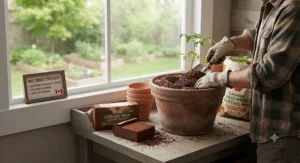
Start by rehydrating your brick in warm, not hot, water — cold water works but takes considerably longer to fully saturate a dense block. A standard 8-quart brick like the compressed format from Burpee Organic Coconut Coir Concentrated Seed Starting Mix typically needs somewhere between 20 minutes and an hour to fully expand, depending on water temperature and brick density; you’ll know it’s ready when it breaks apart easily under light hand pressure rather than resisting in dense clumps. Once expanded, fluff the coir thoroughly with your hands or a small hand rake before filling cells or trays — compacted coir straight out of the water holds too much moisture and too little air for germinating roots.
A common first-30-days mistake is over-fertilizing early: coir carries almost no nutrients of its own, which is a feature for consistent germination but means seedlings need a diluted feed (roughly quarter-strength) starting around the two-true-leaf stage rather than immediately at planting. Maintenance-wise, coir dries from the surface down more visibly than peat, so a light finger test one knuckle deep is a more reliable watering cue than eyeballing the surface colour. Optimization tip: if you’re reusing trays season to season, rinse coir residue out of cell trays between uses to prevent salt crust buildup, especially if your tap water runs hard.
Real-World Scenarios: Matching the Right Growing Medium to Your Garden
The condo balcony container gardener. If you’re growing tomatoes, herbs, and a few pollinator-friendly annuals in pots on a 4th-floor balcony with full sun exposure, weight and watering frequency both matter. A coir-based mix like Happy Trees Coco Coir rehydrates fast after you inevitably forget a watering during a busy week, and it’s noticeably lighter to haul up in bags than a peat-heavy alternative — worth considering if you’re also hauling your own soil up several flights.
The acid-loving shrub owner. Blueberries, azaleas, and rhododendrons genuinely want acidic soil in the 4.5–5.5 range, and this is where peat moss still has a real, defensible edge. Someone amending a planting bed for blueberry bushes gets more direct value from Lambert Canadian Sphagnum Peat Moss worked into the existing soil than from any coir product, since coir’s near-neutral pH does nothing to help acid-loving roots access iron and other nutrients they need in alkaline conditions.
The budget-conscious raised-bed builder. Filling three or four raised beds from scratch is expensive no matter which medium you choose, but cost-per-litre matters enormously at that scale. This is where Verdana Coco Coir Brick‘s expansion ratio does real work, stretching a modest upfront cost across a large volume of finished growing medium, especially when blended with compost to add back some of the nutrient density pure coir lacks.
How to Choose Between Peat Moss and Coco Coir
- Check what you’re actually growing. Acid-loving plants (blueberries, azaleas, camellias) genuinely benefit from peat’s natural acidity; most vegetables and houseplants do fine, or better, in coir’s neutral range.
- Think about your watering habits. If you tend to let containers dry out completely between waterings, coir re-wets far more easily than bone-dry peat, which can develop water-repellent channels.
- Factor in your environmental priorities. Coco coir uses a byproduct of an existing food crop; peat extraction draws down a slow-forming ecosystem, a distinction that matters more to some gardeners than others.
- Consider your container size and count. For large-volume needs like raised beds, look at expansion ratio and cost-per-litre, not just sticker price on the bag.
- Assess your local climate and humidity. In drier prairie climates, peat’s higher raw water-holding capacity can mean less frequent watering; in humid coastal regions, coir’s better drainage helps avoid waterlogging.
- Decide whether you want a pre-blend or a base ingredient. Ready-to-use bagged mixes save time; straight peat or straight coir bricks let you control the final ratio when combined with perlite, compost, or fertilizer.
- Weigh long-term cost against upfront price. A cheaper bag that needs more frequent replacement or more amendment purchases can end up costing more over a full growing season than a pricier, better-balanced mix.
Common Mistakes When Buying Potting Mix
Even experienced gardeners trip over a handful of recurring errors here. The first is assuming “potting mix” and “garden soil” are interchangeable — they’re formulated for completely different physical environments, and using dense garden soil in a container is one of the fastest ways to suffocate roots. The second is buying unwashed, cheap coir bricks without checking for low-EC or “triple-washed” labelling; raw coir can carry enough residual salt to stunt seedlings, and it’s a detail easy to miss when comparing prices at a glance. The third is over-hydrating peat bricks in a single soak instead of working water in gradually, which often leaves a dry, hydrophobic core at the centre of the block even after the outside looks saturated. Finally, buyers frequently skip pH testing altogether, assuming their chosen medium’s “typical” pH matches the bag exactly — actual batches vary, and a cheap pH meter or strip test avoids a season of mysteriously stressed plants.
Water Retention Head-to-Head: Peat Moss vs Coco Coir
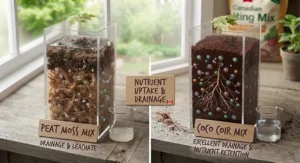
Water retention is the single most-cited factor in the peat moss vs coco coir for potting mix debate, and the honest answer is that both hold impressive amounts of water — the difference is in behaviour, not raw capacity. Peat moss can hold roughly 10 to 20 times its dry weight in water, which is genuinely remarkable, but that capacity comes with a catch: once peat fully dries out, it develops a waxy, water-repellent quality that causes water to run straight through or pool on the surface rather than soaking back in, a frustrating cycle known informally as “hydrophobic peat.” Coco coir holds slightly less water by some measures but re-wets dramatically more easily after drying, since its fibre structure doesn’t develop the same water-resistant coating. In practice, this means gardeners who are consistent, frequent waterers often get excellent results from peat, while gardeners prone to occasionally forgetting a watering cycle tend to have fewer disaster stories with coir. Neither is “wrong” — it’s a matter of matching the medium to your actual watering behaviour rather than your aspirational one.
Renewability: Why It Matters for Your Garden and the Planet
Renewability is where peat moss and coco coir diverge most sharply, and it’s worth understanding the real numbers rather than the marketing shorthand. Peat accumulates in bogs at an extraordinarily slow rate — often cited around half a millimetre to one millimetre per year — meaning a bog harvested today won’t fully regenerate on any timescale relevant to a human gardening career. Conservation groups in Canada have specifically pushed back on peat harvesting, arguing that these ecosystems matter far more than people realize for carbon storage, water filtration, and flood prevention. Coco coir, by contrast, is a byproduct of the coconut industry — husks that would otherwise be discarded or burned as waste are processed into fibre instead, meaning coir production doesn’t require dedicating new land or drawing down a slow-forming resource the way peat extraction does. That said, coir isn’t perfect either: it’s typically shipped from Sri Lanka, India, or similar producing regions, racking up transportation emissions that peat harvested and bagged within Canada often avoids. The honest verdict is that coir wins on resource renewability while peat can sometimes win on transportation footprint, depending on where you live relative to Canadian peat bogs versus overseas coir processing.
Sustainable Alternatives to Peat Moss You Should Know About
If neither peat nor coir feels like a perfect fit, several other sustainable alternatives to peat moss are worth a look, and Canadian industry itself is actively working on this problem. Researchers across Canada, including scientists at Nipissing University and Brandon University, have been transporting healthy peat by helicopter to restore peatlands previously destroyed by mining, using a moss layer transfer technique that has successfully restored peatland in about 12 years in other locations. That kind of active restoration work is a meaningful counterweight to extraction, even if it doesn’t erase the underlying slow-renewal problem.
On the home-garden side, well-made compost is arguably the most sustainable amendment available, since it’s often produced from kitchen and yard waste that would otherwise head to landfill, though it lacks peat’s and coir’s fine, uniform texture for seed starting specifically. Composted leaf mould offers similar benefits with an even lower footprint, built entirely from fallen leaves broken down over a season or two. Aged pine bark fines, a byproduct of the lumber industry, provide excellent drainage and slow-release acidity, making them a reasonable stand-in for peat in mixes for acid-loving plants when peat feels like the wrong environmental trade-off. None of these fully replicate peat’s specific water-holding chemistry on their own, which is why many commercial “peat-free” mixes — including several products on this list — blend multiple alternatives together rather than relying on a single substitute.
Soil Acidity Explained: pH Differences That Affect Plant Growth
Soil acidity is measured on the same 0–14 pH scale you likely remember from a high school chemistry class, with 7 being neutral, lower numbers acidic, and higher numbers alkaline. Raw peat moss typically sits in the 3.5 to 4.5 range straight out of the bag — genuinely acidic — though most commercial peat-based potting mixes buffer that down closer to 5.5–6.5 with added lime, since most common vegetables and flowers prefer something closer to neutral. Coco coir sits naturally higher, typically 5.5 to 6.8, requiring little to no adjustment for the majority of plants. This distinction matters practically because pH controls nutrient availability at the root level — even a nutrient-rich mix can leave plants deficient if the pH locks certain minerals into a form roots can’t absorb. Acid-loving specialists like blueberries, azaleas, camellias, and many conifers specifically need that lower pH range to access iron and manganese properly, which is the clearest scenario where reaching for peat, or a peat-heavy blend, still makes practical sense over a coir-only approach.
Long-Term Cost & Maintenance: Peat Moss vs Coco Coir
Sticker price only tells part of the story here. A compressed coir brick often looks cheaper per unit than a bag of peat mix, but its expansion ratio changes the real cost-per-litre math considerably — a product like Verdana Coco Coir Brick, expanding to 18 gallons from a compact 10-pound block, can undercut peat on a per-litre basis even at a similar sticker price. Maintenance costs matter too: peat-heavy mixes that compact over a season may need more frequent replacement or aeration amendments like perlite, while coir tends to hold its structure longer across multiple growing cycles, particularly chip-blended products like General Hydroponics CocoTek. On the other side of the ledger, coir products with lower quality control sometimes carry hidden costs in the form of buffering agents or extra rinsing needed to manage salt content, an ongoing maintenance step that doesn’t show up on the price tag. Total cost of ownership, in other words, depends less on which medium you pick and more on how well-processed the specific product is — which is exactly why brand and washing/certification details matter as much as the peat-versus-coir label itself.
Frequently Asked Questions
❓ Is coco coir better than peat moss for potting mix?
❓ Can you mix peat moss and coco coir together?
❓ Does coco coir need to be rinsed before use?
❓ Why is peat moss considered unsustainable?
❓ What is the best potting mix for seed starting, peat or coco coir?
Conclusion
There’s no universal winner in peat moss vs coco coir for potting mix — there’s only the right medium for your specific plants, watering habits, and priorities. If you’re growing acid-loving shrubs or you consistently water on a tight schedule, peat products like Lambert Canadian Sphagnum Peat Moss or HollandBasics HB4 still earn their spot on the shelf. If renewability weighs heavily on your decision, or you’re starting seeds where coir’s neutral pH and consistent texture shine, options like Burpee Organic Coconut Coir Concentrated Seed Starting Mix or Happy Trees Coco Coir make more sense. And if you’d rather not choose sides at all, hybrid products like PRO-MIX Premium Potting Mix split the difference deliberately. Whichever direction you lean, the seven products covered here represent real, currently available options across the budget-to-premium range — check current prices before you buy, since availability and pricing shift regularly on Amazon.ca. Affiliate disclosure: this article contains affiliate links, and purchases made through them may earn a small commission at no extra cost to you.
✨ Don’t Miss These Exclusive Deals!
🌱 Take your container garden to the next level with the growing mediums covered above. Click through to check current pricing and availability, and give your seedlings, houseplants, and raised beds the healthy start they deserve!
Recommended for You
- Bagged Compost for Gardens: 7 Best Picks; Buying Guide (2026)
- Compost vs Garden Soil for Vegetable Beds: 7 Best Picks (2026)
- Garden Soil for Raised Beds: 7 Top Picks for 2026
Disclaimer: This article contains affiliate links. As an Amazon Associate, I earn from qualifying purchases. If you purchase products through these links, we may earn a small commission at no additional cost to you.
✨ Found this helpful? Share it with your friends! 💬🤗
