
In This Article
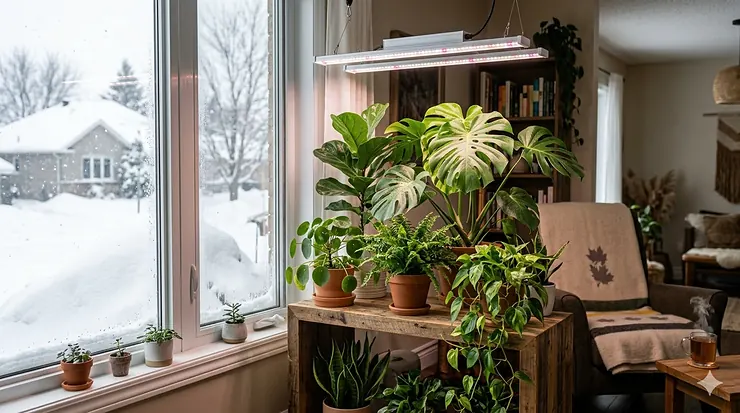
Picture this: it’s mid-January in Toronto, the sun sets before 5 PM, and your once-thriving fiddle leaf fig looks more dejected than enthusiastic. You’re not imagining things—your houseplants are genuinely struggling with Canada’s notoriously dark winter months.
Winter grow lights for indoor plants have become essential for Canadian plant parents who refuse to watch their green companions enter dormancy or, worse, slowly decline during our extended periods of limited natural light. From Vancouver’s grey skies to Montreal’s short winter days, supplemental lighting for dark Canadian winters isn’t just a luxury anymore—it’s a necessity for keeping your indoor jungle thriving year-round.
The science backs this up. According to Space for Life, most foliage plants require 12 to 14 hours of light daily, whilst flowering plants need 14 to 15 hours to initiate blooming. From November to February, as our days shrink and natural light levels plummet, indoor plants show unmistakable signs of distress: stretched stems, faded leaves, and that telltale yellowish tinge that makes every plant lover’s heart sink.
But here’s the good news: modern LED technology has revolutionised how we provide grow lights for seasonal affective disorder plants. Today’s options are energy-efficient, affordable, and sophisticated enough to mimic the sun’s full spectrum—all whilst fitting seamlessly into your home décor. Whether you’re nurturing succulents in a basement apartment or cultivating herbs in a condo kitchen, there’s a photoperiod extension technique perfectly suited to your space and budget.
Quick Comparison Table: Top Winter Grow Lights 📊
| Product | Type | Coverage | Power | Price (CAD) | Best For |
|---|---|---|---|---|---|
| Spider Farmer SF1000D | Panel | 2×2 ft | 100W | $119-$209 | Budget-friendly full coverage |
| SANSI 36W BR30 | Bulb | Single plant | 36W | $45-$65 | Individual plants, easy setup |
| Mars Hydro TS1000 | Panel | 3×3 ft | 150W | $150-$199 | Mid-range, excellent efficiency |
| FECiDA 3-Head Stand | Floor lamp | Large plants | 75W | $129-$169 | Tall houseplants, adjustable |
| GooingTop Dual Clip | Clip-on | Small area | 20W | $35-$55 | Seedlings, desk plants |
| Barrina T5 4-Pack | Strip | Shelving | 40W | $60-$85 | Plant shelves, multiple tiers |
| Mars Hydro TSL2000 | Panel | 4×2 ft | 300W | $270-$349 | Serious growers, large collections |
💬 Just one click – help others make better buying decisions too!😊
Top 7 Winter Grow Lights for Indoor Plants: Expert Analysis 🌟
1. Spider Farmer SF1000D – Best Budget Full-Spectrum Panel
The Spider Farmer SF1000D has earned its reputation as Canada’s go-to entry-level grow light for good reason. This compact powerhouse delivers professional-grade performance without the intimidating price tag that usually accompanies quality grow lighting.
Key Specifications:
- 100W actual power draw (replaces 200W traditional lighting)
- Samsung LM301H EVO or Bridgelux diodes (2026 models)
- Dimmable from 0-100% via external knob
- Coverage: 2×2 ft flowering, 3×3 ft vegetative
- Full spectrum: 3000K, 5000K, 660nm red, IR 760nm
Canadian Pricing & Availability: Currently available on Amazon.ca for CAD $119.99-$209.99 depending on configuration. Ships from Canadian warehouses with 3-5 business day delivery. Spider Farmer maintains a service centre in Canada, which means warranty claims are handled domestically—a significant advantage over import-only brands.
Customer Feedback from Canadian Buyers: Ottawa-based growers consistently praise the SF1000D’s silent operation and minimal heat output, crucial for apartment dwellers. One Vancouver customer reported their basil and cilantro production tripled during winter months after switching from window-only growing.
✅ Pros:
- Exceptional value for money
- Zero fan noise (passively cooled)
- 5-year warranty with Canadian support
- Energy efficient—runs for pennies per day
❌ Cons:
- Basic mounting hardware included
- No built-in timer (requires separate purchase)
2. SANSI 36W BR30 Full Spectrum Bulb – Easiest Setup for Beginners
For Canadians who want to dip their toes into supplemental lighting for dark Canadian winters without committing to a full grow light system, the SANSI 36W BR30 represents the perfect starting point. Simply screw it into any standard E26 socket, and you’re providing professional-quality light within seconds.
Key Specifications:
- 36W power consumption (400W incandescent equivalent)
- Patented COC (Chip on Ceramic) technology
- PPFD: 265.58 μmol/s/m² at 1 ft distance
- PPF: 65.6 μmol/s
- 4000K colour temperature (natural sunlight simulation)
- Fits standard lamp fixtures
Canadian Pricing & Availability: Available on Amazon.ca for CAD $45-$65. Multiple wattage options (15W, 24W, 36W) allow you to match the bulb to your plant’s needs and your space constraints.
Customer Feedback from Canadian Buyers: Toronto apartment dwellers love how these bulbs integrate into existing floor lamps and desk fixtures, providing extending daylight hours for houseplants without requiring wall mounts or stands. The natural-looking white light means they function as reading lamps too.
✅ Pros:
- No installation required
- Works in existing fixtures
- Low heat output—safe for close placement
- 25,000-hour lifespan
- ETL listed for Canadian safety standards
❌ Cons:
- Limited to single-plant coverage
- Higher per-watt cost than panel systems
3. Mars Hydro TS1000 – Best Mid-Range Performance
The Mars Hydro TS1000 strikes that coveted balance between affordability and professional-grade features that makes it a favourite among Canadian indoor gardeners transitioning from casual hobby to serious cultivation.
Key Specifications:
- 150W actual power draw
- 354 premium LEDs
- Patented reflector design (increases efficiency by 25%)
- Full spectrum: 730-740nm red IR, 3200-4200K, 5200-6800K
- Dimmable 0-100% + daisy-chain capability
- Coverage: 2.5×2.5 ft core, 3×3 ft maximum
Canadian Pricing & Availability: Listed on Amazon.ca for CAD $150-$199. Mars Hydro operates Canadian fulfilment centres, ensuring fast delivery across all provinces and territories.
Customer Feedback from Canadian Buyers: Manitoba greenhouse hobbyists report exceptional results with cold-hardy herbs and microgreens throughout winter. The dimming feature allows gradual light adjustment, which helps prevent shock when transitioning plants from natural to artificial light as autumn approaches.
✅ Pros:
- Superior light uniformity
- Daisy-chain up to 50 units
- Excellent heat dissipation
- Perfect for 2×2 or 3×3 grow tents
❌ Cons:
- Heavier than clip-on alternatives
- Requires ceiling hooks or suspension system
4. FECiDA 3-Head Standing Grow Light – Best for Large Houseplants
Tall fiddle leaf figs, monstera deliciosas, and other statement plants need comprehensive coverage from multiple angles. The FECiDA 3-Head Standing Grow Light was engineered specifically for dormancy prevention lighting in large, floor-standing specimens.
Key Specifications:
- 75W total power (25W per head)
- 624 LEDs across three heads
- 7,500 lumen brightness
- Height-adjustable: 24-76 inches
- 4/8/12/16/20 hour timer options
- Stable tripod base design
Canadian Pricing & Availability: Amazon.ca pricing ranges CAD $129-$169 depending on promotions. Free shipping within Canada on most orders.
Customer Feedback from Canadian Buyers: Calgary residents with vaulted ceilings appreciate the adjustable height, whilst Edmonton customers note the stable base doesn’t tip even with curious cats investigating. The multiple timer settings mean you can programme it once and trust it through the entire winter season.
✅ Pros:
- Independent head positioning
- No wall mounting required
- Covers tall plants effectively
- Built-in timer eliminates need for external controls
❌ Cons:
- Footprint requires floor space
- Not ideal for shelving units
5. GooingTop Dual-Head Clip-On – Best Budget Clip Light
Sometimes you just need targeted short day winter plant care for a few seedlings or a desktop succulent collection. The GooingTop Dual-Head Clip-On delivers precisely that without unnecessary complexity or expense.
Key Specifications:
- 20W dual-head configuration
- 84 LEDs (74 white + 10 red)
- 6000K full spectrum
- 5-level dimming (10%-100%)
- 4/8/12 hour timer
- 360-degree flexible goosenecks
Canadian Pricing & Availability: Exceptionally affordable at CAD $35-$55 on Amazon.ca. Ships quickly within Canada, often arriving within 2-3 business days in urban areas.
Customer Feedback from Canadian Buyers: Quebec apartment dwellers praise the compact design for tight spaces, whilst Nova Scotia gardeners use multiple units along plant shelves for even photoperiod extension techniques across their entire collection.
✅ Pros:
- Extremely affordable
- USB-powered option available
- Strong clip grips various surfaces
- Ideal for renters (no permanent installation)
❌ Cons:
- Limited coverage area
- Goosenecks may droop over time with heavier heads
6. Barrina T5 4-Pack – Best for Shelf Growing
Canadian plant enthusiasts with IKEA Fabrikor cabinets or custom shelving systems have found their perfect match in the Barrina T5 4-Pack. These streamlined strips transform any bookshelf into a proper growing station for extending daylight hours for houseplants throughout winter.
Key Specifications:
- 40W total (4 × 10W tubes)
- 200 LEDs delivering 95%+ absorption efficiency
- Linkable up to 16 units
- Individual on/off switches per tube
- 2ft length fits standard shelving
- Includes mounting clips, double-sided tape, cable ties
Canadian Pricing & Availability: Available on Amazon.ca for CAD $60-$85 per 4-pack. Barrina ships from Canadian warehouses, supporting fast delivery and straightforward returns if needed.
Customer Feedback from Canadian Buyers: British Columbia indoor herb gardeners report impressive basil, cilantro, and parsley growth using these lights on 12-hour timers. Saskatchewan customers appreciate the separate switches, allowing them to adjust light intensity across different shelf levels based on plant maturity.
✅ Pros:
- Perfect for IKEA greenhouse cabinets
- Linkable design simplifies wiring
- Cool operation—won’t overheat enclosed spaces
- Multiple installation methods included
❌ Cons:
- Requires timer purchase separately
- Fixed length limits placement flexibility
7. Mars Hydro TSL2000 – Best for Serious Growers
When you’ve graduated from casual plant parent to devoted indoor gardener with a substantial collection, the Mars Hydro TSL2000 represents the logical next step in your supplemental lighting for dark Canadian winters journey.
Key Specifications:
- 300W actual consumption
- 704 premium LEDs
- Optimised diode layout (dense centre, sparse edges)
- 120-degree white reflector (patented design)
- Coverage: 4×2 ft flowering, 5×3 ft vegetative
- Full spectrum with enhanced red IR (730-740nm)
- Daisy-chainable with external dimming
Canadian Pricing & Availability: Investment-tier pricing at CAD $270-$349 on Amazon.ca. Despite the higher upfront cost, Canadian customers report 50% energy savings compared to equivalent HID lighting, resulting in recovered investment within 12-18 months of year-round use.
Customer Feedback from Canadian Buyers: Alberta greenhouse owners transitioning from natural light supplementation to year-round production cite the TSL2000 as transformative. Ontario microgreen farmers report consistent germination and rapid growth regardless of external weather conditions.
✅ Pros:
- Professional-grade performance
- Even PPFD distribution eliminates hot spots
- Substantial energy savings vs traditional lighting
- Suitable for commercial-scale home growing
❌ Cons:
- Significant upfront investment
- Overkill for casual hobbyists
- Requires proper ventilation in enclosed spaces
Understanding Winter Light Deficiency in Canadian Climates ❄️
The Canadian winter presents unique challenges that extend far beyond simply shorter days. According to data from the Sollum Technologies white paper on seasonal variation, greenhouse growers across Canada must contend with exceedingly variable light quality and quantity throughout the year.
In Toronto, for instance, we experience approximately 16 hours of daylight in June versus a mere 9 hours in December. But it’s not just about duration—the solar incidence angle drops dramatically during winter months, meaning even the light we do receive arrives at oblique angles that reduce its photosynthetic effectiveness.
Think about it this way: that beautiful south-facing window that bathes your monstera in glorious light all summer? Come January, the sun’s trajectory has shifted so dramatically that the same window might deliver only 20-30% of the photosynthetically active radiation (PAR) your plant actually requires. Research from plantlightdb.com confirms that most houseplants need a daily light integral (DLI) of 10-20 mol/m²/day, yet Canadian winter windows often provide less than 5 mol/m²/day even on clear days.
This dramatic reduction triggers several stress responses in our indoor plants. Stems elongate as plants desperately search for more light (a phenomenon botanists call etiolation). Chlorophyll production decreases, leading to that characteristic pale, yellowish foliage. Variegated varieties may lose their distinctive patterns entirely. Flowering plants refuse to bloom, whilst others drop leaves to conserve energy during perceived harsh conditions.
The psychological impact on plants mirrors what many Canadians experience: a form of seasonal affective disorder that affects growth, metabolism, and overall vitality. Just as we might reach for vitamin D supplements or light therapy lamps, our plants desperately need photoper
iod extension techniques to maintain their health through our prolonged dark season.
The Science Behind Photoperiod and Plant Growth 🔬
Plants don’t simply use light for photosynthesis—they rely on precise measurements of day length (photoperiod) to regulate critical life processes. According to research published in Trends in Plant Science, plants distinguish different photoperiods to independently control seasonal flowering and growth.
Here’s where it gets fascinating: plants don’t actually measure daylight hours. Instead, they measure darkness. Specialised photoreceptors called phytochromes detect the ratio of red to far-red light, allowing plants to determine both the time of day and the season. During extended darkness periods (like our Canadian winters), phytochrome gradually converts from its active form (Pfr) to its inactive form (Pr). By detecting this ratio at dawn, plants can accurately gauge night length and adjust their physiology accordingly.
This sophisticated sensing system controls everything from flowering initiation to dormancy preparation. Short-day plants (like chrysanthemums and poinsettias) require long nights to trigger blooming. Long-day plants (such as spinach and lettuce) need short nights and extended light periods to flower. Day-neutral plants ignore photoperiod cues entirely, responding instead to temperature or maturity.
For Canadian indoor gardeners, understanding these mechanisms is crucial. When we provide winter grow lights for indoor plants, we’re not merely supplying energy for photosynthesis—we’re actively managing our plants’ biological clocks. By manipulating photoperiod, we can prevent unwanted dormancy, encourage year-round flowering, or even accelerate growth cycles.
The research team at P.L. Light Systems explains that proper photoperiodic lighting requires surprisingly low intensity—just 1-2 μmol/m²/s. This is bright enough for plants to perceive but far below photosynthetic thresholds. In practical terms, this means even modest supplemental lighting can profoundly impact plant behaviour, making winter cultivation more accessible than many Canadians realise.
How to Choose the Right Grow Light for Your Space 🏠
Selecting appropriate winter grow lights for indoor plants requires matching technology to your specific circumstances. Let me walk you through the decision-making process I use when consulting with Canadian plant enthusiasts.
Consider Your Space Configuration
Basement apartments with limited natural light need fundamentally different solutions than condos with south-facing windows requiring only evening supplementation. Measure your available vertical clearance, floor space, and electrical outlet accessibility before browsing products. A stunning floor-standing lamp means nothing if your ceiling height won’t accommodate it.
Calculate Your Actual Coverage Needs
Manufacturers often list two coverage figures: vegetative and flowering. For most houseplants, you’ll reference the vegetative number. A single 2×2 ft panel might adequately serve four medium plants clustered together, whilst sprawling specimens like philodendrons might demand 3×3 ft coverage despite being technically “one plant.”
Match Light Intensity to Plant Requirements
Low-light tolerant plants (pothos, snake plants, ZZ plants) thrive with 50-150 μmol/m²/s PPFD. Medium-light plants (most common houseplants) prefer 150-300 μmol/m²/s. High-light demanding species (fiddle leaf figs, citrus, herbs) need 300-600 μmol/m²/s. Check manufacturer specifications for PPFD values at typical mounting distances.
Evaluate Spectrum Requirements
Full-spectrum lights (3000K-6500K) work universally well and produce natural-looking white light that won’t turn your living room purple. Targeted spectrum lights with enhanced red (660nm) and blue (435nm) maximise photosynthetic efficiency but create that distinctive purple glow many find aesthetically objectionable in living spaces.
Factor in Canadian Electrical Costs
Ontario residents paying $0.12-0.18/kWh will spend approximately $1.30-1.95 monthly running a 100W light 12 hours daily. British Columbia’s lower rates mean the same usage costs roughly $0.85-1.15 monthly. Calculate operating costs based on your provincial electricity rates to avoid billing surprises.
Assess Installation Complexity
Renters should prioritise clip-on, freestanding, or bulb-based solutions requiring no permanent mounting. Homeowners can consider panel systems with ceiling suspension, though remember that proper positioning may require moving lights as plants grow.
Consider Timer Integration
Plants require consistent photoperiods to maintain healthy circadian rhythms. Lights with built-in timers eliminate daily manual operation, whilst basic models require separate timer plugs (typically CAD $12-20 on Amazon.ca).
Optimal Light Duration and Timing for Canadian Winters ⏰
Determining appropriate photoperiod for extending daylight hours for houseplants requires understanding both plant biology and Canadian seasonal patterns. After consulting with numerous Canadian growers and reviewing academic research, I’ve developed these evidence-based recommendations.
Standard Photoperiods by Plant Category
Most foliage houseplants thrive with 12-16 hours of supplemental light during winter months. I typically programme timers for 14 hours, providing a comfortable middle ground that satisfies both moderate and high-light species. Flowering plants need more nuanced approaches—long-day bloomers like African violets benefit from 14-16 hours, whilst short-day plants like Christmas cacti require careful dark period management to trigger flowering.
Herbs and edibles demand generous light exposure. Basil, cilantro, and lettuce flourish under 16-18 hour photoperiods, essentially replicating summer conditions year-round. Tomatoes and peppers grown indoors appreciate 14-16 hours during vegetative growth, though fruiting may require spectrum adjustments rather than duration changes.
Timing Your Light Schedule
Rather than running lights during natural darkness hours only, consider complementary scheduling. If your south window receives decent morning light, programme grow lights for late afternoon through evening, effectively extending the day from both ends. This approach maximises total DLI whilst minimising electricity consumption.
For windowless spaces or north-facing rooms, run lights continuously during your waking hours. The psychological benefit of plants thriving under full illumination when you’re home to enjoy them shouldn’t be underestimated—winter is depressing enough without watching plants struggle in darkness.
Seasonal Adjustments
I recommend gradually increasing photoperiod as we approach winter solstice (December 21), then slowly decreasing as spring approaches. This mimics natural seasonal transitions, preventing shock whilst ensuring adequate light throughout the darkest months. Start with 12 hours in October, increase to 14-16 hours November through February, then taper back to 12 hours by April as natural light returns.
The Importance of Consistent Darkness
Plants require uninterrupted dark periods for proper metabolic function. Phytochrome conversion happens during sustained darkness, triggering essential growth processes. Avoid “checking on” plants mid-dark cycle or positioning grow lights where they’re disrupted by ambient room lighting after programmed shutdown.

Common Mistakes Canadian Growers Make (And How to Avoid Them) ⚠️
After years observing Canadian indoor gardeners, certain patterns emerge repeatedly. Let me save you from these frustrating experiences.
Mistake #1: Inadequate Light Intensity
Many first-time buyers underestimate how much light plants actually require. That charming 10W clip light looks substantial but delivers perhaps 50-100 μmol/m²/s PPFD at best—insufficient for anything beyond low-light tolerant species. Solution: Check manufacturer PPFD specifications and compare against your plant’s documented requirements. When in doubt, oversize slightly.
Mistake #2: Incorrect Mounting Distance
Positioning lights too far reduces PPFD exponentially. A light delivering 400 μmol/m²/s at 12 inches might only provide 100 μmol/m²/s at 24 inches. Conversely, mounting too close risks heat damage (though less common with modern LEDs) and light burn. Solution: Follow manufacturer guidelines for height adjustment, then monitor plants for signs of stress requiring repositioning.
Mistake #3: Neglecting Spectrum Considerations
All full-spectrum lights aren’t created equally. A “full spectrum” bulb emphasising 6500K (cool white) promotes compact, bushy growth but may inhibit flowering in species requiring red-spectrum dominance. Solution: Match spectrum to growth stage—bluer light for vegetative development, enhanced red for flowering and fruiting.
Mistake #4: Forgetting Humidity Management
Grow lights increase transpiration rates, which in Canadian winter conditions (already brutally dry from forced-air heating) can stress plants severely. Solution: Pair supplemental lighting with humidity management. Group plants together, use pebble trays, or invest in a small humidifier to maintain 40-60% relative humidity.
Mistake #5: Inconsistent Photoperiods
Manually operating lights leads to irregular schedules that confuse plant circadian rhythms. Missing even a single day disrupts photoperiod responses and can abort flowering processes. Solution: Use timers religiously. Even basic mechanical timers (CAD $12 on Amazon.ca) eliminate this issue entirely.
Mistake #6: Ignoring Heat Accumulation
Though LEDs run cooler than legacy technologies, heat still accumulates in enclosed spaces. Grow tents, cabinets, and smaller rooms can see temperature spikes of 5-8°C with lights operating. Solution: Ensure adequate ventilation, particularly in confined growing environments. A small circulation fan often suffices.
Energy Efficiency and Cost Analysis for Canadian Users 💰
Understanding operational costs helps Canadian growers make informed decisions about winter grow lights for indoor plants. Let me break down the numbers using current provincial electricity rates.
Calculating Monthly Operating Costs
The formula is straightforward: (Wattage ÷ 1000) × Hours per day × Days per month × Cost per kWh = Monthly cost
Example using a 100W light running 14 hours daily in Ontario (averaging $0.15/kWh): (100 ÷ 1000) × 14 × 30 × 0.15 = $6.30 monthly
The same scenario in British Columbia ($0.10/kWh): $4.20 monthly In Alberta ($0.13/kWh): $5.46 monthly In Quebec ($0.08/kWh): $3.36 monthly
Comparative Efficiency: LED vs Legacy Technologies
Traditional fluorescent T5 tubes consuming 54W to produce 5,000 lumens compare poorly to modern LEDs producing equivalent output at 24W. Over a six-month Canadian winter (October-March), this difference means:
- T5 fluorescent: (54 ÷ 1000) × 14 × 180 × 0.15 = $20.41
- LED equivalent: (24 ÷ 1000) × 14 × 180 × 0.15 = $9.07
- Savings: $11.34 per fixture per winter
Multiply this across multiple lights, and LED upgrades pay for themselves remarkably quickly.
Hidden Costs to Consider
Don’t forget replacement cycles. Quality LED grow lights last 50,000+ hours (roughly 10 years at 14 hours daily), whilst fluorescent tubes need replacing every 10,000-20,000 hours. Factor CAD $15-30 per tube replacement × multiple fixtures over a decade, and LED’s initial premium becomes negligible.
Provincial Incentives and Rebates
Several Canadian provinces offer residential energy efficiency rebates that may apply to LED grow light purchases. Check your provincial utilities commission website—British Columbians might qualify through BC Hydro programmes, whilst Ontarians should investigate Enbridge incentives. Savings of 10-30% aren’t uncommon.
Return on Investment
Consider the alternative: replacing struggling plants costs CAD $20-200+ depending on species and maturity. A $120 grow light that keeps five $40 plants thriving through winter achieves ROI immediately, before even calculating grocery savings from year-round herb cultivation.
Maintaining Optimal Growing Conditions Beyond Light 🌱
Supplemental lighting for dark Canadian winters represents just one component of successful indoor cultivation. Let me share the supporting factors that separate thriving plants from merely surviving ones.
Humidity: The Often-Forgotten Factor
Canadian winter indoor humidity commonly drops to 15-25%—desert levels that stress tropical houseplants accustomed to 50-70% humidity. Symptoms include crispy leaf edges, brown tips, and increased susceptibility to spider mites (which proliferate in dry conditions).
Solutions range from simple to sophisticated. Grouping plants creates a microclimate through collective transpiration. Pebble trays filled with water (ensuring pots don’t sit directly in water) provide localised humidity. For serious collectors, a small humidifier (CAD $40-80 on Amazon.ca) effectively maintains 50% relative humidity in average-sized rooms.
Temperature Consistency
Most houseplants appreciate temperatures between 18-24°C, with a slight nighttime decrease (3-5°C lower) mimicking natural diurnal rhythms. Canadian homes typically meet these requirements, but watch for cold drafts near windows and doors, or excessive heat near radiators and forced-air vents.
I position sensitive species like calatheas and ferns away from heating vents, whilst heat-lovers such as succulents and cacti tolerate (even prefer) warmer, drier microclim
ates near south-facing windows.
Watering Adjustments
Grow lights increase plant metabolic activity and transpiration rates, often requiring more frequent watering than plants would need relying on natural winter light alone. However, don’t fall into the trap of automatic daily watering. Always check soil moisture 2-3 inches deep—overwatering kills more houseplants than any other factor.
Canadian tap water warrants consideration too. Most municipal water contains chlorine and fluoride at levels tolerated by humans but potentially stressful for sensitive species. Letting tap water sit overnight allows chlorine to evaporate, whilst water-softener users might consider RO (reverse osmosis) filtration for particularly finicky plants.
Fertilisation During Extended Photoperiods
Plants grown under 14-16 hour photoperiods maintain active growth throughout winter, unlike naturally dormant specimens. This continued growth demands ongoing nutrient supply. I fertilise at half-strength every two weeks November through March, using balanced formulations (10-10-10 or 20-20-20) for foliage plants and bloom-boosting ratios (5-10-10) for flowering species.
Organic options like fish emulsion, seaweed extract, or compost tea work beautifully for Canadians preferring natural approaches. Whatever fertiliser you choose, follow the “less is more” philosophy—overfeeding causes more damage than light underfeeding.

Frequently Asked Questions ❓
❓ How many hours of grow light do houseplants need during Canadian winters?
❓ What is the best colour temperature for winter grow lights in Canada?
❓ Can I use regular LED bulbs instead of specialised grow lights?
❓ How close should grow lights be positioned to plants?
❓ Are grow lights safe to run continuously during Canadian winters?
Conclusion: Thriving Through Canadian Winters 🌿
Winter grow lights for indoor plants have transformed how Canadian plant enthusiasts approach the challenging months between October and March. What was once a period of anxious plant survival has become an opportunity for year-round cultivation, extended harvests of fresh herbs, and the satisfaction of watching tropical specimens flourish despite snowdrifts outside our windows.
The technology has never been more accessible. Quality full-spectrum LED systems now cost less than a dinner for two, consume minimal electricity, and last a decade or more with proper care. Whether you’re protecting a cherished fiddle leaf fig in downtown Toronto, cultivating microgreens in a Montreal apartment, or maintaining a collection of succulents through Prairie winters, there’s a supplemental lighting solution perfectly matched to your space, budget, and ambitions.
Start with your specific needs. A single plant needs only a bulb-style solution like the SANSI BR30. Small collections thrive under clip lights or compact panels. Serious growers benefit from professional systems offering precise control over photoperiod and intensity. Whatever you choose, the investment in dormancy prevention lighting pays dividends in plant health, personal satisfaction, and the simple joy of greenery thriving regardless of what’s happening outside.
Remember that successful winter growing extends beyond just lighting. Maintain appropriate humidity levels, adjust watering for increased metabolic activity, provide balanced nutrition, and monitor for pests that exploit stressed plants. Think of grow lights as one tool in a comprehensive toolkit that keeps your indoor jungle flourishing year-round.
The Canadian winter doesn’t have to mean plant dormancy or decline. With the right winter grow lights for indoor plants, extending daylight hours for houseplants becomes straightforward, affordable, and remarkably effective. Your plants will reward your efforts with lush foliage, vibrant blooms, and the kind of robust growth that makes visitors ask, “How do you keep everything so green in the middle of winter?”
Now you know the secret. Happy growing! 🍁
Recommended for You 📚
- Electricity Cost Running Grow Lights: 7 Best Options Canada 2026
- 7 Best Cheap vs Expensive Grow Lights Worth It (Canada 2026)
- How to Set Up Grow Lights Safely: 7 Fire Prevention Tips Canada 2026
✨ Don’t Miss These Exclusive Deals!
🔍 Take your indoor gardening to the next level with these carefully selected products available in Canada. Click on any highlighted item to check current pricing and availability on Amazon.ca. These tools will help you create an authentic indoor jungle your friends will envy through the darkest winter months!
Disclaimer: This article contains affiliate links to Amazon.ca. If you purchase products through these links, we may earn a small commission at no additional cost to you.
✨ Found this helpful? Share it with your friends! 💬🤗
