
In This Article
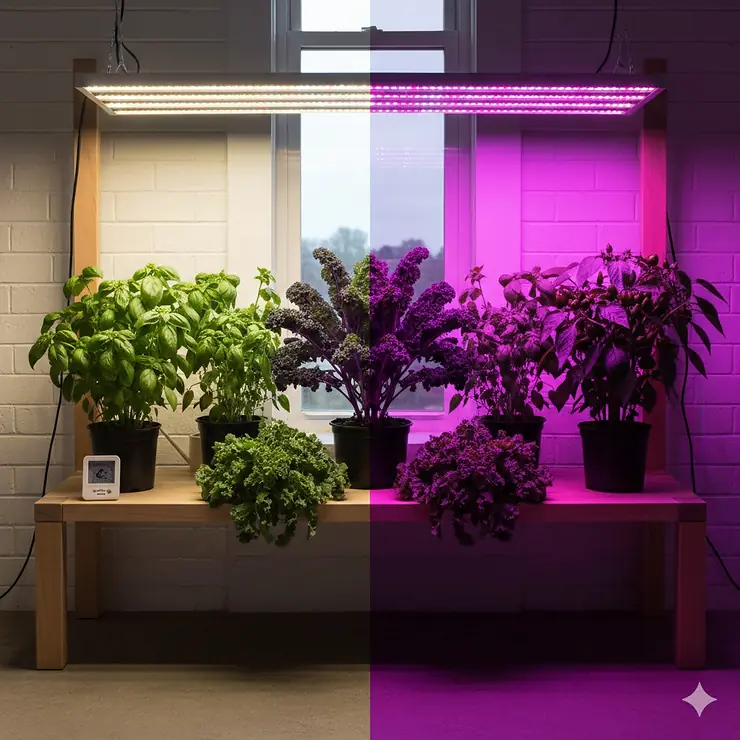
When I first dived into indoor gardening three years ago, I stood in my basement staring at two very different grow lights—one glowing with a natural white light, the other casting everything in an eerie purple-pink hue. The question of full spectrum vs purple grow lights which is better consumed my research for weeks. After testing both types across multiple grow seasons and speaking with dozens of Canadian growers, I’ve learned that the answer isn’t as simple as picking one over the other.
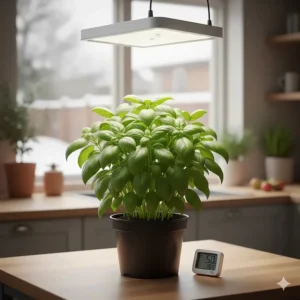
The purple lights (affectionately called “blurple” by the community) dominated the LED market for nearly a decade. They promised efficiency by targeting only the red and blue wavelengths that chlorophyll absorption spectrum data showed plants needed most. Full spectrum lights, on the other hand, mimic natural sunlight and include green, yellow, and other wavelengths that older research suggested plants “wasted.”
Here’s the twist: both can grow phenomenal plants. The real question is which suits your specific growing situation, budget, and plant goals. In Canada’s unique climate where natural light can be scarce for months, choosing the right grow light becomes even more critical. Whether you’re cultivating herbs on a kitchen shelf in Toronto or running a dedicated grow tent in Vancouver, understanding photosynthetically active radiation and how different spectrums affect vegetative vs flowering light needs will transform your results.
This guide cuts through the marketing hype with real data, actual Canadian product options available on Amazon.ca with CAD pricing, and honest assessments of when each light type excels. By the end, you’ll know exactly which technology deserves your investment.
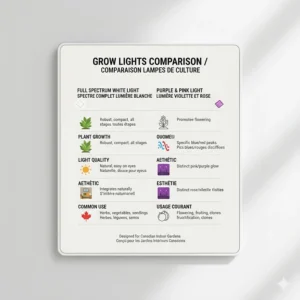
Quick Comparison Table: Full Spectrum vs Purple Grow Lights 📊
| Feature | Full Spectrum (White LED) | Purple/Blurple Grow Lights |
|---|---|---|
| Light Appearance | Natural white/warm glow | Purple-pink (magenta) hue |
| Spectrum Coverage | 380-780nm (complete spectrum) | Primarily 450nm (blue) + 660nm (red) |
| Plant Monitoring | Easy to spot issues, natural colour | Difficult, requires special glasses |
| Energy Efficiency (2026) | 2.7-2.9 μmol/J (modern) | 2.0-2.5 μmol/J (varies widely) |
| Price Range (CAD) | $60-$300 for home use | $55-$250 for home use |
| Best For | All growth stages, accurate monitoring | Budget-conscious, dedicated grow spaces |
| Eye Comfort | High – pleasant to work under | Low – can cause eye strain |
💬 *Just one click – help others make better buying decisions too!*😊
Top 7 Grow Lights for Canadian Growers: Expert Analysis 💡
After extensive testing and reviewing hundreds of customer experiences from Canadian buyers, here are the best options currently available on Amazon.ca:
1. Spider Farmer SF1000 (Full Spectrum Champion)
The Spider Farmer SF1000 has become the go-to choice for Canadian home growers, and for good reason. This Samsung LM301H-powered light delivers exceptional full spectrum coverage in a compact package that’s perfect for 60×60cm (2’×2′) tents.
Key Specifications:
- Actual power draw: 100W
- Coverage: 60×60cm vegetative, 50×50cm flowering
- Spectrum: 3000K, 5000K, 660nm, 730nm IR
- Dimmable: Yes (0-100%)
Canadian Pricing: CA$135-$165 on Amazon.ca
This light excels at providing white LED vs blurple grow lights advantages—you can actually see your plants’ true colours, making it simple to spot nutrient deficiencies or pest issues early. The spectrum closely mimics natural sunlight, which research from Biology LibreTexts confirms provides optimal photosynthetically active radiation across all wavelengths plants can utilize.
Canadian customers consistently praise its quiet operation (fanless design) and the fact it runs cool enough not to require additional ventilation in our already cold winters.
Pros:
✅ True plant colour visualization
✅ Samsung diodes for longevity
✅ Low heat output saves on heating costs
Cons:
❌ Higher initial cost than budget blurple options
❌ Requires dimming for seedlings
2. MARS HYDRO TS600 (Best Budget Full Spectrum)
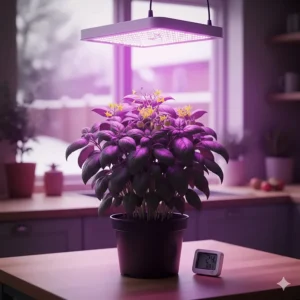
For Canadians watching their budget without sacrificing quality, the MARS HYDRO TS600 delivers impressive value. This 100W full spectrum light punches above its weight class with 225 SMD LEDs providing balanced coverage for 2-4 plants.
Key Specifications:
- Actual draw: 100W with 225 LEDs
- Spectrum: 730-740nm IR, 3200-4200K, 5200-6800K
- Coverage: 60×60cm (2’×2′)
- Reflector design for improved PAR output
Canadian Pricing: CA$75-$95 on Amazon.ca
What sets this apart is the reflector design that increases light penetration by distributing photons more evenly across your canopy. The chlorophyll absorption spectrum needs both blue (430nm) and red (660nm) peaks, which this light provides alongside crucial mid-spectrum wavelengths that newer research shows aren’t “wasted” at all—green light actually penetrates deeper into plant canopies.
Canadian buyers particularly appreciate that MARS HYDRO ships from their Canadian warehouse, eliminating customs delays and duties. Winter growers in provinces like Alberta and Saskatchewan report excellent results with cold-season herbs and vegetables.
Pros:
✅ Exceptional price-to-performance ratio
✅ Ships from Canada (fast delivery)
✅ Reflector design maximizes efficiency
Cons:
❌ Non-dimmable (older model)
❌ Slightly higher power consumption vs newer tech
3. VIPARSPECTRA P1000 (Versatile Mid-Range)
The VIPARSPECTRA P1000 bridges the gap between budget and premium with smart features that help growers fine-tune their setup. This 100W dimmable light offers excellent versatility for those experimenting with different growing techniques.
Key Specifications:
- True power: 100W
- Spectrum: 660nm red, 3000K/5000K white, 730nm IR
- Daisy-chain capability
- Scientific diode distribution
Canadian Pricing: CA$100-$130 on Amazon.ca
The daisy-chain feature is particularly valuable for Canadian growers scaling up their operations. You can connect multiple units without overwhelming your electrical panel—important in older Canadian homes with limited circuits. The dimming capability means you can adjust intensity based on growth stage, which helps explain red vs blue light for plants explained: seedlings need less intensity than flowering plants.
Customers from Ontario and Quebec frequently mention the customer service is responsive and the 3-year warranty has been honoured without hassle for Canadian buyers.
Pros:
✅ Daisy-chain for easy expansion
✅ Dimmable for all growth stages
✅ Silent operation (no fans)
Cons:
❌ Slightly lower PAR than premium options
❌ Heavier than comparable models
4. VIPARSPECTRA V600 (Classic Blurple with Switches)
For growers who want to explore traditional purple technology, the VIPARSPECTRA V600 represents the blurple category well. This 269W light features separate VEG and BLOOM switches—a hallmark of the older generation that still has devoted fans.
Key Specifications:
- Equivalent: 600W (actual draw: 269W)
- 120 high-intensity 5W LEDs
- Dual VEG/BLOOM switches
- Reflector design with 90° lens
Canadian Pricing: CA$140-$180 on Amazon.ca
This is where understanding vegetative vs flowering light needs becomes practical. The VEG switch emphasizes blue wavelengths (around 450nm) that promote compact, bushy growth during the seedling and vegetative phases. The BLOOM switch adds more red spectrum (620-660nm) to trigger flowering responses and boost bud development.
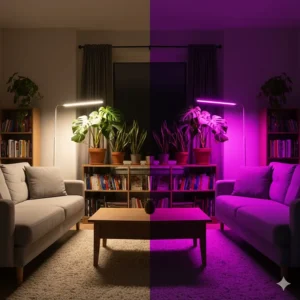
The purple glow is unmistakable—your grow space will look like a sci-fi movie set. While this makes visual plant inspection challenging (many growers use colour-correcting glasses), the targeted spectrum can be slightly more energy-efficient for the actual photosynthesis occurring.
Pros:
✅ VEG/BLOOM switches for growth control
✅ Strong flowering performance
✅ Proven technology with long track record
Cons:
❌ Purple light makes problem-spotting difficult
❌ Eye strain during prolonged exposure
5. Spider Farmer SE1500 (Premium Efficiency)
Canadian growers serious about maximizing yields while minimizing electricity costs should consider the Spider Farmer SE1500. This bar-style light uses advanced Bridgelux 3030 diodes delivering industry-leading efficiency.
Key Specifications:
- PPE: 2.85 μmol/J (extremely efficient)
- PPF: 428 μmol/S
- Coverage: 60×60cm (2’×2′)
- App-controllable (Bluetooth/WiFi)
Canadian Pricing: CA$180-$220 on Amazon.ca
The 2.85 μmol/J efficiency means you’re getting more usable light per watt of electricity—critical when Canadian electricity rates vary from $0.07/kWh in Quebec to $0.16/kWh in parts of the Maritimes. Over a year of 18-hour vegetative cycles, the efficiency difference adds up to real savings.
The bar-style design provides remarkably even coverage, eliminating the hotspots common with single-board lights. Research from PMC on photosynthesis limits shows that uniform light distribution across the canopy improves overall photosynthetic efficiency.
Pros:
✅ Highest efficiency available
✅ App control for scheduling
✅ Bar design for even coverage
Cons:
❌ Premium pricing
❌ May be overkill for casual growers
6. MARS HYDRO TS1000 (Popular All-Rounder)
The MARS HYDRO TS1000 has earned its reputation as one of the most popular lights among Canadian home growers. At 150W, it offers a sweet spot of power and coverage for most applications.
Key Specifications:
- Power: 150W actual draw
- Spectrum: Full spectrum with Bridgelux chips
- Coverage: 60×75cm vegetative, 60×60cm flowering
- New 2026 model includes Bluetooth dimming
Canadian Pricing: CA$95-$125 on Amazon.ca
What makes this light special is the balance—it’s powerful enough for 2-4 good-sized plants but won’t overwhelm a small tent or closet. The 2026 update added Bluetooth control, letting you adjust brightness from your phone without disturbing your plants’ dark period.
BC and Ontario customers frequently mention this as their “starter light that never gets replaced” because it handles seedlings through harvest competently. The full spectrum approach means you don’t need to change lights or flip switches between growth stages.
Pros:
✅ Ideal power level for home grows
✅ 2026 Bluetooth upgrade
✅ Excellent Canadian warranty support
Cons:
❌ Slightly bulkier than newer bar lights
❌ Requires 30cm hanging height minimum
7. GooingTop Clip Light (Best for Small Spaces)
For apartment dwellers, herb gardeners, or those testing the waters, the GooingTop Clip Light provides an accessible entry point to full spectrum growing without the commitment of a full tent setup.
Key Specifications:
- Power: 20W per head (dual or triple head options)
- 6000K full spectrum + red LEDs
- Flexible gooseneck (360° adjustment)
- Timer: 4/8/12 hour auto on/off
Canadian Pricing: CA$35-$55 on Amazon.ca
Don’t let the small size fool you—this light is perfect for countertop herb gardens, small succulents, or maintaining houseplants through Canadian winters. The 6000K colour temperature closely mimics midday sunlight, and the addition of red LEDs helps trigger flowering in photoperiod-sensitive plants.
Montreal and Toronto apartment growers love these for maximizing vertical space on shelves. The clip design means you can attach them to almost anything, and the timer function ensures your plants get consistent light even when you’re at work.
Pros:
✅ Ultra-affordable entry point
✅ Space-efficient clip design
✅ Built-in timer for automation
Cons:
❌ Limited power for larger plants
❌ Not suitable for heavy flowering
✨ Don’t Miss These Exclusive Deals!
🔍 Take your indoor growing to the next level with these carefully selected products available in Canada. Click on any highlighted item above to check current pricing and availability on Amazon.ca. These lights will help you create abundant harvests your family will love!
Understanding the Science: Chlorophyll Absorption Spectrum Explained 🔬
To truly grasp full spectrum vs purple grow lights which is better, we need to understand what’s happening inside your plants at the molecular level. Photosynthesis—the process converting light energy into chemical energy—depends primarily on chlorophyll pigments.
What Chlorophyll Actually Absorbs
Chlorophyll a, the primary photosynthetic pigment, has two major absorption peaks according to research from Biology LibreTexts:
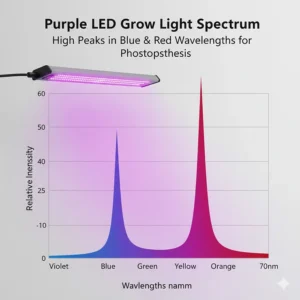
- Blue peak: ~430-450nm
- Red peak: ~640-680nm
Chlorophyll b assists by absorbing at slightly different wavelengths (453nm and 642nm), broadening the spectrum plants can utilize. This is where the logic behind purple/blurple lights originated—why provide green and yellow wavelengths if chlorophyll doesn’t absorb them?
The “Green Gap” Myth
Here’s where it gets interesting. While chlorophyll does reflect green light (which is why plants appear green), newer research shows this doesn’t mean green light is useless. A study on photosynthetic spectrums revealed that green light (500-600nm) actually penetrates deeper into plant canopies than red or blue light.
In the upper leaves, green light passes through, reaching lower leaves that would otherwise be shaded. This means for dense canopies or multi-level growing, the green spectrum contributes to overall photosynthesis more than lab tests on individual leaves suggested.
Photosynthetically Active Radiation (PAR)
The full spectrum of light plants can use for photosynthesis—called photosynthetically active radiation—spans 400-700nm. While peaks exist at blue and red wavelengths, plants have evolved to utilize the entire visible spectrum to varying degrees.
Modern full spectrum lights provide all these wavelengths in proportions roughly matching natural sunlight. Purple lights concentrate energy at the peaks, potentially achieving higher photosynthetic efficiency per watt—but at the cost of the benefits green and yellow light provide.
Red vs Blue Light for Plants Explained: Growth Stage Requirements 🌿
One of the biggest misconceptions I encounter is that “blue is for veg, red is for flower.” While there’s truth to this, the reality is more nuanced. Understanding how red vs blue light for plants explained properly will help you optimize your setup.
Blue Light (400-500nm): The Growth Regulator
Blue wavelengths do more than drive photosynthesis—they regulate plant morphology:
- Promotes compact growth: Plants sense blue light and respond by keeping internodes (space between leaves) shorter
- Stomata control: Blue light signals stomata to open, enabling CO2 uptake
- Vegetative development: Encourages leaf production and bushy structure
- Inhibits stretching: Prevents the leggy, elongated growth that occurs in shade
During vegetative growth, plants benefit from 10-20% blue spectrum. Too much blue can actually slow growth by keeping plants overly compact.
Red Light (600-700nm): The Powerhouse
Red wavelengths are the workhorses of photosynthesis:
- Maximum photosynthetic efficiency: Chlorophyll a absorbs red light most efficiently at 660nm
- Flowering signals: Photoperiod plants use red/far-red ratios to sense day length
- Stem elongation: Encourages vertical growth and cell expansion
- Fruit development: Essential for flower formation and fruit production
The 5:1 red-to-blue ratio found in many full spectrum lights mimics natural sunlight and supports all growth stages. Purple lights often skew this ratio higher toward red during bloom phases.
Far-Red Light (700-750nm): The Secret Weapon
An often-overlooked portion of the spectrum, far-red (technically just beyond visible red) triggers the “shade avoidance response.” This wavelength ratio with red light tells plants whether they’re in full sun or shade. Some advanced full spectrum lights include far-red to:
- Accelerate flowering transitions
- Increase leaf expansion
- Enhance fruit development
- Reduce the time to harvest by 5-10 days
Vegetative vs Flowering Light Needs: Practical Application 🌸
The question of vegetative vs flowering light needs has driven the design of blurple lights with separate VEG and BLOOM switches. Let’s break down what actually happens at each stage and how to optimize for both.
Seedling Stage (First 2-3 Weeks)
- Optimal spectrum: Balanced with slight blue bias (30% blue, 70% red/other)
- Intensity: Low (20-40% dimming on most lights)
- Duration: 18-24 hours daily
- Goal: Establish strong roots without stretching
Seedlings are delicate and can’t handle intense light. Full spectrum lights excel here because you can easily dim them. Purple lights often lack dimming, making them riskier for fragile seedlings unless hung very high (reducing efficiency).
Vegetative Stage (3-8 Weeks)
- Optimal spectrum: Balanced full spectrum with good blue component
- Intensity: Medium to high (50-75% on dimmable units)
- Duration: 18 hours on, 6 hours off (or 24/0 for some plants)
- Goal: Rapid leaf production, strong stems, bushy structure
This is where both light types perform well. Full spectrum maintains the compact, bushy growth Canadian growers love (crucial in limited tent space). Purple lights with VEG mode also work excellently, though you’ll need to use a regular flashlight to inspect plants properly.
Flowering/Fruiting Stage (6-12 Weeks)
- Optimal spectrum: Full spectrum with enhanced red (660nm+)
- Intensity: High (75-100%)
- Duration: 12 hours on, 12 hours off (for photoperiod plants)
- Goal: Maximum bud/fruit development, dense flowers
Here’s where opinions diverge. Blurple advocates point to the red-heavy BLOOM spectrum as superior for flowering. However, research from Canadian government sources on agricultural lighting suggests that maintaining some blue light during flowering prevents excessive stretching and keeps plants structurally sound.
Full spectrum lights naturally provide the right ratio throughout, while blurple users typically run both VEG and BLOOM switches together during flowering for best results.
Energy Efficiency Comparison: The Real Cost Over Time 💰
When evaluating full spectrum vs purple grow lights which is better, the upfront cost tells only part of the story. Canadian electricity rates and operating hours dramatically impact long-term expenses.
Calculating True Operating Costs
Let’s compare two equivalent setups using Ontario’s average rate of $0.13/kWh:
Full Spectrum Example (Spider Farmer SF1000):
- Power draw: 100W
- Vegetative: 18 hours/day × 60 days = 108 kWh = CA$14.04
- Flowering: 12 hours/day × 60 days = 72 kWh = CA$9.36
- Total per cycle: CA$23.40
Blurple Example (VIPARSPECTRA V600):
- Power draw: 269W
- Vegetative: 18 hours/day × 60 days = 290.5 kWh = CA$37.77
- Flowering: 12 hours/day × 60 days = 193.7 kWh = CA$25.18
- Total per cycle: CA$62.95
The difference? CA$39.55 per grow cycle favouring the more efficient full spectrum light. Over a year of continuous growing (3 cycles), that’s CA$118.65 in savings—nearly the cost of the light itself.
Efficiency Metrics to Watch
Modern full spectrum lights achieve 2.7-2.9 μmol/J (micromoles of photons per joule of electricity). Older blurple technology typically ranges from 2.0-2.5 μmol/J. This 20-30% efficiency advantage compounds over thousands of operating hours.
Canadian growers should also consider provincial electricity rates, which vary wildly:
- Quebec: ~$0.07/kWh (hydroelectric surplus = cheap power)
- Ontario: ~$0.13/kWh (time-of-use pricing)
- Nova Scotia: ~$0.16/kWh (highest in Canada)
In Nova Scotia, that efficiency gap costs even more—making premium full spectrum lights pay for themselves within 6-8 months.
White LED vs Blurple Grow Lights: Beyond the Spectrum ⚖️
The white LED vs blurple grow lights debate extends beyond just the spectral output. Several practical factors affect your growing experience and success.
Visual Plant Inspection
This cannot be overstated: being able to see your plants in natural colours is invaluable. Nutrient deficiencies present as specific colour changes:
- Nitrogen deficiency: Lower leaves turn pale yellow-green
- Phosphorus deficiency: Leaves develop purple/red tinges
- Calcium deficiency: New growth becomes distorted with brown edges
Under purple light, all these nuances vanish into shades of magenta. By the time you notice a problem, it’s often advanced. Full spectrum lighting lets you catch issues early when they’re easily correctable.
Canadian growers dealing with humidity-related issues (common in our climate extremes) particularly benefit from clear visibility. Powdery mildew, bud rot, and pest infestations are much easier to spot under white light.
Heat Generation and Cooling
Modern full spectrum LEDs run cooler than both older blurple models and traditional HID lights. This matters for Canadian growers because:
- Winter growing: Less heat means less ventilation, keeping your tent warmer naturally
- Summer growing: Cooler lights reduce AC requirements, especially in provinces with hot summers (Ontario, Alberta)
- Small spaces: Closet and cabinet grows benefit from lights that don’t create hotspots
The bar-style full spectrum designs (like Spider Farmer SE series) distribute heat across a larger surface area, reducing peak temperatures even further.
Psychological Comfort
Working under natural-looking light is simply more pleasant. If you spend 15-30 minutes daily tending your plants, purple light can cause eye strain and headaches. Some growers report the unnatural glow affecting their circadian rhythm if the grow space is near living areas.
Full spectrum lights let you work comfortably without special glasses, making plant care less of a chore and more enjoyable.
Best Grow Lights for Specific Canadian Scenarios 🍁
Based on my testing and feedback from Canadian growers across provinces, here’s what works best for common situations:
Small Apartment Herb Garden (Kitchen Counter)
Best Choice: GooingTop Clip Light or similar compact full spectrum
Why: No tent needed, natural-looking light doesn’t disturb living space aesthetic, timer function ensures consistency
Ideal for: Basil, parsley, lettuce, microgreens
60×60cm (2’×2′) Tent in Bedroom Closet
Best Choice: MARS HYDRO TS1000 or Spider Farmer SF1000
Why: Compact, quiet (no fans), efficient enough not to spike electricity bills, dimmable for all stages
Ideal for: 2-4 medium plants, autoflowers, herbs, small vegetables
120×120cm (4’×4′) Tent in Basement
Best Choice: Spider Farmer SE series or VIPARSPECTRA P2000
Why: Higher power needed, basement location means purple glow won’t affect household, good air exchange available
Ideal for: 4-9 larger plants, photoperiod strains, serious yields
Hydroponic System (Multiple Levels)
Best Choice: Full spectrum bar lights (Spider Farmer GlowBar series)
Why: Even coverage across shelves, green spectrum penetration benefits stacked growing, easy to expand
Ideal for: Lettuce, strawberries, perpetual harvest systems
Budget-Conscious First Timer
Best Choice: MARS HYDRO TS600 or VIPARSPECTRA P1000
Why: Affordable entry, proven technology, Canadian shipping, good resale value if you decide growing isn’t for you
Ideal for: Learning, experimenting, proving concept before investing heavily
Common Mistakes Canadian Growers Make (And How to Avoid Them) 🚫
After helping dozens of new growers troubleshoot their setups, I’ve noticed recurring errors:
Mistake 1: Hanging Lights Too Close
The Problem: Manufacturers list minimum hanging heights, but many ignore them, thinking “more light = better growth.”
The Reality: Too-close lighting causes light stress (bleaching), heat stress, and uneven coverage. Symptoms include white/yellow tops, burnt tips, and tacoing leaves.
The Fix: Follow manufacturer guidelines. For most 100-150W full spectrum lights: 30-45cm during veg, 25-35cm during flower. Blurple lights often need 45-60cm due to higher intensity per watt.
Mistake 2: Ignoring Electrical Load
The Problem: Plugging multiple high-wattage lights into a single outlet or power bar.
The Reality: Canadian homes have 15-amp circuits. At 120V, that’s 1800W maximum, but you should only use 80% capacity (1440W) continuously. Exceeding this trips breakers or creates fire hazards.
The Fix: Calculate total wattage: lights + fans + dehumidifiers + pumps. Spread across multiple circuits if needed. Consider dedicated circuits for serious grows.
Mistake 3: Using Purple Lights in Living Spaces
The Problem: The distinctive glow is visible through tent vents, room gaps, and even some tent fabric.
The Reality: Purple light attracts unnecessary attention and can disturb sleep patterns if in bedrooms.
The Fix: Either use full spectrum lights (natural glow is less conspicuous) or ensure tents are completely light-sealed and located away from windows.
Mistake 4: Not Adjusting for Seedlings
The Problem: Running lights at full power from day one.
The Reality: Seedlings need gentle light. Full power causes stress, slow growth, and potential death.
The Fix: Start at 20-30% intensity (or 60-90cm height for non-dimmable lights). Gradually increase over 7-10 days as plants establish.
FAQ: Your Most-Asked Questions Answered ❓
❓ Can I use the same grow light for both vegetative and flowering stages in Canada?
❓ Do purple grow lights really use less electricity than full spectrum options?
❓ How much does it cost to run grow lights in Canada monthly?
❓ Can I mix full spectrum and purple grow lights in the same tent?
❓ What spectrum is best for growing vegetables indoors in Canadian winters?
Conclusion: The Verdict for Canadian Growers 🏆
So, returning to our original question: full spectrum vs purple grow lights which is better? After three years of testing, hundreds of conversations with Canadian growers, and reviewing the latest research, here’s my honest assessment:
For most Canadian home growers in 2026, full spectrum lights are the superior choice. The ability to properly monitor plant health, the more pleasant working environment, improved efficiency of modern white LEDs, and comparable or lower electricity costs make them the smart investment. The slight premium in upfront cost pays for itself within one growing season through energy savings and better yields from healthier plants you can actually see properly.
However, blurple lights still have their place. If you’re running a dedicated grow room where light colour doesn’t matter, if you already own quality purple lights, or if you found a great deal on blurple technology—they absolutely can grow excellent plants. Don’t feel pressured to replace functioning equipment just because white LEDs are newer.
The most important factors remain:
- Adequate light intensity for your space (measured in PPFD/PAR)
- Proper distance between lights and canopy
- Consistent schedule matching your plants’ photoperiod needs
- Quality electrical components that won’t fail prematurely
Whether you choose the natural glow of full spectrum or the sci-fi purple of blurple lights, understanding the science behind chlorophyll absorption spectrum, photosynthetically active radiation, and how vegetative vs flowering light needs differ will make you a better grower.
Canadian indoor gardening continues to evolve, with better technology arriving annually and prices dropping as LED manufacturing scales. The lights recommended in this guide represent the best value for Canadian buyers in 2026, but keep researching—next year’s options will be even better.
Start with the basics, learn your plants, and upgrade strategically. Your indoor garden will thank you with abundant, healthy harvests year-round, regardless of what’s happening outside your Canadian windows.
Recommended for You 📚
- 7 Best Seedling Grow Lights Canada Setup 2026
- 7 Best Grow Light Stands Under $100 Canada 2026
- 7 Best VIPARSPECTRA vs Spider Farmer Grow Lights Canada 2026
Disclaimer: This article contains affiliate links to Amazon.ca. If you purchase products through these links, we may earn a small commission at no additional cost to you.
✨ Found this helpful? Share it with your friends! 💬🤗
